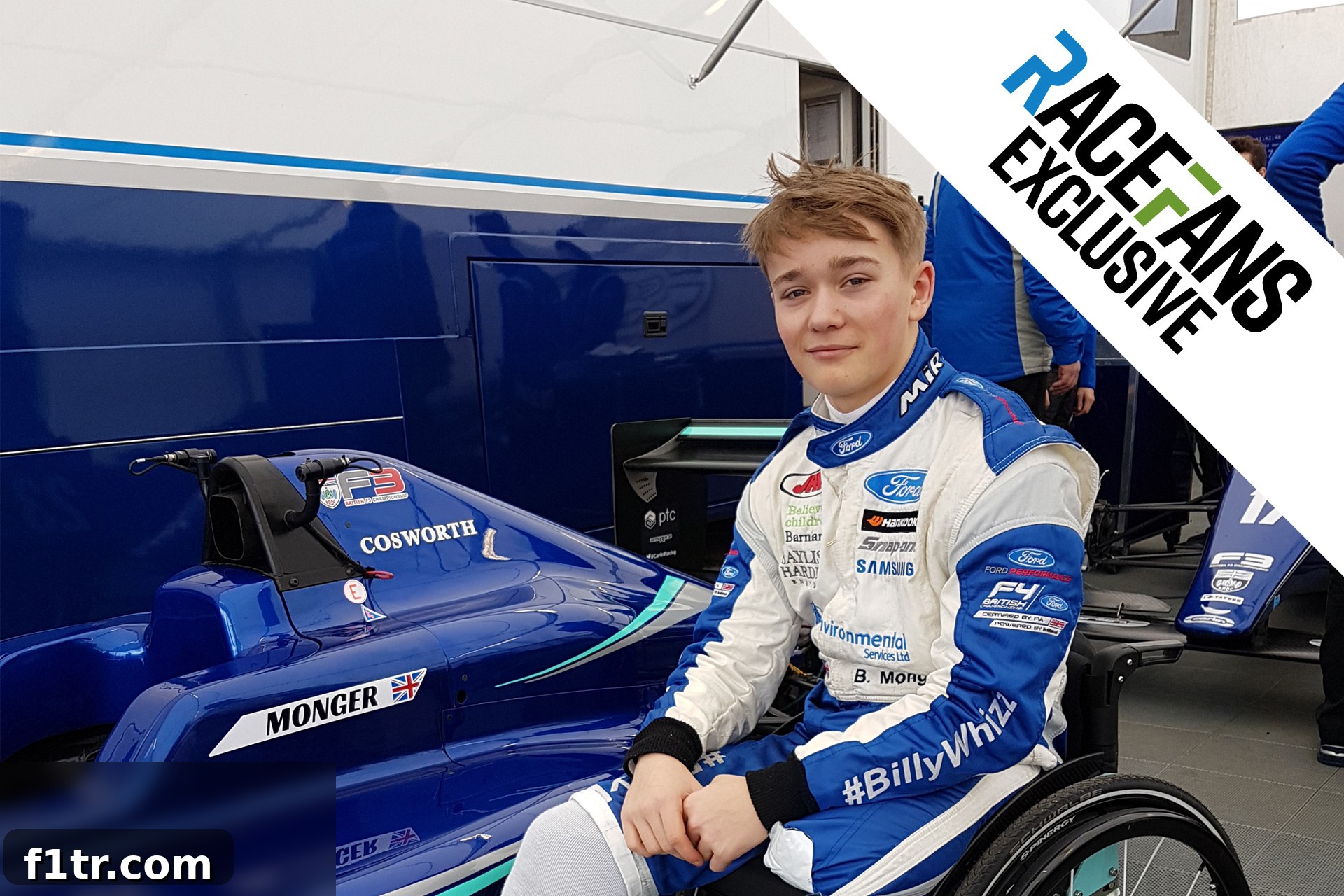
Billy Monger’s Extraordinary Comeback: A Resilient Return to Single-Seater Racing
The Unthinkable Accident and Unyielding Spirit: Billy Monger’s Journey Back to the Grid
In a sport defined by speed, courage, and relentless competition, some stories transcend the ordinary to become true legends of human spirit. Less than a full year – a mere 351 days, to be precise – after a horrifying crash that irrevocably altered his life, Billy Monger made an astonishing return to the cockpit of a single-seater racing car. This profound moment marked his first time lining up on the grid since that fateful April day, a testament to an unyielding will and an unwavering passion for motorsport.
At just 18 years old, Monger was ready to rejoin the fray as one of 17 ambitious drivers in the season-opening round of the British F3 championship at Oulton Park. While his initial race seat with the prestigious Carlin team was secured for this weekend only, his ambition burns brighter than ever: to commit to a full season once the necessary budget is firmly in place. This comeback isn’t just about racing; it’s a powerful narrative of resilience, engineering ingenuity, and the unbreakable bond between a driver and his dream.
A Life-Altering Impact: The Accident that Tested the Limits
Motorsport is replete with tales of heroism and incredible feats, yet Billy Monger’s story stands out as truly remarkable. The incident that led to his life-changing injuries occurred when his Mygale F4 car collided with Patrick Pasma’s stationary machine at a staggering speed of nearly 200 kilometers per hour. The force of the impact was immense, and the subsequent rescue operation was agonizingly long, taking an hour and a half to carefully extricate him from the wreckage. He was immediately airlifted to a nearby hospital, where medical teams fought valiantly to save his limbs. Despite their dedicated efforts, however, both of his legs ultimately could not be saved.
The true measure of Monger’s character emerged in the aftermath. The then 18-year-old described the events of the past year with a striking calmness, a matter-of-fact demeanor that drastically belied the immense trauma he had endured. This incredible composure, perhaps, is to be expected from someone who, just days after the horrific ordeal, was already in his hospital bed, not dwelling on his loss, but meticulously figuring out how to operate a steering wheel-mounted clutch. His mind was already fixed on one goal: returning to the sport he loved.
A Swift and Decisive Comeback: The Path to Requalification
In an exclusive interview with RaceFans, Monger revealed that his focus swiftly shifted from rehabilitation to rigorous training for his comeback, “pretty early on.” He explained, “I knew that I wanted to get back to racing fairly soon, so it’s always been on the back of my mind.” His proactive approach quickly bore fruit; an astonishing 11 weeks after his crash, he successfully regained his license to compete in GT cars. This initial step was a crucial milestone, demonstrating not only his physical readiness but also his psychological fortitude.
Monger’s racing career began in karts, progressing through the popular Ginetta Junior championship where he honed his skills alongside formidable talents such as Lando Norris, now a Formula 1 star. This background made a return to GT racing a logical, albeit temporary, pathway. While other drivers who sustained life-changing injuries in single-seaters later in their careers often transitioned to “tin tops” (touring cars or GTs), like the inspirational Alessandro Zanardi, Monger harbored a unique and fierce determination. He was resolute in his desire to pick up precisely where he had left off: in single-seater racing. His dedication paid off, with his single-seater license arriving in December, paving the way for intensive testing sessions in preparation for the British F3 series—a category he had always intended to tackle after his successful F4 campaign the previous year.
The Financial Race: Beyond the Crowdfund
The global motorsport community rallied around Billy Monger in an unprecedented display of solidarity. In the immediate aftermath of his crash, a crowdfunding campaign was launched, attracting contributions from thousands of fans and a star-studded roster of motorsport’s biggest names, from multiple Formula 1 world champion Lewis Hamilton to legendary team owner Chip Ganassi. The overwhelming support saw the fund soar past its initial target, eventually raising over £800,000 – more than triple the original goal. This incredible outpouring of generosity provided a vital safety net for Monger’s recovery.
Advert | Become a RaceFans supporter andgo ad-free
However, Monger made it unequivocally clear that this substantial fund was dedicated solely to financing his extensive rehabilitation, encompassing medical care, prosthetic limbs, and ongoing physical therapy. It was not, he emphasized, to directly fund his racing career. Like all his rivals in British F3, the estimated cost of a full season, ranging between £125,000 and £150,000, would need to be met by attracting sponsorship and external funding. This distinction highlights the immense financial challenges inherent in motorsport, even for a driver with a story as compelling as Billy’s.
Adapting the Machine: Engineering a Dream
To facilitate Monger’s return, the British F3 series demonstrated remarkable flexibility and support. They granted Carlin, his team, a special dispensation to run an additional car for him during the race weekend. Crucially, they also permitted significant modifications to his Tatuus F4-016 chassis, a design that adhered to British F3 specifications (distinct from the FIA’s European F3 series), to meet his unique requirements. This bespoke adaptation was a testament to the collaborative spirit within the sport.
Adapting the high-performance racing car to Monger’s needs presented a multi-dimensional engineering challenge. Changing the car’s controls was just one facet of the complex undertaking. Equally vital were the development of specialized prostheses and meticulous customization of his seat, ensuring not only his comfort but also optimal control and feedback at the wheel. Every element had to work in harmony, merging cutting-edge medical technology with advanced motorsport engineering.
Monger’s modified setup utilizes a single leg-operated control, managed by his right limb, which was amputated lower than his left. He explains the ingenious solution: “I’m now braking with my right leg on a pedal that’s been moved closer to me, so I use a shorter prosthetic.” This design choice is not arbitrary; a full-size prosthetic leg would be susceptible to greater movement under the intense G-forces experienced during cornering, potentially compromising precision. By using a shorter prosthetic, Monger gains superior control and stability. Furthermore, his seat has been meticulously molded around his body, specifically designed to secure him as tightly as possible, allowing him to apply maximum force to the brakes without compromising his position or stability.
The remaining crucial controls are ingeniously integrated into a specially modified steering wheel. “The throttle’s on the left-hand-side of the wheel; that’s obviously how I accelerate the car,” Monger details. “And then the up and down change are both on the right-hand-side with two paddles, the top one being for up gears and the bottom one to go down.” This intuitive design ensures that all primary driving functions are within immediate reach and comfortably operable, enabling him to drive with the same fluidity and precision as any other competitor.
Uncompromised Performance: “No Different to Before”
Despite the extensive modifications and the fundamental shift in how he interacts with the car, Monger’s confidence and connection to the machine remain unshakeable. He asserts, “I don’t feel any different to how I did before” at the wheel. He acknowledges the learning curve: “The way I control the car, I’ve had to change what I learnt from when I first started.” However, he quickly clarifies the impact on his performance: “But actually, how that affects the car and how I drive it on-track is, in terms of speed, no different to before; it’s just purely using different controls.” This profound statement underscores his belief that his disability has not diminished his raw speed or his ability to compete at the highest level of junior single-seater racing.
Safety, paramount in motorsport, was another critical hurdle Monger had to clear. Crucially, no compromises were made for him to meet the stringent minimum cockpit evacuation time. “To get my license back and to be able to compete, I have to get out of the car within seven seconds,” he explains. “So that didn’t take too long; it’s easier than you think to get out of the car.” He calmly outlines his emergency procedure: “Obviously, when I get out of the car, I’d have to hop along or whatever if it was an emergency. If not, I’d sit with the car and hop onto the nose cone and wait for the medical team to come out to me. But it’s no big deal.” This pragmatic approach to safety further exemplifies his professional mindset.
Advert | Become a RaceFans supporter andgo ad-free
His unwavering confidence was put to an early test shortly after his interview. During a practice session, Monger had a minor shunt, bouncing the front and rear of his car off one of Oulton Park’s barriers. Far from being shaken, he emerged from the incident with his belief system intact, asserting that the events of the previous year had not eroded his resolve.
“I guess you could say it’s affected me mentally, but I don’t think in a negative way,” he reflects. “If anything, it’s only made me stronger mentally.” This profound psychological resilience has been a cornerstone of his recovery. While acknowledging the physical demands of his journey – “Physically it’s been challenging, learning to walk on prosthetics” – he remains focused on the bigger picture: “But I’m getting on well with that and trying to get my career back on track.”
Back on Track: Oulton Park and Beyond
On the very day of the interview, Monger had already demonstrated his immediate competitiveness by setting the second-fastest time on a challenging, slippery track. For him, the time for introspection and recovery had concluded; it was time to draw a line under the events of the past year and return to the passion that defines him. “I just want to be a racing driver again,” he states with powerful simplicity. “I’m proving that this weekend so far.”
His goal is not just personal redemption but also a public declaration. “Hopefully we have a good weekend and change people’s opinions that I can’t compete competitively,” he adds, challenging any lingering doubts about his ability to vie for victories. Billy Monger’s comeback is more than just a personal triumph; it’s a profound statement to the world of motorsport, proving that with indomitable spirit, the right support, and innovative engineering, human potential knows no limits.
The first race of the British F3 championship took place at Oulton Park today, with races two and three scheduled for Monday, promising an enthralling spectacle as Monger begins this new chapter of his remarkable career.
Go ad-free for just £1 per month>> Find out more and sign up
Interviews
- What’s changed in F1 25 – and why? In-depth Q&A with Codemasters’ Gavin Cooper
- F1 24 director Mather on anti-cheat measures and the last-gen tech debate
- F1 24 director Lee Mather on physics, in-race goals and revamped career mode
- Exclusive: Horner on Red Bull’s success, believing in Perez and why 2024 will be closer
- ‘Some days I think ‘why the hell do I do this?’: Steiner on Haas’ future – and Andretti
Browse all Interviews