Ferrari’s Strategic Blunder: Unpacking Leclerc’s Monaco Grand Prix Pit Stop Nightmare
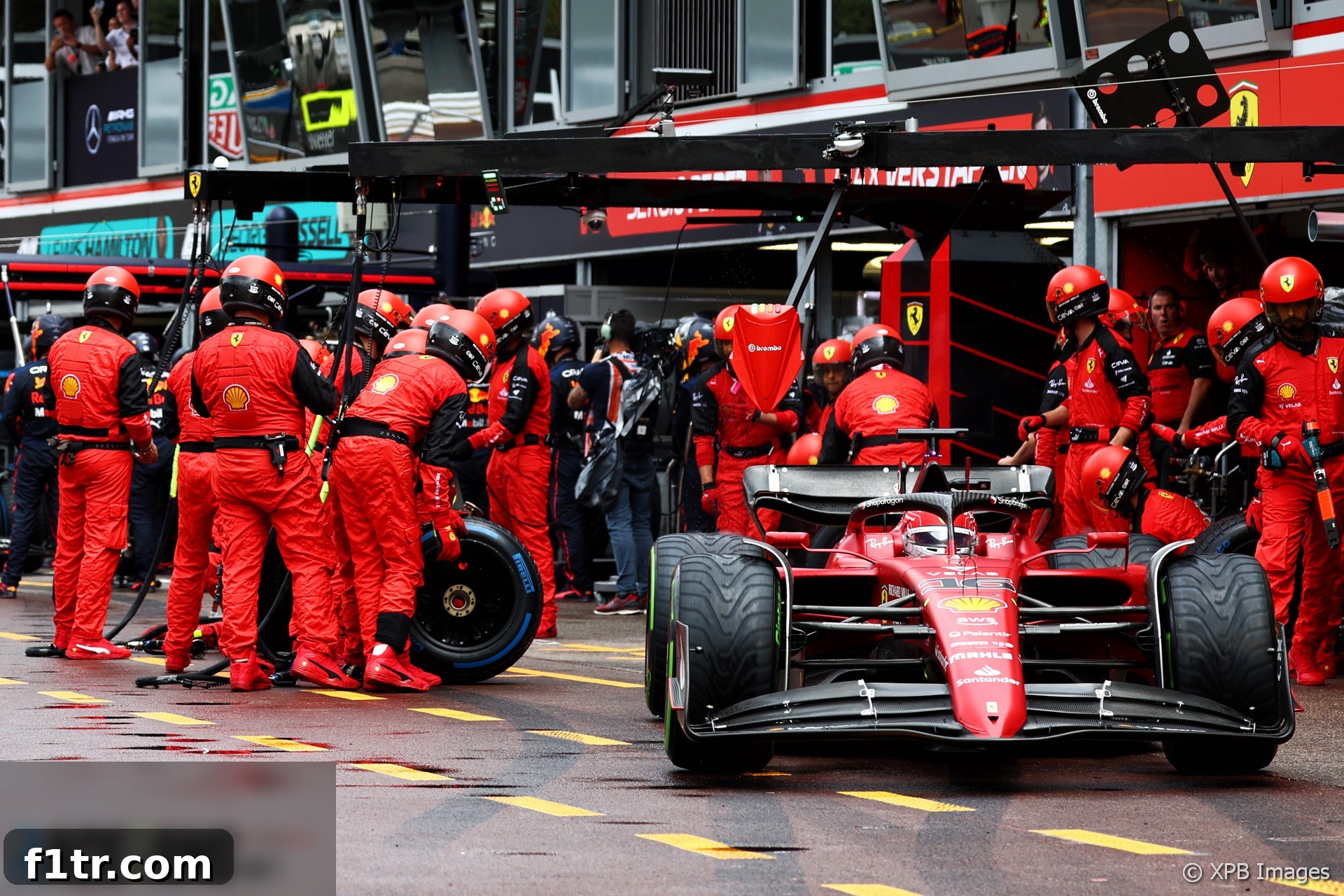
The glitzy streets of Monaco, usually a stage for racing glory, turned into a scene of strategic despair for Charles Leclerc and Ferrari during the rain-affected Grand Prix. Leclerc, who initially dominated the early stages of his home race, ultimately finished a heartbreaking fourth, a result he attributes directly to a series of strategic missteps by his team, beginning with a pivotal first pit stop.
Leclerc’s day, filled with the promise of victory, began to unravel as the Monte Carlo circuit slowly started to dry. The critical moment arrived when Ferrari opted to bring him in for intermediate tyres, a decision made largely in reaction to Red Bull’s Sergio Perez, who had pitted two laps earlier to switch from full wet weather tyres to intermediates and immediately demonstrated superior pace. This reactive strategy, rather than a proactive one based on track conditions, would prove costly.
Intriguingly, Leclerc’s race engineer, Xavier Marcos Padros, had earlier suggested the possibility of waiting for the track to dry more fully and executing a direct switch from full wets to slick tyres. This “skip the intermediates” strategy had historical precedent, notably employed by Lewis Hamilton to win the very same race in 2016, as later highlighted by Ferrari team principal Mattia Binotto. However, after Leclerc was informed of Perez’s intermediate tyre switch, his perspective shifted. He completed a full lap, assessing the conditions, before relaying to his team: “Inter would be much quicker, for sure.”
Moments later, as Leclerc navigated the challenging chicane, Marcos Padros issued the call: “Box this lap.” Leclerc, without questioning the instruction, complied, and Ferrari fitted him with intermediate tyres. This decision, seemingly straightforward in the heat of the moment, would become the subject of intense scrutiny and regret.
Carlos Sainz’s Contrasting Stance: A Glimpse of Independent Thinking
Meanwhile, in the sister Ferrari, Carlos Sainz Jnr was engaged in a remarkably similar radio exchange with his race engineer, Ricardo Adami. Yet, Sainz displayed a starkly different approach. He was notably doubtful about the wisdom of switching to intermediates and proved far less easily swayed by the need to react to Perez’s pit stop.
When informed that Perez had pitted for intermediates, Sainz’s immediate response was: “I’m not sure it’s the right call. It’s nearly ready for dry.” His engineer, adhering to team protocol, countered: “We would like to cover Checo on our side.” But Sainz, demonstrating impressive conviction and a keen understanding of the evolving track conditions, firmly asserted: “I don’t think it’s the right thing to do. In five, six laps, it might be dry.”
Despite Sainz’s clear objections, Ferrari initially called him into the pits. However, in a chaotic and ultimately beneficial turn of events for Sainz, the instruction was swiftly cancelled. Leclerc, by contrast, came in shortly afterwards and, as a direct consequence of this strategic gamble, lost his track position to Perez, setting the tone for a frustrating remainder of the race.
Leclerc’s Unraveling Race and Post-Race Regret
From that pivotal first pit stop onwards, Leclerc’s troubles only compounded. He lost valuable time battling through traffic, a common and often unavoidable frustration on the tight Monaco circuit. His misfortune was further exacerbated when he had to queue in the pits behind his team mate, Sainz, during their subsequent stop to switch to slick tyres. This double-whammy of strategic errors and on-track congestion effectively extinguished any hope of a podium finish, let alone a victory, at his cherished home Grand Prix.
Following the race, a visibly disappointed Leclerc did not mince words, stressing that the initial decision to change to intermediate tyres had been “very wrong.” His candid assessment underscored the depth of his frustration and the magnitude of the missed opportunity for Ferrari.
Team Principal Binotto’s Perspective and the Driver-Team Dynamic
Team principal Mattia Binotto acknowledged Ferrari’s preparedness for the scenario of skipping intermediates and directly switching from wets to slicks, a strategy Sainz ultimately adopted. He referenced Lewis Hamilton’s 2016 Monaco victory using this exact approach, indicating it was a well-discussed possibility within the team prior to the race. “It was a scenario we were discussing between us before the race,” Binotto explained. “It already happened in the past – I think it was Hamilton here in Monaco – from extreme [wet] switching directly to dry. So it’s something which we were aware of and was part of the discussion we had and the judgement which would have been necessary during the race.”
Binotto emphasized the critical role of driver feedback in making such decisions: “The drivers call in that respect – because they’ve got the feeling of the tyres and the track, how much it is wet and the grip they’ve got – was essential.” This statement, however, highlights a potential disconnect, as Leclerc later revealed he wasn’t fully aware of the intermediate call and didn’t have time for a full discussion.
Sainz’s Strategic Acumen in Treacherous Conditions
Sainz himself described the tyre strategy discussions as a “huge challenge” amidst the intense focus required to navigate the narrow Monaco circuit in treacherous, wet-to-drying conditions. Yet, his clarity of thought shone through. “The important thing is that by the time that everyone started pitting for inters, and they were telling me that everyone on inters was very quick, for me we were not very far off from slicks,” he recounted. This insight led him to believe that waiting was the superior option.
“So it was worth – not taking a gamble, because it was not a gamble, it’s Monaco and it’s still difficult to pass – but to make sure that we waited until the slick to pit and we save a pit stop,” Sainz articulated. “I was trying to transmit to the team that was my feeling, that this was my intention or at least what I thought was the right call.” His ability to calculate Perez’s closing rate and predict the optimal window for slicks demonstrated a remarkable strategic mind at work under pressure.
Unfortunately, despite his astute judgement on tyre strategy, Sainz later lost time behind the slower Nicholas Latifi, which ultimately allowed Perez to leapfrog him when he eventually made his pit stop for slicks. This underlines the fine margins and unpredictable nature of racing at Monaco.
Leclerc’s Lack of Awareness: A Communication Breakdown?
Perhaps the most concerning revelation from Leclerc was his admission regarding the intermediate tyre decision. “I was not aware that we were pitting for intermediates,” he stated after the race. “We didn’t have the time to speak about it. Obviously I got the call and I listened to it. So we didn’t have the time to discuss because it was at a particular moment and I think the aim was to react to Perez. But we’ll analyse all of this. Obviously it’s disappointing and it hurts especially at home, but it’s the way it is.”
This suggests a critical communication breakdown or a reactive environment where rapid decisions superseded thorough discussion, ultimately costing Leclerc dearly. The difference in communication and driver-team synergy between Leclerc and Sainz during these crucial laps became a defining factor in their respective race outcomes.
Analyzing Charles Leclerc’s Radio Messages: The Swift Shift
The radio exchanges shed light on the rapidly evolving situation and Ferrari’s reactive mindset. Initially, before Perez’s pit stop, Leclerc and his race engineer were actively considering a direct switch to slicks, indicating a proactive thought process.
| Marcos Padros | Let me know track condition. |
| Leclerc | It’s drying up quickly |
| Marcos Padros | Okay. Copy that. And other drivers thinking about going straight to slicks. Let me know your opinion on that. |
| Leclerc | Yeah could be a thing but not now. |
| Marcos Padros | Understood. Sainz lap time 33.0. |
| Marcos Padros | And if possible, try to use wet patches for tyre temps. |
| Marcos Padros | Gap to Sainz behind, Sainz lap time 32.6. |
However, the moment Leclerc was informed of Perez’s pit stop for intermediates, the conversation pivoted dramatically. Leclerc, perhaps feeling the urgency of the situation and the perceived threat of Perez’s pace on inters, quickly suggested that intermediates would be “much quicker.” There was no further discussion about slicks from either side before the pit call was made.
| Marcos Padros | So Perez just pitted now, we believe for inters. Confirm inters on Perez. |
| Leclerc | Inter would be much quicker, for sure. |
| Marcos Padros | Copy, understood. |
| Marcos Padros | Gap to Sainz behind 6.3. I will let you know the lap times from Perez. |
| Marcos Padros | And box this lap, box, pit confirm. |
| Leclerc | Box this lap. |
| Marcos Padros | Multi-function tyre position seven, tyre position seven when you can. |
| Marcos Padros | And box now, box. Verstappen also pitted. |
| Marcos Padros | Will be tight with Perez. |
| Marcos Padros | Gap to Perez in front, 4.4. |
This rapid sequence underscores the high-pressure environment and the team’s instinct to react to rivals, potentially at the expense of a more optimal, pre-planned strategy.
Carlos Sainz Jnr’s Radio Messages: A Masterclass in Conviction
Sainz’s radio exchanges provide a fascinating contrast, showcasing his unwavering conviction and strategic foresight. Upon hearing of Perez’s intermediate pit stop, Sainz immediately cast doubt on the team’s inclination to follow suit.
| Adami | For info Safety Car window is open for inters, just in case. |
| Sainz | Copy. |
| Adami | Charles lap time 32.0. For info Gasly with inters 31.2 at the back. We are monitoring. Get your plan. |
| Adami | Hamilton has pitted for inters, for reference, and Perez is three seconds behind. |
| Adami | And push, in-lap. Perez is in for inters. Push, in-lap. |
| Sainz | I’m not sure it’s the right call. It’s nearly ready for dry, yeah? |
| Adami | Okay, copy, we’ll come back to you. |
| Adami | We would like to cover Checo on our side. |
| Sainz | I don’t think it’s the right thing to do. |
| Sainz | In five, six laps, might be dry. |
Despite Sainz’s repeated expressions of doubt, Ferrari initially issued a pit call, only to reverse it moments later. This indecision cost Leclerc dearly, but ultimately allowed Sainz to stick to his preferred strategy.
| Adami | And box, confirm, box. We need to respond to Checo. |
| Adami | And stay out, stay out. |
| Sainz | Copy, stay out. |
Sainz’s persistence paid off. He made it abundantly clear he wished to remain on track until conditions were ripe for slick tyres, a conviction he held to and executed successfully.
| Adami | Charles lap time 31.4. |
| Adami | Verstappen four seconds behind. |
| Adami | Charles is coming in for inters. Verstappen 2.8 behind, 2.8. |
| Sainz | Happy to stay out. |
| Adami | Okay. Understood. |
| Sainz | Stay out until dry. |
| Adami | Copy. |
| Adami | Checo is in front of Charles. Head down. |
| Sainz | Who? |
| Sainz | Checo is in front of Charles with inters. 25.2 lap time. |
| Sainz | Perez is nine seconds behind, nine seconds. |
| Adami | Let me know what you think for slicks. |
| Sainz | It’s going to be a few laps but not a lot. |
| Sainz | Okay understood. And Mick is on slicks already, for reference, we are monitoring. |
The Cost of Confusion and the Lessons for Ferrari
The 2022 Monaco Grand Prix served as a stark reminder of the immense pressure and the critical importance of clear communication and decisive, yet flexible, strategy in Formula 1, especially in unpredictable conditions. For Charles Leclerc, the race was a painful illustration of how rapidly a commanding lead can evaporate due to strategic misjudgment. The reactive nature of Ferrari’s decision-making, coupled with a seeming communication gap with Leclerc, transformed a potential victory into a frustrating fourth-place finish.
Carlos Sainz’s performance, by contrast, highlighted the value of a driver’s conviction and a proactive approach to tyre strategy. His initial skepticism about intermediates, his clear communication, and his eventual insistence on waiting for slicks underscored his strategic intelligence, even if other race incidents later hampered his overall result.
For Ferrari, a team with championship aspirations, the Monaco Grand Prix was a costly lesson. It underscored the need for enhanced strategic clarity, improved real-time communication between drivers and engineers, and perhaps a firmer hand in sticking to a pre-determined optimal plan rather than reacting solely to rivals. As the season progresses, how Ferrari internalizes and acts upon these lessons will be crucial in their quest for Formula 1 supremacy.
Become a RaceFans Supporter
RaceFans is run thanks in part to the generous support of its readers. By contributing £1 per month or £12 per year (or the same in whichever currency you use) you can help cover the costs of creating, hosting and developing RaceFans today and in the future.
Become an RaceFans Supporter today and browse the site ad-free. Sign up or find out more via the links below:
- Become a RaceFans Supporter
- RaceFans Supporter FAQ
2022 Monaco Grand Prix
- Whatever triggered it, Verstappen’s defiance of his own team makes little sense
- Transcript: How Red Bull seized a win that ‘Ferrari looked like they had in the bag’
- Verstappen now has as many poles as Leclerc – but six times as many wins
- Schumacher’s chassis-splitting crash shows effects of rising car weight – Alonso
- Norris still can’t drive McLaren the way he wants to, despite strong results
Browse all 2022 Monaco Grand Prix articles