Hulkenberg Slams Hockenheim Run-Off as “Not F1 Standard” After German GP Crash
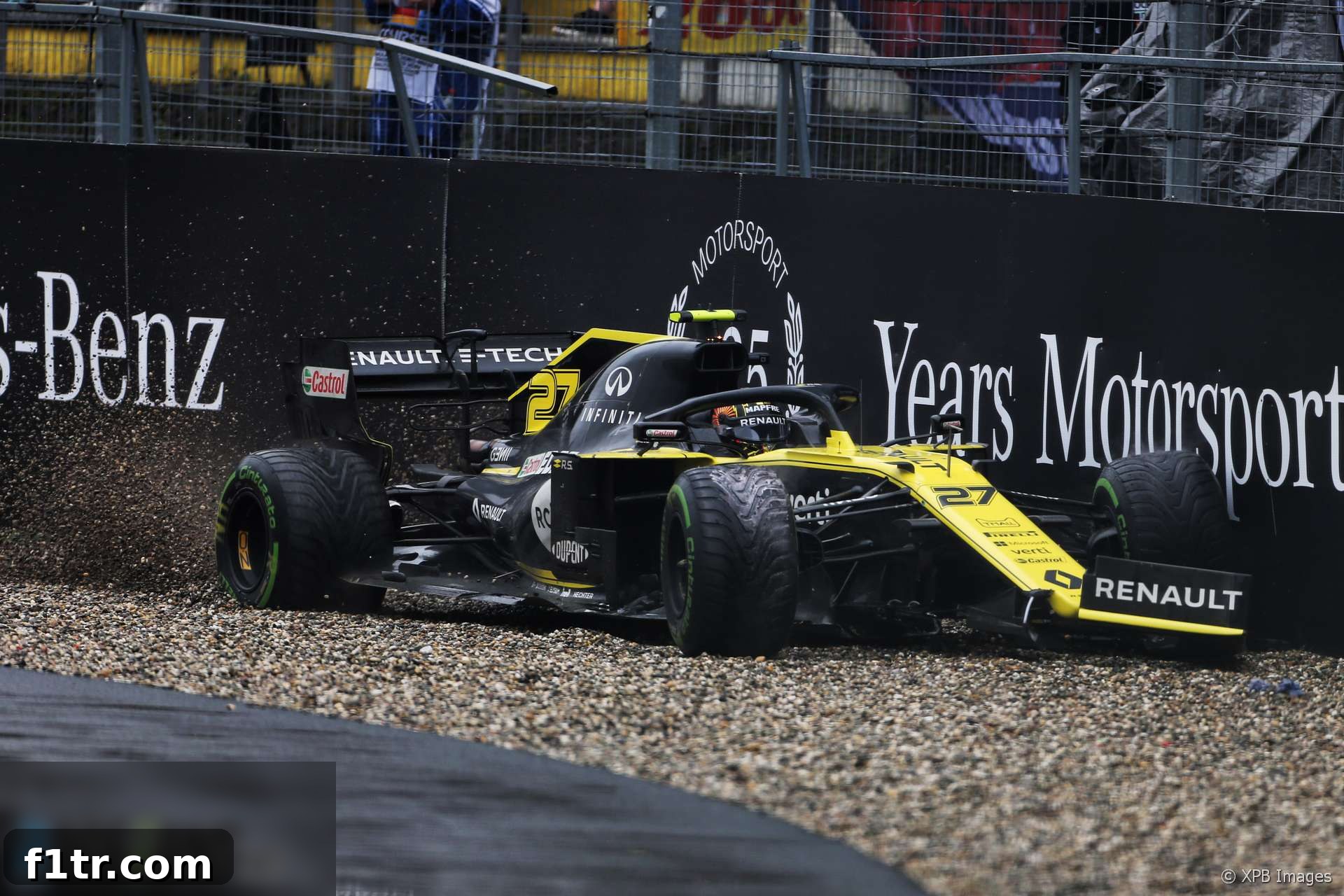
The 2019 German Grand Prix at the iconic Hockenheimring was a race defined by drama, unpredictable weather, and a series of high-profile incidents. Among the many twists and turns, one moment stood out for its controversial aftermath: Nico Hulkenberg’s race-ending crash at Turn 15. The Renault driver, a popular figure on the Formula 1 grid, expressed profound frustration and concern over the circuit’s run-off area, vehemently declaring it “not up to F1 standard” and raising significant questions about track safety protocols.
Hulkenberg’s unfortunate retirement came when he lost control on a treacherous section of the track, veering onto a run-off area that proved to offer virtually no grip. This critical lack of adhesion propelled his car into the barrier, prematurely ending what had been a promising performance. The incident ignited a debate about circuit design and the specific challenges posed by the Hockenheimring’s layout, particularly under adverse weather conditions.
Advert | Become a Supporter & go ad-free
The Tense Moments: Hulkenberg’s Crash at Turn 15
The German Grand Prix, held on July 28, 2019, was a chaotic spectacle. A rain-soaked track presented immense challenges for every driver, pushing their skills and their machinery to the absolute limit. Nico Hulkenberg, known for his robust driving style and ability to perform in tricky conditions, had been running strongly, vying for a podium position – a career-defining achievement that had eluded him for so long. However, on lap 40, his hopes were dashed at Turn 15, also known as the Sachskurve exit, a notorious section of the track that transitions into a drag strip.
As Hulkenberg navigated the corner, pushing his Renault R.S.19 to its limits, he strayed just wide of the racing line onto the asphalt run-off. This particular section, repurposed from a drag strip, presented an unexpectedly slick surface. Formula 1 cars, with their highly specialized tyres designed for immense grip on race-grade asphalt, found this different surface devoid of any meaningful adhesion, especially when wet. The moment his tyres touched this area, all control was lost.
“It doesn’t help,” Hulkenberg stated with palpable disappointment, referring to the knowledge that other drivers had also struggled at the same corner. “It doesn’t recover anything, it doesn’t soothe the pain. It just shows that something was wrong in that corner, with the run-off area.” His frustration was not just about his retirement but also the perceived inadequacy of the safety provisions at that specific point on the circuit. This sentiment was echoed by many within the paddock, highlighting a shared concern among drivers about the unique challenges presented by the drag strip run-off.
A Unique Challenge: The Drag Strip Run-Off
The section in question was not a conventional gravel trap, nor was it standard high-friction asphalt designed for F1 run-offs. Instead, it was a repurposed drag strip, a surface engineered for straight-line acceleration and typically offering different grip characteristics than a typical F1 circuit. For a racing car cornering at high speed, especially in wet conditions, this proved to be a critical flaw. The specific texture and composition of the drag strip asphalt, combined with the standing water, created an incredibly low-friction environment, making it impossible for a Formula 1 car to maintain any directional control once off the racing line.
Hulkenberg recounted his experience with stark clarity: “The way I went off and the angle I went off I had no chance of recovery. That’s very frustrating and very painful because it’s something that in that time I couldn’t correct any more.” Unlike some other incidents where drivers might spin and recover or endure a less impactful slide into a barrier, Hulkenberg felt utterly helpless. The car became an uncontrollable projectile, leaving him as a mere passenger in a high-speed collision. This distinction between a recoverable spin and an irrecoverable slide is crucial for driver safety and confidence, and Hulkenberg’s inability to correct his trajectory was a significant point of contention.
He further elaborated on the issue, describing the drag strip run-off as “something that’s not in line with our normal standards” in Formula 1. F1 circuits are meticulously designed and maintained to the highest safety standards, with various types of run-off areas (gravel, asphalt, high-friction paint) strategically placed to decelerate cars and mitigate impact forces. A section that offers such minimal grip under racing conditions clearly falls short of these expected norms.
Wider Safety Implications and Driver Concerns
Hulkenberg’s crash was not an isolated incident. The chaos of the 2019 German Grand Prix saw several other top drivers, including Lewis Hamilton, Charles Leclerc, Kimi Raikkonen, and Carlos Sainz Jnr, all losing control or spinning at the very same corner. While some were fortunate enough to recover or suffer less severe consequences, the sheer number of incidents underscored a systemic problem with that section of the track. This pattern of incidents provided compelling evidence supporting Hulkenberg’s assertions about the substandard nature of the run-off.
“In a way, also, a bit on safety because when you can’t control a car it’s never safe,” Hulkenberg added, highlighting the broader safety implications. He pointed out Lewis Hamilton’s terrifying near-miss with Charles Leclerc’s crashed car, illustrating how rapidly a loss of control in an inadequate run-off zone could escalate into a far more dangerous situation involving multiple vehicles or trackside personnel. This near-tragedy served as a stark reminder of the fine line between a racing incident and a severe accident, particularly when track safety features are compromised.
The feedback from drivers is paramount in Formula 1’s continuous pursuit of enhanced safety. They are the ultimate arbiters of how a circuit performs under race conditions, and their direct experiences provide invaluable insights that engineers and governing bodies might overlook. When multiple elite drivers report similar issues at a specific corner, it signals a critical area for review and potential modification.
Advert | Become a RaceFans supporter andgo ad-free
FIA Response and Future of Hockenheimring
Following the race, FIA Race Director Michael Masi initially conducted his post-race inspection of the circuit and reportedly stated that the drag strip “looked fine.” However, Hulkenberg was not convinced. He took the initiative to personally speak with Masi on the Thursday morning after the race, presenting his firsthand account and strong arguments about the danger posed by the run-off. This direct engagement between a driver and the head of race control is a vital mechanism for addressing safety concerns in Formula 1.
Hulkenberg believes his intervention, combined with the overwhelming visual evidence from the race footage, will lead to changes. “Maybe his opinion’s different now,” said Hulkenberg, implying that Masi had a clearer understanding after reviewing the incidents and discussing them with the drivers. “I mean it was clear if you look at the TV footage, what other proof do you need? Just look at the images. We were just passengers there. You can’t do nothing.” His statement underscores the undeniable visual evidence that depicted cars sliding uncontrollably, a clear deviation from expected Formula 1 safety standards.
The implication is that if Hockenheim were to host a round in the 2020 F1 calendar (or any subsequent season), modifications to the Turn 15 run-off area would be a prerequisite. This highlights the FIA’s commitment to constantly review and improve circuit safety. The governing body works closely with circuits to ensure they meet the stringent demands of modern Formula 1, and driver feedback is a crucial component of this iterative process. This incident serves as a potent reminder that even classic circuits like Hockenheim, with their rich history and traditional layouts, must continually adapt and evolve to maintain the highest levels of safety for the cutting-edge machinery and incredibly fast speeds of contemporary F1.
The Enduring Legacy of Hockenheim and F1 Safety
The Hockenheimring has a storied history in Formula 1, known for its long straights and challenging stadium section. However, like many circuits, it has undergone significant changes over the decades to enhance safety and improve racing. The 2019 incident at Turn 15 demonstrates that the process of refining circuit safety is never truly complete. As car technology advances and speeds increase, so too must the scrutiny applied to track design and run-off efficacy.
The German Grand Prix incident underscored the critical importance of selecting appropriate materials for run-off areas. While asphalt run-offs are generally preferred over gravel in many modern circuits for their ability to allow drivers to rejoin the track more easily after a mistake, they must still provide adequate friction. A surface that becomes a slip-and-slide under wet conditions, especially one where cars are approaching at high speeds, is counterproductive to the primary goal of a run-off area: to safely slow and contain an errant vehicle.
Nico Hulkenberg’s outspoken criticism, backed by the experience of several other drivers, served as a powerful catalyst for potential change. It reinforced the notion that driver welfare and safety should always be at the forefront of circuit design and event management. The dialogue between drivers and the FIA, as exemplified by Hulkenberg’s direct conversation with Michael Masi, is an indispensable part of Formula 1’s ongoing commitment to pushing the boundaries of safety without compromising the thrill of racing.
The 2019 German Grand Prix will long be remembered for its drama, but also for the important safety debate it ignited. The outcome, hopefully, will be safer and more consistent run-off areas across all Formula 1 circuits, ensuring that drivers can push the limits of their incredible machines with the utmost confidence in the protective measures around them.
2019 F1 season
- Crying in the Melbourne car park at 2019 grand prix was my career low – Ocon
- McLaren Racing reports reduced £71 million loss in 2019
- Kvyat: Hockenheim podium last year was “my biggest achievement” so far
- How the FIA’s new encrypted fuel flow meter targets Ferrari’s suspected ‘aliasing’ trick
- “He smashed my office door”: 23 must-see moments from ‘Drive to Survive’ season two
Browse all 2019 F1 season articles