Lewis Hamilton and the Mercedes-AMG Petronas Formula 1 Team are approaching the Mexican Grand Prix with cautious optimism, hoping to leave behind the challenges faced at the Circuit of the Americas (COTA). The seven-time world champion is vocal about his belief that the smoother tarmac of the Autódromo Hermanos Rodríguez could play to the W15’s strengths, potentially mitigating the instability issues that plagued their performance in Austin.
Advertisement
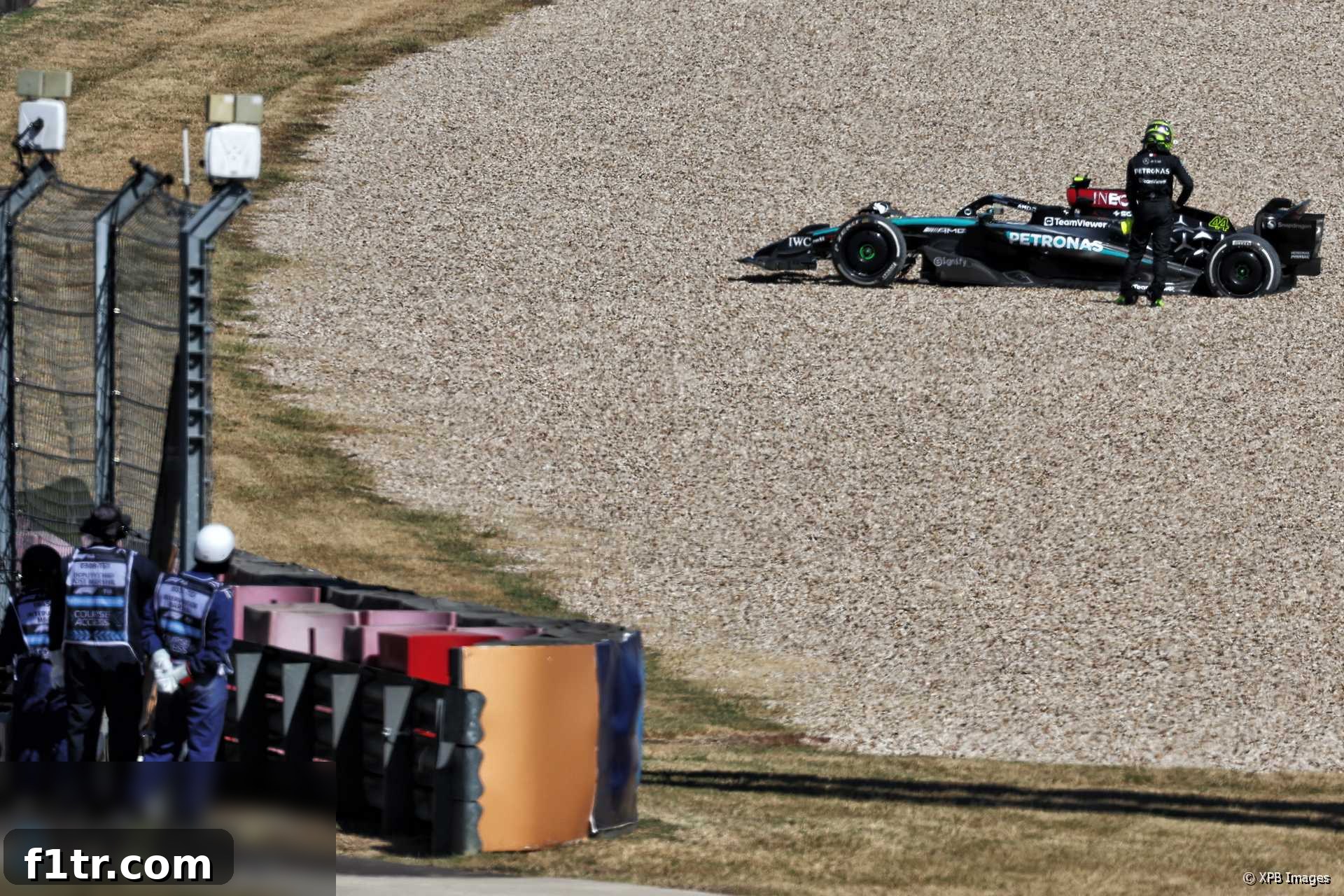
The COTA weekend proved to be a significant setback for Hamilton, who, despite showing promising pace during Friday practice sessions, failed to translate that potential into a strong race result. His qualifying session for the Grand Prix was particularly disappointing, seeing him knocked out in Q1, relegated to 16th place on the grid. The race itself offered little reprieve, as an early spin on the second lap forced his retirement. Mercedes engineers later attributed this incident, in part, to a powerful gust of wind, exceeding 40 kph, which unsettled the aero-sensitive W15 at a critical moment.
Mercedes had introduced new upgrades to their W15 package for the Austin race, an effort to close the performance gap to their rivals. However, the bumpy nature of the COTA track appeared to highlight, rather than resolve, certain inherent instabilities in the car’s design or setup. Hamilton’s hopes for Mexico are firmly anchored in the expectation that these upgrades will perform more predictably on a circuit known for its smoother surface.
“It really depends if I experience the same problems that I did in the last race with the upgrades,” Hamilton commented, reflecting on the previous weekend’s tribulations. His words underscore the delicate balance F1 teams face when introducing new components. While designed to enhance performance, fresh upgrades often require specific track characteristics and meticulous fine-tuning to unlock their full potential. COTA, with its undulating profile and varied grip levels, presented a formidable test for the updated W15.
He elaborated on his cautious optimism, stating, “The car was unstable last weekend, but it was a very bumpy track. This is not a bumpy track, so hopefully on a smoother circuit, maybe we won’t have the same problems.” This sentiment highlights a critical factor in modern Formula 1: the sensitivity of ground effect cars to track irregularities. The ability of the car to run close to the ground is paramount for maximizing aerodynamic efficiency, but this often comes at the cost of ride comfort and stability over bumps. A smoother circuit reduces the frequency and severity of these impacts, allowing the car’s aerodynamic platform to remain more consistent.
Hamilton continued, expressing the team’s collective aspiration: “If we don’t have the problems we had last week then maybe we can be a little bit closer to the front. It’s all a big ‘if’ and I’m just hoping for the positive.” This acknowledgment of uncertainty speaks volumes about the challenge Mercedes currently faces. While they possess a car capable of flashes of brilliance, consistency and predictability remain elusive. The team is on a journey of understanding and optimizing their W15, especially in the wake of significant aerodynamic changes. The “big ‘if'” represents not just Hamilton’s personal hope, but the entire team’s quest to unlock the car’s true performance potential without compromising its stability.
Advertisement
Mercedes’ technical director, James Allison, provided a deeper technical analysis of the issues encountered at COTA. He theorized that the team’s struggles over the bumps were primarily a consequence of running the car too low to the ground. This setup choice, while typically yielding performance gains on smoother circuits by maximizing ground effect downforce, proved detrimental on COTA’s challenging surface.
Allison’s explanation sheds light on the inherent trade-offs in modern F1 car design and setup. He pointed out that the W15’s performance on Friday in Austin was notably strong, suggesting that the car fundamentally possesses pace. “Not only did George [Russell] nearly secure the pole in that [sprint race qualifying] session, Lewis nearly smashed it utterly out of the park,” Allison recalled in a team video. He further elaborated on Hamilton’s impressive early showing: “He was way ahead of any of the times until he got a bit tangled up with Colapinto.” This glimpse of raw pace from both drivers on Friday underscores the frustration within the team over the subsequent drop in performance.
The crucial question, as Allison articulated, was why this initial promise did not materialize through the rest of the weekend. “My guess is that we were flirting a bit too closely with the ground,” he offered as a primary hypothesis. He delved into the intricacies of ground effect aerodynamics, explaining, “These cars like running low and you generally pick up lap time as you are able to get the car nearer to the ground. But push it too far and the car starts behaving in a fairly unpleasant fashion.” This “unpleasant fashion” can manifest as unpredictable handling, sudden loss of grip, or extreme sensitivity to track irregularities, making it incredibly difficult for drivers to extract consistent performance.
Allison continued to detail the consequences of an overly aggressive ride height: “If you just hit a bump wrong, it’ll unseat the car, make the rear end come out on you and just deliver a level of performance that when it’s good, it’s great, but if you just hit a bump at the wrong moment, a crosswind at the wrong time, then you get punished for it.” This vivid description illustrates the fine margin of error in Formula 1 car setup. A setup optimized for peak downforce on a perfectly smooth surface can quickly become a liability when faced with the real-world variables of a Grand Prix circuit, such as unexpected bumps or sudden changes in wind direction. The delicate aerodynamic balance, once disturbed, can dramatically reduce the car’s stability and driver confidence.
Concluding his technical assessment, Allison admitted, “My guess is that we were just pushing our luck a little bit too much in terms of how near to the ground we got, how stiff we ran it.” This statement indicates that Mercedes might have opted for a more aggressive setup in Austin, aiming to maximize performance, but ultimately overstepped the boundary for the conditions presented. The stiffness of the suspension, combined with a low ride height, would have further exacerbated the car’s reaction to bumps, leading to the instability that plagued Hamilton’s weekend.
Looking ahead to the Mexican Grand Prix, the Autódromo Hermanos Rodríguez offers a distinct set of characteristics. While known for its smoother surface compared to COTA, the track’s high altitude presents its own unique challenges, primarily reduced air density impacting engine power, cooling, and aerodynamic downforce. However, for Mercedes, the absence of severe bumps might allow them to run a more stable setup, enabling their upgrades to perform closer to their intended potential. The team will undoubtedly be analyzing every data point from Austin to refine their approach for Mexico City, hoping to find that elusive sweet spot between maximum performance and predictable handling.
Advertisement
2024 Mexican Grand Prix
- McLaren have no regrets over pitting Norris shortly before red flag came out
- Leclerc fined, avoids same penalty as Verstappen after apologising for swearing
- Leclerc not in the clear over swearing as Verstappen claims he went unpunished
- Majority of drivers wanted racing rules to change “straight away” – Russell
- Verstappen was “over the limit” with Norris but others would do same – Leclerc
Browse all 2024 Mexican Grand Prix articles