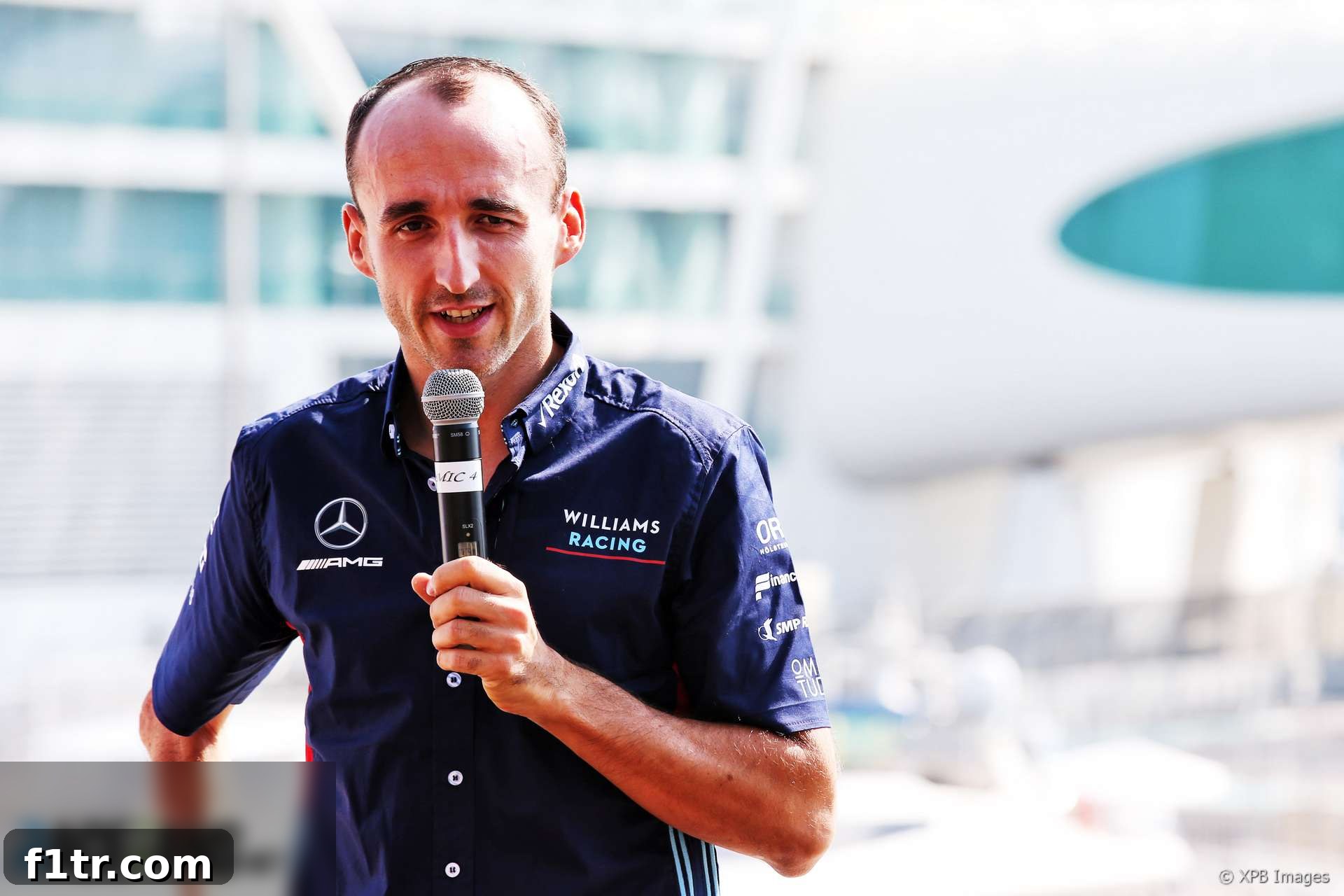
In a story that embodies extraordinary resilience and unwavering determination, Robert Kubica has officially confirmed his return to Formula 1, declaring that his comeback “shows nothing is impossible.” This momentous announcement, marking one of the most remarkable returns in the history of motorsport, sent ripples of excitement and inspiration across the global racing community. After years of relentless recovery from a career-threatening rally crash, Kubica is set to partner George Russell at Williams Racing for the upcoming season, a move that is as much a testament to his indomitable spirit as it is to his raw talent.
The Long Road Back: A Test of Unbreakable Spirit
Kubica’s journey back to the pinnacle of motorsport is nothing short of miraculous. In February 2011, while competing in a minor rally event in Italy, he suffered a horrific crash that left him with severe injuries, particularly to his right arm and hand. The incident, which occurred just as he was at the peak of his Formula 1 career with Renault, was widely believed to have definitively ended his future in the sport. Many, including experts and fans alike, saw his return as an impossibility, a dream too distant to ever materialize.
“It’s a story which probably nobody has believed,” Kubica reflected in an interview in Abu Dhabi, where the announcement was made. “The only one who probably never gave up was myself and the people around me, I’d like to thank them. But we all knew it might be something un-achievable.” His words encapsulate the immense challenge he faced and the profound skepticism he had to overcome. Yet, through years of excruciating rehabilitation, countless hours of physical therapy, and an unshakeable belief in himself, Kubica systematically defied all expectations. This deep-seated conviction, shared by his closest circle, was the engine that powered his seemingly impossible comeback. “This day shows that somehow, nothing is impossible,” he asserted, embodying the very essence of human perseverance.
Defying Limitations: Proving His Competitiveness
One of the primary concerns surrounding Kubica’s potential return was his physical limitations, particularly the reduced mobility in his right arm. However, the Polish driver is confident that he has adapted and evolved, turning perceived weaknesses into unique strengths. He dismisses any doubts about his ability to compete at the highest level, promising that his performance on track will speak for itself.
“From a driving point of view the point is very simple. You just need to wait two months and you will see,” he stated firmly. “I think if I was not able to drive competitive enough I would not be here.” This direct challenge to his doubters underscores his conviction. It’s “normal” for people to “see my limitations and [ask] how it’s possible I can do it,” he acknowledged, understanding the public’s perception. However, he emphasized that those who have witnessed his recent performances, particularly Williams Racing and himself, are fully convinced of his capabilities. “I know it’s hard to believe but I think Williams has seen it this year and I have seen it in the last 18 months since I first drove an F1 car in Valencia last year that I can do it. My limitations are not limiting myself as most people are thinking.”
The Turning Point: Rediscovering Natural Instinct
The path to regaining his natural driving instinct was a critical phase in Kubica’s recovery. After his accident, he returned to racing in various categories, including rallying and GT endurance, slowly rebuilding his confidence and adapting his driving style. However, the ultimate test came in 2017 when he was given the opportunity to test a modern Formula 1 car with Renault. These initial tests, particularly one in Valencia, were pivotal.
Kubica described how he realized during these tests that he could once again drive an F1 car “naturally.” This was a profound moment, signifying not just physical capability but a return to the intuitive, instinctive driving required at the elite level. “In order to drive at the top level you have to drive as naturally as possible. It has to come from no thinking, just driving,” he explained. This effortless connection with the machine, the ability to react without conscious thought, is what separates the good drivers from the great ones. For Kubica, finding that flow again after such a traumatic injury was a monumental breakthrough.
“The turning point was last year when after a few tests in F1 I realised I’ve actually started driving naturally. Then of course I had to adapt my driving more of a technical point of view because the cars had changed a lot. But this I’m happy with what I did this year. And that’s it. There is nothing more to add.” This satisfaction with his adaptations and performance throughout the testing phase with Williams clearly cemented his belief, and the team’s, in his readiness for a full-time return.
Williams Racing: A Leap of Faith and Strategic Partnership
Williams Racing’s decision to bring Kubica back into Formula 1 is a strategic move that reflects both belief in his talent and the team’s own aspirations for revival. For a team seeking to reclaim its competitive edge, Kubica brings a wealth of experience, technical insight, and an unparalleled understanding of car development. His feedback from years of F1 testing and development, combined with his recent experience across various motorsport disciplines, will be invaluable to the team.
His partnership with George Russell, a highly-rated young talent, creates an intriguing dynamic. Russell, a Mercedes junior driver and Formula 2 champion, represents the future of the sport, while Kubica embodies its enduring spirit. This blend of youthful exuberance and seasoned wisdom could provide Williams with a comprehensive approach to car development and race strategy, crucial for a team aiming to climb the constructors’ standings. The rigorous evaluation process Kubica underwent with Williams, involving extensive simulator work and track tests, demonstrated beyond doubt that he possesses the speed, consistency, and physical endurance required to compete in modern F1.
More Than a Comeback: An Inspiration to the World
Robert Kubica’s return transcends the boundaries of Formula 1. It is a powerful narrative of triumph over adversity, a living embodiment of the phrase “never give up.” His story will undoubtedly inspire millions worldwide, proving that with enough grit, dedication, and belief, even the most formidable obstacles can be overcome. In a sport often defined by technological advancements and cutthroat competition, Kubica’s human story stands out, reminding us of the incredible strength of the human spirit.
As the new season approaches, all eyes will be on Kubica. While the challenges of Formula 1 are immense, particularly with the highly competitive field and demanding physical nature of the cars, Kubica is not just looking to participate; he is looking to compete. His goal is not merely to prove his ability to drive, but to demonstrate that he can do so competitively, contributing significantly to Williams’ efforts. His journey serves as a powerful reminder that while talent is important, it is often the strength of character and an unyielding will that ultimately define greatness.
Looking Ahead: The Road to Redemption and New Beginnings
The 2019 Formula 1 season promises to be an emotional and captivating chapter in Robert Kubica’s career. Each race will not only be a contest for points but also a celebration of his extraordinary comeback. The cheers of the crowd, the roar of the engines, and the thrill of competition will represent the culmination of years of unimaginable struggle and unwavering hope. His presence on the grid will be a poignant reminder that dreams, no matter how distant they may seem, can indeed come true with enough perseverance. Robert Kubica’s return is not just a personal victory; it is a universal message of hope, resilience, and the relentless pursuit of passion.
Related F1 Content
Browse all 2019 F1 season articles