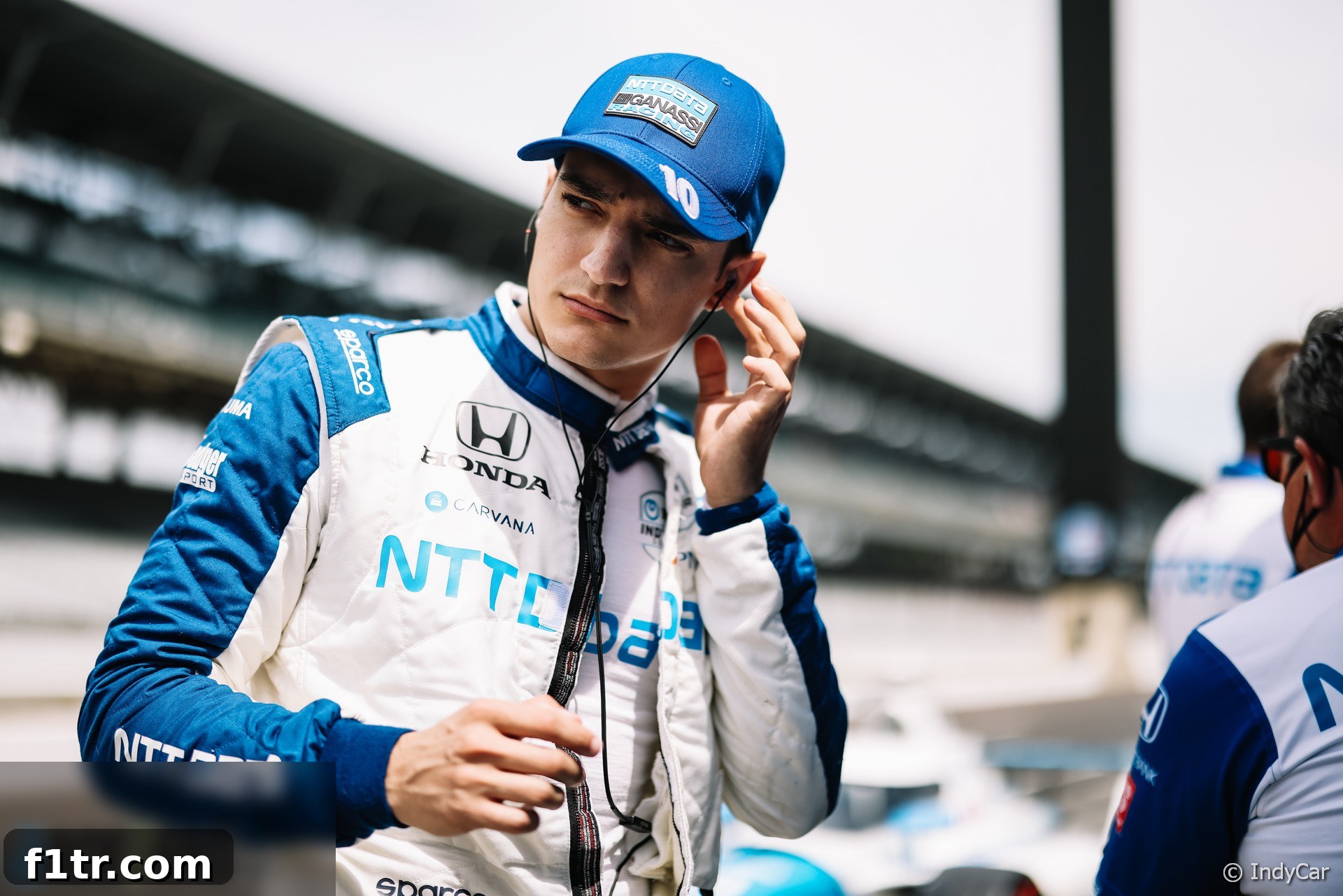
In a season already brimming with high drama and intense competition, IndyCar championship leader Alex Palou faces a significant hurdle this weekend, as he has been handed a six-place grid penalty for the inaugural race of the Detroit Grand Prix double-header. This penalty stems from an engine change that occurred prior to last month’s Indianapolis 500, a race where Palou delivered a masterful performance, ultimately finishing a breathtakingly close second.
The rules governing engine usage in IndyCar are stringent, particularly for prestigious events like the Indianapolis 500. Once a nominated engine has been fitted for the iconic race, it may not be changed. However, the Chip Ganassi Racing driver’s Honda unit was replaced just before the start of the 500, triggering a regulatory infraction. While such an alteration would typically incur a grid penalty, an intriguing exception in IndyCar’s rulebook stipulates that any engine penalties incurred at the Indy 500 are applied at the subsequent round of the championship, rather than at the 500 itself. This allowed Palou to start the Indianapolis 500 from his qualified sixth position, setting the stage for his unforgettable drive.
Consequently, the six-place grid penalty will now impact Palou’s starting position for the first of two crucial races in Detroit. Under IndyCar regulations, engine changes at oval events typically result in a nine-place grid penalty, whereas changes at road and street courses carry a six-place penalty. Since the Detroit Grand Prix is contested on a challenging street circuit, Palou will drop six spots from wherever he qualifies for Saturday’s race. This development adds an extra layer of complexity to a weekend already pivotal for the championship chase.
Palou himself offered a concise, almost enigmatic, explanation for the pre-Indy 500 engine swap, simply stating, “We had to change our race engine during the 500.” This brief comment leaves room for speculation, but whether it was a precautionary measure, a technical issue discovered at the last minute, or a strategic decision by the team, the consequence is now undeniable for Detroit. Despite the unseen circumstances surrounding the engine change, Palou’s performance at the Indy 500 was nothing short of spectacular. He led 35 laps, demonstrating incredible pace and race craft, and was only narrowly denied victory by the seasoned Helio Castroneves, crossing the finish line less than half a second behind the four-time winner. His resilience and skill were on full display, making the deferred penalty a tougher pill to swallow for a driver in such dominant form.
Heading into the Detroit Grand Prix, Alex Palou holds a commanding 36-point lead at the top of the championship standings over his illustrious teammate, Scott Dixon. The double-header format of the Detroit event means a significant haul of points is available, making the grid penalty a critical factor. Starting six places lower than his qualifying position will undoubtedly make his path to victory, or even a strong points finish, considerably more arduous. This presents a golden opportunity for Dixon, a multi-time champion known for his consistency, to potentially close the gap and inject further tension into the championship battle. Palou will need to leverage every ounce of his skill and the strategic acumen of Chip Ganassi Racing to mitigate the damage and maintain his championship momentum.
The upcoming races also mark a significant milestone for Palou, as it will be his first time competing on the demanding Belle Isle track. The Detroit Grand Prix was absent from last year’s IndyCar schedule due to the global pandemic, meaning Palou, who joined the series in 2020, has not yet experienced the unique challenges of this temporary street circuit in a live racing environment. To prepare for this formidable debut, Palou has diligently utilized his home simulator, logging countless virtual laps to familiarize himself with the layout, braking points, and optimal racing lines. This virtual preparation is crucial, but as many drivers will attest, it can only go so far in replicating the true feeling of a street course.
Palou candidly shared his expectations for the demanding weekend ahead, particularly concerning the initial free practice sessions. “During free practice, it’s going to be tough,” he predicted, highlighting the steep learning curve he anticipates. “I’m going to have to be able to get up to speed really quick.” This reflects the inherent challenge of street courses, where track limits are defined by unforgiving concrete barriers, and mistakes are punished severely. Drivers must quickly find confidence and push the limits without overstepping them, a delicate balance that takes precious track time to master.
His focus for acclimatization is comprehensive, touching upon several critical aspects of street course racing. “I just need to focus on everything. I need to focus on all the bumps. I need to see how the car rides the bumps. That’s super-important,” Palou emphasized. Belle Isle is renowned for its undulating and sometimes abrasive surface, which can significantly impact a car’s handling, stability, and the driver’s comfort over a long race distance. Understanding how the car reacts to these imperfections is vital for setting up the suspension and aerodynamics to maximize both speed and durability.
Beyond the bumps, Palou also underscored the crucial role of braking zones on such a circuit. “And then braking zones. I think it’s super-important on street courses to really nail and attack the braking zones,” he added. On a street course, precise braking is paramount for carrying speed through tight corners, setting up overtakes, and avoiding contact with barriers. Drivers must push the limits of tire grip and brake performance, extracting every tenth of a second in these critical areas. A slight misjudgment can lead to significant time loss, or worse, an incident that could end a race weekend prematurely.
The ultimate goal for Palou during the limited practice time, despite the learning curve and the impending penalty, is to quickly establish a competitive setup. “Hopefully we are able to do that soon enough so we can start developing our car during free practice,” he concluded. For a driver who hasn’t raced on the track before, and who needs to recover from a grid penalty, maximizing every minute of practice to not just learn the track but also fine-tune the car’s performance will be paramount. The stakes are incredibly high, not just for the individual race wins in Detroit, but for the trajectory of the entire championship season. Alex Palou’s ability to navigate these challenges will undoubtedly define his title aspirations in what promises to be an electrifying pair of races.
Don’t miss anything new from RaceFans
Follow RaceFans on social media:
- Join RaceFans on Facebook
- Follow RaceFans on Twitter
- Get daily email updates from RaceFans
IndyCar
- IndyCar driver McLaughlin cleared of injury after crashing through barrier at Barber
- Schumacher says his IndyCar feels like ‘an F2 car, just with better tyres’
- IndyCar “way faster than Formula 1” in some corners, says Grosjean
- FIA to award more F1 superlicence points to IndyCar drivers from 2026
- Schumacher to race full-time in IndyCar with RLL in 2026
Browse all IndyCar articles