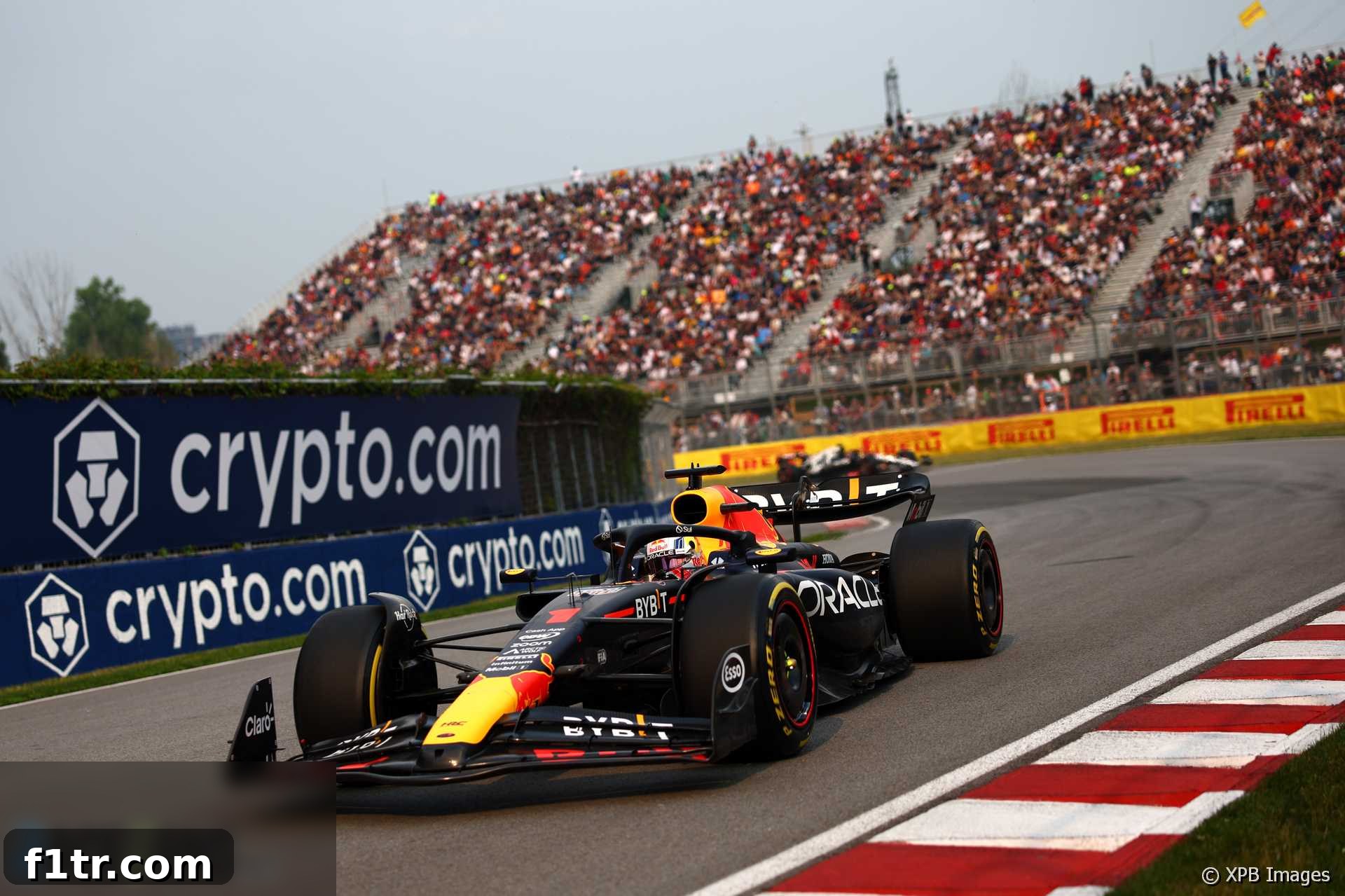
In a display of unwavering determination, Max Verstappen secured his sixth victory of the season at the Canadian Grand Prix, a feat he candidly described as “really difficult” despite his seemingly unchallenged lead from start to finish. The triumph at the Circuit Gilles Villeneuve marked his fourth consecutive win at the iconic track and further cemented his dominant position in the 2023 Formula 1 season.
Verstappen, starting from pole position, guided his Red Bull Racing machine across the finish line just under ten seconds ahead of a tenacious Fernando Alonso. The race, punctuated by an early Safety Car period, presented unique challenges that tested the mettle of even the sport’s most formidable drivers. While observers might have perceived a straightforward procession to victory, Verstappen painted a more nuanced picture of his afternoon’s endeavors.
Reflecting on the race dynamics, the reigning world champion explained, “It was not a very straightforward race because the tyres were not really getting in their window. It was very cold today compared to Friday, and we were sliding around quite a bit.” This insight reveals the intricate balance and constant adaptation required at the pinnacle of motorsport, where even a slight deviation in track temperature can profoundly impact tire performance and, consequently, race pace. The cool conditions in Montreal made it particularly challenging for drivers to generate and maintain optimal tire temperature, leading to reduced grip and a constant battle against the car’s tendency to slide.
The strategic implications of these tire challenges were significant. Drivers were forced to manage their tires meticulously, often compromising outright speed for longevity and consistent performance. For Verstappen, this meant a race where maximum attack was not always an option, instead requiring a disciplined approach to keep the RB19 within its performance window. The Safety Car intervention early in the race further complicated strategies, forcing teams to react quickly and decide on optimal pit stop timings, adding another layer of pressure to an already demanding race.
This hard-fought victory was not just another notch on Verstappen’s belt; it was his 41st career Grand Prix win, an astonishing tally that places him among the sport’s all-time greats. More significantly for the team, it marked the 100th Grand Prix victory for Red Bull Racing, an incredible milestone for the Milton Keynes-based outfit. Verstappen expressed profound pride in being a part of this historic achievement, stating, “To today win the 100th Grand Prix for the team, that’s incredible. It’s amazing.”
The Dutchman, known for his relentless pursuit of excellence, also humbly acknowledged the rapid ascent of his career. “I never expected to be on these kind of numbers myself as well, so we keep enjoying, we keep working hard, but today has been a great day again,” he added. This personal reflection highlights the extraordinary trajectory of his journey in Formula 1, from a prodigious talent to a multiple world champion consistently rewriting the record books. Reaching 41 wins puts Verstappen on par with legendary figures, underscoring his generational talent and the formidable package that Red Bull Racing provides.
The 100th victory for Red Bull Racing is a testament to years of dedicated effort, innovation, and strategic brilliance. Since their inaugural win at the 2009 Chinese Grand Prix with Sebastian Vettel, the team has consistently challenged the established order, cultivating a winning culture that has delivered four constructors’ championships and six drivers’ titles. This centenary win in Canada is a powerful symbol of their sustained success and their current unmatched dominance in the hybrid era of Formula 1.
Despite leading every lap of the Canadian Grand Prix, Red Bull’s margin of victory was notably smaller than some of the commanding wins they have enjoyed throughout the 2023 season. This observation led to speculation about whether rivals were beginning to close the performance gap. However, Verstappen remained unfazed, indicating that the tighter competition was largely expected given the challenging conditions and the unique characteristics of the Circuit Gilles Villeneuve.
“I expected more or less what we had today,” he commented, reiterating the impact of the conditions. “It was really difficult to just keep the grip and the temperature in the tyres because the grip was disappearing very quickly. That’s why maybe the gap was not that big, but we had a few Safety Cars here and there. But overall, we won, that’s the most important.” This pragmatic assessment underscores that the perceived shrinking gap was more a function of the specific race conditions and the need for tire preservation rather than a definitive shift in the pecking order. The Circuit Gilles Villeneuve, with its low-grip tarmac and concrete walls, often produces races where outright car performance can be somewhat mitigated by driver skill and tire management.
From the perspective of their closest competitor, Fernando Alonso and Aston Martin had entered the Canadian Grand Prix with high hopes of posing a more significant challenge to the dominant Red Bull. Alonso, a two-time world champion, was aiming to leverage his AMR23’s strong race pace and his own immense experience to put pressure on Verstappen. However, his race was compromised from the outset when Lewis Hamilton of Mercedes managed to get ahead of him off the starting line.
“We lost a place at the start with Lewis, and then it was a battle with the Mercedes,” Alonso recounted. This early setback meant Alonso spent a considerable portion of the race in a high-intensity duel with Hamilton, preventing him from focusing solely on chasing Verstappen. The battle between the two seasoned champions was a highlight of the Grand Prix, showcasing their exceptional racecraft and unwavering determination. Hamilton, driving a revitalized Mercedes W14, pushed Alonso relentlessly throughout the race, leaving no room for error or relaxation for the Spanish veteran.
Alonso elaborated on the demanding nature of their fight: “Lewis was pushing all the race, so I didn’t have one lap where I could relax a little bit. So it was an amazing battle.” This sustained pressure from Hamilton meant that Alonso had to be absolutely precise in every corner, every braking zone, and every acceleration, effectively extracting every ounce of performance from his Aston Martin. While ultimately finishing second, the intense battle with Hamilton undoubtedly shaped Alonso’s strategy and pace, making it harder to mount a direct challenge to Verstappen.
The Canadian Grand Prix of 2023 will be remembered not just for Max Verstappen’s continued dominance and Red Bull’s historic 100th win, but also for the underlying challenges that tested the very best. The unpredictable tire behavior, coupled with the relentless pressure from seasoned rivals like Alonso and Hamilton, provided a compelling narrative. Despite the difficulties, Verstappen’s ability to navigate these complexities and emerge victorious further solidifies his status as a true legend in the making. As the Formula 1 season progresses, all eyes will remain on Red Bull and Verstappen, as well as the determined efforts of their rivals to bridge the gap and challenge for supremacy in what promises to be an exhilarating championship chase.
2023 Canadian Grand Prix Related Articles
- Norris ‘even more’ sure Canada penalty was wrong after review request fails
- McLaren seeking more than just downforce gains from major upgrade
- Winning more races won’t necessarily lead to F1 seat – Palou
- Red Bull’s testing restriction will “massively affect” 2024 car development
- Schumacher’s set-up input gives Mercedes a “super advantage” – Wolff
Browse all 2023 Canadian Grand Prix articles