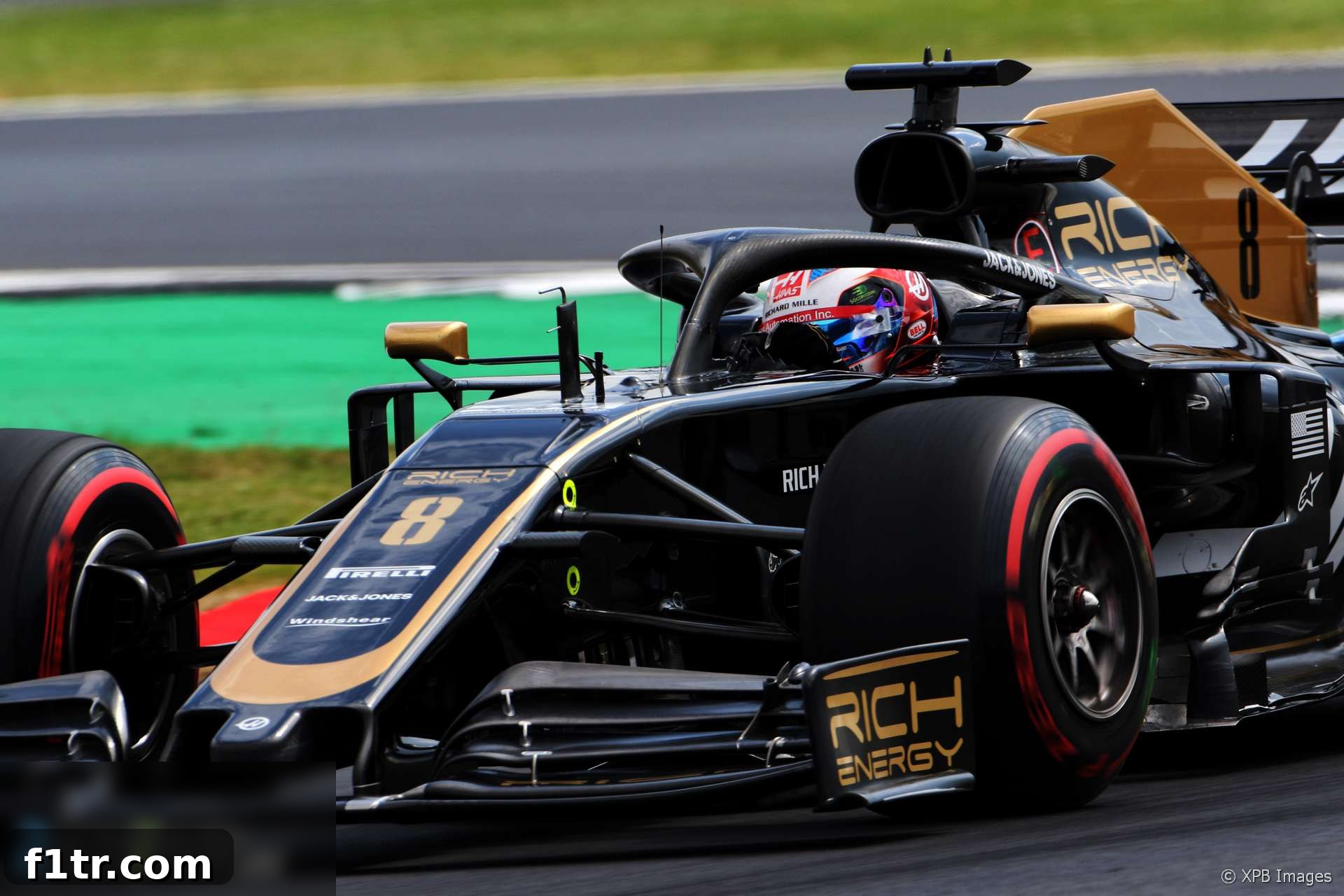
Haas F1’s Bold Gamble: Grosjean Pilots Old-Spec VF-19 in Critical German GP Experiment
The 2019 Formula 1 season presented a perplexing challenge for the Haas F1 Team, a puzzle they sought to solve with an unusual and high-stakes strategy at the German Grand Prix. In an unconventional move designed to unearth the elusive performance of their VF-19 challenger, Romain Grosjean was slated to compete at Hockenheim in a car featuring a specification that was four months old, harking back to the season’s opening race in Australia. Meanwhile, his teammate, Kevin Magnussen, would pilot an updated version of the car, incorporating the latest developments and further modifications. This stark divergence in equipment between the two drivers underscored the depth of Haas’s struggles and their desperate pursuit of answers.
This experimental approach wasn’t new; it had actually commenced at the preceding British Grand Prix at Silverstone. The initial plan was for Grosjean to revert to the Australia-spec VF-19, allowing the team to directly compare its performance against the updated version. The aim was to meticulously gather data, analyze the differences, and pinpoint why the team had been consistently unable to extract optimal performance from its Pirelli tyres – a recurring and debilitating issue that had plagued their 2019 campaign from the outset. The team suspected a fundamental disconnect between their car’s aerodynamic philosophy and the tyre compounds, leading to an inconsistent operating window and a chronic lack of pace.
The Rationale: Unraveling the VF-19’s Enduring Mystery
Haas had entered the 2019 season with high hopes, having demonstrated flashes of brilliance in previous years. However, the VF-19 quickly proved to be a temperamental machine. While it occasionally showed formidable speed, particularly in qualifying, its race pace often deteriorated sharply, leaving both drivers frustrated and far from the points. The team’s primary antagonist was identified as the car’s inability to consistently bring its tyres into their optimal operating window, or to keep them there for a sustained period. This problem manifested differently across various track conditions and temperatures, making it incredibly difficult to diagnose and rectify.
A significant upgrade package had been introduced at the Spanish Grand Prix in Barcelona, intended to resolve these issues and unlock the car’s full potential. However, instead of providing a clear path forward, the updates only deepened the mystery. The team found themselves questioning whether the new components were indeed an improvement or if they had inadvertently exacerbated the existing problems. Without a clear understanding of the upgrade’s true effect, further development became a shot in the dark, leading to the radical decision to run two different specifications.
Silverstone’s Frustrating Outcome: A Data Drought
The initial phase of this audacious experiment at Silverstone was unfortunately curtailed by a catastrophic incident. In a cruel twist of fate for a team already grappling with performance woes, both Romain Grosjean and Kevin Magnussen collided on the opening lap of their home race. The unfortunate contact forced both cars to retire prematurely, delivering a devastating blow to the team’s data collection efforts. Team Principal Guenther Steiner, visibly frustrated, articulated the extent of the loss: “We got four turns [of data]. That will not help a lot.” This meant that the crucial comparative analysis the team desperately needed was virtually non-existent, pushing the comprehensive test to the subsequent German Grand Prix.
The collision was not just a setback for data, but also a significant morale blow for a team already under immense pressure. It highlighted the fragile nature of their season and the added stress on the drivers to perform amidst uncertainty. The incident underscored the urgency for the team to gain clarity on their car’s performance characteristics, not just for the remainder of 2019, but also for shaping their development philosophy for future seasons.
Hockenheim: A New Testbed for Data Collection
With Silverstone proving to be a washout for their experimental data, the German Grand Prix at Hockenheim became the pivotal next stage for Haas’s ambitious comparative test. The Hockenheimring presented a very different set of characteristics compared to Silverstone, making it an ideal location to continue the evaluation. Steiner explained the reasoning: “We’re running this again in Hockenheim, which is a different type of track with different temperatures – they’ll be a lot higher – and, as we all know, we couldn’t get a lot of data from the race at Silverstone from either of the cars.”
Hockenheim’s layout, featuring a mix of high-speed straights, sweeping curves, and tighter technical sections, coupled with the typically higher summer temperatures, would provide a comprehensive evaluation environment. The expectation of higher track and ambient temperatures was particularly relevant, as tyre performance is profoundly affected by thermal management. If the older specification behaved differently under these conditions, or if the updated car still struggled, it would offer crucial insights into the car’s temperature sensitivity and aerodynamic efficiency.
Divergent Paths: Grosjean’s Experience vs. Magnussen’s Progress
The decision placed Romain Grosjean in a unique and challenging position. Driving the older specification VF-19 meant he was effectively sacrificing his own weekend performance in the interest of the team’s long-term understanding. For a driver of Grosjean’s experience, this was a test of both patience and precision, as he would need to provide consistent feedback on a car setup that was known to have shortcomings, while his teammate pushed for contemporary performance. His role was critical: to serve as a baseline, a known quantity against which the progress (or lack thereof) of the newer car could be measured.
Kevin Magnussen, on the other hand, was tasked with testing further new updates for the current specification car. This meant he would be at the forefront of development, continually evaluating modifications designed to improve the VF-19’s performance. Magnussen’s feedback would be instrumental in determining if the latest iterations of the aerodynamic package or other components were finally steering the team in the right direction. For both drivers, the German Grand Prix was not just about race results, but about providing invaluable data to their engineers, a testament to the collaborative, albeit unusual, nature of their roles that weekend.
Guenther Steiner’s Perspective: A Search for Answers
Guenther Steiner, known for his candid assessments, articulated the team’s underlying desperation and conviction in this unusual approach. “We decided on this exercise to get data and understand better what the difference between the two cars is, good or bad, then we can see where we can make improvements,” Steiner explained. His words highlighted the fundamental confusion surrounding the VF-19’s performance envelope. The team was no longer certain if their design philosophy was sound, or if their development trajectory since Australia had been truly beneficial.
The lack of certainty regarding the Barcelona update was particularly troubling. In Formula 1, every upgrade is meticulously designed, tested in simulations, and refined in wind tunnels before making it to the track. For a team to question the very efficacy of such a significant development package midway through the season signaled a deep-seated problem. Steiner’s strategy was a direct admission that the traditional development path had become opaque, and only direct, real-world comparison could illuminate the way forward. It was a clear demonstration of the team’s commitment to leaving no stone unturned in their quest for competitive form.
The Complexities of F1 Tyre Management
The core of Haas’s problems, and indeed a common challenge across the Formula 1 grid, lay in tyre management. Modern F1 tyres are incredibly sensitive instruments, designed to operate within a very narrow temperature window to provide optimal grip. Too cold, and they lack adhesion; too hot, and they degrade rapidly, leading to graining or blistering. The intricate relationship between a car’s aerodynamics, suspension setup, driver input, and tyre behavior makes tyre performance a multifaceted engineering challenge.
Haas’s VF-19 seemed particularly susceptible to these sensitivities. The car could generate immense downforce in qualifying, heating the tyres quickly and efficiently, leading to strong single-lap pace. However, during race stints, with varying fuel loads, different driving styles, and in traffic, the tyres would often fall out of their optimal window, leading to a dramatic drop-off in performance. This inconsistent behavior meant that even if the car had raw speed, it was frequently unable to sustain it, turning promising grid positions into disappointing race finishes. Understanding this elusive tyre interaction was paramount for Haas, and the dual-spec car experiment was a direct attempt to isolate the factors contributing to this critical weakness.
Haas’s 2019 Season: A Mid-Season Review
Heading into the German Grand Prix, Haas was languishing in the Constructors’ Championship standings, a stark contrast to their competitive form in previous seasons. The team, which aimed to consistently challenge for midfield points, found itself battling towards the rear of the pack on many occasions. The inconsistency of the VF-19 was not just frustrating but also financially detrimental, as points finishes directly translate to prize money and sponsorship appeal. This difficult mid-season context amplified the pressure on the team to find answers quickly.
Both Grosjean and Magnussen, while experienced and capable drivers, struggled to extract consistent performance. The internal tension was palpable, occasionally boiling over, as evidenced by the Silverstone collision. The German Grand Prix, therefore, was not merely another race weekend; it was a crucible for Haas, a chance to halt their downward spiral and lay the groundwork for a more competitive second half of the season, or at least gain crucial knowledge for their 2020 car development.
Implications and the Road Ahead
The outcome of this bold experiment at Hockenheim carried significant implications for the Haas F1 Team. If the older specification car driven by Grosjean proved to be consistently faster or more manageable on its tyres, it would suggest that the Barcelona upgrade, or subsequent developments, had indeed been a step backward. Such a realization would force a fundamental reassessment of their aerodynamic philosophy and development path. Conversely, if Magnussen’s updated car demonstrated clear improvements and better tyre management, it would validate the team’s current development direction, albeit with the need for further fine-tuning.
Ultimately, the data gleaned from Hockenheim would be invaluable, regardless of the immediate on-track results for either driver. It was about gaining clarity, turning uncertainty into understanding, and providing the engineering team with concrete evidence to guide their future modifications. This unconventional strategy highlighted the intense pressure and the creative problem-solving required to compete at the pinnacle of motorsport, especially when a team finds itself adrift in a sea of technical complexity.
Conclusion: A High-Stakes Gamble for Redemption
The German Grand Prix represented a pivotal moment for the Haas F1 Team in their tumultuous 2019 season. By fielding two different specifications of their VF-19 car, with Romain Grosjean in the original Australia-spec and Kevin Magnussen in the updated version, Haas embarked on an audacious and crucial data-gathering mission. This unusual strategy, born out of frustration and the lack of clarity following the Silverstone incident, underscored the depth of their struggle with the car’s tyre performance and the effectiveness of their upgrade packages.
Guenther Steiner and his team were essentially conducting a live A/B test on the world stage, prioritizing long-term understanding over immediate race results for one of their drivers. The insights gained from Hockenheim, a track with distinct characteristics and higher temperatures, were anticipated to be foundational for the remainder of their season and crucial for shaping the development of their 2020 challenger. This high-stakes gamble was a testament to Haas’s determination to unravel the mysteries of their VF-19, hoping to find a clear path towards consistent performance and regain their competitive edge in the fiercely contested world of Formula 1.
2019 F1 season
- Crying in the Melbourne car park at 2019 grand prix was my career low – Ocon
- McLaren Racing reports reduced £71 million loss in 2019
- Kvyat: Hockenheim podium last year was “my biggest achievement” so far
- How the FIA’s new encrypted fuel flow meter targets Ferrari’s suspected ‘aliasing’ trick
- “He smashed my office door”: 23 must-see moments from ‘Drive to Survive’ season two
Browse all 209 F1 season articles