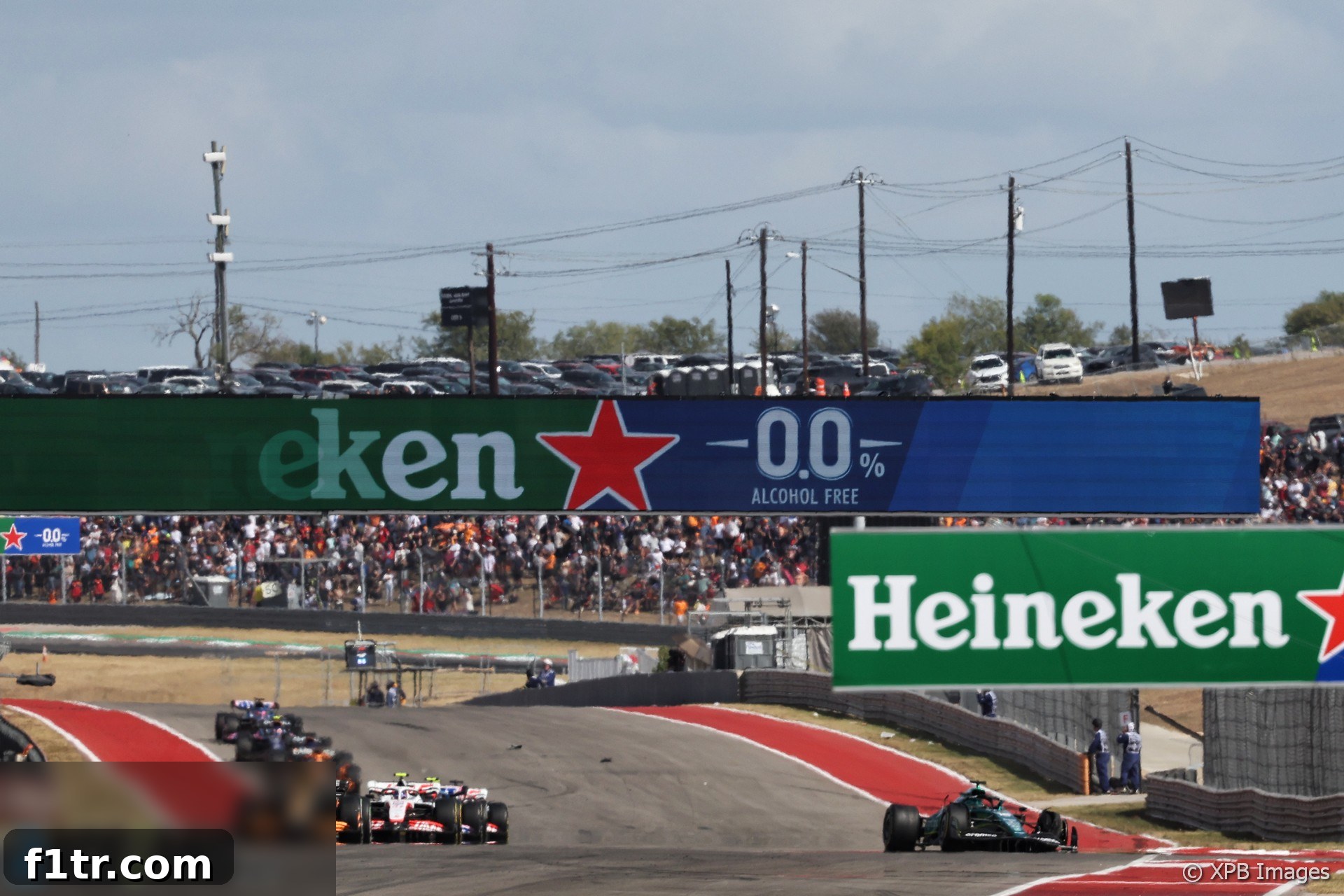
In a significant development following the drama-filled United States Grand Prix, Aston Martin driver Lance Stroll has been handed a three-place grid penalty for the upcoming Mexican Grand Prix. This decision comes after race stewards determined Stroll was primarily responsible for a high-speed collision with Fernando Alonso during the COTA race, an incident that brought Stroll’s race to an abrupt and spectacular end.
The highly anticipated 2022 US Grand Prix, held at the Circuit of the Americas (COTA), delivered a thrilling spectacle, but none more heart-stopping than the lap 22 incident involving the Aston Martin of Lance Stroll and the Alpine of Fernando Alonso. The clash occurred along the long back straight, a notoriously high-speed section of the track where drivers frequently utilize slipstream to gain an advantage. Both drivers were locked in a fierce battle for seventh place, an important points-scoring position, especially after the first Safety Car restart had bunched up the field and intensified the competition.
As the race unfolded, Alonso, demonstrating his renowned race craft and aggressive pursuit of track position, found himself in the slipstream of Stroll’s Aston Martin. Capitalizing on the aerodynamic tow, Alonso moved to the left, initiating an overtaking maneuver designed to seize seventh place. In response, Stroll appeared to make a defensive move, shifting his car towards the left as well. This late movement created an unavoidable convergence point, leading to a catastrophic collision.
The impact was severe and immediate. Alonso’s Alpine made contact with the rear of Stroll’s car, a force so powerful it lifted the front wheels of the Alpine off the ground, momentarily sending Alonso veering precariously towards the unforgiving barriers. Stroll’s car, having taken the brunt of the impact, was sent into a violent spin across the track, scattering debris across the racing line and forcing cars behind to take evasive action to avoid further incident. The straight became a hazardous zone, momentarily under a yellow flag as marshals prepared for cleanup.
Miraculously, Fernando Alonso’s Alpine, despite striking a glancing blow against the barriers, sustained what was deemed relatively minor damage, allowing him to continue his race. His resilience and the robust construction of the Alpine chassis were put to the test, and both held up admirably under immense stress. Stroll, however, was not so fortunate. The damage to his Aston Martin was too extensive, rendering it undriveable, and he was forced to retire from the race on the spot, his hopes of securing valuable points dashed.
Recognizing the severity and potential danger of the incident, race stewards promptly announced that a full investigation would be launched once the Grand Prix had concluded. This post-race scrutiny is standard procedure for significant on-track incidents, allowing stewards to review all available evidence, including telemetry, onboard camera footage, and driver statements, without disrupting the ongoing race. Following a thorough review of the incident, and after having spoken directly with both Lance Stroll and Fernando Alonso to gather their perspectives and accounts of the events, the stewards reached their verdict.
The official statement from the stewards was clear: Lance Stroll was deemed “predominantly to blame” for the collision. Their detailed decision elaborated on the key factors influencing their judgment. “It was clear to us that the driver of car 18 [Stroll] made a late move in reacting to the overtaking attempt by the driver of car 14 [Alonso] by moving to the left,” the stewards explained. This late defensive maneuver, carried out while Alonso was already committed to his overtake and alongside, was deemed unsafe and ultimately the catalyst for the crash. The stewards’ determination underscored the importance of predictable and safe driving standards, particularly during high-speed overtaking scenarios.
The repercussions for Lance Stroll extend beyond a mere reprimand. In addition to the three-place grid penalty for the upcoming Mexican Grand Prix, which will significantly hinder his starting position and strategic options at the Autódromo Hermanos Rodríguez, Stroll was also penalised with two penalty points on his superlicence. These penalty points are a crucial component of Formula 1’s system to monitor driver conduct and ensure safety. Drivers accumulate points for various infractions over a 12-month rolling period, and reaching a total of 12 points within that timeframe triggers an automatic one-race suspension.
With these additional two points, Lance Stroll now has a total of five penalty points on his superlicence for the preceding 12-month period. While this leaves him seven points shy of the automatic one-race ban threshold, it serves as a stark reminder of the close scrutiny drivers are under and the cumulative impact of on-track incidents. Each additional penalty point brings a driver closer to the precipice of a suspension, placing increased pressure on their future conduct and decision-making on track. This accumulation also forces teams to manage driver behaviour more closely, as a ban for one of their drivers can have significant implications for constructors’ championship points and team performance.
The incident at COTA, and the subsequent penalty, added another layer of intrigue to the already captivating 2022 Formula 1 season. For Aston Martin, Stroll’s retirement meant a loss of potential points in their constructors’ championship battle. For Alpine, despite Alonso’s continuation, the damage sustained, however minor, still added a burden on the team’s resources and potentially compromised his car’s performance for the remainder of the race. Alonso’s ability to continue and even recover strongly after such a frightening incident was a testament to his experience and the robustness of modern F1 cars.
Looking ahead to the Mexican Grand Prix, Stroll’s grid penalty will undoubtedly influence his race weekend strategy. A three-place drop could mean starting further back in the midfield, forcing him into more aggressive overtaking maneuvers or a revised tyre strategy to make up positions. This makes qualifying even more critical for Stroll, as a strong Saturday performance would be essential to mitigate the penalty’s impact. The Autódromo Hermanos Rodríguez is a circuit known for its challenging high-altitude conditions and unique atmosphere, adding another variable to an already complex racing scenario.
This incident also sparks broader discussions within the Formula 1 community regarding the fine line between aggressive, hard racing and dangerous defensive driving. While drivers are expected to defend their positions vigorously, there are clear rules and expectations regarding movement under braking and late defensive shifts when another car is attempting to overtake. The stewards’ decision in Stroll’s case reinforces the principle that drivers must leave sufficient room and maintain predictable lines, especially at high speeds, to ensure the safety of all competitors. Incidents like these serve as crucial reminders of the inherent dangers of Formula 1 and the constant vigilance required from both drivers and race control to maintain the highest safety standards.
The 2022 United States Grand Prix will be remembered for many reasons, and the high-speed collision between Lance Stroll and Fernando Alonso is certainly one of its most talked-about moments. The stewards’ decisive action, resulting in a grid penalty and superlicence points for Stroll, underlines the sport’s commitment to policing aggressive driving and ensuring fair play. As the Formula 1 circus moves to Mexico, all eyes will be on Lance Stroll to see how he navigates the challenge of his penalty and seeks to rebuild momentum in what has been a rollercoaster season.
Advert | Become a RaceFans supporter andgo ad-free
2022 United States Grand Prix
- Steiner annoyed by lack of apology from race director over COTA protest error
- How many victory chances did Hamilton have in his first winless F1 season?
- Income from new title sponsor will bring Haas up to cost cap level – Steiner
- Mexico’s first home win or Verstappen’s record 14th? Six Mexican GP talking points
- Mercedes doubt tyre strategy cost Hamilton chance to beat Verstappen to win
Browse all 2022 United States Grand Prix articles