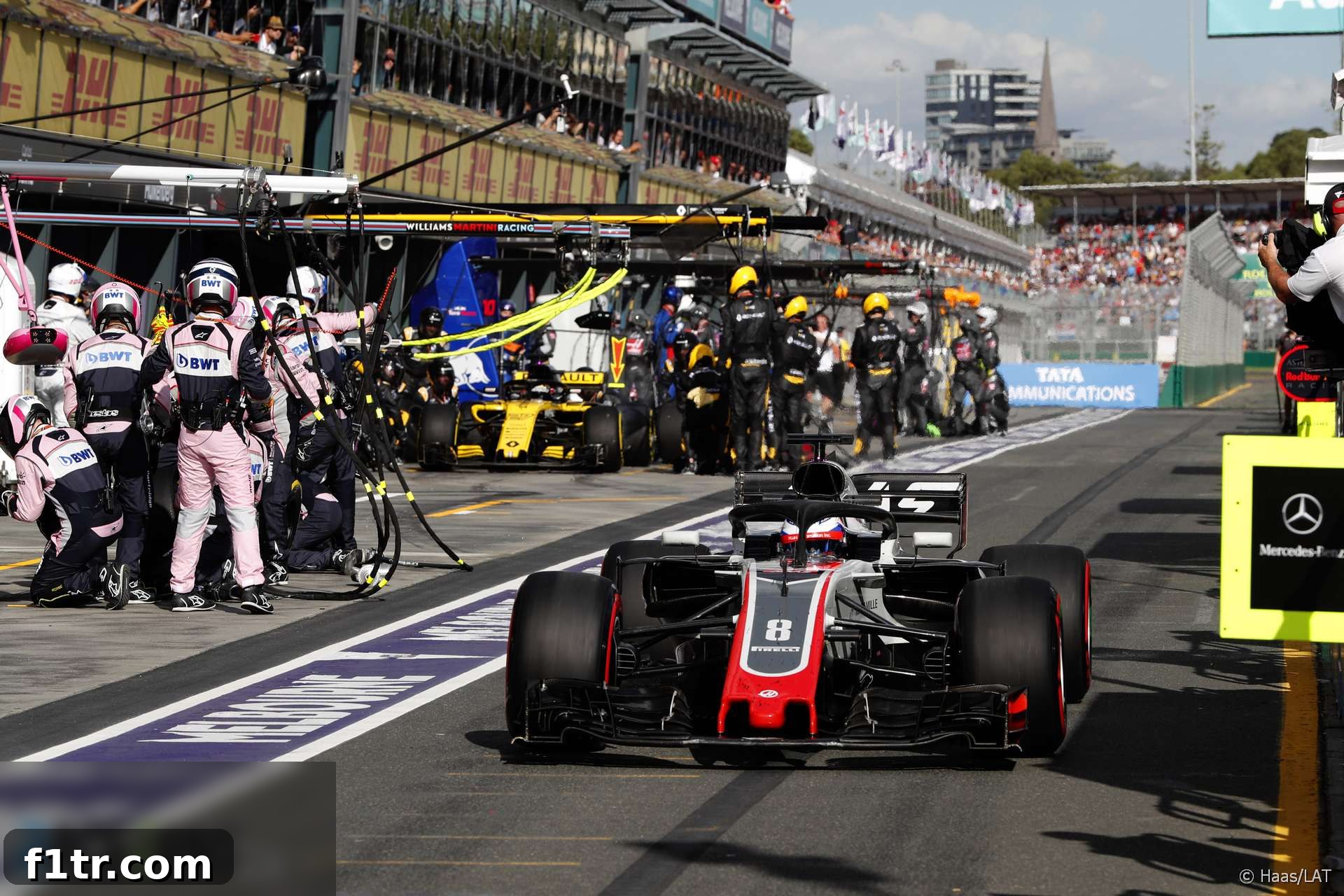
The 2018 Formula 1 season was a roller-coaster of highs and lows for the Haas F1 Team, a season that ultimately saw them fall short of their ambitious goal of securing fourth place in the Constructors’ Championship. Reflecting on a campaign filled with promising pace, unexpected setbacks, and hard-fought battles, Team Principal Guenther Steiner pinpointed one specific event as the most damaging blow to their aspirations: the double retirement at the season-opening Australian Grand Prix due to critical pit stop errors. This incident, he contended, set a precedent for a season where immense potential was often undermined by operational missteps and external challenges.
Haas had entered the 2018 season with a palpable sense of optimism. Their new car, the VF-18, quickly proved itself to be remarkably competitive, frequently demonstrating the fourth-quickest pace on the grid, placing them firmly at the front of the midfield pack. This strong performance allowed the team to envision a legitimate challenge for fourth in the championship, a significant achievement for a team in only its third year of existence. By the summer break, Haas found themselves in a respectable fifth place, trailing Renault by a mere 16 points – a gap that felt entirely surmountable given their car’s consistent speed.
However, the journey from hopeful contender to fifth-place finisher was fraught with difficulties. A series of less-than-stellar race weekends following the summer break chipped away at their momentum. Compounding these performance issues was a significant off-track setback: the loss of eight crucial points scored by Romain Grosjean at the Italian Grand Prix in Monza. Grosjean had finished sixth, a strong result for the team, but a post-race protest from rival Renault regarding the legality of Haas’s floor led to his disqualification. These two factors—a dip in form and the protest—combined with other challenging races, such as a particularly poor outing in Mexico, ultimately sealed their fate, making a fourth-place finish an increasingly distant dream.
“After the mid-season break we didn’t have a few strong races,” Steiner candidly admitted, detailing the cumulative effect of these challenges. “Then we had the protest, one thing to the other. In Mexico we had a very bad race.” While these events undeniably contributed to their predicament, Steiner’s focus remained sharply on the earliest and most impactful misstep of the year: the Australian Grand Prix.
The opening round in Melbourne had started spectacularly for Haas. Both Kevin Magnussen and Romain Grosjean were running in an astonishing fourth and fifth position, respectively, showcasing the VF-18’s raw speed and the team’s clear potential. The prospect of a double points finish, with a substantial haul, was tantalizingly close. However, fate, or rather, human error, intervened during their routine pit stops. Both cars suffered from loose wheel nuts, leading to agonisingly slow and ultimately terminal stops that forced both drivers to retire from the race. It was a crushing blow, transforming what could have been a career-defining moment for the team into a painful learning experience.
“I think fourth place was lost in Australia more than anything else,” Steiner emphasized, highlighting the magnitude of that day’s failures. “22 points, plus the points which Renault scored, we would be still fourth now.” The loss of 22 potential points in one fell swoop, coupled with the points Renault managed to secure, created an immediate and significant deficit that Haas struggled to recover from throughout the rest of the season. Despite the undeniable frustration, Steiner adopted a pragmatic and mature perspective: “But ‘if’ and ‘when’ doesn’t count. We are grown up, we can live with that.” This acknowledgment underscored the harsh realities of Formula 1, where every missed opportunity carries tangible consequences.
The inherent challenge for Haas, as a relatively young and independent team, was to consistently execute at the level required to compete with factory outfits like Renault. While the VF-18 chassis often demonstrated superior pace to its direct rivals, the team occasionally struggled with the operational consistency and development resources that larger, manufacturer-backed teams could deploy. The pit stop errors in Australia were a stark reminder of the fine margins in Formula 1, where even the smallest oversight can have catastrophic implications for championship standings. Similarly, the successful protest by Renault over Grosjean’s floor highlighted the intense scrutiny and competitive pressures within the paddock, where every technical detail can be a battleground.
Despite these critical setbacks and the ultimate disappointment of missing out on fourth place, Steiner firmly believed that the Haas team had ample reason to be proud of their accomplishments in 2018. “You don’t ever forget we are in our third year and it’s still quite a good achievement to beat other people,” he stated, reminding everyone of the team’s relatively nascent status in the sport. Finishing fifth in the Constructors’ Championship, ahead of several more established teams, was a testament to the talent, dedication, and fighting spirit within the Haas organization. It showcased their ability to design a competitive car and challenge the established order with a significantly smaller budget and fewer personnel than many of their rivals.
Nevertheless, a tinge of regret lingered. Steiner admitted that “in theory we should have beaten Renault without some mistakes by us, without the protest.” This sentiment encapsulated the season’s overarching narrative: a team with the raw speed and potential to achieve more, ultimately hampered by a combination of self-inflicted errors and external interventions. The 24-point lead Renault held over Haas heading into the final race of the year underscored the gap that had formed, making a late comeback for fourth virtually impossible.
As the season drew to a close, the team was resigned to ending the year in fifth position. While not their ultimate goal, Steiner framed it as a significant achievement given the circumstances. “Some fights you win, some you lose but in the end I think for the whole team it’s still a good result if we finish fifth, which we should now [unless] something magic happens in Abu Dhabi. I think we can be happy with that.” This acceptance, however, did not diminish the team’s inherent competitive drive. “You’re always frustrated a little bit because you always know you can do better. That is racing,” he concluded, perfectly encapsulating the relentless pursuit of perfection that defines Formula 1.
The 2018 season, therefore, stands as a pivotal chapter in the Haas F1 Team’s history. It was a season that demonstrated their incredible potential and ability to compete at the sharp end of the midfield, yet also brutally exposed the areas where further refinement and consistency were needed. The lessons learned from the pit stop failures in Australia, the complexities of technical regulations, and the challenges of sustaining development will undoubtedly serve as crucial building blocks for the team’s future endeavors in the highly competitive world of Formula 1.
Further Reading: 2018 F1 Season Insights
- F1 feared “death knell” for Drive to Survive after Ferrari and Mercedes snub
- McLaren staff told us we were “totally crazy” to take Honda engines in 2018 – Tost
- ‘It doesn’t matter if we start last’: How Red Bull’s junior team aided Honda’s leap forward
- Honda’s jet division helped F1 engineers solve power unit problem
- McLaren Racing losses rise after Honda split
Browse all 2018 F1 season articles