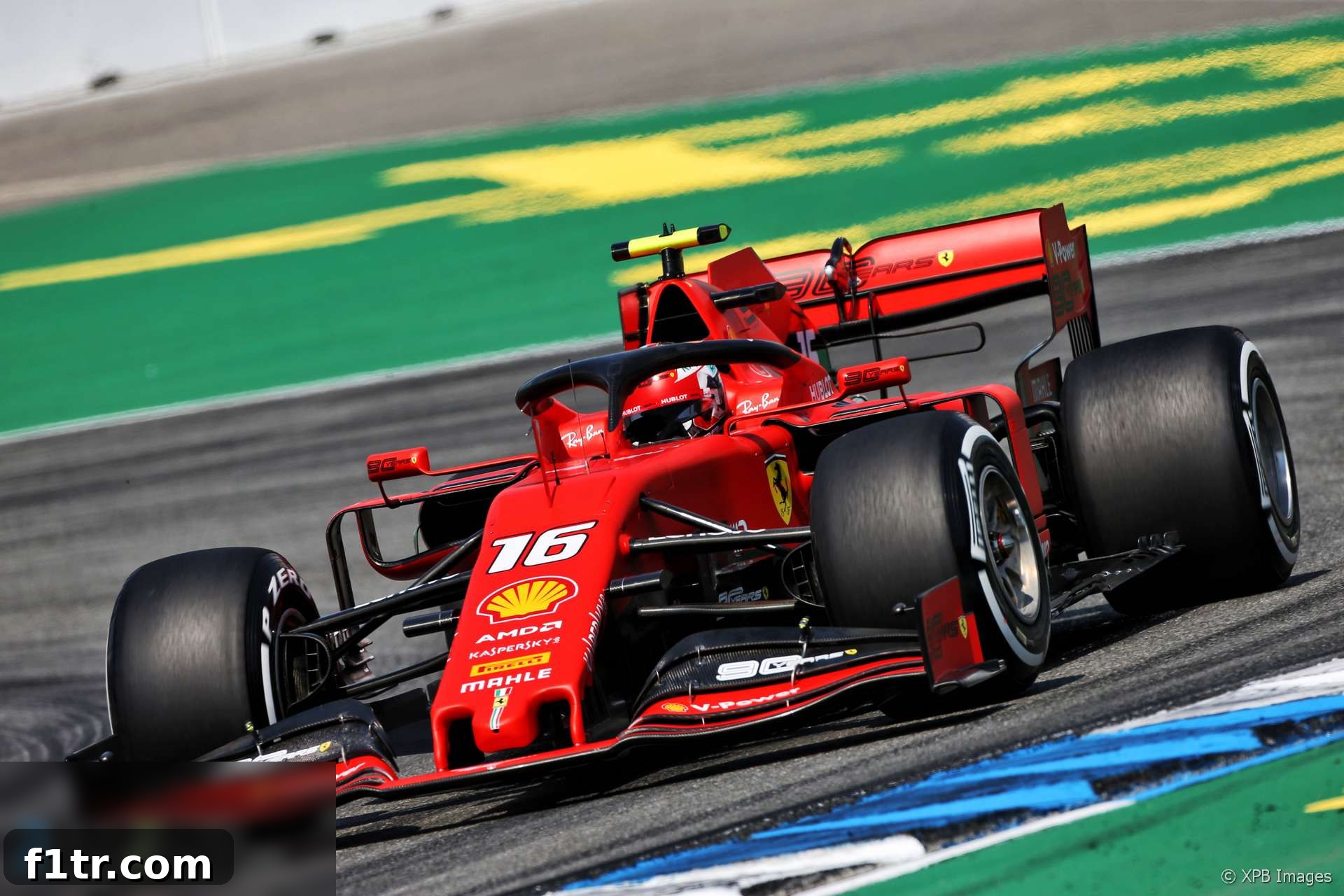
In the dynamic world of Formula 1, driver feedback is paramount, and the nuances of car handling can significantly differentiate performance between teammates. Recent comments from Ferrari’s Charles Leclerc have shed light on the SF90’s challenging characteristics, revealing a divergence in how he and Sebastian Vettel perceive the car’s stability issues. Leclerc suggests that the Ferrari’s handling, particularly its rear-end instability, poses less of a problem for him compared to his experienced German teammate, Sebastian Vettel. This insight provides a deeper understanding of the team’s technical struggles during the season and the critical role individual driving styles play in optimizing performance.
Leclerc Addresses Ferrari’s Handling Quirks: A Tale of Two Driving Styles
The spotlight recently fell on Ferrari’s technical challenges when Sebastian Vettel openly discussed his struggles with the SF90’s rear-end instability. His comments highlighted a recurring theme for the Scuderia: a car that, while potent in certain areas, has proven difficult to tame consistently. When asked about Vettel’s observations, Charles Leclerc offered a contrasting perspective, revealing how different driving approaches can lead to varied perceptions of the same vehicle characteristics.
To be completely honest on that point, I struggle less or I feel it less. I think he’s complaining a little bit of entry instability which doesn’t affect me as much.
I think these are the weaknesses of the car, we know them, and we are trying very hard to fix them as soon as possible.
Leclerc’s statement suggests a crucial difference in how the two Ferrari drivers manage the car’s limits. Vettel, a four-time world champion, is known for his preference for a stable rear end, which allows him to carry immense speed through corners with confidence. Any deviation from this, such as an “entry instability,” can profoundly impact his ability to extract maximum performance. Conversely, Leclerc, often praised for his aggressive yet adaptable driving style, appears to be more comfortable with a car that demands more active management of its rear. This adaptability might stem from his karting roots and junior formula experience, where cars often exhibit more lively handling characteristics.
This discrepancy in driver feedback presents a complex challenge for Ferrari’s technical team. Developing a car that suits both drivers equally, especially when their preferences diverge on such fundamental handling traits, requires a delicate balance. While the team acknowledges these “weaknesses,” their efforts to “fix them as soon as possible” underscore the high-stakes nature of Formula 1 development, where even minor handling improvements can translate into significant lap time gains. The ongoing quest for stability and predictability remains a core focus for the Maranello squad, as they strive to provide both Leclerc and Vettel with a machine capable of consistently competing at the front.
Quotes: Dieter Rencken
Advert | Become a RaceFans supporter andgo ad-free
Social Media Pulse: Reflecting on F1 Moments and Memories
The world of Formula 1 extends far beyond the racetrack, with social media serving as a vibrant platform for teams, drivers, and fans to share insights, celebrate achievements, and engage in spirited discussions. Here’s a snapshot of notable posts that recently captured the F1 community’s attention, offering glimpses into team history, driver opinions, and memorable race moments.
Mercedes-AMG PETRONAS F1 Team Offers a Glimpse into History:
A fascinating Instagram post from the Mercedes-AMG PETRONAS F1 Team recently showcased a remarkable collection of “Silver Arrows” cars, prompting nostalgia and appreciation for the team’s storied past. The image, described by photographer Sebastian Kawka as one of his very first for Mercedes-AMG F1, presented a rare sight of modern Mercedes F1 cars assembled together in what was dubbed “garage goals.” This post resonated with fans, celebrating the engineering marvels and the legacy of dominance that these cars represent. It serves as a powerful reminder of the meticulous craftsmanship and continuous innovation that define Formula 1, and the pride teams take in their heritage.
https://www.instagram.com/p/B1gmSv1ILlM/
A Look Back at Mercedes’ Dominance and Team Dynamics:
“That’s what I call garage goals! What a sight! You’ll rarely see all of the modern ‘Silver Arrows’ at once. This shot is even more special to me, because it’s literally one of the very first pictures I took for @MercedesAMGF1.” – Sebastian Kawka #SebsBestPics pic.twitter.com/ZHyEA9GJZe
— Mercedes-AMG PETRONAS F1 Team (@MercedesAMGF1) August 23, 2019
In another engaging social media interaction, Gavin Ward, a notable figure in motorsport, responded to a user’s comment, sparking a discussion about the historical competitive landscape of Formula 1. Ward’s tweet, filled with a hint of irony, recalled a period when Renault underwent significant staff reductions, while Mercedes maintained and expanded its personnel, reportedly gaining a substantial advantage through “reliability updates.” This exchange touches upon critical themes in F1: the impact of team investment, personnel stability, and strategic development on long-term performance and dominance. It highlights how past decisions continue to shape narratives and rivalries within the sport.
Oh you mean when Renault sacked most their staff while Merc kept theirs on & built a huge advantage via ‘reliability’ updates? Gahhhh #memories https://t.co/qVqcyvAg7E
— Gavin Ward 🇨🇦 (@GDubRacer) August 16, 2019
Lewis Hamilton’s Memorable Press Conference Moment:
RaceFans celebrated a moment of wit and candor from Lewis Hamilton during a press conference, hailing it as potentially the “best press conference answer of the year.” The tweet referenced a clip of Hamilton discussing the German Grand Prix, a race that was particularly eventful and challenging. Such moments showcase the personalities behind the helmets, offering fans a deeper connection with their racing heroes. Hamilton’s response, whatever its content, clearly resonated as a highlight of the season’s media interactions, underlining the blend of competitive intensity and engaging personalities that makes F1 so captivating.
Best press conference answer of the year so far?@LewisHamilton on the #GermanGP #F1 pic.twitter.com/rEGa8x00fI
— RaceFans (@racefansdotnet) August 23, 2019
- For fans looking to stay even more connected, the F1 Twitter Directory offers a comprehensive guide to official F1 accounts, ensuring you never miss a beat from your favorite teams, drivers, and experts.
Essential F1 Insights: Exploring Key Issues Beyond the Track
Beyond the immediate race action, the Formula 1 landscape is constantly shaped by broader strategic, economic, and competitive discussions. Here’s a look at some of the most compelling motor racing links of interest, delving into topics that define the sport’s present and future.
Advert | Become a Supporter & go ad-free
COTA: We’ll host the U.S. Grand Prix for as long as our circuit exists (ESPN)
The future of Formula 1 in the United States has been a hot topic, with discussions about potential new venues in major cities. In this significant statement to ESPN, the Circuit of the Americas (COTA) firmly asserts its long-term commitment to hosting the U.S. Grand Prix, emphasizing its unique position and infrastructure. COTA’s leadership highlights the importance of traditional, purpose-built circuits in creating lasting history and a marquee event experience for fans. They express concern that “a race around a parking lot” – a veiled reference to street circuits often proposed – may lack the historical gravitas and fan appeal of established venues. This perspective underscores the ongoing debate within F1 about balancing expansion into new markets with preserving the heritage and challenge of iconic racetracks, particularly as the sport seeks to grow its audience in North America.
Two-tier Formula 1 won’t change soon (Motorsport magazine)
A persistent concern within Formula 1 is the significant performance gap between the top-tier teams (Mercedes, Ferrari, Red Bull) and the rest of the grid. Motorsport Magazine delves into this “two-tier” structure, presenting an insightful analysis suggesting that this competitive imbalance is unlikely to shift dramatically in the near future. The article points out a compelling trend: “Notice that at the two circuits with the longest corners, Barcelona and Budapest, the gap really stretches out.” This observation suggests that the superior aerodynamic efficiency and stability of the leading teams’ cars, particularly in high-speed, long-duration corners, contribute significantly to their advantage. This enduring disparity raises critical questions about the sport’s regulatory framework, budget caps, and the effectiveness of measures aimed at promoting closer competition throughout the field. The piece implicitly argues that fundamental changes are needed to truly level the playing field and foster a more unpredictable championship.
We always endeavour to credit original sources. If you have a tip for a link to feature in the next RaceFans round-up please send it in via the contact form.
Advert | Become a RaceFans supporter andgo ad-free
Debating Fair Play: The Evolving Landscape of F1 Stewarding and Penalties
The application of penalties and the interpretation of racing incidents are perennial sources of debate in Formula 1. Australian legend Alan Jones recently voiced criticisms regarding F1 stewarding, prompting a lively discussion among fans and pundits alike. The core of the argument often revolves around whether penalties accurately reflect the “gained advantage” or if they are applied inconsistently.
Gained advantage is not taken into account in most penalties anyway. They already have the power to say if something is a racing incident.
At least these days the time penalties are an option, there was a time when any penalty meant a drive through which destroyed a drivers race and that was in the good old days…
@slowmo
This astute comment from user @slowmo encapsulates much of the frustration and evolution surrounding F1 stewarding. The commenter rightly highlights that the concept of “gained advantage” isn’t always a primary factor in penalty decisions, often leading to perceived injustices. Furthermore, the stewards possess the crucial power to deem an event a “racing incident,” allowing for more nuanced judgment without automatically resorting to punitive action. This discretion is vital in a sport where close, aggressive racing is celebrated.
Historically, penalties were often less flexible. As @slowmo notes, there was a period when almost any infraction resulted in a mandatory drive-through penalty. While intended to be a clear deterrent, such a penalty could, as described, “destroy a driver’s race,” disproportionately impacting their final position and championship hopes for relatively minor infringements. The introduction of time penalties – 5-second, 10-second, or even longer additions to race time – represents a significant improvement in the stewards’ toolkit. These options allow for a more proportionate response to infractions, aiming to correct an advantage or punish a rule breach without necessarily obliterating a driver’s entire race effort. This evolution reflects a continuous effort to strike a balance between enforcing regulations, promoting fair play, and maintaining the excitement and integrity of the competition, ensuring that while drivers are held accountable, their races are not unduly impacted.
Community Corner: Engaging Discussions from the RaceFans Forum
The RaceFans forum remains a vibrant hub for passionate discussions among Formula 1 enthusiasts. Here’s a glimpse into one of the engaging topics currently captivating our community:
- Which two Formula 1 drivers would you pick for the new Panthera team if they come in? – This speculative discussion invites fans to act as team principals, selecting their dream driver line-up for a hypothetical new F1 entrant, sparking debates about talent, experience, and team dynamics.
Celebrating Our Community: Happy Birthday to RaceFans Members!
A special shout-out to our community members celebrating their birthdays! We extend our warmest wishes to Andrew White, Hlahalasas, Lord Stig, and Mcl88Asap. Your passion for Formula 1 enriches our community.
If you’d like to receive a birthday shout-out and celebrate with us, please let us know your special day via the contact form or by adding your date to our dedicated list here. We love celebrating with our fellow F1 enthusiasts!
F1 History Rewound: A Look Back at Key Moments on This Day
Formula 1 is a sport rich in history, filled with unforgettable races, dramatic incidents, and iconic victories. Looking back “On this day in F1” often reveals pivotal moments that shaped championships and cemented driver legacies. Today, we recall a particularly dramatic Grand Prix:
- Five years ago today Daniel Ricciardo won the Belgian Grand Prix after Lewis Hamilton and Nico Rosberg collided – This memorable event from 2014 at the iconic Spa-Francorchamps circuit saw a dramatic turn of events. Teammates Lewis Hamilton and Nico Rosberg, embroiled in a fierce championship battle, made contact, leading to damage for Hamilton and a subsequent retirement. This incident profoundly impacted their rivalry and the race outcome. Daniel Ricciardo, then driving for Red Bull Racing, capitalized on the Mercedes’ misfortune, seizing a popular victory that further cemented his reputation as a opportunistic and skilled racer. This race remains a significant chapter in the intense Hamilton-Rosberg rivalry and highlights the unpredictability that makes Formula 1 so thrilling.