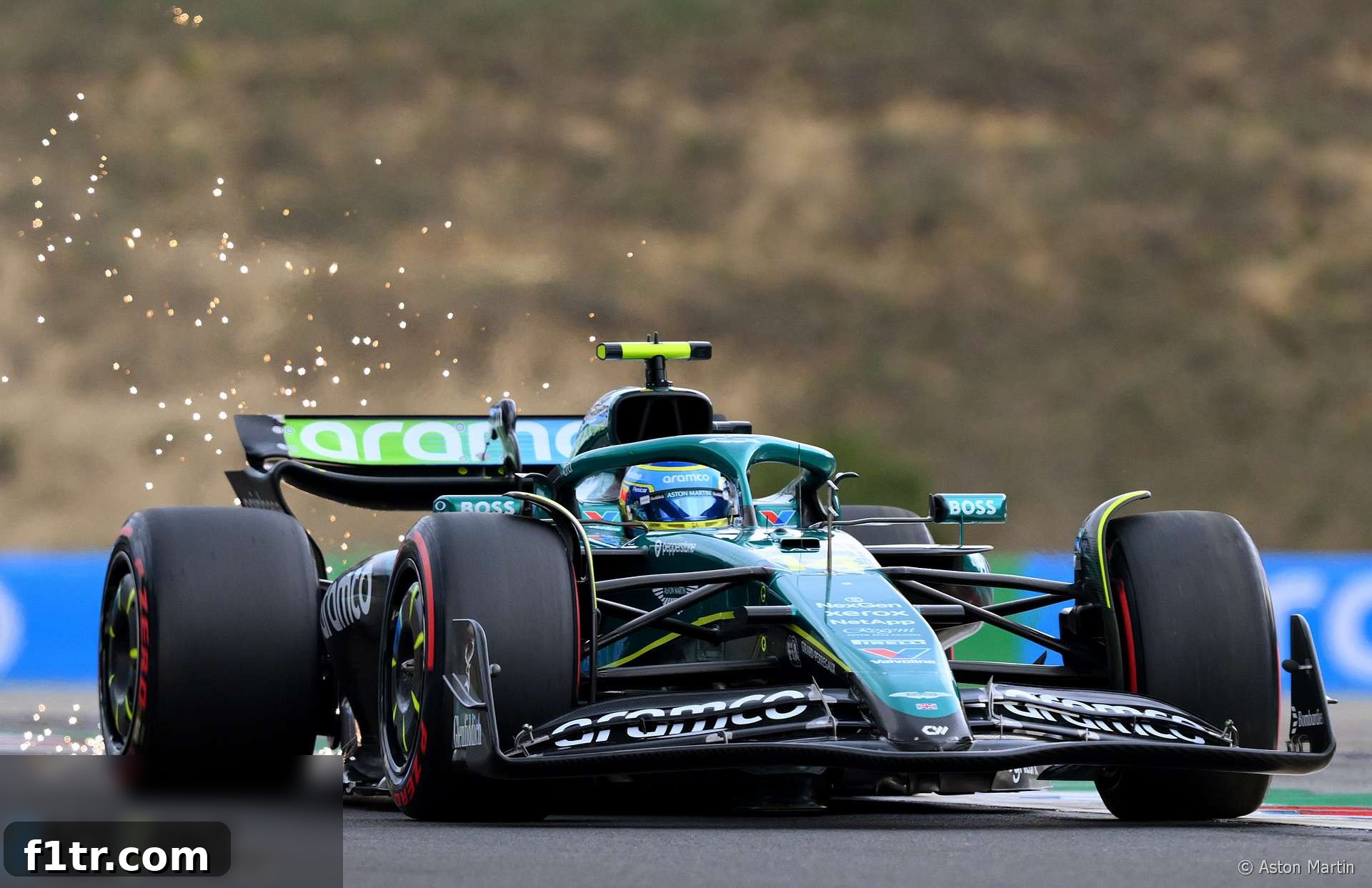
The 2025 Formula 1 Hungarian Grand Prix at the iconic Hungaroring circuit unfolded as a captivating display of strategic brilliance and high-stakes racing, with Fernando Alonso at the very heart of the drama. Aston Martin’s seasoned driver, renowned for his tactical acumen and exceptional race craft, secured a hard-fought fifth place. This crucial result not only represented his and the team’s best performance of the season thus far but also significantly reshaped Aston Martin’s standing in the Constructors’ Championship. Coupled with a commendable seventh-place finish from teammate Lance Stroll, the team amassed a vital 16 points, propelling them from eighth to sixth in the competitive constructors’ battle.
However, Alonso’s stellar achievement was anything but straightforward. As the race entered its critical final phase, a palpable sense of tension permeated the Aston Martin garage and crackled over the team radio. The source of this apprehension was clear: the rapidly advancing threat of reigning world champion Max Verstappen. Despite starting further down the grid and employing a distinctly different tyre strategy with his Red Bull, Verstappen appeared poised to challenge Alonso’s painstakingly managed track position. This set the stage for a thrilling, strategic duel that held spectators in suspense until the very moment the chequered flag fell.
Alonso’s Early Gamble: A Masterclass in Tyre Preservation and Strategic Vision
Fernando Alonso’s strategic narrative for the Hungarian Grand Prix truly began in his opening stint, where he delivered an extraordinary demonstration of tyre management on the medium compound. From the green light, the two-time world champion embarked on a calculated strategy aimed at maximizing track position and minimizing pit stops, a daring approach that would require immense discipline. Early in the race, specifically at the start of the third lap, Alonso was overtaken by Lando Norris, who moved his McLaren ahead. Rather than immediately retaliating or pushing hard, Alonso made a deliberate and counter-intuitive decision: he consciously dropped his pace. He began running over a second a lap slower than Norris, a controlled sacrifice designed to meticulously preserve his tyres and transform a speculative one-stop strategy into a plausible reality.
Such a tactic is inherently fraught with peril in the unforgiving world of modern Formula 1, where every tenth of a second can determine success or failure. Sacrificing outright speed often leaves a driver vulnerable to rivals employing more aggressive strategies or benefiting from fresher rubber. Yet, Alonso, leveraging his unparalleled experience and profound understanding of tyre degradation, navigated this delicate balance with surgical precision. Despite maintaining a relatively slower pace compared to the immediate front-runners, he exerted masterful control over his Aston Martin AMR25. His meticulous management ensured he consistently held a comfortable buffer, preventing him from coming under any serious attack from Gabriel Bortoleto in the Sauber, who was constantly lurking behind. This early strategic gamble was not merely about saving tyres; it was a profound statement of intent and laid the crucial foundation for his eventual strong finish, unequivocally proving that, under certain circumstances, a slower, more controlled pace can indeed translate to a faster overall race result.
The Verstappen Factor: A Late-Race Threat and Aston Martin’s Strategic Conundrum
As the Hungarian Grand Prix progressed and the strategic picture began to evolve, the race took on an entirely new dimension. Following his exceptionally long and meticulously managed opening stint, Alonso finally made his first and only scheduled pit stop at the end of lap 39, trading his well-worn medium tyres for a fresh set of hard compounds. He rejoined the race in a promising fifth position, seemingly consolidating his strategic gains. However, events unfolding elsewhere on the circuit were about to introduce a significant and potentially race-altering complication. Max Verstappen, the formidable world champion, who had been on a contrasting two-stop tyre strategy with his Red Bull RB21, executed his second pit stop on lap 48. This decision saw him re-emerge further down the order, specifically in ninth place and, critically, behind Liam Lawson. Crucially, Verstappen was now armed with significantly fresher tyres than all eight cars ahead of him, instantly transforming him into a rapidly approaching and formidable threat for the closing stages of the Grand Prix.
The looming prospect of Verstappen unleashing the full, unadulterated potential of his Red Bull on pristine rubber sent a clear ripple of concern through the Aston Martin pit wall. Alonso’s race engineer, Andrew Vizard, wasted no time in communicating this perceived danger. At the start of lap 40, Vizard’s voice came over the radio with an urgent instruction: Alonso was to activate “HPP on” – referring to a higher power unit setting – and increase his speed. The message was unequivocal: “Verstappen is just now in the pit lane, he could be a threat at the end. So just make sure you have good tyres at the end of the race – that is the key.” This direct and immediate instruction vividly underscored the team’s apprehension about Verstappen’s potential closing speed, urging Alonso to extract every ounce of available performance from his AMR25 to maintain a critical gap.
However, Alonso, ever the astute strategist, offered an alternative perspective, questioning the immediate activation of the higher power mode. He suggested, “I would prefer strat-11, rather than HPP?” Strat-11 typically denotes a specific engine mapping or energy management strategy that could offer different benefits, perhaps focusing on sustained, consistent performance over an immediate, short-burst power boost, or optimizing for better fuel efficiency across a longer period. Vizard initially responded with the team’s preference for immediate aggression: “We’ll go HPP-on and then we can do strat-11 later.” Yet, within moments, the team appeared to reconsider, communicating to Alonso at the start of lap 41, “now we can do strat-11.” This brief but revealing exchange illuminated the dynamic, real-time strategic discussion unfolding between driver and pit wall, constantly evaluating the delicate balance of risk versus reward during a Grand Prix. Alonso, still cautious and pragmatic, responded with characteristic foresight: “I don’t need it for the moment. It’s better to save it, no?” His rationale was simple yet profound: conserving the precious power boost for a truly critical moment, perhaps a direct wheel-to-wheel battle with the Red Bull, rather than expending it prematurely when the immediate threat wasn’t directly upon him.
The Relentless Pursuit: Alonso’s Unwavering Resolve and Defensive Masterclass
As anticipated, armed with his significantly fresher tyres, Max Verstappen swiftly began to demonstrate his formidable pace, rapidly closing the gaps to the cars ahead. The updates from the Aston Martin pit wall kept Alonso fully informed of the evolving situation: the Red Bull driver was now eight seconds behind but, crucially, still separated by four other cars. This multi-car buffer provided Alonso with a vital, albeit temporary, shield, but the sustained pressure from behind was undeniable. Despite Verstappen’s initial inability to find a way past Liam Lawson – a testament to Lawson’s robust defensive driving and perhaps the inherent limitations of the Hungaroring’s tight layout for overtakes – Alonso maintained his relentless push, refusing to yield any ground.
Alonso’s response to the looming threat was unequivocally clear, perfectly encapsulating his fierce competitive spirit and unwavering determination. He transmitted a decisive message back to Vizard: “For me, it’s qualifying laps until the end. Tell me otherwise.” This powerful declaration crystallized his mindset – to drive at the absolute limit, extracting every available ounce of performance from his Aston Martin, effectively transforming the final laps of the race into a series of mini-qualifying efforts. He steadfastly refused to ease off, understanding that the most effective defense was often a potent offense in terms of consistently maintaining a blistering pace and optimizing track position against a faster, pursuing car.
As the race meticulously wound down towards its conclusion, Alonso continued to receive critical updates regarding Verstappen’s progress, or more accurately, his persistent struggle to advance past Lawson. This detailed real-time information proved invaluable in shaping Alonso’s refined strategy for the final segment of the race. He consistently maintained an impressive pace, registering lap times in the mid-to-high 1’20s over the conclusive 15 laps. This unwavering consistency was paramount, enabling him to remain comfortably out of reach not only of the charging Verstappen but also of Gabriel Bortoleto, who continued to follow behind. The team eventually advised him to run in strat-11 for the final nine laps, a strategic adjustment likely optimizing engine settings for maximum sustainable performance and fuel economy in the dying stages of the Grand Prix. The only minor deviation from his otherwise flawless closing stint occurred as a brief moment of oversteer at Turn Five on lap 63, a rare and fleeting lapse that momentarily cost him approximately a second. However, this momentary hiccup proved insufficient to derail his meticulously executed plan or his hard-earned position.
A Rewarding Finish and Significant Championship Impact
Fernando Alonso’s calculated risks, his impeccable tyre management, and his unwavering resolve ultimately culminated in a resounding success. He crossed the chequered flag in a magnificent fifth place, comfortably ahead of his immediate rivals and securing a deeply satisfying result for Aston Martin. He finished a solid seven seconds clear of Gabriel Bortoleto, who had closely shadowed him for a significant portion of the race, and a remarkable 13 seconds ahead of Max Verstappen. The Red Bull driver, despite his fresher tyres, remained frustratingly stuck behind Liam Lawson, unable to convert his strategic gamble into a higher finishing position against Alonso’s defensive masterclass. This outcome served as a powerful testament to Alonso’s strategic brilliance and the Aston Martin team’s highly effective execution under immense pressure.
The sheer elation and relief were palpable in Alonso’s voice as he crossed the finish line. “Beautiful! Beautiful,” he exclaimed, his satisfaction evident. His immediate thought turned to the team’s points tally, as he queried his engineer, “Sixteen points, isn’t it?” Andrew Vizard, equally delighted by the result, responded with a lighthearted yet accurate jab, “Good at driving, good at maths. Nice way to go into the summer.” Alonso, in full agreement with the sentiment, replied, “Absolutely. Thank you, guys. We need four or five of these ones…” His comments vividly underscored the team’s ambitious hunger for similar performances throughout the season and a clear recognition of how critically vital such substantial points hauls are for their championship aspirations.
Indeed, this strategic triumph at the Hungaroring had immediate and profoundly positive effects on the Constructors’ Championship standings. Aston Martin’s invaluable 16-point haul decisively propelled them into sixth place, elevating them to a single point ahead of Sauber, who had previously held that coveted position. Furthermore, the weekend proved to be a particularly significant gain against Williams. While Aston Martin celebrated their strong double-points finish, Williams endured a challenging Hungarian Grand Prix, failing to score any points as their drivers Carlos Sainz Jnr and Alexander Albon finished down in 14th and 15th places, respectively. This starkly contrasting performance meant Aston Martin substantially closed the gap to Williams, who currently occupy fifth place, now only 16 points ahead. This significant shift in the standings not only intensifies the “midfield battle” but also highlights that the fight for every position and every point will be fiercely contested as the season progresses. The Hungarian Grand Prix, therefore, transcended being merely a race of individual achievement; it was a crucial strategic victory in Aston Martin’s ongoing, ambitious campaign for supremacy within the Constructors’ standings.
Beyond Hungary: Aston Martin’s Ambitions and the Road Ahead
The exceptional performance at the Hungaroring serves as a significant and well-deserved morale booster for Aston Martin as they prepare to navigate the crucial latter half of the 2025 Formula 1 season. The team’s demonstrated capability to execute a challenging one-stop strategy, meticulously manage tyre degradation under immense and sustained pressure, and effectively fend off a potential threat from a driver of Max Verstappen’s unparalleled calibre, speaks volumes about their operational capabilities and the profound strategic prowess embedded within their driver lineup. Fernando Alonso’s unparalleled experience, his innate ability to astutely read a race, and his masterful command of tyre management, coupled with the increasingly consistent performance of Lance Stroll, together form a formidable combination that Aston Martin will undoubtedly lean on heavily as they relentlessly pursue further gains and higher positions in the Constructors’ Championship.
The vital 16 points secured in Hungary unequivocally underscore the team’s ambition to not just consolidate their hard-earned position within the top half of the Constructors’ table, but to actively challenge and compete for even higher rankings. The intense battle with both Sauber and Williams is far from concluded, and every subsequent Grand Prix on the calendar will undoubtedly present new opportunities, fresh challenges, and unexpected strategic twists. The profound confidence gained from executing such a strategically astute and flawlessly managed race like the Hungarian Grand Prix will prove invaluable, providing a robust psychological and technical foundation for future technical development initiatives and meticulous race weekend planning. As the 2025 season progresses into its decisive stages, fans and pundits alike will be watching closely to see if Aston Martin can consistently replicate this level of strategic success and continue their impressive upward trajectory, leveraging Alonso’s unparalleled race craft and the team’s continually improving car package to deliver even more “beautiful” results and memorable moments on the global stage of Formula 1.