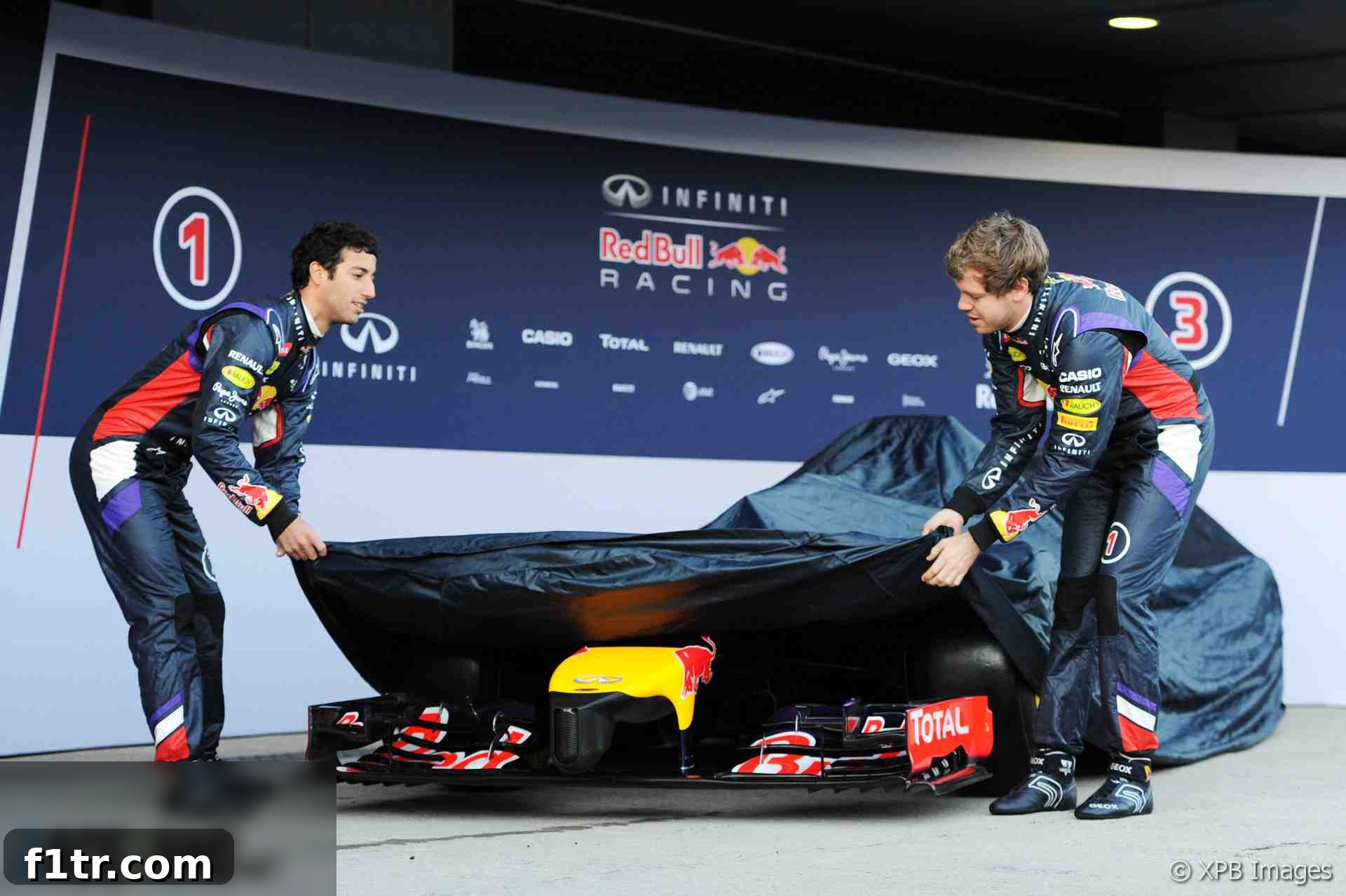
The highly anticipated unveiling of the Red Bull Racing RB10 at the Jerez circuit in Spain marked a pivotal moment for Formula 1. Just as pre-season testing was set to begin, the reigning champions presented their latest challenger, a car designed to navigate the sport’s most radical technical regulations in decades. This tenth Formula 1 car from the team carried an immense burden of expectation, aiming to extend Red Bull’s unprecedented reign that saw its four predecessors sweep both the constructors’ championships and Sebastian Vettel’s drivers’ titles for four consecutive years. Vettel himself concluded the previous season with a staggering record-equalling nine consecutive Grand Prix victories, underscoring the formidable legacy the RB10 had to uphold.
Red Bull RB10: Launching into Formula 1’s Hybrid Era
Red Bull Racing had etched its name into the annals of Formula 1 history with a period of unparalleled dominance from 2010 to 2013. This era was defined by the synergy of Adrian Newey’s groundbreaking aerodynamic designs and Sebastian Vettel’s exceptional talent. Each car, from the RB6 to the RB9, was a masterpiece of engineering, consistently outperforming the competition and securing a remarkable eight world championships – four drivers’ and four constructors’. The weight of this incredible success naturally rested heavily on the RB10, which was designed not just to compete, but to continue a legacy of victory in a vastly altered technical landscape.
Revolutionary Regulations: The Core of F1 2014’s Challenge
The 2014 Formula 1 season introduced a seismic shift in technical regulations, fundamentally transforming the sport’s technical paradigm. The most significant change was the move from naturally aspirated 2.4-litre V8 engines to a new generation of 1.6-litre V6 hybrid turbo power units. These highly complex power units incorporated sophisticated Energy Recovery Systems (ERS), comprising both kinetic (MGU-K) and heat (MGU-H) energy recovery components. This transition required teams to rethink every aspect of car design, placing an unprecedented emphasis on thermal management, fuel efficiency, and seamless integration of hybrid technology. Drivers were also challenged with a strict fuel limit of 100kg per race, making fuel management a critical skill.
Aerodynamic regulations also underwent substantial changes, impacting areas such as front wing width and mandating lower, more restrictive nose cone designs. These alterations forced designers, including Red Bull’s revered Adrian Newey, to innovate within tighter constraints. Red Bull Racing continued its partnership with Renault, relying on their V6 hybrid turbo power units to power the RB10. The success of this collaboration would be paramount, as engine performance, reliability, and efficient energy deployment were set to become decisive factors in the championship battle. The complexity of these new systems meant that pre-season testing would be less about outright pace and more about proving reliability and understanding the intricate interplay of car and powertrain.
A New Chapter: Sebastian Vettel and Daniel Ricciardo Form RB10 Driver Lineup
The unveiling of the RB10 also marked a new chapter in Red Bull Racing’s driver lineup. Four-time reigning world champion Sebastian Vettel, an undisputed titan of the sport, was joined by the exciting young Australian talent, Daniel Ricciardo. Ricciardo, who had spent the preceding two years honing his skills with Red Bull’s junior team, Toro Rosso, stepped up to the senior outfit, fulfilling a long-held ambition. His Formula 1 journey began with HRT in 2011 before moving to Toro Rosso, where he consistently demonstrated raw speed and an infectious personality.
Daniel Ricciardo’s arrival to replace the retiring Mark Webber brought a fresh dynamic to the team. While Vettel commanded respect as a serial winner, Ricciardo’s proven pace and youthful exuberance promised to push his experienced teammate. The partnership was keenly observed, as Ricciardo faced the formidable challenge of competing against a champion while adapting to a new car under radically different regulations. His ability to integrate quickly and extract performance from the complex RB10 would be crucial for Red Bull’s aspirations to maintain their dominance, adding an exciting internal rivalry to the external championship fight.
First Glimpses: The RB10’s Debut and Initial Testing Challenges in Jerez
The launch event at Jerez provided the first public opportunity to scrutinize Adrian Newey’s interpretation of the 2014 regulations. While detailed technical analyses would follow, initial impressions highlighted the car’s aggressive styling and tightly packaged rear, characteristic of Newey’s philosophy. However, the true test began immediately on the track during pre-season testing. Jerez, known for its mild winter climate, became a critical proving ground for all teams, particularly for Red Bull and Renault, who faced the immense task of bringing a brand-new powertrain concept to race readiness.
The 2014 pre-season testing was unlike any before. It was less about setting blistering lap times and more about fundamental reliability, comprehensive data acquisition, and deeply understanding the intricate V6 turbo hybrid systems. Teams grappled with complex software, sophisticated energy management strategies, and the delicate balance required between outright performance and sustained durability. Every lap was invaluable, as engineers worked tirelessly to identify and rectify the inevitable teething issues that accompany such a profound technical revolution. The performance of the RB10 during these crucial Jerez sessions offered early insights into whether Red Bull could successfully marry Newey’s aerodynamic genius with Renault’s new power unit to continue their championship-winning momentum amidst unprecedented change.
Engineering Excellence: Decoding the RB10’s Design Philosophy
The Red Bull RB10 was not merely a racing car; it represented Adrian Newey’s strategic response to the drastic 2014 rule changes. Every curve, every vent, and every aero-surface was meticulously crafted, from the aesthetically divisive but regulation-compliant “anteater” style nose cone, seen across much of the grid, to the highly integrated and compact rear packaging designed to maximize aerodynamic efficiency around the bulkier V6 turbo hybrid power unit. Newey’s design philosophy consistently prioritizes aerodynamic supremacy, and even with the significant engine constraints, the RB10 aimed to be the most aerodynamically efficient car on the grid.
The chassis, a marvel of composite engineering, was designed to seamlessly house the new power unit and its extensive ancillary systems, including vastly increased cooling requirements for the turbo and ERS components, all while minimizing drag. Subtle but crucial innovations were anticipated in areas such as suspension geometry, vital for translating the increased torque of the hybrid engine into mechanical grip and maintaining optimal tire performance. The symbiotic relationship between Red Bull’s chassis design team and Renault’s engine engineers reached new levels of criticality, as the power unit’s integration was no longer peripheral but central to the car’s overall aerodynamic and thermal performance. The RB10 was a testament to adaptable engineering, seeking to find new avenues for downforce and efficiency in a rulebook that had fundamentally altered the game.
Pictures: Red Bull RB10 Launch and Technical Details
Advert | Become a RaceFans supporter andgo ad-free
The Road Ahead: Navigating the Unpredictable 2014 F1 Season
The 2014 Formula 1 season was widely anticipated to be one of the most unpredictable and captivating in the sport’s recent history. For Red Bull Racing, the launch of the RB10 was more than just presenting a new car; it was a powerful declaration of their unwavering intent to defend their hard-earned championships against a backdrop of unprecedented technical upheaval. The seamless integration of the potent Renault V6 turbo hybrid power unit with Adrian Newey’s renowned aerodynamic platform would be the ultimate determinant of whether Red Bull could extend their remarkable reign or if a new era of challengers would emerge to seize the crown.
The early performance and reliability observed during pre-season testing would inevitably set the tone for the entire year. Reliability issues, effective fuel management strategies, and mastering the sheer complexity of the new power units were expected to be significant hurdles for all teams. This created a fascinatingly level playing field where innovation, problem-solving prowess, and operational excellence would prove paramount. The RB10, therefore, was not merely a cutting-edge racing car; it embodied adaptability and the relentless pursuit of perfection in the face of radical change. The global Formula 1 community watched with bated breath to see if Red Bull could achieve an extraordinary fifth consecutive championship double.
Further Reading: Formula 1 Insights and Analysis
Dive deeper into the thrilling world of Formula 1 with our comprehensive collection of articles, analyses, and exclusive insights. Explore everything from historical races and technical innovations to driver stories and future predictions that continuously shape the pinnacle of motorsport.
- Controversies, Norris, Newey and more: Five new motorsport books reviewed
- One of F1’s greatest races happened 15 years ago today. Or did it?
- “Overtaking is overtaking”: Domenicali denies F1’s yo-yo racing is “artificial”
- The crashes F1 is trying to prevent may be rare – but the danger is obvious
- F1 returning to India soon after 2027 sounds like wishful thinking
Browse all Formula 1 articles