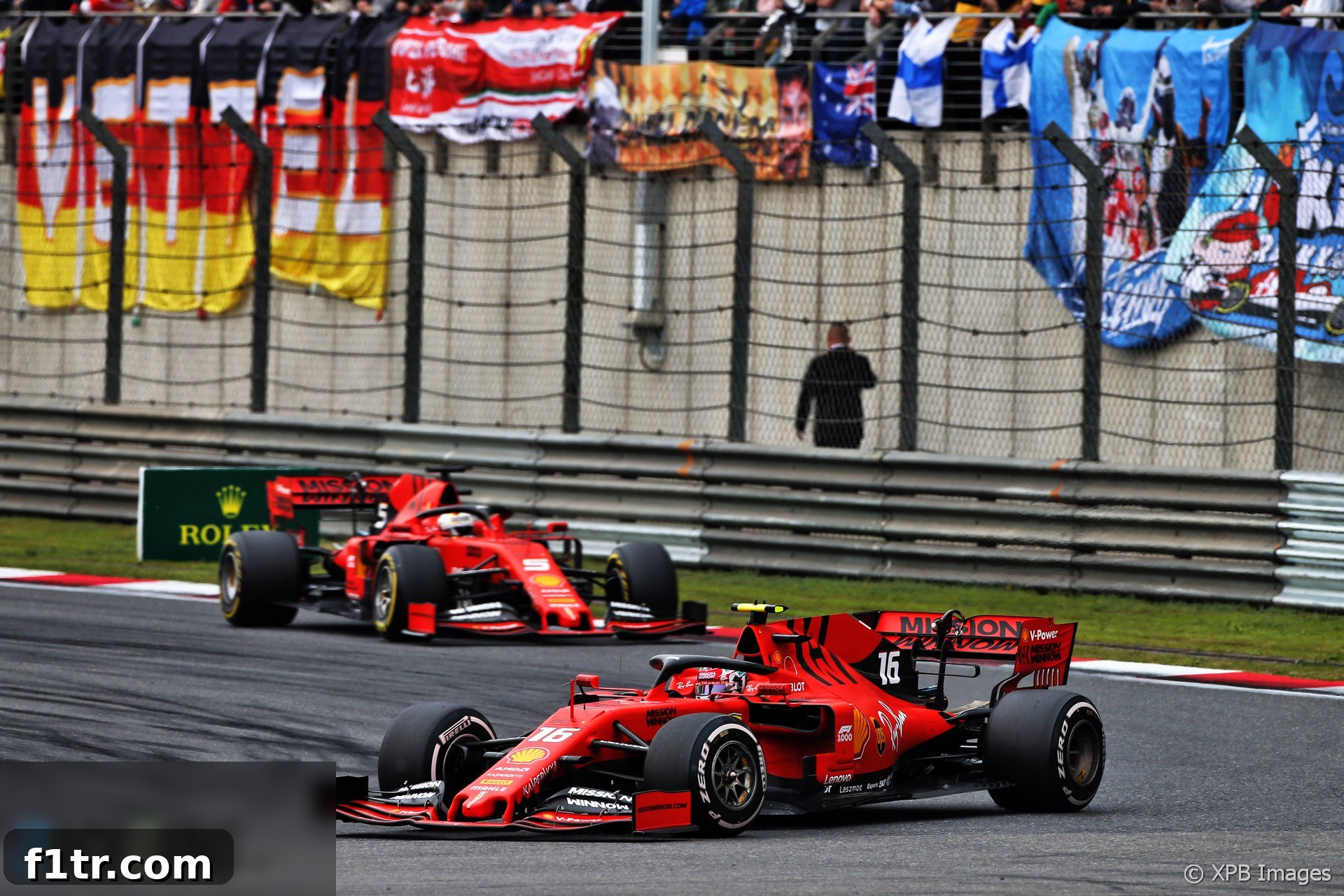
In a sport defined by relentless competition, few narratives captivate Formula 1 enthusiasts quite like an intra-team rivalry. The 2019 season at Ferrari presented one of the most compelling examples, as Charles Leclerc, in only his second season in the pinnacle of motorsport, rapidly emerged as a formidable challenger to four-time world champion Sebastian Vettel. Leclerc’s astonishing pace and unwavering confidence defied initial expectations, quickly putting him on equal terms with his highly decorated teammate and igniting a fierce internal battle within the Scuderia.
This unexpected dynamic within Ferrari drew immediate parallels to a similar high-stakes scenario witnessed at Red Bull Racing just five years prior. There, Sebastian Vettel, then a reigning champion, found his dominance challenged by the arrival of the charismatic and lightning-quick Daniel Ricciardo. The intensity of that rivalry ultimately led to Vettel’s decision to seek new horizons, famously joining Ferrari. Now, the roles were reversed; Vettel, having sought refuge and a championship challenge at Maranello, found himself in a remarkably similar predicament, faced with a young, hungry talent threatening to usurp his position as the team’s leading driver. This historical echo added an extra layer of intrigue and tension to the unfolding drama at Ferrari, raising questions about Vettel’s future and the team’s ability to manage two highly competitive individuals.
Before the season even began, and prior to the SF90 hitting the track in anger, Ferrari team principal Mattia Binotto attempted to establish a clear hierarchy. He publicly declared that Vettel would receive favoured status in any “50-50 scenarios” that might arise between his two drivers. These words, intended to stabilize the team and perhaps shield Vettel from immediate pressure, instead set the stage for an inevitably controversial season. Once such a statement was made, it was clear that Binotto would be compelled to act upon it, and indeed, in each of the first four races, Ferrari intervened in Vettel’s favour, shaping the outcomes and fueling speculation about the team’s true intentions and the fairness of their approach to driver management.
Early Season Tensions: Team Orders and Defiance
The Australian Grand Prix, the opening round of the season, offered the first glimpse into Ferrari’s strategy. Leclerc, demonstrating impressive pace throughout the weekend, found himself behind Vettel in the race. Despite clearly being quick enough to pass his teammate with relative ease, he was instructed to hold position and follow Vettel home. Leclerc, a rookie in his first season with a top team, dutifully obeyed, showcasing his discipline, but the decision left many wondering if Ferrari was suppressing his potential for the sake of an established pecking order. This initial intervention, while seemingly minor, laid the groundwork for the growing unease within the team and among fans.
The Bahrain Grand Prix, however, was a watershed moment, one that dramatically altered the perception of the intra-team battle. Leclerc was in scintillating form, displaying a clear and undeniable pace advantage over Vettel. He surged past his teammate early in the race, taking the lead with authority. When the team radioed him, suggesting he follow Vettel for a couple of laps, Leclerc, emboldened by his superior performance, chose not to comply. He pressed on, extending his lead and demonstrating a fierce independence that resonated with the F1 community. Tragically, a power unit issue in the closing stages robbed him of what would have been a dominant maiden victory, but his performance undeniably sent a strong message to both Ferrari and the F1 paddock: Charles Leclerc was not merely a number two driver.
The contentious team orders continued at the Chinese Grand Prix. In a move that was widely criticized and seemed to lack genuine sporting justification, Ferrari instructed Leclerc to let Vettel pass. From an objective standpoint, Vettel didn’t appear to possess the superior pace that would warrant such an intervention. This decision not only potentially compromised Leclerc’s race but also highlighted Ferrari’s struggle to manage the burgeoning rivalry fairly, leading to frustration for Leclerc and further questions about the team’s overall strategy. Such calls, made early in the season, created a sense of imbalance and internal discontent that would linger.
Azerbaijan saw another instance of team interference, though this time the circumstances were slightly different, involving diverging strategies for the two drivers. Leclerc, despite having to let Vettel by again, had shown immense potential throughout the weekend. His raw speed was evident, particularly in qualifying, where he was a strong contender for pole position before a crucial mistake led to a crash in Q2. This incident, while self-inflicted, blunted Ferrari’s overall competitiveness and overshadowed what could have been a standout performance, potentially allowing him to challenge for the win had he started higher up the grid. The race highlighted how even minor errors could have significant consequences in a tightly contested internal battle.
Mid-Season Swings and Shifting Momentum
Following these tumultuous early races, Sebastian Vettel enjoyed a somewhat stronger run of form, demonstrating his championship pedigree and ability to extract performance from the SF90. However, this period was not without its own controversies. The Monaco Grand Prix, a race where local hero Leclerc carried immense expectations, turned into a disaster due to what could only be described as shambolic tactical errors by Ferrari in Q1. Leclerc, mistakenly kept in the garage when track conditions were improving, was eliminated early, effectively ruining his home race before it had even truly begun. This blunder further underscored Ferrari’s inconsistent operational execution and the pressure weighing on the team.
Canada brought a surge of optimism for Ferrari, with Vettel taking pole position and coming agonizingly close to securing a victory before a controversial penalty denied him. While the team showed strong pace, Leclerc expressed dissatisfaction with his own qualifying performance, feeling he hadn’t maximized the car’s potential. This period of self-reflection and determination, however, proved to be a turning point for the young Monegasque driver. In the subsequent races, Leclerc demonstrably turned his qualifying fortunes around, and notably, Vettel had not beaten him on a Saturday since, marking a significant shift in the balance of power in terms of raw one-lap pace and qualifying prowess.
The intense rivalry and the inherent pressures of Formula 1 inevitably led to mistakes from both drivers throughout the season. Perhaps unsurprisingly, the less experienced Leclerc arguably lost more points due to errors as he pushed the limits in pursuit of his established teammate. The German Grand Prix served as a stark example. Leclerc again showed blistering pace, appearing capable of challenging for victory, but his aggressive driving in treacherous conditions eventually culminated in a costly crash. Meanwhile, Sebastian Vettel, starting from the back of the grid due to his own qualifying issues, executed a masterful recovery drive through the field, climbing an impressive seventeen positions to secure an unexpected second place. This race vividly illustrated the contrasting ways the drivers handled pressure and changing conditions.
Further insights into their respective strengths and areas for development emerged in races like the Hungarian Grand Prix. While Charles Leclerc had clearly unlocked the key to consistent, blistering one-lap qualifying pace – often outperforming Vettel in single-lap shootouts – he still had more to learn from his seasoned teammate when it came to managing race stints and providing meticulous technical feedback to the engineers. Vettel’s extensive experience and understanding of car dynamics allowed him to consistently optimize tyre performance over a full race distance and communicate precise adjustments. This nuance in racecraft and technical collaboration is a critical differentiator at the elite level of Formula 1.
Leclerc himself acknowledged this learning curve, expressing admiration for Vettel’s methodical approach. “He is so precise with everything he feels with the car,” said Leclerc when asked what he could learn from Vettel. “This is something I straight away noticed when I listened to him from the first time during a meeting post-session. And on that I still think that I have some improvements to do.” This candid admission highlighted Leclerc’s humility and his dedication to continuous improvement, recognizing that while raw speed is paramount, the intricate details of race management and technical dialogue are equally vital for championship success.
The Points Battle and Future Outlook
As the season progressed, the narrative shifted from initial team favoritism towards a genuine meritocracy, largely driven by Leclerc’s undeniable speed and consistency. Sebastian Vettel’s lead over his teammate, which had initially been bolstered by early team orders, stood at a mere 24 points. A closer look at the early races reveals that without Ferrari’s controversial interventions, Vettel’s margin of superiority would have been even smaller, if it existed at all. Leclerc’s rapid development and his consistent ability to outperform Vettel in qualifying sessions strongly suggested that it was only a matter of time before he would not only overhaul his teammate on points but potentially establish himself as the clear number one driver within the Scuderia.
The emergence of Charles Leclerc as a genuine front-runner presented Ferrari with a complex dilemma. On one hand, they had a four-time world champion in Sebastian Vettel, a driver with immense experience and proven championship-winning capabilities. On the other, they had a young prodigy in Leclerc, brimming with raw talent, fearlessness, and the potential to be a future world champion. Balancing the ambitions of these two drivers while simultaneously pursuing the constructors’ and drivers’ championships required exceptional management and communication. The internal rivalry, while challenging, also pushed both drivers to perform at their absolute peak, extracting the maximum from the SF90.
Ultimately, the 2019 season became a defining chapter in both drivers’ careers. For Charles Leclerc, it was a coming-of-age year, where he asserted himself as a legitimate superstar in Formula 1, capable of challenging the very best. For Sebastian Vettel, it marked a period of intense scrutiny and pressure, forcing him to re-evaluate his approach and demonstrating the unforgiving nature of top-tier motorsport when a younger, faster talent arrives on the scene. The ongoing battle for supremacy at Ferrari promised to be one of the most enthralling aspects of the Formula 1 landscape for seasons to come, highlighting the sport’s eternal quest for speed, skill, and strategic brilliance.
Sebastian Vettel vs Charles Leclerc: Key Rivalry Aspects
The internal contest between Sebastian Vettel and Charles Leclerc wasn’t just about raw speed; it encompassed various facets of Formula 1 performance. Their head-to-head qualifying results often showcased Leclerc’s explosive one-lap pace, particularly as the season progressed. Conversely, Vettel frequently demonstrated his tactical acumen and greater experience in managing race situations, especially tire degradation and strategic calls, though Leclerc steadily closed this gap with each passing Grand Prix. The comparison between their on-track positions at the end of each race highlighted the ebb and flow of their individual performances, often influenced by external factors like team strategy and reliability. Their points difference, while seemingly a simple metric, became a complex indicator, reflecting not only pure pace but also the impact of team orders, mechanical failures, and individual errors.