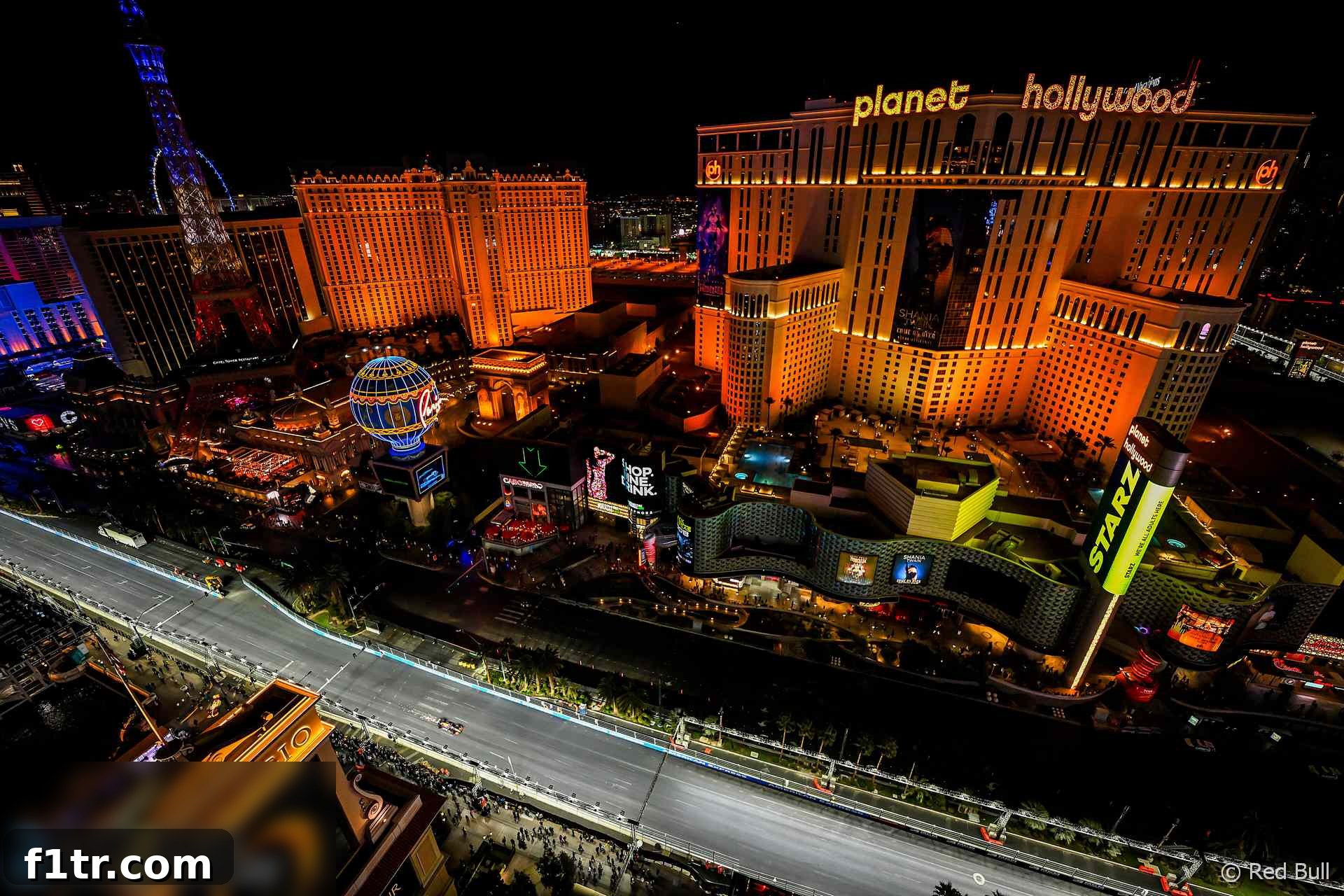
This session has concluded, and no further live updates will be posted here. The focus now shifts entirely to the build-up for the much-anticipated 2024 Las Vegas Grand Prix Qualifying session.
The glittering lights of the Las Vegas Strip Circuit are ready to host one of the most unpredictable qualifying sessions of the Formula 1 calendar. With the championship nearing its thrilling climax, every grid position gained or lost holds immense significance for drivers and teams alike. The unique demands of this street circuit, coupled with the cool desert air, promise a strategic battle under the night sky.
Mercedes Shows Dominance in Practice Sessions
Heading into qualifying, the Mercedes-AMG Petronas Formula One Team has emerged as the standout performer, topping the timesheets in all three practice sessions. This impressive consistency suggests they have found a sweet spot on the challenging Las Vegas layout. The crucial question now is whether they can translate this practice pace into a pole position when it truly counts. George Russell, in particular, has been a force to be reckoned with this season, securing both of Mercedes’ pole positions so far. His first came at Montreal, where he famously matched Max Verstappen’s time, and his second was more recently at Silverstone in July. Russell’s ability to extract single-lap performance under pressure makes him a strong contender for pole in Las Vegas.
Ferrari’s Las Vegas Legacy and Current Challenges
Charles Leclerc etched his name in the history books by claiming pole position for the inaugural Las Vegas Grand Prix last year, showcasing Ferrari’s potential on this specific track. However, the Scuderia hasn’t appeared as competitive as initially expected during this weekend’s practice sessions. This raises questions: are they deliberately holding back their true potential, perhaps running higher fuel loads or less aggressive engine modes? Or have they been more significantly impacted than their rivals by the FIA’s recent clarification regarding floor skid blocks? This ruling has introduced new complexities for aerodynamic performance, potentially forcing teams to adapt their car setups and losing some of the critical downforce generated by the underfloor. For a team like Ferrari, known for its strong qualifying pace, any such setback could be detrimental.
Red Bull’s Unexpected Setup and Horner’s Clarification
Red Bull Racing, surprisingly, did not appear to be on their usual blistering form until the latter stages of final practice. It was then that Max Verstappen declared himself “much happier” with the car, hinting at a breakthrough in setup. Intriguingly, given the many long straights that define the Las Vegas Strip Circuit – typically favoring a low-downforce configuration – the team is running its ‘high downforce’ engine cover package. This decision sparked considerable speculation. Christian Horner, Red Bull’s Team Principal, swiftly addressed these rumors, unequivocally stating: “We didn’t forget our rear wing. There’s no issue with it. I don’t know quite where it came from, but we don’t have a specifically-designed wing for very low-downforce, which is basically potentially here and Monza.” Horner elaborated on the financial implications under the stringent cost cap regulations: “The money that is involved in creating that, within the cost cap, you’ve got to pick and choose where are you going to spend it. So the wing that we have, you end up trimming the wings to achieve a top speed and that’s what many of the teams have done.” This explanation highlights the strategic compromises teams must make, especially on unique circuits that only appear once a year.
Aston Martin’s Race Against Time for Stroll
Aston Martin faced a frantic scramble before qualifying. They confirmed that their mechanics were working intensely to repair Lance Stroll’s car in time for Q1. An energy recovery system (ERS) package failed on his AMR24 late in final practice, necessitating a complete replacement. Such a complex repair against the clock adds immense pressure to the team and uncertainty for the driver, whose participation in the crucial first qualifying segment hung in the balance.
Q1: The Opening Salvo Under the Lights
As the pit lane opened for Q1, George Russell positioned himself at the very front of the queue, eager to be the first out on track. He led the field, boldly opting for a set of medium compound Pirelli tyres on his Mercedes, a strategic choice aimed at scrubbing them in for a potential later stint or perhaps gauging early track conditions. Most of his rivals, however, chose the softer compound, indicating a preference for immediate pace on the evolving circuit. Pierre Gasly of Alpine was the first to set a flying lap, clocking a 1’43.773 on softs – a time far from competitive, highlighting the initially low grip levels. Russell quickly pitted after his out-lap, having seemingly only completed a scrubbing run on the mediums. The Sauber drivers then registered the first truly representative times, setting a baseline for the session.
As more cars completed their laps, the times began to tumble. Gasly improved significantly to a 1’34.846, a substantial leap reflecting the rapid track evolution. However, Sergio Perez in the Red Bull was unable to beat it on his first attempt, slotting into fourth, indicating that Red Bull hadn’t quite found their optimal pace yet. McLaren’s duo, Lando Norris and Oscar Piastri, quickly asserted their authority, with Piastri leading Norris to put the McLarens at the top with a pair of 1’34.0s. The Mercedes drivers then slotted in right behind them, showcasing their strong form, while the Ferrari drivers began their first flying laps. Impressively, Yuki Tsunoda managed to split the two Mercedes, a testament to the pace of the RB team on this circuit. Fernando Alonso then placed his Aston Martin fifth, the only one to have run so far, adding pressure to the midfield. The Haas pair were among the last to set their initial times.
The leaderboard continued its rapid reshuffle. Charles Leclerc momentarily seized the fastest time, but his reign was short-lived as Piastri, demonstrating incredible pace, beat it by half a second. Norris followed closely, just a tenth behind, solidifying McLaren’s strong start. Meanwhile, the tension mounted for Lance Stroll; he was heading for elimination unless Aston Martin could get his repaired car onto the track imminently. The Haas drivers, fighting hard, managed to move themselves out of the drop zone, pushing Bottas and Ocon into precarious positions, with Zhou and Lawson also in danger. Russell then stormed to the top with a 1’33.363, ahead of Leclerc, Piastri, Sainz, and Norris, underlining Mercedes’ raw speed. The Haas drivers’ efforts saw them move into the top 10, meaning the drop zone now consisted of Bottas, Colapinto, Perez, Lawson, and Stroll. In a heroic effort, the Aston Martin team managed to get Stroll’s car out, though he had minimal time, potentially just one flying lap, to register a time. However, the big shock came when Perez, despite improving, only managed 12th place, just three-tenths safe, but the relief was temporary. As the final moments ticked away, the Mercedes drivers established a dominant one-two, pushing Perez down to an astonishing 16th place. The Red Bull driver was out, a major blow for his championship aspirations and the team’s strategy!
The eliminated drivers in Q1 were: Sergio Perez (Red Bull), Lance Stroll (Aston Martin), Fernando Alonso (Aston Martin – surprisingly, a double elimination for Aston Martin), Alexander Albon (Williams), and Valtteri Bottas (Sauber).
Q2: The Stakes Intensify
Q2 commenced with an immediate burst of speed. Lewis Hamilton quickly went quickest, setting a formidable time that was a mere thousandth of a second faster than Piastri, highlighting the incredibly tight margins at the sharp end of the grid. The Ferrari drivers were among the last to make their runs, and a moment of concern emerged for Leclerc. His race engineer, Bryan Bozzi, worked to calm his driver who expressed worries about being called to the weigh bridge – a mandatory procedure that could disrupt his critical qualifying rhythm and potentially affect tire temperatures. Despite Perez’s shock exit, the remaining Red Bull of Verstappen quickly rose to the occasion, producing a blistering 1’33.085 to claim the fastest time. However, Russell, already on his second run, was on a charge and looking poised to beat it. Indeed, Russell dipped under the 1’33 barrier, setting a time two-tenths ahead of Verstappen, with Hamilton backing him up in second, showcasing Mercedes’ undeniable pace.
With just two minutes remaining in Q2, the pressure reached its zenith for drivers in the drop zone: Gasly, Colapinto, Ocon, Lawson, and Zhou. Hamilton further improved his time with a strong 1’32.567, consolidating his position. However, the session took a dramatic turn. Zhou Guanyu missed out on a top-10 spot by less than a tenth of a second, a heartbreaking margin. Then, disaster struck for Williams as Franco Colapinto crashed! It was more pain for the struggling team as another of their cars found the barrier. Initial reports confirmed he was moving inside the car, a reassuring sign. Replays quickly showed Colapinto clipped the apex barrier at turn 16, a critical error that sent him careening into the wall on the outside. The damage to his Williams was significant, bringing out the red flag and prematurely ending Q2. This incident meant no further improvements could be made, sealing the fate of those in the drop zone.
The eliminated drivers in Q2 were: Franco Colapinto (Williams), Liam Lawson (RB), Esteban Ocon (Alpine), Kevin Magnussen (Haas), and Zhou Guanyu (Sauber).
Q3: The Fight for Pole Position
The start of Q3 was inevitably delayed while marshals worked diligently to recover Colapinto’s heavily damaged Williams and clean up the track, which had debris scattered across the racing line. Crucially, barrier repairs were also necessary, adding to the delay. After a tense wait, the announcement came: Q3 would begin in three minutes, setting the stage for the ultimate showdown for pole position.
As the green light illuminated, the remaining drivers burst onto the circuit. Oscar Piastri immediately lit up the timing screens, kicking up a huge shower of sparks as he aggressively approached turn 14, posting a strong 1’33.520. Not to be outdone, his McLaren teammate Lando Norris beat that, gaining considerable time in the final sector, indicating the rapid track evolution and McLaren’s strong grip on the circuit. Charles Leclerc, however, could only manage sixth place on his first run, visibly struggling with oversteer and sliding a lot in turn two. But the Ferrari camp quickly had something to cheer about as his teammate, Carlos Sainz, put in a phenomenal lap, moving ahead of both McLarens by two-tenths of a second to claim provisional pole. The battle for pole was intensifying with every passing second.
Then, George Russell delivered a stunning performance, hitting the front with a 1’32.811 for Mercedes, firmly establishing himself as the man to beat. His teammate Hamilton, however, endured a miserable first run, losing significant time in the middle sector. Replays showed he went off track at turn 12, a costly mistake that left him languishing in 10th place without a truly representative time, putting him under immense pressure for his final run. With all drivers now out for their final, decisive runs, Hamilton found himself in a precarious position, vulnerable as the last driver circulating in 10th. Leclerc’s first sector didn’t look promising on his final attempt, and he initially found himself only eighth. But the drama was far from over. Russell pushed even harder, setting an even faster time. Norris then snatched second place, showcasing McLaren’s impressive pace. In a brilliant turnaround, Leclerc delivered a very strong middle sector, launching himself into provisional pole – only for Carlos Sainz to immediately snatch it back from him in a thrilling display of Ferrari’s one-lap potential. The crowd roared as times changed in a blink.
Then came another incredible surprise: Pierre Gasly, who had started Q1 slowly, produced a phenomenal lap to momentarily go second alongside Sainz, sending shockwaves through the pit lane. But the ultimate glory belonged to George Russell. With a final, majestic effort, he reclaimed pole position, demonstrating absolute mastery of the Las Vegas Strip Circuit. For Lewis Hamilton, his miserable Q3 session ended exactly where it began, in 10th place, after yet another mistake in turn two on his final attempt.
The drivers’ reactions encapsulated the intensity of the session. “Shit, shit, shit lap,” fumed Leclerc, clearly frustrated. “Tyres felt completely different.” Max Verstappen, despite not being on pole, also acknowledged the challenging conditions, stating: “I gave it all, mate. Super slippery.”
Russell on Pole as Verstappen Nears Championship Glory
Thus, George Russell will start the 2024 Las Vegas Grand Prix from pole position, a significant achievement for both him and Mercedes, underscoring their strong performance this weekend. Max Verstappen, despite missing out on pole, is strategically poised to clinch the championship after qualifying ahead of Lando Norris, his closest rival. This outcome sets the stage for a truly remarkable and potentially championship-deciding race.
What an extraordinary and unpredictable qualifying session! For a detailed breakdown and analysis of all the key moments, read our full report here.
2024 Las Vegas Grand Prix: Further Insights and Developments
- “Disappointing” Las Vegas GP performance prompts ticketing changes for 2025 race
- Vowles clarifies Colapinto’s claim he was concussed in Las Vegas crash
- Norris lost title because McLaren weren’t competitive enough early on – Stella
- Ferrari are now in their longest-ever championship drought
- F1 “was trying too hard” in first year at Las Vegas – Sainz
Browse all 2024 Las Vegas Grand Prix articles