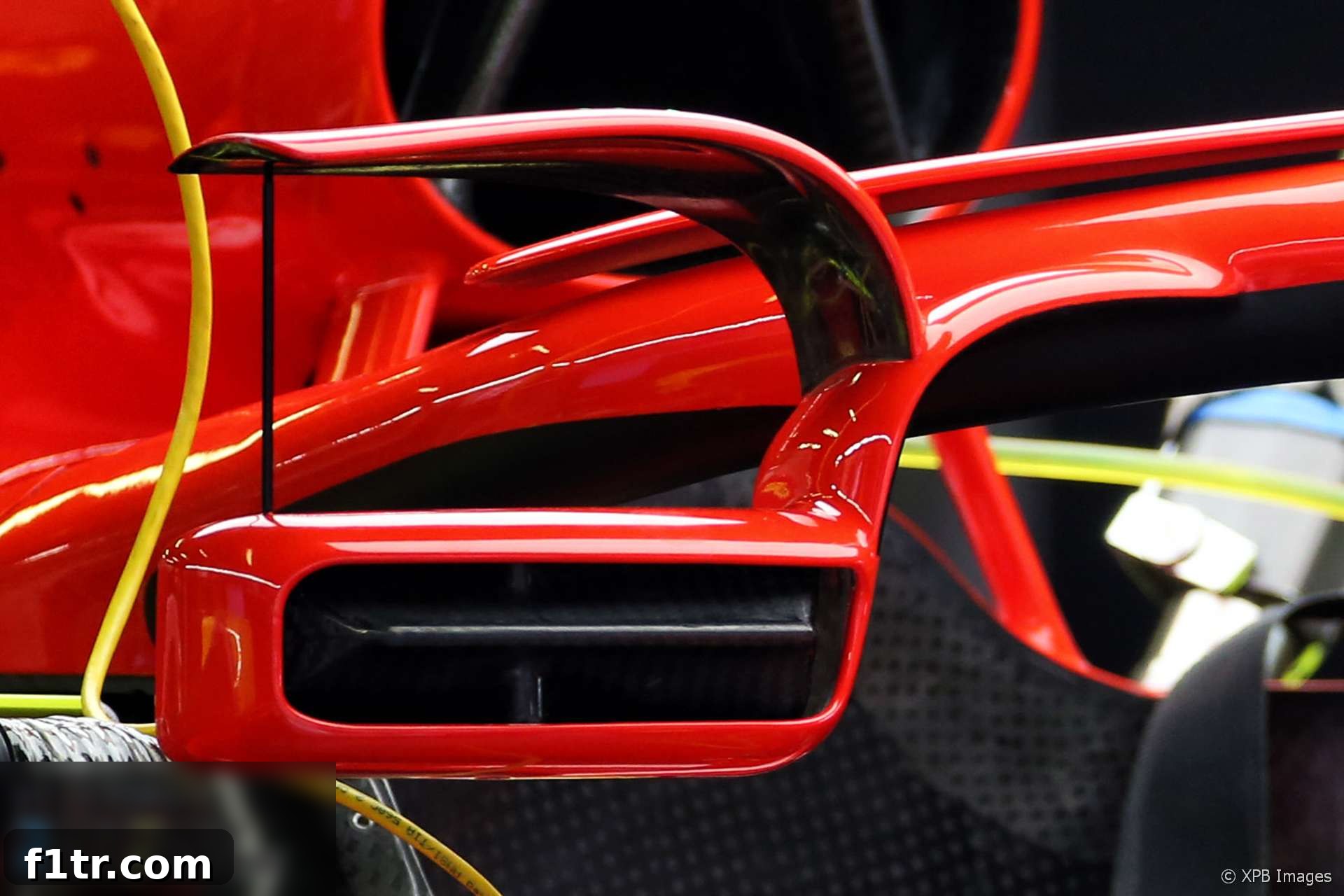
The Controversy Unveiled: Ferrari’s Halo-Mounted Mirrors and the FIA’s Swift Ban
Formula 1 is a sport where innovation is as critical as driver skill, with teams constantly pushing the boundaries of technical regulations in pursuit of marginal gains. This relentless pursuit often leads to intriguing — and sometimes controversial — interpretations of the rulebook. One such instance that sparked considerable debate and led to a swift ruling by the sport’s governing body, the FIA, involved Ferrari’s innovative Halo-mounted wing mirrors during the 2018 Spanish Grand Prix.
The Scuderia Ferrari team introduced a novel design for their SF71H car, positioning the wing mirrors directly on the Halo safety device rather than on the sidepod or chassis traditionally. While ostensibly aimed at improving driver visibility, the design quickly raised eyebrows across the paddock, with many suspecting a secondary, more potent advantage: aerodynamics. The FIA, through its Race Director Charlie Whiting, wasted no time in addressing these concerns, ultimately issuing a technical directive that would ban the controversial design.
Ferrari’s Innovative Mirror Design: A Technical Overview
Advert | Become a Supporter & go ad-free
At the heart of the controversy was the specific attachment mechanism of Ferrari’s mirrors. While the FIA had previously confirmed that mounting mirrors on the Halo itself was permissible, Ferrari’s interpretation stretched the concept of a “mounting” beyond what the regulators deemed acceptable. The design featured intricate wing-like structures extending from the Halo to support the mirror, which many observed appeared to have a significant aerodynamic purpose, rather than purely functional support.
These supplementary elements, often referred to as “winglets,” were meticulously shaped, suggesting an intention to manipulate airflow around the car. In Formula 1, even the smallest aerodynamic appendage can influence critical airflow, impacting everything from cooling efficiency to overall downforce and drag. The design was seen by competitors and officials alike as an attempt to exploit a loophole in the regulations, using the mirror’s mounting as a guise for an additional aerodynamic device in an otherwise restricted area of the car.
The FIA’s Stance: Charlie Whiting and the “Liberal Interpretation”
Charlie Whiting, the then-Race Director for the FIA, was unequivocal in his assessment of Ferrari’s design. Speaking on the matter, Whiting stated, “There’s a liberal interpretation of the word ‘mounting’. That’s how they’ve become legal because there’s no bodywork allowed in the area.” His comments highlighted the critical point of contention: what constitutes a legitimate mounting versus an illicit aerodynamic element.
Whiting explained that the FIA’s interpretation hinged on whether the attachment mechanism truly served only to hold the mirror, or if it was intentionally designed to influence aerodynamics. “The interpretation hinges on whether we think that’s a mounting or not. We somehow think not, so we’re going to take some action on that,” he confirmed. This statement signaled the impending technical directive (TD) that would outlaw the design.
The FIA’s swift response underscores its role in maintaining fair competition and ensuring that teams adhere to the spirit, not just the letter, of the regulations. While Ferrari’s design was allowed to run during the Spanish Grand Prix due to the grey area it exploited, Whiting made it clear that such ambiguity would be short-lived. “If it was a clear breach of the regulations they wouldn’t have been allowed to use it here. But we’ll clarify that to everybody,” he affirmed, indicating that clarity was paramount for all competing teams.
The impending technical directive was designed to leave no room for doubt. Whiting warned that if Ferrari attempted to run the same design at the subsequent Monaco Grand Prix, “we’ll probably go and see the stewards about it.” However, he expressed confidence that “the TD will make it clear,” removing any potential for further interpretation battles.
Advert | Become a RaceFans supporter andgo ad-free
Precedent and Clarification: The Evolution of Mirror Regulations
It is important to note that the FIA had already addressed the principle of Halo-mounted mirrors weeks prior to Ferrari’s Spanish Grand Prix innovation. In response to inquiries from various teams, a technical directive had been issued confirming the permissibility of mounting mirrors on the Halo. However, this initial directive came with specific stipulations, one of which was that the attachment must genuinely function as a mounting, without secondary aerodynamic intent.
The problem, as Whiting articulated, was that Ferrari’s specific execution did not align with the FIA’s intended interpretation of this earlier directive. “It’s just a matter of interpretation,” he explained. “We feel that something that is such a tenuous interpretation is not something that we’re happy with.” This highlights the constant tug-of-war between regulatory bodies and engineering teams in Formula 1, where every word of the rulebook is scrutinized for potential areas of exploitation. The FIA’s commitment to strict interpretation ensures that any design purporting to be a functional component doesn’t inadvertently become a performance-enhancing device through clever engineering.
Ferrari’s Defense: Visibility or Performance? Sebastian Vettel Weighs In
Despite the FIA’s concerns, Ferrari driver Sebastian Vettel offered a different perspective on the team’s motivation behind the Halo-mounted mirrors. According to Vettel, the primary objective was not performance enhancement, but rather an improvement in driver visibility and safety.
“For us it’s straightforward – I see better,” Vettel stated. “That was the point of moving them. We asked already in the beginning of the year if we can put them on the Halo because then they would just be in a better position to see what’s going on behind.” The Halo, while a vital safety device, can obstruct driver views in certain areas, and repositioning mirrors could logically mitigate this issue. Enhanced visibility, particularly in congested race conditions, contributes directly to driver safety and confidence.
Vettel’s explanation put the emphasis on practical driver benefits. Drivers constantly rely on their mirrors to monitor competitors, especially during defensive driving or when anticipating overtakes. Any improvement in this crucial aspect would undoubtedly be welcomed by the drivers. However, Whiting remained skeptical about this being the sole motivation for the design.
The Aerodynamic Advantage Debate: Every Millisecond Counts
While Sebastian Vettel championed the visibility aspect, Charlie Whiting’s opinion strongly leaned towards the aerodynamic benefits of Ferrari’s design. “I doubt they would be there if there wasn’t a measurable aero advantage,” Whiting asserted. He added a crucial point about the fine margins in Formula 1: “These days, that doesn’t have to be big.”
This statement encapsulates the essence of modern F1 engineering. Teams invest millions into research and development to gain even the slightest performance edge. A “measurable aero advantage,” no matter how small, can translate into milliseconds per lap, which over the course of a race, can be the difference between winning and losing. The complex interaction of airflow around a Formula 1 car means that even seemingly minor additions can have significant downstream effects, influencing everything from the efficiency of the rear wing to the overall stability of the car.
Aerodynamicists are masters at manipulating air. A small winglet near the Halo, while not directly producing massive downforce, could condition the air more effectively for other aerodynamic surfaces further down the car, or even subtly reduce drag. In a sport where championships are won and lost by fractions of a second, no stone is left unturned in the quest for speed. Thus, the FIA’s concern was entirely justified, as even a small, unintended aerodynamic gain from a component meant purely for mounting could disproportionately affect the competitive landscape.
Advert | Become a RaceFans supporter andgo ad-free
The Ongoing Battle: Innovation vs. Regulation in Formula 1
The episode of Ferrari’s Halo-mounted mirrors serves as a quintessential example of the perpetual cat-and-mouse game between Formula 1 teams and the sport’s governing body. Teams are driven by an insatiable desire to innovate and find competitive advantages, often pushing the boundaries of what is explicitly stated in the regulations. The FIA, in turn, is tasked with interpreting these regulations, closing loopholes, and ensuring a level playing field for all competitors.
Technical directives are a crucial tool in the FIA’s arsenal, allowing them to provide clarifications and ban controversial designs swiftly, often mid-season, to prevent unfair advantages from persisting. This incident demonstrated the FIA’s commitment to proactive regulation, ensuring that novel interpretations of rules do not undermine the sport’s integrity or lead to unintended performance disparities.
Ultimately, Ferrari complied with the technical directive, and subsequent designs of Halo-mounted mirrors from all teams adhered to the stricter interpretation of what constitutes a genuine mounting. This incident, though brief, left its mark on Formula 1’s regulatory landscape, reminding everyone that while innovation is celebrated, it must always operate within the clearly defined — and rigorously enforced — parameters set by the sport’s rulemakers.
Don’t miss anything new from RaceFans
Follow RaceFans on social media for the latest updates, analyses, and breaking news from the world of Formula 1:
- Join RaceFans on Facebook to engage with our community.
- Follow RaceFans on Twitter for real-time news and discussions.
- Get daily email updates from RaceFans directly to your inbox.
Exploring the 2018 F1 season and beyond
Delve deeper into the events and storylines of the 2018 Formula 1 season and other pivotal moments in motorsport history with these related articles:
- F1 feared “death knell” for Drive to Survive after Ferrari and Mercedes snub
- McLaren staff told us we were “totally crazy” to take Honda engines in 2018 – Tost
- ‘It doesn’t matter if we start last’: How Red Bull’s junior team aided Honda’s leap forward
- Honda’s jet division helped F1 engineers solve power unit problem
- McLaren Racing losses rise after Honda split
Browse all 2018 F1 season articles