Colapinto Recounts Near-Miss with Lawson at Australian Grand Prix Start, Fueling Safety Debates
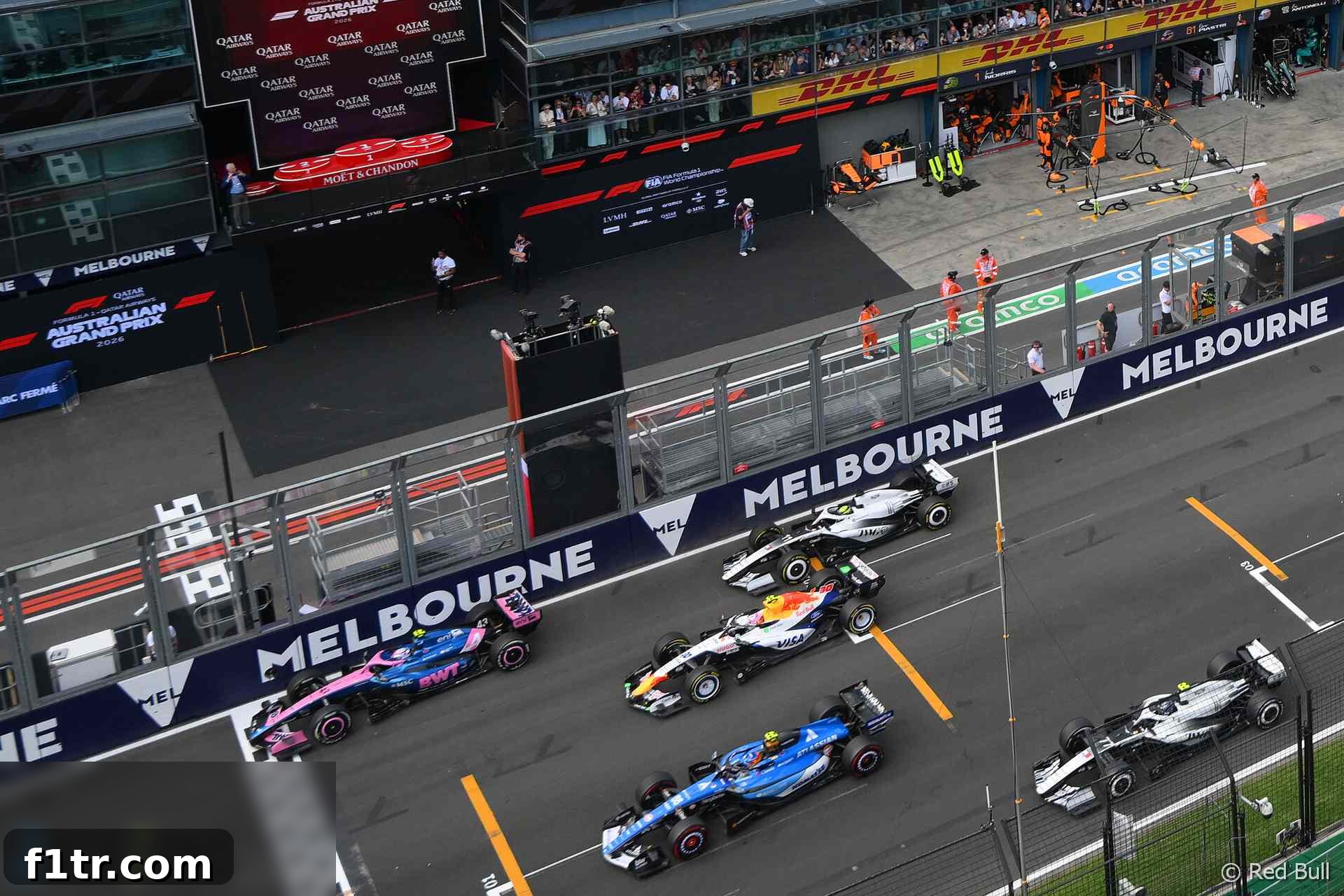
The opening moments of any Formula 1 Grand Prix are always fraught with tension, but for Franco Colapinto and Liam Lawson at the recent Australian Grand Prix, the tension nearly escalated into a catastrophic multi-car pile-up. Alpine driver Franco Colapinto found himself in a heart-stopping situation just seconds after the lights went out, narrowly avoiding a significant collision with Liam Lawson’s stalled Racing Bulls car.
The incident, which saw both drivers ultimately finish outside the points, has reignited discussions about safety protocols during race starts and the potential for devastating accidents when cars fail to launch cleanly from the grid. Colapinto, starting from 16th position, described the harrowing experience as a stroke of immense luck, acknowledging that his race could have ended before the first corner.
The Heart-Stopping Start: Colapinto’s Evasive Maneuver
As the five red lights extinguished, signaling the start of the race, the roar of engines typically gives way to a rapid surge of cars. However, for Liam Lawson, poised in eighth place on the grid, his Racing Bulls machine remained stubbornly stationary, losing power at a critical moment. This unexpected halt created an immediate and severe hazard for the drivers behind him, particularly Colapinto.
“I was actually lucky to finish the race, as it almost ended at the start with a scary moment trying to avoid Lawson who was very slow off the line,” Colapinto recounted after the race, still processing the adrenaline of the moment. The young Argentine driver, demonstrating incredible reflexes and spatial awareness, had mere milliseconds to react to the looming obstacle directly in his path.
His instinctual reaction was crucial. “I almost went straight into the back of him [but] managed to see him at the last minute,” he explained. The sight of a competitor’s car virtually motionless amidst a charging pack is every driver’s nightmare. Colapinto made a decisive swerve to the right, aiming for the narrowest gap available. “I swerved to the right and squeezed between him and the pit wall,” he elaborated, painting a vivid picture of the incredibly tight maneuver.
The daring move was not without consequence. “I think I touched the wall, but thankfully we didn’t suffer any serious damage and we got through the first lap unscathed,” Colapinto confirmed, expressing relief that his Alpine car escaped with only minor scrapes, allowing him to continue the race. This critical evasive action not only saved his own race but potentially prevented a chain reaction involving other drivers who were also accelerating towards the stalled car.
Lawson’s Frustration: A Sudden Loss of Power
From Liam Lawson’s perspective, the start was equally perplexing and deeply frustrating. Having prepared meticulously, he believed he had executed his start procedure flawlessly. “Obviously the lights went out very quick, but I thought I nailed the reaction and the procedure,” Lawson stated, his words tinged with disappointment and confusion.
The problem, however, was not with his reaction time but with an unforeseen mechanical or electronic issue. “I don’t know: we obviously have to review it,” he admitted, indicating a thorough investigation would be necessary by the Racing Bulls team. The sudden loss of power rendered his car a static target on a track designed for explosive acceleration. “But the car didn’t move, I lost all power and I couldn’t get power for another five seconds. I was just sitting there, so it’s pretty frustrating.”
For a Formula 1 driver, five seconds on the grid at the start of a race is an eternity. In those precious moments, dozens of cars stream past, transforming a potential strong start from eighth position into an immediate struggle at the back of the pack. Lawson’s helplessness as he watched his competitors surge ahead highlighted the brutal reality of motorsport, where even the smallest technical glitch can derail an entire weekend’s efforts.
Consequences and Penalties: A Race Undermined
The dramatic opening lap set a challenging tone for both drivers, who ultimately finished outside the points-scoring positions. For Franco Colapinto, his race was further complicated by a procedural infringement before the start, leading to a significant penalty that effectively extinguished any hopes of a strong finish.
Colapinto was issued a 10-second stop-and-go penalty because his Alpine team members were still working on his car after the mandatory 15-second signal was given before the race start. This rule is strictly enforced to ensure fairness and safety, preventing teams from making last-minute adjustments that could confer an unfair advantage or delay the start procedure. A stop-and-go penalty requires the driver to enter the pit lane, stop his car for the specified duration, and then rejoin the race, typically losing significant track position and time.
Reflecting on his overall performance, Colapinto acknowledged the setback. “Based purely on the result, it’s not where we wanted to be,” he conceded. “However there’s definitely some positives to take away with the race pace and data we gathered, which we can learn from for future races.” Despite the challenging circumstances, he emphasized the value of the technical data and insights gained from running the car at race pace. “From where we started on the grid, it was always going to be difficult and ultimately the penalty for a start infringement [prevented] us from fighting further up.”
Liam Lawson’s race, too, was severely compromised by his inability to get off the line cleanly. Losing numerous positions in the opening seconds meant he spent the remainder of the race fighting through traffic, expending tires and fuel in a bid to recover ground. While his car eventually regained power, the initial deficit proved too great to overcome in a fiercely competitive field, leading to a disappointing result for the promising driver.
Broader Implications: Safety, Rules, and Team Performance
The incident between Colapinto and Lawson has brought into sharp focus the inherent dangers of Formula 1 starts and the need for continuous evaluation of safety protocols. The potential for a high-speed collision with a stationary car is a scenario that frightens drivers and fans alike, harkening back to historical incidents where stalled cars led to major accidents.
Indeed, there have been increasing calls from drivers for rule changes to mitigate the “dangerous” risk of crashes at the start. Drivers advocate for better systems to detect and warn following cars of a stalled vehicle, or potentially automatic safety mechanisms that could prevent such scenarios from escalating. The F1 governing bodies are under constant pressure to balance the spectacle of a competitive start with the paramount concern of driver safety, making incidents like this a critical data point for future regulations.
This race also offered insights into the broader team dynamics. Alpine, Colapinto’s team, has been under scrutiny recently, with figures like Flavio Briatore reportedly “not happy at all” with the team’s “very weak” performance. Colapinto’s ability to extract positive race pace data, despite the incident and penalty, offers a glimmer of hope amidst a challenging period for the French outfit. Similarly, for Racing Bulls, the technical glitch on Lawson’s car will prompt a deep dive into power unit and launch control systems, as reliability is key to challenging for points.
The data gathered, even from races without points, is invaluable. Teams analyze everything from tire degradation and aerodynamic performance to engine mapping and driver inputs. This incident will provide critical information for both Alpine and Racing Bulls, enabling them to refine their strategies and systems for future rounds.
Lessons Learned and the Road Ahead
The Australian Grand Prix served as a stark reminder of the unpredictable nature of Formula 1. For Franco Colapinto, it was a testament to his quick thinking and skill under pressure, turning a near-disaster into a learning experience. For Liam Lawson, it was a frustrating lesson in the unforgiving reliability demands of top-tier motorsport, highlighting areas where his team needs to improve.
Both drivers, despite the lack of championship points, can draw positives from their respective performances. Colapinto demonstrated commendable race pace and resilience, while Lawson, once his car was operational, showed his fighting spirit in attempting to recover. As the season progresses, these experiences will undoubtedly shape their development and the strategies of their teams. The fine margins between success and failure in Formula 1 were never more evident than in those dramatic opening moments in Australia, underscoring why every single element, from driver skill to mechanical reliability, must be perfectly executed.
Miss nothing from RaceFans
Get a daily email with all our latest stories – and nothing else. No marketing, no ads. Sign up here:
2026 Australian Grand Prix – Related Articles
- Briatore “not happy at all” with Alpine’s “very weak” performance
- Drivers want rules changes to cut “dangerous” risk of crash at start
- Russell becomes the 68th different Formula 1 driver to lead the world championship
- Hadjar told Red Bull his car’s performance was “embarrassing” and “just c***”
- “How did you not call the pit?” Ups and downs in Hamilton’s first race with new engineer
Browse all 2026 Australian Grand Prix articles