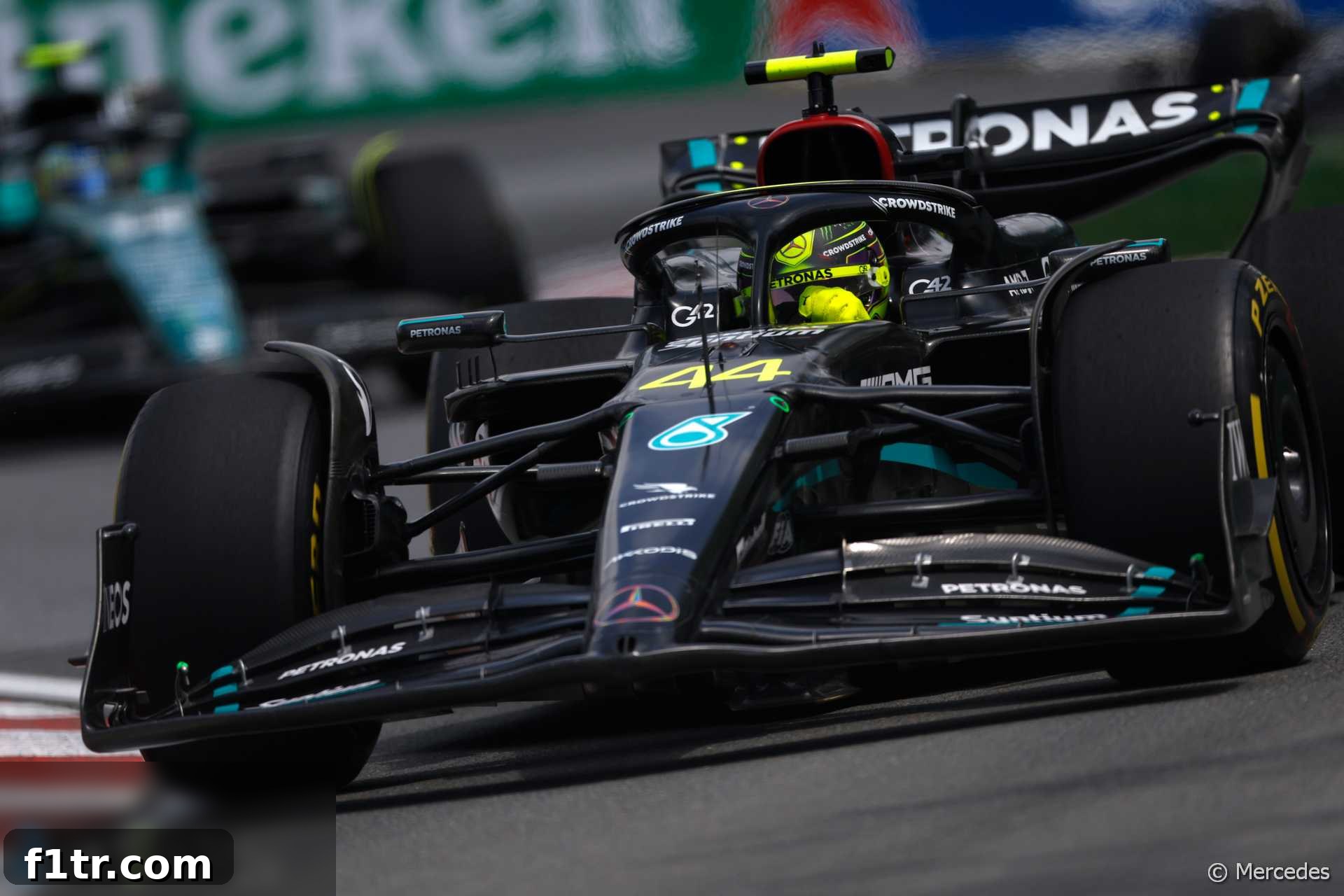
Mercedes F1’s Ambitious Recovery: Targeting Race Wins and Strategic Excellence
Mercedes-AMG Petronas Formula 1 Team is once again setting its sights on a monumental recovery, aiming to cap off the 2023 season with a race victory. This goal echoes their impressive turnaround in the previous year, where the initially challenging W13 chassis was transformed into a competitive machine by season’s end, culminating in a memorable win for George Russell at the penultimate round in Brazil.
The dawn of the 2023 season brought with it renewed optimism within the Mercedes camp, fueled by the momentum of their late-2022 resurgence. However, the initial performance of the new W14 chassis proved to be a significant hurdle, leaving the team trailing behind rivals. Recognising the need for a fundamental shift, Mercedes promptly embarked on a critical new development direction. This strategic pivot led to the introduction of a major upgrade package at the iconic Monaco Grand Prix, a turning point that has since demonstrably improved the team’s on-track performance and overall competitive standing.
The W14’s Evolution: From Struggle to Podium Contention
The early phase of the 2023 Formula 1 season presented considerable challenges for Mercedes. The W14, despite its predecessor’s late-season success, struggled with fundamental balance issues, unpredictable handling, and a persistent lack of outright pace, particularly in certain cornering conditions. This forced the team to re-evaluate their design philosophy and commit to a substantial mid-season development program. The fruits of this intensive labor began to emerge with the comprehensive upgrade package rolled out at the Monaco Grand Prix. This wasn’t merely an incremental update; it represented a strategic re-imagining of key aerodynamic and mechanical elements, significantly altering the car’s characteristics and unlocking greater performance potential.
Since the Monaco developments, the W14 has shown a marked improvement, consistently demonstrating stronger pace and greater stability across a variety of circuits. This enhanced performance has propelled Mercedes back into regular contention for podium finishes, a crucial step towards their ultimate ambition. Mike Elliott, Mercedes’ Chief Technical Officer, articulated the renewed optimism within the team in a recent video, stating, “It’s really nice to be now racing at least for podiums, being able to show what we’re capable of doing.” This sentiment underscores a shift in mindset, from problem-solving to actively competing at the sharp end of the grid, a testament to the dedication and expertise of the entire Mercedes engineering team.
Chasing Victories: The Road Ahead for Mercedes
While consistently challenging for podiums is a significant achievement given their early-season difficulties, the ultimate goal for a team of Mercedes’ caliber remains race victories. Elliott’s remarks confirm this ambition, as he expressed hope that the team can “turn that into more upgrades, more performance over the races to come and hopefully start fighting for some victories by the end of the season.” This outlook reflects a strategic pathway where continuous development and fine-tuning are expected to bridge the remaining gap to the dominant front-runners. The team understands that transitioning from consistent podium finishes to outright wins requires not just incremental gains but a holistic improvement in qualifying pace, race management, and strategic execution.
Achieving a race win in the highly competitive landscape of Formula 1, particularly against a formidable competitor like Red Bull Racing, demands peak performance from every aspect of the operation. Mercedes’ pursuit of victory also carries significant implications for the Constructors’ Championship, where every point is vital. Their focus now shifts to maximizing the W14’s potential on circuits that inherently suit its strengths, a strategy crucial for capitalizing on any opportunity that may arise in the latter half of the season. This strategic approach highlights Mercedes’ methodical planning and their commitment to returning to the pinnacle of Formula 1 success.
Key Venues: Austria and Silverstone Offer New Opportunities
Looking ahead, Mike Elliott highlighted two specific circuits on the Formula 1 calendar where the W14 is anticipated to perform particularly well: the Red Bull Ring, host of the upcoming Austrian Grand Prix and its sprint race, and Silverstone, home to the British Grand Prix a week later. Elliott explained the rationale behind this optimism: “I think where we’ve seen the car struggling is more the low-speed corners. So if we start looking at circuits that’ve got more medium and high-speed content, I think we’ll do better there.” This crucial insight points to the W14’s improved aerodynamic efficiency and stability at higher speeds, characteristics that are essential for success at these two legendary venues.
The Red Bull Ring, nestled in the picturesque Styrian mountains, is characterized by its relatively short lap and a series of high-speed straights interspersed with medium to high-speed corners. Its undulating nature and fast transitions demand a car with strong traction and excellent aero balance, areas where the updated W14 is expected to shine. The circuit’s fewer slow-speed chicanes play directly into Mercedes’ current strengths, offering a prime opportunity to demonstrate their enhanced competitiveness and potentially challenge for a top step on the podium.
Following Austria, the championship moves to the iconic Silverstone Circuit, a track revered for its relentless high-speed corners such as Maggotts, Becketts, and Chapel. Silverstone is often considered a true test of a Formula 1 car’s aerodynamic prowess and mechanical grip. The circuit’s flowing layout and emphasis on sustained high-speed performance make it a natural fit for a car that thrives in medium and high-speed sections. For Mercedes, their home Grand Prix at Silverstone presents an ideal stage to showcase the W14’s evolved capabilities and potentially deliver a strong result in front of their passionate British fanbase. The contrasting demands of these two circuits, both leaning towards higher-speed characteristics, provide Mercedes with a critical window to validate their development trajectory and push for their elusive first win of the season.
Canadian Grand Prix: A Deep Dive into Strategy
The recent Canadian Grand Prix provided a stern test of strategic acumen, with Lewis Hamilton ultimately securing a strong third-place finish after starting P2 and briefly leading. Despite his impressive drive, the team’s chief technical officer, Mike Elliott, offered a detailed post-race analysis of their strategic choices, particularly regarding Hamilton’s two pit stops. The initial assessment suggested that a conventional one-stop strategy would have been optimal for a ‘normal race’ at the Circuit Gilles Villeneuve, given the track’s characteristics and tyre degradation rates.
However, the intervention of an early Safety Car period, triggered by George Russell’s incident, dramatically altered the strategic landscape. This pivotal moment forced teams to reassess their options. Elliott explained the two primary alternatives considered by Mercedes under the Safety Car. The first involved pitting Hamilton early for a set of hard tires and then attempting to complete an extremely long second stint to the flag. Mercedes’ analysis, however, indicated that this approach would have led to “far too much degradation,” leaving Hamilton “vulnerable to cars from behind later in the race.” The risk of losing track position and pace towards the end of the Grand Prix made this option unviable for a top result.
The second alternative was to emulate Ferrari’s strategy with Charles Leclerc, which involved staying out under the Safety Car and pitting much later in the race, effectively running a significantly longer first stint. While this strategy proved effective for Ferrari, allowing them to jump cars stuck in a DRS train and then utilize their inherent pace, Elliott contended that it would not have worked for Mercedes. “For us, if we’d have stayed out, I think we’d have just been vulnerable to the cars around us and we wouldn’t have ended up in a better place overall.” This assessment suggests that Mercedes might not have had the same raw pace advantage in clear air as Ferrari, or perhaps that Hamilton’s specific track position at the time would have exposed him to more risk. Ultimately, the team’s decision to pit Hamilton for fresh tires, even if it meant an extra stop, was deemed the most robust strategy to secure a podium finish given the evolving race conditions and the competitive environment. This highlights the complex, real-time decision-making process that defines success in Formula 1 strategy.
The Path Forward: Sustained Development and Strategic Precision
Mercedes’ journey through the 2023 Formula 1 season is a compelling narrative of resilience, adaptation, and unwavering ambition. From the initial struggles with the W14 to the significant strides made through strategic development, the team has consistently demonstrated its capability to evolve and improve. The focus on maximizing performance at upcoming circuits like the Red Bull Ring and Silverstone, coupled with their meticulous post-race strategic analyses, underscores a comprehensive approach to reclaiming their position at the very front of the grid.
While the dominance of Red Bull Racing remains a formidable challenge, Mercedes’ trajectory suggests they are firmly on course to challenge for race victories. The synergy between their robust development program, epitomized by the Monaco upgrades, and the strategic precision of their pit wall will be crucial in the remaining races. As the season progresses, all eyes will be on Lewis Hamilton and George Russell as they push the W14 to its limits, striving to deliver on the promise of a triumphant return to the top step of the podium and solidify Mercedes’ standing as a premier force in Formula 1.
Related 2023 F1 Season Articles
- FIA president cleared of alleged interference in two 2023 races
- First week viewing figures for new Drive to Survive season fall again
- Max who? Drive to Survive season six prefers its favourite faces
- RaceFans’ complete 2023 season review
- The F1 drivers who pulled off the 10 biggest charges through the field in 2023
Browse all 2023 F1 season articles