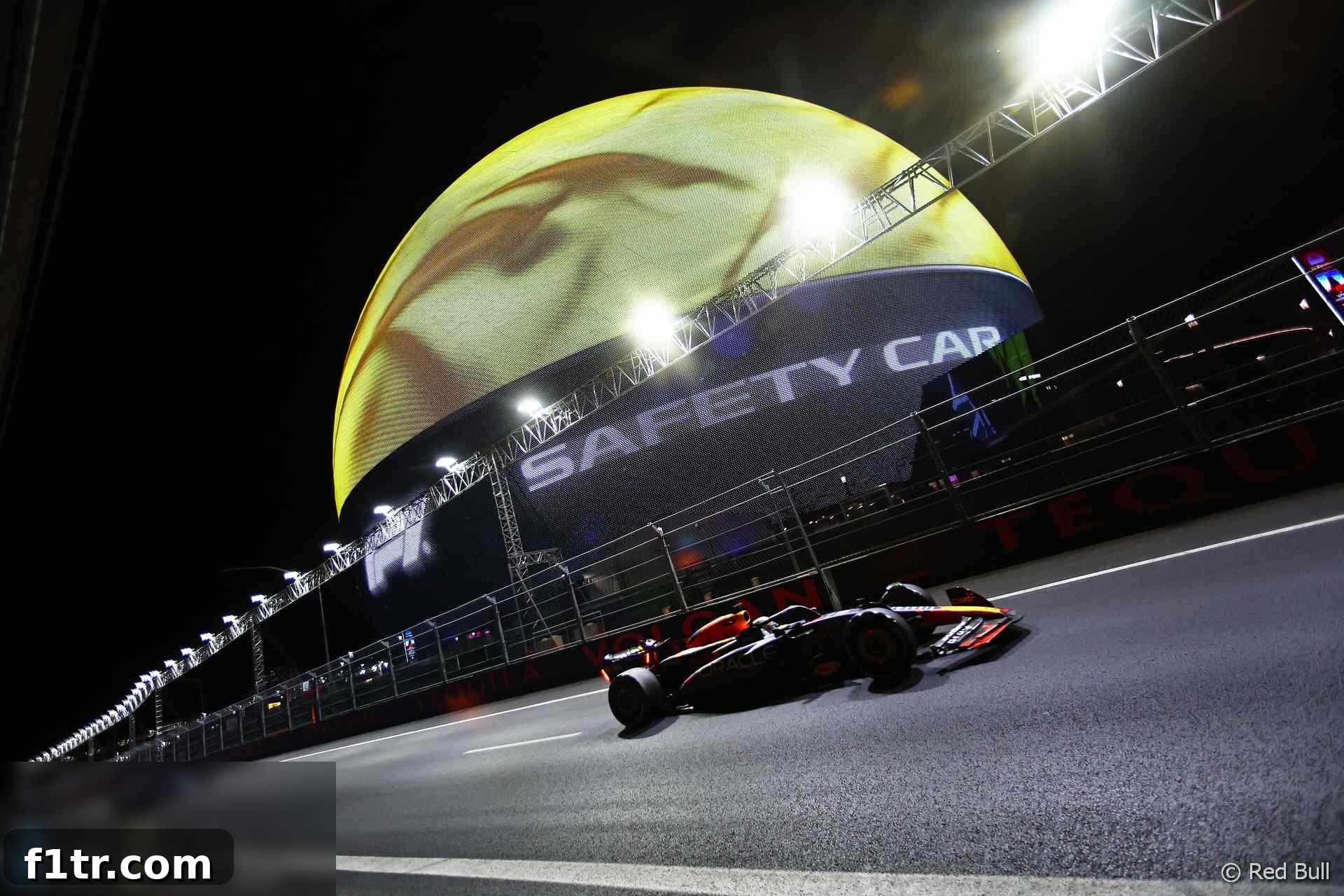
When Formula 1 announced its triumphant return to Las Vegas after a four-decade hiatus, promising what many anticipated would be the championship’s most ambitious street race yet, the imagination immediately conjured images of Sin City’s iconic landmarks. The dazzling lights of the world-renowned Las Vegas Strip, the mesmerizing dance of the Bellagio fountains, the grandeur of Caesars Palace, the colossal presence of the MGM Grand, and a myriad of other neon-lit casinos were all expected to form the breathtaking backdrop for this spectacular event. Yet, amidst this familiar panorama of glamour and excess, an entirely new and utterly unforgettable feature emerged, capturing the lion’s share of attention during the inaugural 2023 race weekend: the awe-inspiring, 112-meter-tall, globe-shaped entertainment complex known simply as ‘the Sphere.’
Advert | Become a Supporter & go ad-free
Having opened its doors just weeks before the much-anticipated race, this architectural marvel, a staggering $2.8 billion investment, strategically positioned itself adjacent to the race track near the turns seven and eight chicane. The Sphere stands as an unmissable landmark, a testament to cutting-edge design and engineering. Its external display, famously dubbed the ‘exosphere,’ is constructed from approximately 54,000 square meters of high-resolution LEDs, making it the single largest LED screen on the planet. This colossal canvas allows for an endless array of elaborate animations, dynamic video content, and impactful advertisements to be beamed across the city skyline, transforming it into the ultimate multi-purpose billboard for Formula 1’s premier night race, elevating the spectacle to unprecedented levels.
A Dynamic Canvas: The Sphere’s Role in the Grand Prix Experience
Race organizers wasted no time in fully leveraging the Sphere’s unique capabilities, transforming it into an integral part of the Grand Prix experience. During the event, the exosphere became a dynamic display, showcasing various F1-themed visuals. Most notably, it adopted the form of a whimsical yellow cartoon face, adorned with the helmet designs of different drivers. As the cars sped past, the eyes of this digital persona would playfully ‘follow’ the drivers, creating an immersive and interactive visual spectacle for both those at the track and the global television audience. Such was the sheer scale and luminosity of the Sphere that it remained visible from nearly every grandstand seat, particularly those lining the final corner and the approach to turn one. For the thousands of fans who invested significant sums to witness the race live, the Sphere was an undeniable focal point, captivating their attention whether it was featured on the world feed coverage or not.
Beyond the race visuals, the Sphere also served as a central hub for fan engagement. An entire section of the circuit grounds, aptly named the T-Mobile Zone, was established just outside the structure. Here, ticket holders could immerse themselves in a vibrant atmosphere, enjoying live music performances and a host of other entertainment options that ran concurrently with the racing action. Furthermore, throughout the Grand Prix, the Sphere displayed critical race status updates with special graphics, clearly indicating significant events such as Safety Car deployments and the eagerly anticipated chequered flag signaling the end of the race. Yet, for much of the Grand Prix, its vast surface was also utilized for displaying high-impact advertisements for the event’s prominent sponsors, including global brands like Heineken, Paramount+, and Google Chrome, among others, demonstrating its versatility as a commercial platform.
Advert | Become a RaceFans supporter andgo ad-free
Distraction or Spectacle? Addressing Driver Concerns
One of the most pressing concerns leading up to the inaugural Las Vegas Grand Prix, particularly given the novelty of both the circuit and its audacious surroundings, was whether the giant, rapidly changing kaleidoscope of colors emitted by the Sphere would prove to be a significant distraction for the drivers on track. The question lingered: could such an enormous and dynamic visual element compromise safety or performance in a sport where milliseconds and laser-sharp focus are paramount?
Ahead of the weekend, then-AlphaTauri driver Daniel Ricciardo offered his perspective, acknowledging the undeniable presence of the structure: “It’s very obvious. It’s huge – we’re not going to miss it.” However, he quickly downplayed the potential for distraction during the heat of competition. “But truthfully, when you get in that kind of rhythm and in that zone, you’re aware of everything, but you don’t really notice it – well, maybe you notice it, but it doesn’t kind of spark your awareness to a point where it’s actually affecting what you do.” This sentiment reflects the extraordinary concentration required of Formula 1 drivers, who are adept at filtering out ambient stimuli to maintain their focus on the track ahead.
Proactive measures were also implemented by race organizers to mitigate any potential risks. Even before drivers took to the Las Vegas Strip Circuit, it was announced that certain colors—specifically yellow, red, and green—would be deliberately avoided on the Sphere’s exosphere during active racing sessions. This crucial decision was made to minimize any risk of drivers instinctively reacting to what they might mistakenly perceive as official flag signals, which could create a dangerous and confusing situation on track. Once the racing commenced and the practice sessions, qualifying, and the Grand Prix itself unfolded, there were no reported complaints from drivers regarding the animations or brightness of the Sphere causing a distraction in the cockpit. The world’s elite drivers, true to their reputation, demonstrated their exceptional skill in maintaining unwavering focus, proving that the Sphere, while a grand spectacle, did not impede their primary objective of competitive racing.
The Green Debate: Energy Consumption and F1’s Sustainability Goals
While the Sphere’s visual impact is undeniably captivating, the sheer amount of energy required to power such a colossal structure is equally, if not more, eye-watering. The exosphere alone is composed of 1.2 million individual LED pucks, each containing 48 LED diodes. The interior screen, which is the primary attraction of the entertainment venue for its immersive experiences, relies on an advanced computing infrastructure, famously utilizing 150 Nvidia RTX A6000 GPUs, each boasting 48 gigabytes of memory, to render its breathtaking displays. All this cutting-edge, light-generating hardware demands a considerable power supply to operate effectively.
Reports indicate that a peak load of approximately 28 megawatts is required to operate the Sphere, a figure roughly equivalent to the power consumption of over 20,000 average American homes simultaneously. This substantial energy demand inevitably sparks discussions regarding sustainability, particularly when the Sphere is intertwined with events like the Formula 1 Grand Prix, which itself is on a dedicated path toward environmental responsibility.
The Sphere’s operating company acknowledges these concerns and has outlined its commitment to sustainability. They estimate that around 70% of the power consumed by the Sphere is sourced from “dedicated solar and battery resources,” aiming to minimize reliance on non-renewable energy. Furthermore, the company asserts that the Sphere utilizes “the most energy-efficient lighting available” and actively engages in voluntary purchases of carbon credits to “mitigate the impact of all non-renewable sources of power” used in its operations. These efforts demonstrate a recognition of their significant environmental footprint and a proactive approach to address it.
Formula 1, too, has made significant strides and commitments in its own sustainability journey, prominently advertising its ‘Net Zero 2030’ initiative. This ambitious goal aims to achieve net zero carbon emissions “from factory to flag” across all its operations by the 2030 season. Concrete steps have already been taken, including carbon-neutral television broadcasts of events like the British Grand Prix in 2021 and 2022, a transition to entirely renewable energy sources at F1’s main headquarters, and a strong push to introduce a “100% sustainable fuel” in the next generation of F1 power units slated for 2026. The organizers of the Las Vegas Grand Prix echo these sentiments, stating that reducing the event’s carbon footprint is fundamental to their operational philosophy, and they are “fully committed” to aligning with F1’s overarching net-zero objective. Last year, the event also piloted an innovative water conservation scheme, deploying new technology to capture atmospheric moisture and convert it into potable drinking water, showcasing a holistic approach to environmental stewardship.
The debate over whether the Sphere’s substantial energy consumption aligns perfectly with these ambitious sustainability goals remains an ongoing point of discussion. However, it is crucial to recognize a fundamental distinction: the Sphere is not an intrinsic part of F1’s Las Vegas infrastructure. Therefore, its operational carbon emissions do not directly contribute to the official carbon footprint calculated for the Formula 1 event itself, unlike, for example, the energy consumed by the temporary lighting installations specifically erected to illuminate the race track. This nuanced separation highlights the complexities of assessing environmental impact in a shared urban environment.
Advert | Become a RaceFans supporter andgo ad-free
A Permanent Fixture: The Sphere’s Enduring Presence in F1’s Night Sky
Despite not being directly owned or operated by Formula 1, the Sphere has firmly established itself as an enduring and captivating element of the Las Vegas Grand Prix. Its unique presence ensures it will remain a significant talking point and a visual icon for as long as the event holds its coveted spot on the Formula 1 calendar. The relationship between F1 and the Sphere is envisioned to be a long-term partnership, promising increasingly integrated and elaborate activations in the years to come.
Greg Maffei, F1’s outgoing CEO, articulated this vision during last year’s Las Vegas Grand Prix, stating, “We have a long-term relationship with the Sphere, and I think we will have more programming in place.” He acknowledged that the inaugural year presented unique challenges: “Partly because we didn’t know if the Sphere would be done, and partly we were hustling to get ourselves done, that combination made it hard to programme for this year [2023].” However, Maffei’s forward-looking statement underlined a clear intent for deeper collaboration, anticipating a more expansive and creative integration. “But I think in future years, we’ll have a lot more going on.”
While specific details regarding future displays and animations for upcoming events remain under wraps, it is highly anticipated that the Sphere will continue to evolve its engagement with the Grand Prix. This could include even more sophisticated driver-specific visuals, enhanced race information displays, innovative sponsor activations, and perhaps bespoke artistic content that celebrates both the spirit of Formula 1 and the unique allure of Las Vegas. The Sphere’s unprecedented blend of technology, art, and entertainment guarantees its ongoing status as a major talking point and an unforgettable backdrop, cementing its place as a defining feature of the Las Vegas Grand Prix for the foreseeable future, adding an unparalleled dimension to the sport’s global spectacle.
Pictures: The Las Vegas Grand Prix sphere in 2024
Miss nothing from RaceFans
Get a daily email with all our latest stories – and nothing else. No marketing, no ads. Sign up here:
Advert | Become a RaceFans supporter andgo ad-free
Formula 1
- Exploring the Latest Innovations in F1 Technology
- The Evolution of Grand Prix Circuits: From History to Modern Design
- Driver Insights: The Mental Fortitude Required for Formula 1 Racing
- F1’s Global Footprint: Expanding Horizons and New Races
- Sustainability in Motorsport: F1’s Vision for a Greener Future
Browse all Formula 1 articles