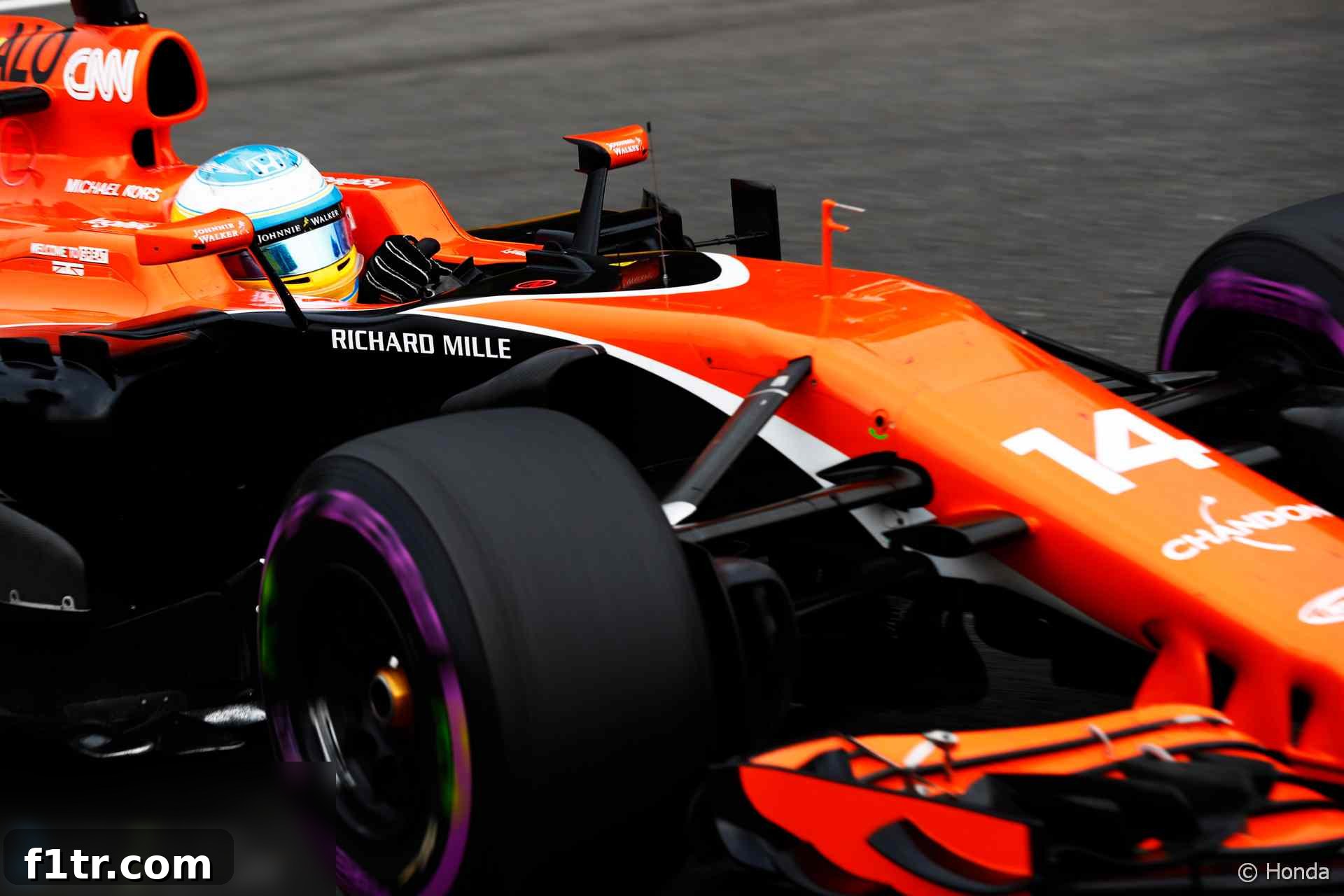
Fernando Alonso’s Frustrating Belgian Grand Prix Retirement: A Glimpse into McLaren’s 2017 Struggles
The 2017 Formula 1 season was a particularly challenging period for the McLaren racing team, primarily due to persistent reliability and performance issues with their Honda power units. This underlying frustration was vividly encapsulated during the Belgian Grand Prix at the iconic Spa-Francorchamps circuit. Two-time world champion Fernando Alonso, a driver globally renowned for his exceptional talent and relentless competitive spirit, found himself locked in a battle not just with his on-track rivals but also with the inherent limitations of his own machinery. His eventual retirement from the race, punctuated by a series of increasingly despondent and blunt radio messages, served as a potent symbol of McLaren’s struggles and intensified existing questions about Alonso’s long-term future in the sport.
Advert | Become a Supporter & go ad-free
A Race Derailed: The Inescapable Power Unit Woes at Spa
Fernando Alonso’s weekend at Spa-Francorchamps began with fleeting moments of optimism, yet these quickly dissipated under the harsh realities of the V6 turbo-hybrid era. The legendary circuit’s expansive straights, most notably the fearsome Kemmel Straight, unforgivingly highlighted the Honda engine’s significant power deficit when compared to its Mercedes, Ferrari, and Renault counterparts. Despite executing a masterful start that propelled him several positions forward in the chaotic opening lap, Alonso’s McLaren MCL32 simply lacked the raw pace to contend with the more powerful machines surrounding him.
Throughout the duration of the race, Alonso’s radio communications painted a compelling and unfiltered picture of a driver pushed to his absolute limits. His tone perceptibly shifted from initial determination to one of escalating exasperation as car after car effortlessly overtook him. Following the race, Alonso unequivocally confirmed the precise cause of his eventual retirement, stating directly to assembled journalists: “It was a problem, an engine problem. We lost the power unfortunately.” This straightforward confirmation served to underscore the chronic and systemic issues that plagued the McLaren-Honda partnership, rendering any genuine hopes of scoring championship points an increasingly distant and unattainable objective for the highly decorated Spaniard.
“It was a difficult race, maybe the points were impossible today,” Alonso conceded, reflecting with a hint of resignation on the inherent performance limitations he faced. “Let’s see what we can do next week.” His immediate professional focus, even amidst such overwhelming adversity, turned to the upcoming Grand Prix, a testament to his unwavering professional resilience. However, the disheartening and recurring nature of these power unit failures was undoubtedly taking a significant toll on his morale, further fueling widespread speculation regarding his long-term commitment to the Woking-based team.
Alonso’s Future: A Looming Question Mark Over His McLaren Tenure
The 2017 season was a pivotal period for Fernando Alonso, with his existing contract at McLaren nearing its expiration at the conclusion of the year. The constant struggles, particularly the glaring unreliability and lack of performance from the Honda engine, cast a formidable shadow over his decision-making process concerning his future. Despite the disheartening on-track performance, Alonso publicly maintained a degree of loyalty and respect, acknowledging the team’s rich historical significance and its inherent potential. “I think we will see what happens in the next couple of weeks,” he cautiously remarked, deliberately keeping his options open for a potential move.
“I’m happy with the team,” he affirmed, even in the face of the undeniable and persistent difficulties they encountered. “I think we are having tough seasons so far in the last three. But McLaren is one of the best teams in the world, I will be happy to keep working with them, but we need to see how things will evolve in the next couple of weeks.” This carefully worded statement perfectly encapsulated the deep-seated dilemma confronting Alonso: a world-class driver, striving to compete at the very front of the grid, deeply connected to a historically revered racing team, yet continually let down by its fundamental technical package. His words carried a clear implication of a conditional willingness to remain with the team, contingent upon significant and demonstrable improvements and a much clearer strategic path towards sustained competitiveness. The underlying message was unmistakable: McLaren needed to present a credible and viable plan for moving forward, especially concerning its engine supplier, if it harbored any hope of retaining its highly sought-after star driver.
Advert | Become a RaceFans supporter andgo ad-free
Moments of Profound Frustration: Alonso’s Memorable Belgian Grand Prix Radio Messages
The broadcast radio messages from Fernando Alonso during the 2017 Belgian Grand Prix offered a rare and unfiltered window into the psyche of a top-tier athlete grappling with profound and systemic underperformance. Following an initially impressive first lap that saw him surge to seventh position, the car’s inherent lack of power inevitably led to him being systematically overtaken by Nico Hulkenberg and a succession of other cars, inexorably pushing him out of the points-paying positions. These candid exchanges with his race engineer vividly highlighted the escalating despair and the stark, crushing reality of McLaren’s difficult situation. Here’s a closer examination of some of those highly telling communications before his ultimate retirement from the race:
Alonso: “Embarrassing, really embarrassing.”
Engineer: “Yep Fernando we see that. Be careful, we have two warnings for turn four.”
This early exchange captures Alonso’s immediate and acute disappointment. For a driver of his extraordinary caliber, being so easily passed and rendered virtually defenseless against rivals was not merely frustrating but genuinely humiliating. The engineer’s subsequent response, which focused on track limits, appeared almost trivial and inconsequential in the face of Alonso’s broader and more significant point regarding the car’s pervasive lack of performance.
Engineer: “Magnussen is 1.2s behind Grosjean.”
Alonso: “I really don’t care about all the gaps too much. This is just a test.”
Arguably the most memorable and widely quoted line from that particular race, Alonso’s blunt dismissal of tactical information, famously stating “This is just a test,” perfectly encapsulated his profound disillusionment. He clearly felt that the race had ceased to be a genuinely competitive event and had instead devolved into little more than an extended data-gathering exercise for a car fundamentally lacking competitive pace. It was a stark and powerful admission that McLaren was so far off the competitive mark that typical strategic intricacies felt entirely irrelevant to him.
Engineer: “Fernando suggest shape four to protect the rears.”
Alonso: “No more radio for the rest of the race.”
This technical instruction from the engineer, aimed at managing tire wear, was met with an unprecedented and remarkably defiant demand from Alonso. His “no more radio” comment was a crystal-clear indication of his mental exhaustion and a fervent desire to be left in silence to contend with his struggles. It was more than a mere refusal to engage; it was a desperate plea for respite from the constant, yet ultimately unhelpful, stream of information.
Engineer: “Fernando, Stoffel is pitting this lap.”
Alonso: “Why? The only [censored by FOM] car that I will overtake.”
Engineer: “Fernando we didn’t want to be pushed back into Hulkenberg and Stroll. Sorry, Palmer and Stroll.”
Alonso: “They will pass me in the next lap. I have no protection now. But anyway it doesn’t change my life.”
The palpable anger and frustration evident in this exchange are unmistakable. Stoffel Vandoorne, Alonso’s teammate, was often the sole car he could realistically compete with or hope to overtake on track. The strategic decision to pit Vandoorne, likely intended to avoid an undercut from rivals or to manage tire degradation, inadvertently removed Alonso’s only tangible on-track “target.” His subsequent cynical remark, “it doesn’t change my life,” underscored the profound sense of apathy and resignation that had irrevocably set in regarding the ultimate outcome of the race.
Alonso: “Any rain expected?”
Engineer: “No, no rain on the radar.”
This hopeful query for rain was a desperate, last-ditch attempt to find an unpredictable element that might level the playing field. Inclement weather often introduces an element of chaos that can diminish the importance of raw engine power, instead rewarding exceptional driver skill. The engineer’s definitive “no” swiftly extinguished any remaining flicker of hope for a miracle scenario that could have altered the course of his race.
Alonso: “Engine problem. Engine problem.”
Engineer: “Yeah let’s box to retire the car.”
The final and conclusive exchange confirmed the inevitable. Alonso’s concise declaration of “Engine problem” was less a question seeking clarification and more a definitive statement of an unarguable fact, a profound resignation to the mechanical failure that had regrettably plagued his entire season. The engineer’s subsequent instruction to “box to retire” irrevocably sealed the fate of his Belgian Grand Prix, bringing an abrupt end to a race that had ultimately been less about direct competition and far more about sheer survival.
The Wider Context: McLaren-Honda’s Annus Horribilis
Fernando Alonso’s highly visible frustration at Spa was not an isolated incident but rather a deeply recurring theme that permeated the entirety of the 2017 season. The McLaren-Honda partnership, then in its third year, was widely anticipated to demonstrate significant progress and a return to competitiveness. Instead, it delivered a relentless litany of reliability failures, grid penalties, and agonizingly slow performances. The Honda power unit consistently struggled with both its inherent reliability and its outright power output, perpetually leaving McLaren at a significant disadvantage, especially on power-sensitive circuits such as Spa. This continuous and profound underperformance led to mounting pressure on both Honda and McLaren, ultimately culminating in the termination of their engine supply agreement at the end of the season.
For a driver of Fernando Alonso’s extraordinary pedigree, who had previously clinched two Formula 1 World Championships and competed consistently at the very pinnacle of global motorsport, these particular years were undeniably trying. His exceptional talent frequently shone through in qualifying sessions or in moments of opportunistic racing, yet the car’s fundamental limitations rendered consistent point-scoring, let alone podium finishes or race victories, an insurmountable impossibility. His public expressions of discontent, though occasionally controversial, were entirely understandable reflections of a fiercely competitive individual who found himself trapped within the confines of an uncompetitive and unreliable machine.
Advert | Become a RaceFans supporter andgo ad-free
2017 Belgian Grand Prix: Further Insights and Analysis
For more detailed coverage and in-depth analysis of the 2017 Belgian Grand Prix, we invite you to explore the following comprehensive articles:
- 2017 Belgian Grand Prix team radio transcript
- 2017 Belgian Grand Prix Predictions Championship results
- 2017 Belgian Grand Prix Star Performers
- “That’s a BS call”: 2017 Belgian GP team radio highlights
- Hamilton equals Schumacher’s pole record with 41 races to spare
Browse all Belgian Grand Prix articles