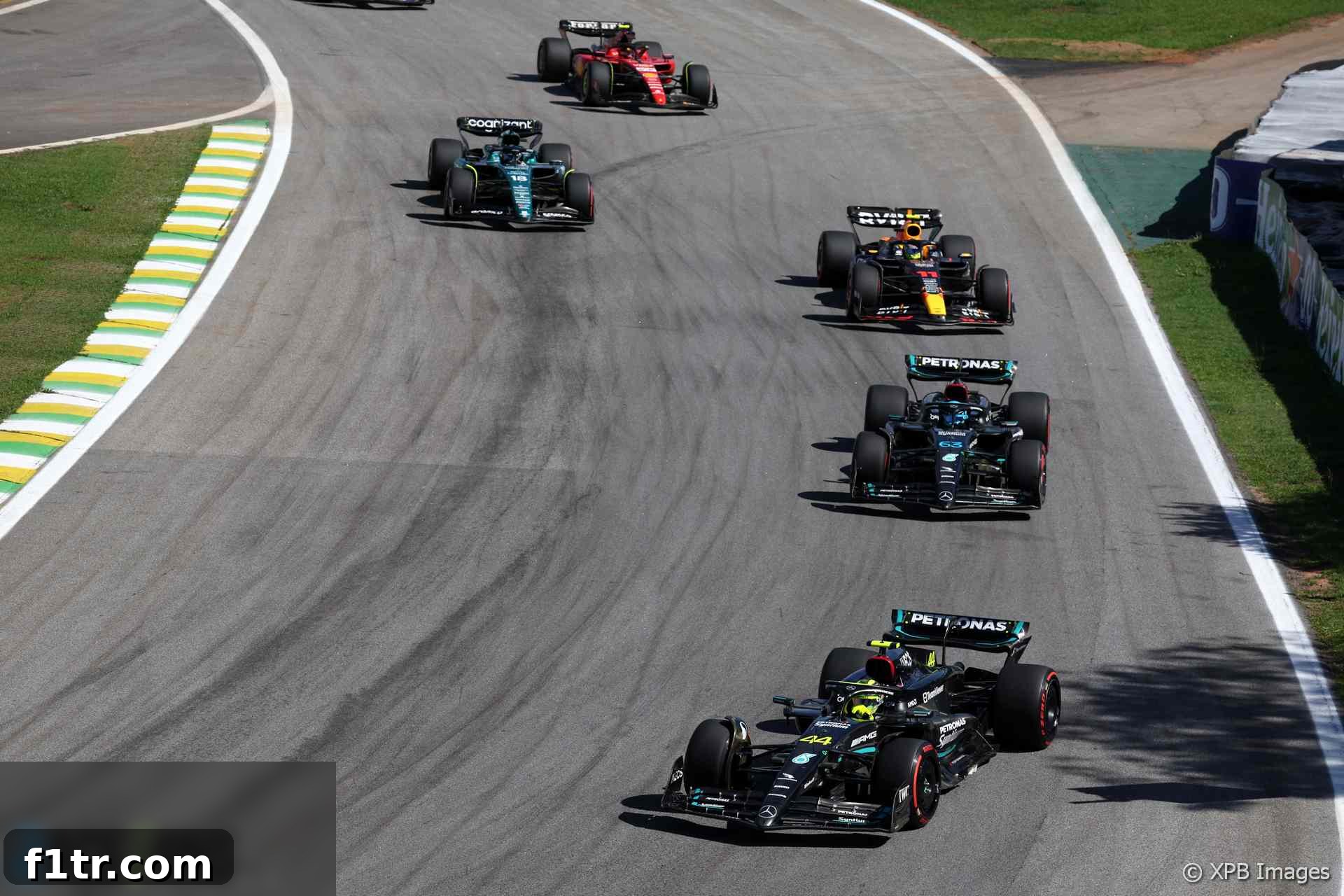
In a candid reflection following what Mercedes team principal Toto Wolff described as their “worst weekend for 13 years” at the Brazilian Grand Prix, the Austrian boss firmly stated that his primary concern lay not with George Russell’s frustrated radio complaints but with the fundamental and alarming lack of pace displayed by the W14 car. The tumultuous Interlagos weekend saw Lewis Hamilton salvage a disappointing eighth place, while his teammate Russell was forced to retire after 57 laps due to critical overheating issues, compounding a truly miserable outing for the Silver Arrows.
The São Paulo circuit, historically a strong venue for Mercedes, instead became the backdrop for a stark performance crisis. For a team accustomed to consistent victories and championship battles, such a dismal showing, particularly after a season fraught with developmental challenges and fluctuating form, sent ripples of concern through their headquarters. Wolff’s declaration underscored a deeper, more systemic problem that overshadowed any individual driver’s on-track grievances.
Mercedes’ Interlagos Nightmare: A Deeper Look at the Performance Crisis
The 2023 Brazilian Grand Prix unfolded as a stark reminder of Mercedes’ struggles to consistently challenge at the very front of the Formula 1 grid. The W14, a car that had shown glimmers of promise at various points in the season, particularly during mid-season upgrades, failed spectacularly to perform on the high-energy Interlagos track. This lack of inherent speed and stability was the true elephant in the room, far more critical than any heated exchange between driver and pit wall.
Wolff articulated his perspective unequivocally, dismissing the radio exchanges as a “complete sideshow.” He explained, “I think the race [management] and the messages for us today are completely irrelevant. There was nothing to manage or nothing to say, it’s a complete sideshow. I think the fundamental issue is that the car was slow.” This powerful statement laid bare the core problem: a car that simply wasn’t competitive. For a top-tier F1 team, having a slow car is the ultimate indictment, rendering discussions about strategy or driver communication secondary.
The team’s performance deficit was profound. Hamilton, a seven-time world champion renowned for his ability to extract every ounce of performance from his machinery, could only manage eighth, struggling with grip and balance throughout the race. Russell’s fate was even harsher, succumbing to an overheating power unit that prematurely ended his race. The confluence of poor pace, tire management issues, and reliability concerns painted a grim picture for Mercedes, prompting Wolff to label it their worst performance in over a decade.
George Russell’s Frustrations: The Unavoidable Radio Drama
While Toto Wolff may have downplayed their significance, the radio messages from George Russell offered a raw, unfiltered glimpse into the pressures and frustrations experienced by a top-flight racing driver when their car underperforms. For much of his race, Russell found himself trapped behind his teammate, Lewis Hamilton, a situation that severely compromised his ability to manage his tires and extract pace. This scenario was not entirely new, following similar communication in the Japanese Grand Prix and a notable collision between the pair in Qatar, indicating a recurring dynamic within the team.
Russell’s complaints, broadcast on the world feed, highlighted the critical importance of a cohesive team strategy, especially when fighting for marginal gains. Early in the restarted race, with Russell running directly behind Hamilton, his plea was clear: “Let’s work together. I won’t attack in these early laps, but I’ll need DRS.” This message underscored his initial hope for a cooperative effort to pull away from the pack and potentially challenge for higher positions, leveraging the aerodynamic tow (DRS) effect.
However, as Hamilton focused on maintaining pace with Fernando Alonso’s Aston Martin ahead, Russell’s situation became increasingly precarious. His exchanges with race engineer Ricardo Musconi revealed a growing sense of desperation:
Russell: “Make sure he doesn’t go outside of DRS.”
Musconi: “He’s trying to get DRS off Alonso as well.”
This initial exchange highlighted the classic F1 dilemma: both drivers needed DRS, but being the second car in a train meant Russell was at a significant disadvantage, struggling to stay within DRS range without overworking his tires and car. The situation escalated as Russell’s frustration mounted:
Russell: “If we’re going to work together he needs to manage more in [turn] 11. I’m having to push loads through there to stay in DRS.”
Musconi: “He’s been told to manage as well.”
Russell: “I’m having to push too hard in 11 and 12. I either overtake or he needs to manage more through there.”
These communications illustrate the precarious balance between individual racecraft and team strategy. Russell felt he was being forced to push his car beyond its optimal operating window simply to stay within a beneficial aerodynamic window, a scenario that is detrimental to tire life and overall race performance. His repeated calls for better management from Hamilton indicated a perceived lack of cooperation or understanding of his position.
Team Orders and the Overheating Crisis
Despite the radio exchanges, Mercedes did not implement traditional team orders to swap positions. Instead, their directive focused on a more pressing technical concern: temperature management. Both drivers were instructed to prioritize cooling, a clear sign that the W14 was operating at its absolute limits, or even beyond, in the Brazilian heat. This was a critical pivot, shifting the focus from strategic positioning to sheer survival of the power unit.
Russell’s subsequent radio messages reflected a deeper underlying issue—the car’s inherent lack of pace, irrespective of team strategy:
Russell: “My feeling is we don’t have the pace. I’m sliding.”
Russell: “Are we working together here or are we just doing our own race?”
These poignant questions from Russell encapsulated his despair. The sliding indicated poor grip and tire degradation, further cementing his belief that the car simply wasn’t fast enough. The query about “working together” revealed a potential breakdown in trust or understanding of the overall race plan.
As the race progressed, the critical overheating issues began to manifest more severely in Russell’s car:
Musconi: “We need more management turn 11 on throttle.”
Russell: “Do you want to race or concede positions? You want more management, or we go backwards.”
Musconi: “We do need to make sure these tyres make it through the stint. We do want to race, but we want to make it through the stint.”
This exchange highlighted the desperate juggling act faced by the team. They wanted to race competitively, but the car’s limitations forced them into a conservative management mode, effectively conceding performance. Russell’s direct challenge — “Do you want to race or concede positions?” — spoke volumes about the internal conflict between a driver’s instinct to push and the car’s physical boundaries.
After his first pit stop, Russell’s frustration reached a peak. Running once again close behind Hamilton, his final broadcast message painted a vivid picture of his predicament:
Russell: “I haven’t been on the radio because I thought it was quite obvious about the pace. I’m just sat here, burning my tyres.”
This statement, delivered with palpable exasperation, underscored the obvious performance deficit and the damaging effect on his tires from being stuck in turbulent air. Mercedes’ advice to seek clear air, while technically sound for cooling, was ultimately insufficient. A few laps later, Russell began suffering from de-rating – a loss of electrical power deployment – a direct precursor to his eventual retirement due to the severe overheating.
Wolff’s Leadership in Adversity: A Forward-Looking Perspective
Toto Wolff’s decisive stance—to focus squarely on the car’s lack of pace rather than the radio drama—revealed a leader steering his team through a profound engineering challenge. His comments were not merely dismissive of Russell’s frustration but were a clear directive to the entire Mercedes organization: the problem is fundamental, and it requires a fundamental solution. This approach aims to prevent distractions and channel all energy into understanding and rectifying the W14’s weaknesses ahead of the upcoming seasons.
The implications of such a “worst weekend” are far-reaching for Mercedes. Beyond the immediate disappointment, it necessitates a rigorous re-evaluation of their aerodynamic philosophy, power unit integration, and chassis design for the 2024 season and beyond. For a team that has set incredibly high standards for itself, the Brazilian Grand Prix served as a painful but perhaps necessary wake-up call, emphasizing that past glories mean little when current performance falters. The psychological impact on drivers and the broader team is undeniable, but Wolff’s leadership signals a clear path forward: diagnose the root cause, innovate, and return stronger.
The road ahead for Mercedes will undoubtedly be challenging. They face stiff competition and a constant battle for technological advantage. However, Wolff’s resolute focus on the core engineering problem—the “slow car”—is a testament to their commitment to excellence. The radio messages, while illuminating, are indeed a sideshow when compared to the monumental task of rebuilding a championship-contending package. Mercedes will be looking to transform this painful learning experience into a catalyst for a stronger, more competitive future in Formula 1.
2023 Brazilian Grand Prix
- Perez’s missed “open goal” in Miami was turning point in title fight – Horner
- F1 drivers insist new rules to prevent impeding in qualifying don’t work
- McLaren surprised by margin over rivals at track Norris thought would be “tough”
- “Follow Fernando’s line” – How Red Bull tried everything to get Perez past Alonso
- Mercedes’ Brazilian GP set-up was “conservative” after US GP disqualification
Browse all 2023 Brazilian Grand Prix articles