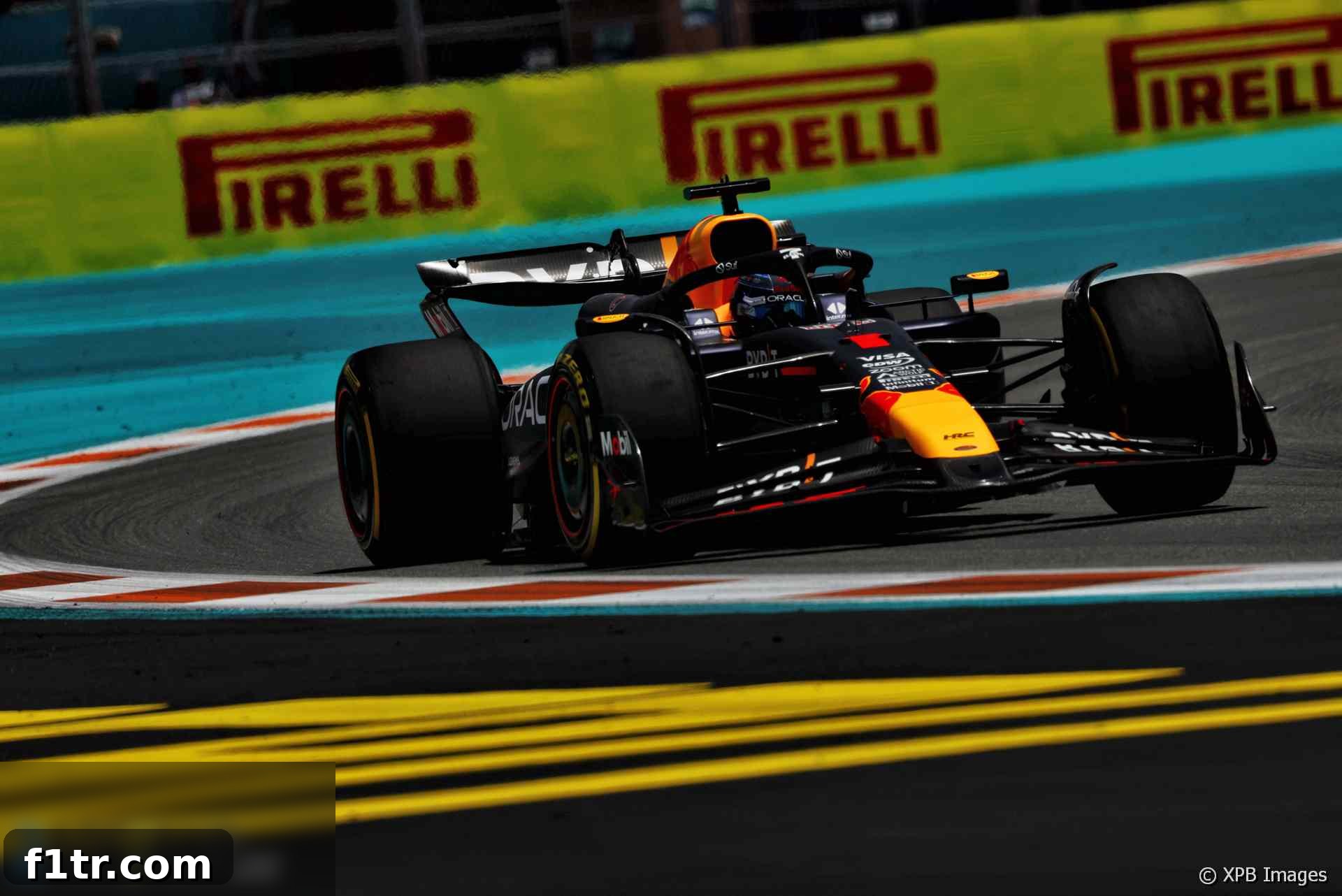
In a surprising twist at the Miami Grand Prix, reigning Formula 1 champion Max Verstappen secured pole position for Saturday’s sprint race despite admitting that his qualifying lap “felt pretty terrible.” The Red Bull driver, known for his relentless pursuit of perfection and often expressing clear confidence in his machinery, described an uncharacteristic struggle with his car’s handling, making his pole a testament to his sheer skill and adaptability under pressure.
The Dutchman claimed the coveted top spot for the sprint race by a narrow margin of just one-tenth of a second over Ferrari’s Charles Leclerc. However, watching his on-board camera during the decisive lap revealed a driver visibly wrestling with his RB20. This stark contrast between the outcome and the perceived performance immediately became a major talking point within the paddock and among fans alike, highlighting the fine margins and unpredictable nature of top-tier motorsport.
Verstappen’s pole-winning effort was far from clean. He encountered a significant snap of oversteer upon exiting the chicane – a critical section of the Miami International Autodrome – which visibly unsettled the car and cost him valuable time compared to his closest rival, Leclerc. Despite this momentary loss of control and the subsequent feeling of an uncooperative car, he managed to hold it together, ultimately crossing the line with the fastest time. His immediate radio communication with race engineer Gianpiero Lambiase painted a vivid picture of his dissatisfaction, as he flatly stated that the car felt “terrible,” underscoring the unexpected difficulty of his achievement.
Verstappen’s Uncomfortable Ride: A Deep Dive into Car Handling and Driver Feedback
Speaking to the media after the session, Verstappen elaborated on his frustrations, explaining that the car’s handling characteristics had undergone a dramatic transformation between the earlier free practice session and the crucial sprint qualifying. “To be honest with you, it felt pretty terrible,” he reiterated, emphasizing the extent of his discomfort. This shift in behavior is particularly perplexing for a team as meticulously prepared as Red Bull Racing and for a driver as attuned to his vehicle as Verstappen.
The challenges weren’t unique to Verstappen. A common theme among many drivers was the difficulty in adapting to the rapidly evolving track conditions and the switch from the medium-compound Pirelli tyres, used earlier in the session, to the softer compound for the final sprint qualifying segment (SQ3). These softer tyres, designed for ultimate grip over a single lap, often require a precise warm-up and delicate handling, which appeared to be elusive for many on the day.
“Maybe that last session was just incredibly difficult to get the tyres to work because already in SQ2 I didn’t feel great,” Verstappen commented, offering insight into the gradual decline in his confidence with the car. “In SQ3, I think it just felt quite similar for me. I didn’t really improve a lot on the softs, but somehow we were first.” His candid admission that the experience was “not enjoyable out there to drive for whatever reason” is striking, given his consistent dominance and apparent ease behind the wheel. He contrasted this with the practice session, where he felt “really, really nice. I was very comfortable and confident. Qualifying not so much.” This disconnect suggests either a fundamental setup issue that emerged, or an extreme sensitivity to track conditions that Red Bull hadn’t fully anticipated.
The Miami International Autodrome: A Circuit of Surprises
The Miami International Autodrome itself has a reputation for being a challenging and at times unpredictable circuit. Its temporary nature, combined with a street-style layout, can lead to varying grip levels across the asphalt, especially as rubber is laid down and temperatures fluctuate. The tight, low-speed sections interspersed with long straights demand a versatile car setup, often forcing teams to make compromises that might manifest as handling quirks under specific conditions, like the switch to soft tyres in a sprint qualifying format.
Verstappen’s surprise at securing pole position was further amplified by the fact that his fastest time was not the quickest overall lap recorded during the entire qualifying session. That honour went to McLaren’s Lando Norris, who set a blistering pace in SQ2 on the medium-compound tyres. The competitive landscape was incredibly tight, with the top ten drivers separated by just over eight-tenths of a second, underscoring the intense battle for every fraction of a second on track. In such close competition, even a perceived “terrible” lap can yield pole if rivals falter or struggle even more.
“It might be the track layout a little bit,” Verstappen mused, pondering the reasons behind the unusual session. “I thought after practice I was quite confident that we could really fight for pole. Then in qualifying, it didn’t really look like that for me, but somehow we still ended up in first. I don’t know what happened to the other cars on the last lap.” This introspection highlights the fine margins in Formula 1 and the often-unseen struggles that even the most dominant drivers face, suggesting that perhaps others encountered even greater difficulties in extracting performance from their soft tyres under the evolving conditions.
Implications for the Sprint Race and Main Grand Prix
While pole position for the sprint race is a significant achievement, the nature of Verstappen’s success raises questions about Red Bull’s underlying pace and the car’s behaviour heading into the longer races. If the car felt “terrible” on a single qualifying lap, maintaining consistent performance over a sprint race or, more critically, the full Grand Prix distance, could prove to be a stern test. Teams will be meticulously analysing data from this session to understand the nuances of tyre behaviour and car setup in Miami’s unique environment.
For Charles Leclerc and Ferrari, being just a tenth behind Verstappen, despite the Red Bull driver’s self-admitted struggles, offers a glimmer of hope. It suggests that on a good day, or if Red Bull fails to dial in their car for race pace, Ferrari could be in a strong position to challenge. Similarly, Lando Norris’s blistering SQ2 lap hints at the potential of the McLaren, especially if they can replicate that form consistently.
The Miami Grand Prix weekend promises to be an intriguing affair. Verstappen’s pole, born out of adversity and a surprising lack of comfort, adds an extra layer of narrative to the unfolding drama. Can he translate this hard-fought pole into a dominant sprint race victory, or will the underlying issues with the car’s handling manifest themselves over a longer run? The answers will undoubtedly unfold on the challenging streets of Miami, keeping fans on the edge of their seats.
His ability to extract pole position from a car he described as terrible serves as a powerful reminder of why Max Verstappen is a triple world champion. It underscores his unparalleled talent for finding the limit, even when the car is not cooperating, and his relentless determination to perform at the highest level regardless of the circumstances. As the paddock looks ahead to the sprint race and the main Grand Prix, the question remains: will Red Bull find a solution to Verstappen’s discomfort, or will he once again have to rely on his extraordinary driving to overcome the challenges presented by his own machinery and the fierce competition?
2024 Miami Grand Prix Related Articles
- McLaren had superior pace before Verstappen’s damage in Miami – Norris
- Sainz ‘struggles to understand’ why he got penalty when Perez didn’t
- Alonso’s unusual brake problem and more unheard Miami team radio
- McLaren’s Miami upgrade success points to even stronger form in coming races
- Norris expects more wins this year and believes “100%” in 2025 title bid
Browse all 2024 Miami Grand Prix articles