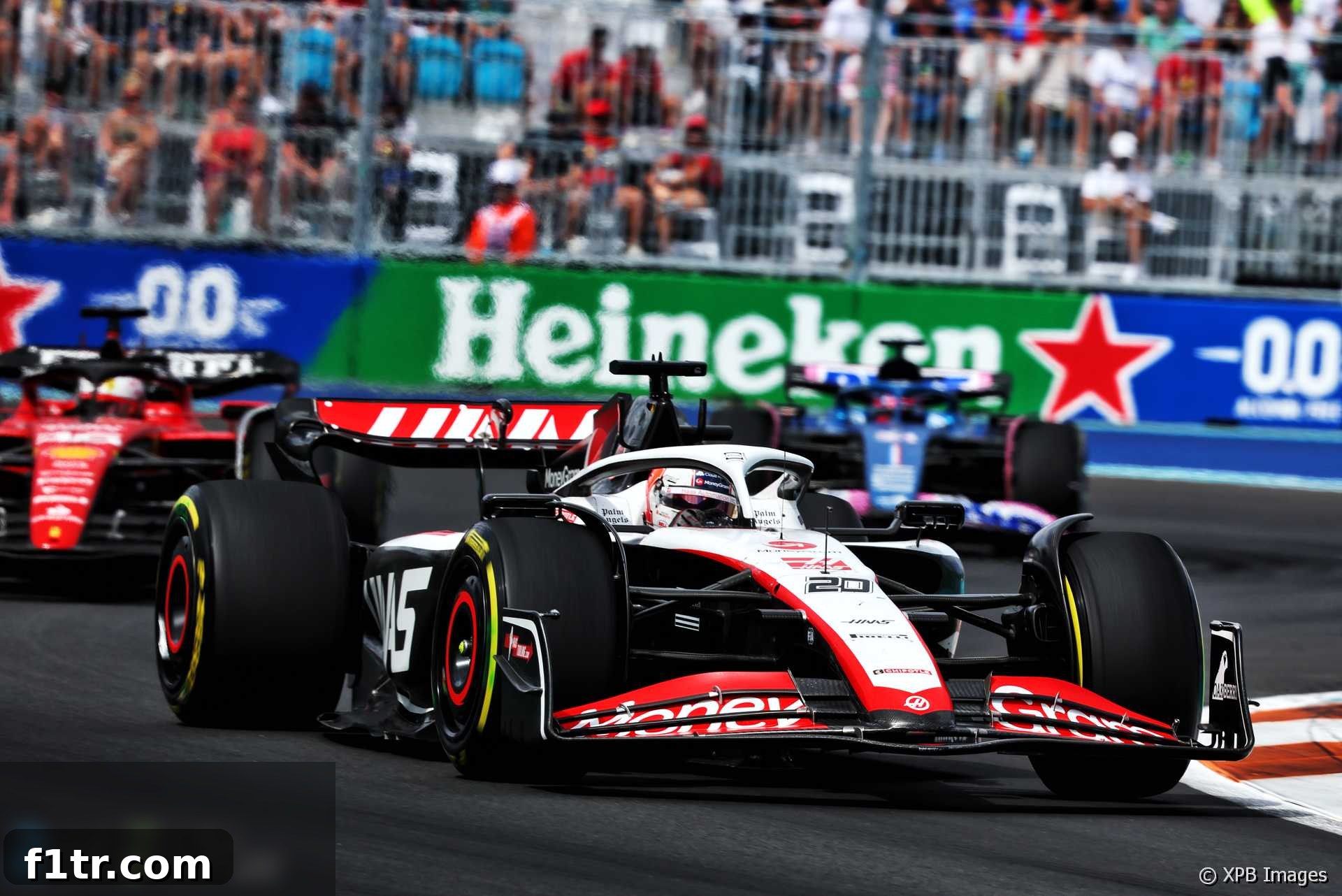
Kevin Magnussen’s Qualifying Comeback: Unpacking Haas F1’s Strategic Shift
The high-octane world of Formula 1 is a relentless arena where precision, pace, and strategic acumen dictate success. For Kevin Magnussen, the early stages of the 2023 season presented a significant challenge, particularly during the crucial qualifying sessions that determine starting grid positions. However, a remarkable turnaround saw the Danish driver dramatically improve his Saturday performances, culminating in a sensational fourth-place grid slot at the Miami Grand Prix. This was not just a personal best for Magnussen but also the highest starting position Haas F1 Team had ever achieved in a Grand Prix, a testament to a strategic pivot that unlocked greater performance.
The Miami achievement, while benefiting from a timely red flag in qualifying, marked a pivotal moment. It was the first time that season Magnussen had managed to out-qualify his formidable teammate, Nico Hulkenberg, who made a much-anticipated return to F1 after a three-year hiatus from a full-time seat. Hulkenberg’s immediate pace and adaptability had put Magnussen under pressure, making the Miami breakthrough even more significant for the Dane’s confidence and standing within the team.
This resurgence followed a notably positive weekend in Baku, Azerbaijan, where Magnussen showcased glimpses of his renewed form. Despite encountering technical problems that relegated him to Q1 the day before, he fought back strongly in sprint qualifying, advancing to SQ2. These back-to-back strong performances signaled a shift in approach, hinting at a solution to the qualifying conundrum that had plagued him in the initial races.
The Early Season Grind: Struggles and Setbacks
Before the Azerbaijan Grand Prix, Magnussen often found himself grappling with qualifying on Saturdays. The start to the 2023 season was far from ideal for the Haas driver, as he consistently struggled to extract maximum performance from his VF-23 during the critical Saturday sessions. At the Bahrain Grand Prix, the opening race of the calendar, Magnussen was eliminated in Q1, failing to progress to the second segment of qualifying. This early setback set a worrying precedent for the season.
The difficulties persisted into the Australian Grand Prix in Melbourne, where the gap to his teammate, Nico Hulkenberg, was particularly stark. Magnussen was almost a full second slower than Hulkenberg, a substantial margin in Formula 1 where hundredths of a second can separate positions. These early struggles were not just isolated incidents; they painted a picture of a driver unable to find a comfortable and competitive rhythm with his car, especially when it mattered most. The inability to consistently reach Q2 or Q3 meant starting further down the grid, making it significantly harder to score valuable championship points for the Haas F1 Team, which operates on a tighter budget and needs to maximize every opportunity.
In the highly competitive midfield, where several teams vie for the same few points-scoring positions, qualifying performance is paramount. A tenth of a second can be the difference between starting 10th and 15th, profoundly impacting race strategy and the likelihood of finishing in the top ten. For Magnussen, the consistent underperformance in qualifying was not only frustrating but also costly for Haas, highlighting an urgent need for a fundamental reassessment of their approach.
Unpacking the “Mechanical Set-up” Conundrum
The root cause of Magnussen’s early-season struggles, as he candidly explained to media including RaceFans, lay in the team’s extensive experimentation with the car’s mechanical set-up. “We’ve been experimenting a lot with the mechanical set-up,” Magnussen stated, shedding light on the intricate challenges faced by the team. The term “mechanical set-up” encompasses a wide array of adjustments that influence how the car physically interacts with the track. This includes elements like suspension stiffness, ride height, anti-roll bars, camber, toe, and differential settings. Each of these parameters plays a crucial role in the car’s balance, grip, and overall handling characteristics, especially under varying conditions and track layouts.
The 2023 season brought with it “a few new things mechanically on the car this year that we’ve been exploring a lot.” Introducing new components or designs often necessitates a period of intense learning and adaptation. Teams must understand how these new elements behave, how they interact with existing components, and how to optimize them for maximum performance. This process of exploration, while essential for long-term development and unlocking potential, comes with an inherent “cost,” as Magnussen elaborated.
This cost is multifaceted. Firstly, it demands significant track time during practice sessions. Teams spend invaluable minutes and laps trying different configurations, gathering data, and assessing their impact. If a particular experimental set-up doesn’t yield the desired results, the team has to “spend a lot of time figuring that out.” This involves analyzing telemetry, reviewing driver feedback, and making iterative changes, all within the extremely tight schedule of a Grand Prix weekend. Precious practice time is thus consumed on configurations that might ultimately be discarded.
The challenge is further compounded by Formula 1’s parc fermé regulations. These rules, which typically come into effect after the final practice session before qualifying, restrict teams from making significant changes to the car’s set-up. Once parc fermé begins, teams are largely locked into their chosen configuration. This means that if a team has spent all of its practice sessions experimenting with a novel set-up that proves ineffective, they are often forced to revert to a “more traditional set-up” for qualifying. The dilemma arises because “you’ve spent all of your practice with a different car.” Consequently, when the driver straps in for qualifying with a completely different set-up, they enter the session “not fully knowing that car.”
The implications of this unfamiliarity are significant. Even marginal differences in car behavior can have a profound impact on a driver’s confidence and ability to push to the absolute limit. In the razor-thin margins of F1 qualifying, “it can cost one or two tenths and can cost a mistake.” A tenth of a second, which might seem negligible, can easily mean the difference between progressing to the next qualifying segment or being eliminated. Furthermore, the slightest uncertainty can lead to a driver making a small error, running wide, or missing an apex, which inevitably compromises lap time. Magnussen himself acknowledged, “I think that’s what we’ve been doing a few times this year,” pinpointing this strategic misstep as a major contributor to his initial qualifying woes.
The Baku Catalyst: A Forced Shift and a Positive Outcome
The Azerbaijan Grand Prix weekend proved to be a pivotal moment in Magnussen’s season, not just for the positive results, but for the fundamental shift in approach it inadvertently instigated. The unique format of the Baku sprint race weekend played a crucial role. With only a single practice session available before qualifying for the main Grand Prix, and then another dedicated sprint qualifying session, teams had significantly less time for extensive experimentation compared to a standard Grand Prix weekend. This compressed schedule, rather than being a hindrance, became a catalyst for change.
“For Baku, also given there was only one practice, we went in with this set-up that we know,” Magnussen revealed. The team, faced with limited track time, made a conscious decision to forego radical experimentation. Instead, they opted for a tried-and-tested configuration, focusing on an “area of the set-up that we know very well.” This pragmatic approach immediately paid dividends. By sticking with a familiar and well-understood set-up, Magnussen was able to enter qualifying with a higher degree of confidence and a better understanding of how his car would behave. This reduced the uncertainty that had plagued him in previous races, allowing him to push closer to the car’s limits.
Despite encountering technical problems with his car “both in FP1 and in qualifying” at Baku, the underlying stability and predictability of the set-up still allowed him to perform strongly. He elaborated, “but at least we put a car on-track that I knew was going to be good and we’ll be on that approach a little more this year.” This statement highlights a crucial learning point for Haas F1. The success in Baku demonstrated that a known, reliable set-up, even if not absolutely optimized for every single variable, was far more beneficial for a driver’s confidence and overall performance in qualifying than endlessly chasing marginal gains with experimental configurations that bred uncertainty.
The implication is clear: consistency and driver comfort with the car often outweigh the theoretical maximum performance of an untested, complex set-up, especially under the pressure of a qualifying session. This newfound understanding has prompted Haas to recalibrate their approach, signaling a commitment to prioritizing driver familiarity and a stable baseline set-up, particularly for the critical Saturday sessions. This strategic pivot, born out of necessity in Baku, ultimately empowered Magnussen to deliver his standout performance in Miami and promises to be a key factor in his and Haas’s performance throughout the remainder of the 2023 F1 season and beyond.
Impact and Future Outlook for Haas F1
Kevin Magnussen’s qualifying turnaround carries significant implications for both the Danish driver and the Haas F1 Team. For Magnussen, regaining confidence in the car’s setup and his ability to extract performance on Saturdays is paramount. A driver’s mental state and trust in their machinery are critical factors in Formula 1, and the success in Baku and Miami undoubtedly injected a much-needed boost into his season. This revitalized approach could lead to more consistent qualifying performances, reducing the pressure to make up ground during the Grand Prix itself and opening up more strategic options on race day.
For Haas F1 Team, the learnings from Magnussen’s experience are invaluable. It underscores the importance of a stable and predictable car for driver performance, even when exploring new components. While innovation and development are vital, especially for a smaller team looking to climb the grid, striking the right balance between experimentation and established reliability is crucial. The team’s stated intention to adopt this “approach a little more this year” suggests a strategic shift towards a more pragmatic and driver-centric setup philosophy. This could involve focusing on a core setup that provides a solid baseline, allowing for smaller, more targeted adjustments rather than wholesale overhauls during race weekends.
The dynamic with teammate Nico Hulkenberg also stands to benefit from Magnussen’s renewed form. While Hulkenberg has shown impressive pace upon his return, a consistently performing Magnussen creates a stronger intra-team rivalry, pushing both drivers to higher levels. This internal competition, if managed effectively, can be a powerful motivator and a source of valuable data and feedback for the team’s engineers. Two drivers consistently pushing the car’s limits from strong grid positions significantly increases Haas’s chances of scoring points more regularly, which is crucial for their championship standing and financial health.
Ultimately, the ability to qualify strongly is often the precursor to scoring points in Formula 1. Starting higher up the grid reduces exposure to first-lap incidents, allows for cleaner air, and provides better strategic flexibility. As the 2023 F1 season progresses, the application of these hard-earned lessons from the early races will be a key determinant of Haas F1 Team’s success. Magnussen’s journey from qualifying struggles to a podium-challenging grid slot in Miami is a compelling narrative of adaptation, strategic recalibration, and the enduring quest for perfection in the pinnacle of motorsport.
2023 F1 season
For more detailed insights and analysis into the thrilling events and developments of the year, explore a curated collection of articles from the 2023 Formula 1 season. From in-depth race reviews to exclusive driver interviews and comprehensive technical breakdowns, stay informed on all the key moments that shaped one of the most exciting seasons in recent memory.
Browse all 2023 F1 season articles