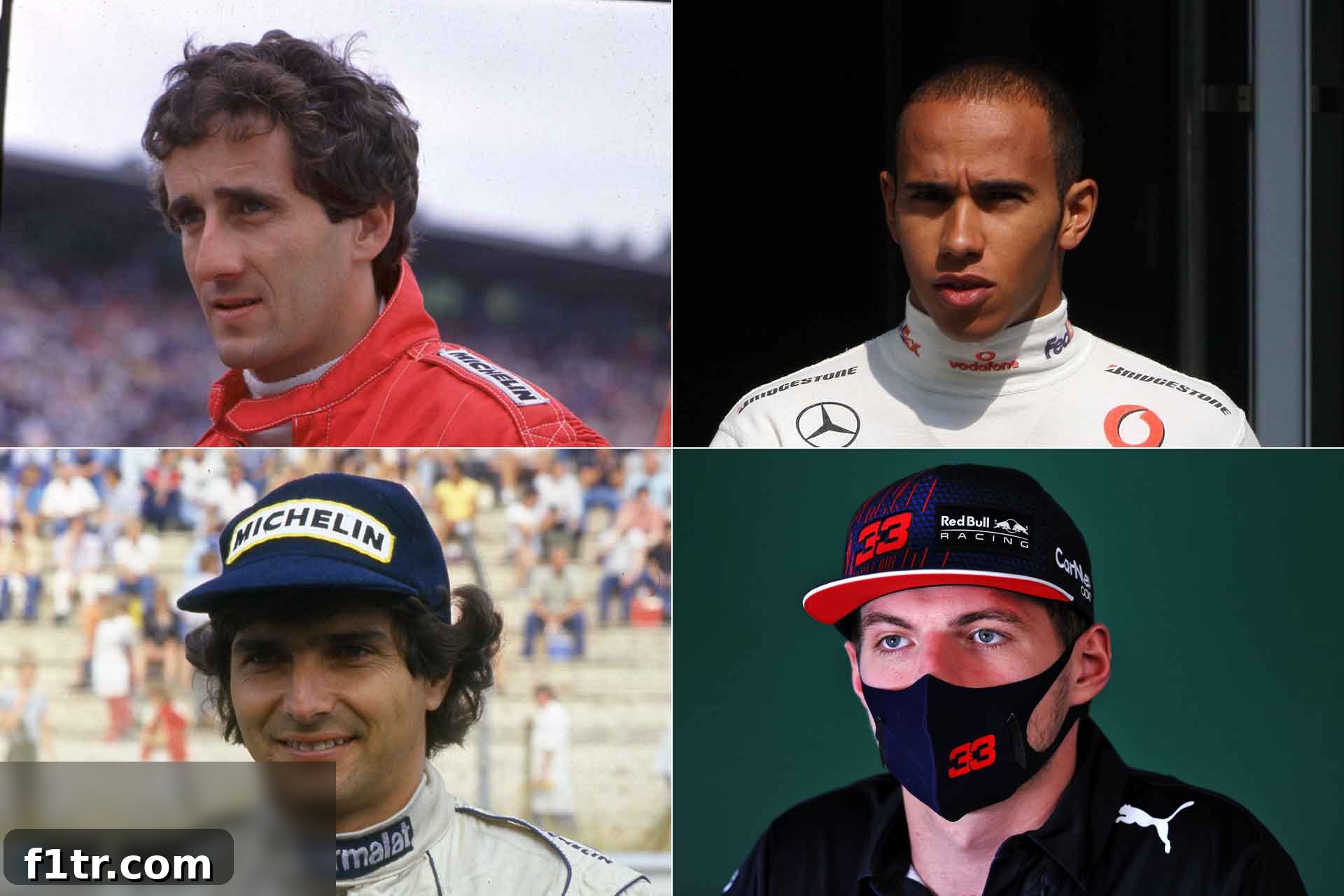
F1’s Ultimate Test: Drivers Who Conquered the Championship Without the Best Car
As Fernando Alonso frequently emphasizes, securing the Formula 1 Drivers’ Championship often hinges on possessing the most competitive machinery. It’s a widely accepted truth in motorsport: a superior car provides a distinct advantage, making the path to glory significantly smoother.
Indeed, history shows that most F1 drivers who have claimed the prestigious drivers’ title did so at the wheel of a car that simultaneously propelled their team to win the Constructors’ Championship in the very same season. This synergy between driver and constructor is the most common narrative in F1 success.
However, Formula 1 is a sport rich with narratives of individual brilliance defying conventional wisdom. Since the Constructors’ Championship was first introduced in 1958, a full eight years after the drivers’ title began, a remarkable 10 drivers have etched their names into history by winning the ultimate individual prize even when their team did not secure the constructors’ crown. These instances stand as powerful testaments to driver skill, resilience, and often, a touch of extraordinary circumstance.
This rare phenomenon is poised to repeat itself in the current season. With a significant portion of the season remaining, Max Verstappen is firmly on track to clinch his next drivers’ title. Yet, his formidable Red Bull Racing team recently conceded the Constructors’ Championship lead to a resurgent McLaren, now trailing by a substantial 41 points. This scenario prompts a fascinating question: is winning the drivers’ championship in a car that falls short of the teams’ title the ultimate measure of an F1 driver’s greatness? Let’s delve into the past achievements of these exceptional drivers and uncover the unique stories behind their remarkable triumphs.
Legends Forged in Challenge: Drivers Who Won the WDC Without the WCC
Mike Hawthorn – 1958
1958 drivers’ champion with Ferrari while Vanwall won constructors’ championship
The inaugural Constructors’ Championship in 1958 was claimed by Vanwall, a team whose drivers, despite their speed, never clinched the individual world title. Vanwall’s dominance was overshadowed by tragedy, as team owner Tony Vandervell ultimately wound down operations following the horrific death of Stuart Lewis-Evans in a fiery crash at the season finale in Morocco.
It was at this same fateful race that Ferrari’s Mike Hawthorn secured the Drivers’ Championship. Despite winning only a single race all year – at Reims in France – Hawthorn’s consistent points accumulation proved decisive. His rival, Stirling Moss, driving for Vanwall and Cooper, had taken four victories that season. The memorable narrative surrounding their battle includes Moss’s incredible act of sportsmanship at the Portuguese Grand Prix, where he intervened on Hawthorn’s behalf after a disqualification, urging stewards to reinstate him. This pivotal moment highlighted the respect between rivals but ultimately played a part in the championship outcome.
The sheer pace of the Vanwall cars, with Moss and his teammate Tony Brooks also winning three times, was enough to secure the constructors’ trophy. However, Hawthorn’s steady hand and ability to score points even on less dominant days demonstrated his championship mettle in an era where only the best-placed car from each team scored points towards the constructors’ standings.
Jackie Stewart – 1973
1973 drivers’ champion with Tyrrell while Lotus won constructors’ championship
In 1973, Jackie Stewart claimed his third and final World Championship, a remarkable feat that solidified his status as one of the sport’s all-time greats. This title, however, came in a season where his Tyrrell team was outperformed in the Constructors’ Championship by Lotus.
Lotus boasted a formidable car and a strong driver lineup with reigning champion Emerson Fittipaldi and the rapid Ronnie Peterson. Yet, a fierce internal rivalry between the two Lotus drivers led them to consistently take points off each other throughout the season. This dynamic opened the door for Stewart, whose consistent and masterful performances allowed him to secure the title with two rounds remaining, demonstrating his ability to maximize every opportunity.
Tyrrell’s hopes of adding a constructors’ title to Stewart’s individual triumph were tragically dashed at the season finale. François Cevert, Stewart’s talented teammate and close friend, suffered a fatal crash during practice. In the wake of this devastating loss, Stewart, with the full blessing of team boss Ken Tyrrell, withdrew from what was intended to be his final race. This poignant decision, while understandable, meant Tyrrell, just one point behind Lotus before the finale, ceded the Constructors’ Championship to their rivals. Stewart’s 1973 title remains a poignant testament to his skill amidst a highly competitive, and ultimately tragic, season.
James Hunt – 1976
1976 drivers’ champion with McLaren while Ferrari won constructors’ championship
James Hunt’s 1976 championship season is the stuff of legend, a dramatic tale famously immortalized in film. His chances seemed all but over at several points, including a highly contentious disqualification after winning the British Grand Prix. This followed an earlier reinstatement of a victory in Spain, showcasing a tumultuous season even before its defining moment.
Following the Brands Hatch controversy, where Niki Lauda was awarded victory, the Ferrari driver headed to the Nürburgring with a commanding lead, holding twice as many points as his nearest rival, Jody Scheckter. However, a horrific crash early in the German Grand Prix nearly cost Lauda his life and forced him to miss several races. This unprecedented event drastically reshaped the championship landscape.
In an incredible display of resilience, Lauda made a miraculous return to the cockpit after missing just two further races. Yet, by this point, Hunt had seized the opportunity, winning races in Canada and the USA to set up a thrilling final-round showdown in Japan. Amidst treacherous, rain-soaked conditions, Lauda, prioritizing his safety, made the difficult decision to withdraw from the race. Hunt, battling through the spray, clinched the title by a single point with a third-place finish. Despite McLaren’s individual triumph, Ferrari had already secured the Constructors’ title, a reflection of their overall strength throughout the season, even with Lauda’s mid-season absence.
Nelson Piquet – 1981 & 1983
1981 drivers’ champion with Brabham while Williams won constructors’ championship
1983 drivers’ champion with Brabham while Ferrari won constructors’ championship
Nelson Piquet holds a unique distinction as the only driver in Formula 1 history to win the Drivers’ Championship on more than one occasion when his team did not secure the Constructors’ title. This exceptional feat underscores his incredible talent and strategic prowess.
His 1981 victory with Brabham serves as a textbook example of a dominant individual performance within a ‘one-car team.’ While Brabham’s BT49C was undoubtedly effective, its rivals, particularly Williams, possessed an arguably superior package. However, the Williams team was plagued by an acrimonious internal rivalry between reigning champion Alan Jones and Carlos Reutemann, who famously fell out spectacularly. Piquet skillfully capitalized on this division, scoring an impressive 50 of Brabham’s total 61 points that year. He ultimately ended the season as champion, with both warring Williams drivers finishing within four points of him. His teammate, Hector Rebaque, never finished higher than fourth, further emphasizing Piquet’s solitary charge.
Two years later, Piquet repeated the feat, securing his second title in 1983, again with Brabham, while Ferrari claimed the Constructors’ Championship. Although his teammate, Riccardo Patrese, was a far more capable driver than Rebaque, he endured a season marred by dire unreliability, only managing a single win at the very last race as Piquet clinched the championship. These two titles highlight Piquet’s incredible ability to perform at an elite level, often carrying his team’s championship hopes almost single-handedly against strong, and sometimes better-resourced, constructor champions.
Keke Rosberg – 1982
1982 drivers’ champion with Williams while Ferrari won constructors’ championship
The 1982 Formula 1 season was one of the most unpredictable and tragic in the sport’s history, and it saw Keke Rosberg claim the Drivers’ Championship with Williams, despite Ferrari securing the Constructors’ title for the first of two consecutive seasons. Ferrari’s strong car, with drivers like René Arnoux and Patrick Tambay, was a formidable force, but its individual championship aspirations were cruelly blighted by a series of devastating events.
The season began with great promise for Ferrari, but tragedy struck early. Gilles Villeneuve, one of F1’s most revered figures, was killed in a qualifying crash at Zolder. His teammate, Didier Pironi, then took up the championship challenge, eventually leading the standings, only to suffer career-ending injuries in another severe accident at Hockenheim. These shocking events left Ferrari with a constructors’ title, but no clear driver to challenge for the individual crown.
This opened an unexpected door for Rosberg. Driving for Williams, he seized his opportunity with a gritty performance, taking his first and only victory of the year at Dijon. This single win propelled him into the championship lead, a position he maintained to the season’s end, clinching the title by just five points over the absent Pironi. Rosberg’s title, secured in a season marked by chaos and heartbreak, stands as a testament to capitalizing on every chance and maintaining composure amidst extraordinary circumstances.
Alain Prost – 1986
1986 drivers’ champion with McLaren while Williams won constructors’ championship
The 1986 season delivered one of Formula 1’s most breathtaking championship finales, with Alain Prost emerging as the Drivers’ Champion for McLaren, despite Williams securing a dominant Constructors’ title. Nelson Piquet had moved to Williams that year and won on his debut, but he quickly became frustrated by the team’s refusal to designate him as their clear ‘number one’ driver. This created a potent internal rivalry with his teammate, Nigel Mansell, who went on to take the next four victories for the team and establish himself at the top of the championship standings.
While the Williams pair battled intensely, McLaren’s Alain Prost, the reigning champion, proved to be an unwavering threat. He consistently exploited the points split between Piquet and Mansell, showcasing his renowned strategic acumen and smooth driving style. By the latter stages of the season, Prost also had the advantage of his teammate, Keke Rosberg, retiring from the sport, allowing McLaren to focus all efforts on his championship bid.
The climax arrived at the Australian Grand Prix in Adelaide. In a dramatic turn of events, Mansell suffered a spectacular tyre explosion while leading, forcing his retirement. Piquet, now in a position to win the title, made a precautionary pit stop due to concerns about his own tyres. Astonishingly, Prost, who had been forced into an extra pit stop earlier in the race, capitalised on these misfortunes, driving a flawless race to claim the victory and, against all odds, snatch the Drivers’ Championship in truly stunning fashion. It was a classic demonstration of Prost’s ability to win with consistency and seize opportunities when his rivals faltered.
- 1986 Australian Grand Prix: Heartbreak for Mansell as Prost grabs title in dramatic Adelaide finale
Michael Schumacher – 1994
1994 drivers’ champion with Benetton while Williams won constructors’ championship
The tragic 1994 Formula 1 season remains one of the sport’s greatest ‘what-ifs,’ perpetually raising questions about how the title fight might have unfolded between Michael Schumacher and Ayrton Senna had the Brazilian icon not tragically died in a crash at the third round at Imola. In a season marred by profound sorrow, rule changes, and intense controversy, Schumacher eventually pipped Senna’s teammate Damon Hill to the title by a single point.
Schumacher’s championship was characterized by a series of contentious incidents, including disqualifications, race bans, and a highly disputed final-round collision with Hill. Despite being thrown into disarray by Senna’s death and having to re-engineer an initially ill-handling car, Williams remarkably clinched the Constructors’ title. This was largely due to the consistent points gathered by Damon Hill, supported by contributions from David Coulthard and the returning veteran Nigel Mansell, who fittingly won the season finale in Adelaide.
Meanwhile, Schumacher’s Benetton team operated very much as a ‘one-driver’ effort. His original choice of teammate, JJ Lehto, was injured in pre-season testing and subsequently replaced by a revolving cast of drivers including Jos Verstappen and Johnny Herbert at various stages of the demanding season. Schumacher’s ability to maintain focus and deliver performances amidst such turmoil, and against a team as resilient as Williams, speaks volumes about his early dominance and unwavering determination.
- 1994 Australian Grand Prix: Schumacher’s first title tainted by clash with Hill
Mika Hakkinen – 1999
1999 drivers’ champion with McLaren while Ferrari won constructors’ championship
Five years after the dramatic 1994 season, Formula 1 witnessed another compelling ‘what-if’ scenario in 1999. Mika Hakkinen arrived at Silverstone with an eight-point lead over Michael Schumacher. However, tragedy struck again when Schumacher broke his right leg in a crash during the British Grand Prix, forcing him to miss a significant portion of the remaining season. This pivotal moment transformed the championship dynamic.
With Schumacher sidelined, his Ferrari teammate, Eddie Irvine, unexpectedly stepped up to challenge Hakkinen for the title. What followed was a hard-fought battle where Hakkinen, despite his natural speed, often made hard work of fending off Irvine. Ferrari’s strategic team play was evident, with Irvine being ‘gifted’ wins first by Mika Salo in Germany, and then controversially by a returning Schumacher in Malaysia, who famously moved aside to let Irvine pass.
Ultimately, Hakkinen’s resilience prevailed, and he clinched the Drivers’ Championship with a decisive victory in Japan. However, McLaren lost the Constructors’ title to Ferrari, partly due to squandering valuable points, and significantly due to a highly controversial decision by the FIA. After Irvine and Schumacher had secured a one-two finish at the penultimate race in Sepang, their Ferrari F399s were initially disqualified for non-conforming bargeboards. Many in the paddock predicted the FIA would find a way to deem them legal to keep the championship fight alive, and sure enough, the Court of Appeal ruled that the part had not been measured correctly. This resulted in a critical 22-point swing, proving decisive as Ferrari celebrated their first Constructors’ Championship in 16 years by a margin of just four points.
Lewis Hamilton – 2008
2008 drivers’ champion with McLaren while Ferrari won constructors’ championship
Nine years after Hakkinen’s triumph, McLaren once again saw their driver crowned world champion in a year where the team missed out on the Constructors’ title. In 2008, Lewis Hamilton secured his maiden Drivers’ Championship in arguably the most dramatic finale in Formula 1 history. The final points standings vividly illustrate the situation: Hamilton snatched the title from Felipe Massa by a single point, while Massa’s Ferrari teammate, Kimi Räikkönen, finished third in the drivers’ standings. Hamilton’s own teammate, Heikki Kovalainen, who joined McLaren that year, finished a distant seventh, highlighting a disparity in performance within the team.
While Kovalainen’s contribution to McLaren’s points tally was certainly a factor in their Constructors’ deficit, Hamilton himself was not without fault, missing several crucial scoring opportunities throughout the season. Most notably, he famously crashed into Räikkönen in the pit lane in Canada and delivered a scruffy, error-strewn performance in France. These missed chances compounded McLaren’s challenge against a very strong Ferrari outfit.
Despite these setbacks, Hamilton’s sheer pace and unwavering determination allowed him to arrive at the season finale in Brazil with a narrow lead. In a rain-affected race that went down to the very last corners, Hamilton made a decisive overtake to secure the fifth position he needed, clinching the championship in truly unforgettable circumstances. Ferrari’s consistent, two-car performance throughout the season ultimately ensured they comfortably won the Constructors’ Championship, even as their lead driver suffered heartbreak.
- 2008 Brazilian Grand Prix: Hamilton denies Massa the title in epic last-lap climax to final race
Max Verstappen – 2021
2021 drivers’ champion with Red Bull while Mercedes won constructors’ championship
Max Verstappen’s 2021 Drivers’ Championship victory for Red Bull stands as another compelling example of an individual title won in a season where his team did not secure the Constructors’ crown. The circumstances surrounding this title, however, were notoriously controversial, marked by a highly disputed conclusion to the championship. If Verstappen indeed secures the 2024 drivers’ title as projected while Red Bull misses out on the constructors’ trophy, he will become only the second driver in F1 history, after Nelson Piquet, to achieve this feat twice, hopefully under less contentious circumstances.
The 2021 season was a titanic struggle between Red Bull and Mercedes, following an off-season tweak to F1’s floor regulations which, serendipitously, gave Mercedes more engineering headaches than it did Red Bull. This resulted in two teams that were incredibly closely matched on performance for the vast majority of the season, producing one of the most thrilling title fights in modern F1 history. While Verstappen’s new teammate, Sergio Perez, delivered what was arguably his best year-long performance for the team since joining, providing crucial support and strategic assistance, it ultimately wasn’t enough.
Lewis Hamilton and Valtteri Bottas, driving for Mercedes, collectively amassed sufficient points to secure their eighth consecutive Constructors’ Championship, demonstrating the strength and consistency of their overall team effort. Verstappen’s individual brilliance, aggressive driving, and a series of memorable victories saw him clinch the Drivers’ Championship, but the final outcome in Abu Dhabi left a lasting mark on the season’s legacy, underscoring the delicate balance between individual and team success in Formula 1.
- 2021 Abu Dhabi Grand Prix: Verstappen victorious as Hamilton loses title in finale soured by restart row
More Than Just Speed: The True Meaning Behind These Unconventional Titles
The narratives of these ten extraordinary drivers offer a multifaceted perspective on what it truly means to be a champion in Formula 1. It’s often too simplistic to declare that every instance of a driver winning the World Championship when their team failed to secure the Constructors’ title automatically proves they were a ‘true great.’ However, these achievements undeniably highlight some of F1’s most impressive, challenging, and often hard-fought title-winning performances.
Several of these champions can justifiably claim to have wrung the absolute maximum performance out of a car that was not definitively the best over a full season, expertly taking advantage of better-equipped rivals who faltered. Jackie Stewart in 1973, navigating internal strife at Lotus, and Alain Prost in 1986, masterfully exploiting the Williams civil war, stand out as particularly conspicuous examples of this strategic brilliance. Max Verstappen’s 2021 triumph, the controversial finale notwithstanding, also falls into this category, demonstrating a driver overcoming a formidable opponent in a remarkably even fight, hence why he was often named driver of the year on that occasion.
In other cases, the champion’s team effectively operated as a ‘one-driver’ operation, where a singular talent carried the team’s entire championship hopes. This was notably true for Nelson Piquet with Hector Rebaque in 1981, and to a significant extent for Michael Schumacher in 1994, partly due to the rotating door of teammates he had that season. These wins emphasize the immense pressure and responsibility placed on one individual to deliver consistently.
Then there are the unique outlier cases, where unusual and often tragic circumstances played a profound role in shaping the outcome. James Hunt’s 1976 championship, heavily influenced by Niki Lauda’s horrific accident, and Keke Rosberg’s 1982 title, secured amidst a season of unprecedented tragedy for Ferrari, are powerful examples of drivers capitalizing on incredibly complex and emotionally charged situations. While luck undoubtedly played a part, it was their mental fortitude and ability to remain competitive that allowed them to be in a position to seize these opportunities.
Ultimately, these unconventional championships illuminate the intricate interplay of car performance, driver skill, team strategy, reliability, and sheer fortune that defines Formula 1. They serve as a powerful reminder that while the fastest car is often a prerequisite for a title, exceptional talent and an unyielding will to win can, on rare and memorable occasions, overcome even the strongest of opponents and the most challenging of circumstances.
Miss nothing from RaceFans
Get a daily email with all our latest stories – and nothing else. No marketing, no ads. Sign up here:
Formula 1
- Controversies, Norris, Newey and more: Five new motorsport books reviewed
- One of F1’s greatest races happened 15 years ago today. Or did it?
- “Overtaking is overtaking”: Domenicali denies F1’s yo-yo racing is “artificial”
- The crashes F1 is trying to prevent may be rare – but the danger is obvious
- F1 returning to India soon after 2027 sounds like wishful thinking
Browse all Formula 1 articles