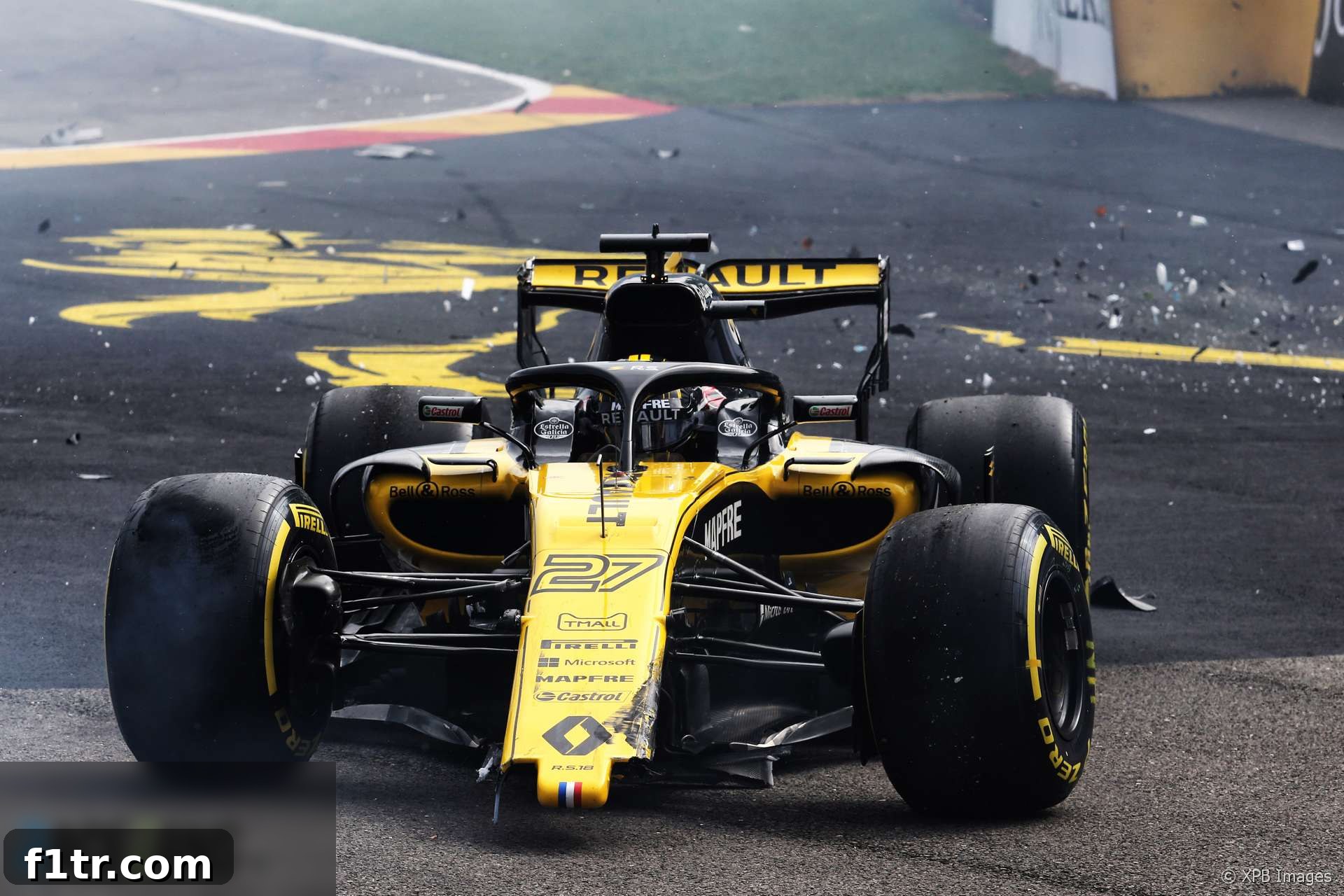
The aftermath of a dramatic opening lap at the Belgian Grand Prix saw Nico Hulkenberg handed a significant 10-place grid penalty for the upcoming Italian Grand Prix at Monza. This sanction comes as a direct consequence of his involvement in a multi-car collision that brought an abrupt and disappointing end to several drivers’ races at Spa-Francorchamps.
The incident, which unfolded in the crucial early seconds of the race, involved Hulkenberg misjudging his braking point for the notorious La Source hairpin. The stewards, following a thorough investigation, wasted no time in determining culpability, with Hulkenberg himself openly acknowledging his error. His candid admission played a pivotal role in the stewards’ decision-making process, underscoring a clear instance of driver fault.
Advert | Become a Supporter & go ad-free
The Devastating Impact of the Belgian Grand Prix Crash
The opening lap of any Formula 1 race is often a spectacle of aggressive maneuvering and daring overtakes, but it also carries inherent risks. The 2018 Belgian Grand Prix unfortunately illustrated these dangers in stark fashion. As the cars hurtled towards the tight La Source hairpin, a critical bottleneck after the long run from the start line, Nico Hulkenberg, driving for Renault, failed to brake adequately. His car careened into the rear of Fernando Alonso’s McLaren, triggering a chain reaction that sent debris flying and multiple cars spinning out of control.
The initial impact propelled Alonso’s car airborne, narrowly missing Charles Leclerc’s Sauber cockpit in a terrifying moment that highlighted the crucial role of the Halo safety device. Daniel Ricciardo’s Red Bull and Kimi Räikkönen’s Ferrari were also caught up in the melee, sustaining significant damage that ultimately forced them to retire from the race. In total, the incident led to the immediate retirement of four other drivers besides Hulkenberg, effectively decimating the hopes of several teams within seconds of the green light. The sheer scale of the pile-up underscored the gravity of Hulkenberg’s misjudgment and its far-reaching consequences for the competitive integrity of the Grand Prix.
Hulkenberg’s Immediate Admission and Remorse
In the high-pressure environment of Formula 1, drivers are often quick to defend their actions, but Nico Hulkenberg’s response was refreshingly transparent. Immediately after the crash, and subsequently to the race stewards, he took full responsibility for the incident. “The driver of car 27 stated that he completely misjudged the situation and freely admitted it was his mistake,” read the stewards’ official report, capturing the essence of his immediate confession.
Speaking to the media, a visibly disappointed Hulkenberg elaborated, acknowledging that he “probably misjudged a bit on my side” where to brake for the first corner. This genuine acceptance of blame is not always a given in motorsport, and his candor likely factored into how the stewards perceived the incident, separating it from malicious intent or reckless driving. Beyond the grid penalty, Hulkenberg was also issued three penalty points on his super licence, bringing his running total to four within the current 12-month period. These points are a critical component of the FIA’s driver discipline system, designed to monitor and sanction repeat offenders, ultimately ensuring safer racing.
The Stewards’ Verdict and the Evolving Landscape of F1 Penalties
The decision to impose a 10-place grid penalty for the subsequent race at Monza, coupled with penalty points, reflects the FIA’s consistent approach to maintaining safety and fair play in Formula 1. The stewards’ ruling emphasized the severity of the incident, which not only took out multiple competitors but also posed potential safety risks due to the high-speed nature of the collision.
This incident naturally drew comparisons to a strikingly similar multi-car collision that occurred at the very same circuit six years prior, during the 2012 Belgian Grand Prix. On that occasion, Romain Grosjean was deemed responsible for a massive first-lap crash that eliminated several front-runners, including championship contender Fernando Alonso. Grosjean’s penalty was significantly harsher: a one-race ban. The stark difference in outcomes – a race ban versus a grid penalty – has often been a point of contention and discussion among fans and pundits alike, prompting a deeper look into the evolution of Formula 1’s disciplinary framework.
A Deeper Dive into the FIA’s Penalty Points System
The stewards were keen to address this perceived disparity in their ruling on Hulkenberg’s incident. They explicitly noted: “It should be noted that since 2014 the FIA has introduced the penalty points system which takes into account previous offences by a driver and can lead to a race suspension if 12 points are accumulated within a 12-month period. This system was not in force when an incident not dissimilar to this, occurred in 2012.” This clarification is crucial for understanding the modern approach to driver discipline.
Prior to 2014, penalties for major incidents often involved immediate grid drops, drive-through penalties, or, in extreme cases like Grosjean’s, race bans. However, the introduction of the penalty points system aimed to create a more cumulative and progressive form of discipline. Instead of a single, severe punishment for an isolated incident, the system tracks a driver’s infractions over a rolling 12-month period. Each transgression, depending on its severity, accrues a certain number of points. Once a driver accumulates 12 penalty points, they automatically receive a one-race ban. This system provides a clearer deterrent against repeated dangerous driving and ensures that drivers are held accountable for a pattern of behavior rather than just individual mistakes, though a single egregious error can still lead to substantial immediate penalties as seen with Hulkenberg.
Charlie Whiting’s Perspective on the Penalty
FIA Race Director Charlie Whiting, a revered figure in the sport for his extensive experience and authority, weighed in on the incident, reinforcing the stewards’ findings. While Whiting’s role is to refer matters to the stewards and oversee race operations, he does not make the final disciplinary decisions. However, his assessment carries significant weight within the F1 paddock. Whiting confirmed that Hulkenberg’s admission of fault was unequivocal. “It was clearly Nico’s fault,” said Whiting. “He admitted completely, he said he was completely to blame for it. And he took three, arguably four cars out, or destroyed their races. I think that obviously came into it.”
Whiting further expressed his agreement with the chosen penalty, suggesting it was an appropriate measure given the circumstances and the driver’s own accountability. “I think the points are exactly right and I think that the 10 grid place penalty is pretty much what he expected. He didn’t say too much after it,” Whiting concluded. This professional consensus from the sport’s senior officials underscores the belief that the penalty was fair, proportionate, and aligned with current FIA regulations, effectively balancing the need for discipline with the progressive nature of the penalty points system.
Implications for the Italian Grand Prix at Monza
The 10-place grid penalty for the Italian Grand Prix at Monza represents a significant hurdle for Nico Hulkenberg and the Renault F1 team. Monza, known as the ‘Temple of Speed’, is a circuit where track position is exceptionally important due to the limited overtaking opportunities outside of the long straights and chicanes. Starting ten places further back than his qualifying performance dictates will make his race considerably more challenging. It will require him to execute a flawless strategy, manage tires impeccably, and rely on opportunistic driving to climb through the field.
For a team like Renault, which was battling for a strong mid-field position in the constructors’ championship, this penalty could have wider ramifications. Every point is crucial, and a compromised starting position can severely limit the potential for scoring points. Hulkenberg, a seasoned driver, will undoubtedly be focused on damage limitation, aiming to recover as many positions as possible and salvage some points from what will inevitably be an uphill battle. The incident at Spa serves as a stark reminder of how quickly fortunes can change in Formula 1, and the ripple effect of a single mistake can be felt across multiple race weekends.
While safety in Formula 1 has advanced dramatically over the decades, incidents like the one at Spa-Francorchamps serve as crucial lessons. They continuously prompt reviews of track design, car safety features, and driver conduct, ensuring that the sport remains thrilling yet as safe as possible for all participants. The comprehensive penalty system, with its blend of immediate sanctions and cumulative points, is a testament to the FIA’s ongoing commitment to fostering responsible and competitive racing.
Advert | Become a RaceFans supporter andgo ad-free
Don’t miss anything new from RaceFans
Follow RaceFans on social media:
- Join RaceFans on Facebook
- Follow RaceFans on Twitter
- Get daily email updates from RaceFans
2018 F1 season
- F1 feared “death knell” for Drive to Survive after Ferrari and Mercedes snub
- McLaren staff told us we were “totally crazy” to take Honda engines in 2018 – Tost
- ‘It doesn’t matter if we start last’: How Red Bull’s junior team aided Honda’s leap forward
- Honda’s jet division helped F1 engineers solve power unit problem
- McLaren Racing losses rise after Honda split
Browse all 2018 F1 season articles