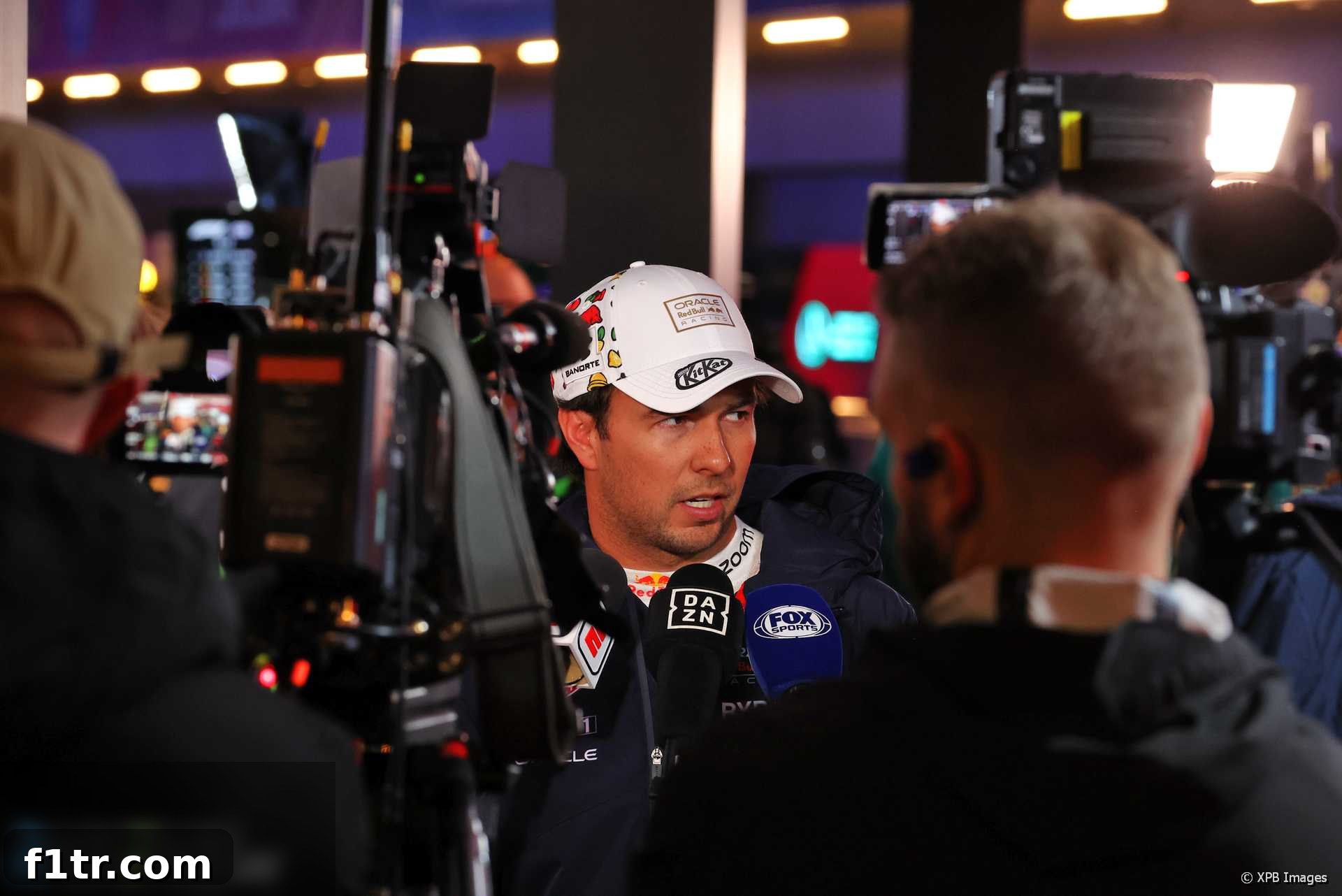
Sergio Perez’s Las Vegas GP Q1 Exit: A Steep Uphill Battle for Red Bull’s Under-Pressure Driver
The inaugural Las Vegas Grand Prix promised an spectacle of speed and glamour, but for Sergio Perez, the event began with an immediate and unwelcome dose of reality. In a qualifying session that sent ripples through the paddock, the Red Bull Racing driver failed to advance beyond Q1, a stark and disappointing outcome for a driver in a championship-winning car. This unexpected elimination has cast a shadow over his weekend, placing him 16th on the grid and setting the stage for what promises to be an arduous recovery drive through the pack if he hopes to score any valuable championship points.
Perez’s struggles were not entirely unforeseen; the entire Red Bull team appeared to be grappling with the unique challenges presented by the glittering but tricky Las Vegas Strip Circuit. Unlike their usual dominant form, the RB20 seemed to lack its customary edge, particularly in finding optimal grip on the cold, green asphalt. For Perez, these car characteristics compounded his already evident challenges this season, culminating in a qualifying performance that further intensified the scrutiny on his future with the team.
Grip Deficit: Unraveling Perez’s Struggles on the Las Vegas Strip Circuit
The core of Sergio Perez’s woes throughout the Las Vegas Grand Prix weekend revolved around a persistent lack of grip. The Mexican driver openly admitted his difficulties, explaining how the car’s handling on the unique street circuit made it nearly impossible to extract its full potential. “Mainly the whole weekend I’ve been struggling quite a lot with the grip,” Perez revealed after qualifying. “It’s just really difficult to put a lap together with the amount of sliding and then with the tyres not making it work. I think that’s been the most difficult one.”
This candid assessment highlights a critical issue: on a new, low-grip surface like the Las Vegas Strip, coupled with unusually cold evening temperatures, driver confidence and the car’s ability to generate mechanical grip are paramount. The combination of these factors meant Perez was constantly battling his car, unable to push to the absolute limit without risking costly errors. He foresaw the difficulties even before the session, stating, “I expected a very difficult qualifying and it turned out to be a quite a tough one.” This premonition underscores the deep-seated issues that prevented him from adapting to the challenging conditions.
The Las Vegas Strip Circuit, a temporary track designed for high speeds and overtakes, combines long straights with several tight, low-speed corners. This configuration demands a versatile car setup – one that offers strong straight-line speed without sacrificing too much downforce in the corners, all while maintaining crucial tire temperature and grip. For Red Bull, a team known for its aero efficiency, finding this sweet spot proved elusive, especially for Perez. The lack of optimal grip translated into excessive sliding, making it difficult to warm the tires effectively and consistently, creating a vicious cycle of underperformance. Ultimately, the fine margins of F1 qualifying saw him miss out on Q2 by a mere 68 thousandths of a second, edged out by RB’s Liam Lawson.
A Troubling Pattern: Perez’s Sixth Q1 Exit of the Season
The Q1 elimination in Las Vegas is not an isolated incident but rather a continuation of a worrying trend for Sergio Perez. This marks the sixth time this season that he has failed to progress beyond the first segment of qualifying, a statistic that stands in stark contrast to the almost superhuman consistency of his teammate, Max Verstappen. While Verstappen has made it into Q3 in every single qualifying session this year – an astonishing 21 occasions – Perez has only managed this feat 13 times. This significant disparity in qualifying performance not only impacts his individual standing but also has broader implications for Red Bull Racing’s overall strategy and their bid for championship dominance.
For a driver in one of F1’s top cars, regular Q1 exits are virtually unheard of, highlighting a fundamental disconnect between Perez and the full potential of the RB20. These struggles in qualifying often translate into compromised race strategies, forcing him to fight through midfield traffic rather than supporting Verstappen at the front. While Verstappen’s unparalleled performances have largely secured the Constructors’ Championship for Red Bull, the team thrives on having both cars operating at the peak of their performance. The absence of a consistent two-car challenge allows rivals like Ferrari and McLaren to gain ground, reducing Red Bull’s strategic flexibility and potentially impacting their long-term dominance.
Christian Horner’s Call: The Imperative for Dual Car Contributions
The pressure on Sergio Perez has been building steadily throughout the season, but recent comments from Red Bull team principal Christian Horner have brought it to a critical juncture. Prior to the Las Vegas Grand Prix, Horner was unequivocal about the necessity of having both cars perform at the highest level, particularly for the Constructors’ Championship. “From a constructors’ point of view, we desperately need both cars right up there working as a pair, which we haven’t had,” Horner emphasized, a statement that was widely interpreted as a direct challenge to Perez.
Horner’s remarks, especially when coupled with the underlying pressure regarding Perez’s seat for the upcoming seasons, underscore the urgency of the situation. He further articulated his expectations, stating, “Hopefully Checo can get some strong performances in these last three races,” setting a clear mandate for the Mexican driver to significantly improve his form in the final races of the season. Perez’s recent track record of failing to score points in the two Grands Prix preceding Las Vegas only amplifies these concerns, adding another layer of expectation on his performance.
The Constructors’ Championship, while largely secured by the sheer brilliance of Max Verstappen, still demands consistent contributions from the second driver to truly consolidate a team’s dominance. For Red Bull, a team that prides itself on strategic superiority and a comprehensive understanding of race dynamics, the recurring inability of one of its drivers to consistently perform at the front is a strategic vulnerability. This creates unwanted pressure on Verstappen and potentially opens doors for rivals to chip away at Red Bull’s overall advantage.
The Road Ahead: A Grueling Race from 16th for Perez
Starting from 16th on the grid at the Las Vegas Grand Prix presents Sergio Perez with an formidable challenge. Navigating the notoriously chaotic and competitive midfield pack will demand exceptional race craft, strategic acumen, and perhaps a touch of good fortune. Overtaking, while potentially aided by the circuit’s long straights and DRS zones, can still be tricky on a street circuit with limited runoff areas, and the inherent risk of incidents is always higher when starting further back.
The race strategy will be critical. Tire management, particularly with the cold track temperatures and varying grip levels, will play a decisive role. Perez will need to demonstrate his ability to make clean passes, conserve his tires, and potentially capitalize on any safety car periods or strategic gambles. Every position gained will be hard-fought, and securing any championship points from such a starting position would be a testament to a strong recovery drive. His ability to climb through the field and deliver a meaningful points haul will be under intense scrutiny, not just from the team but from fans and pundits worldwide.
Conclusion: A Pivotal Moment in Sergio Perez’s Red Bull Career
The Las Vegas Grand Prix qualifying proved to be a stark and potentially pivotal moment for Sergio Perez. His surprising Q1 elimination, driven by persistent grip issues on the challenging street circuit, has once again underscored the performance gap between him and teammate Max Verstappen. With Christian Horner’s recent, direct comments emphasizing the vital need for a strong two-car contribution to the Constructors’ Championship, the pressure on Perez is now at its peak.
The race from 16th position will be a crucial test of his resilience, skill, and ability to perform under immense pressure. For Perez, the stakes couldn’t be higher; his performance in Las Vegas and the remaining races of the season will undoubtedly influence discussions about his future with Red Bull Racing. The Formula 1 world will be watching closely to see if “Checo” can rise to the occasion, deliver a strong recovery drive, and prove he is still capable of consistently contributing to a championship-contending team.