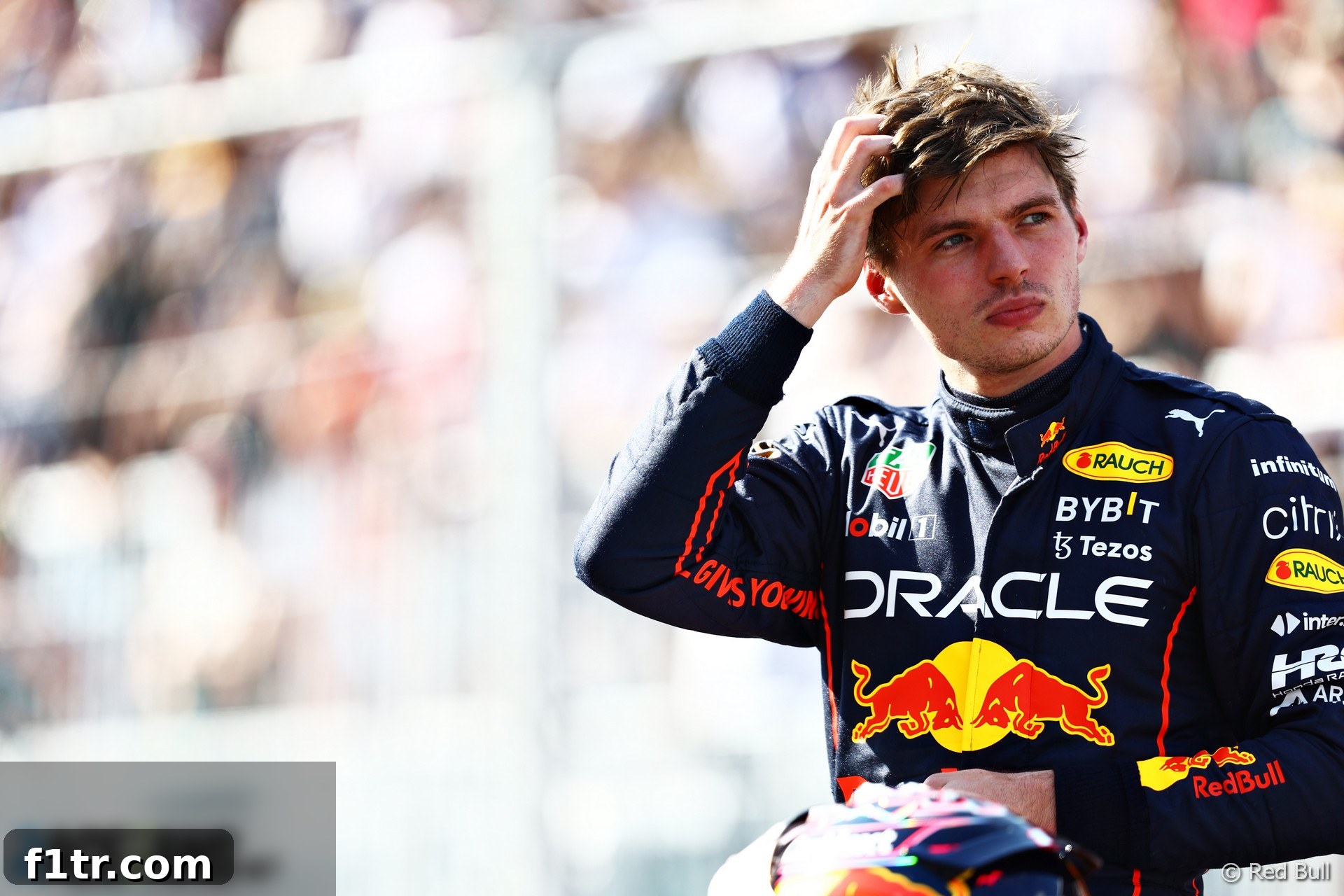
Max Verstappen has unequivocally stated that Red Bull Racing “cannot afford” a repeat of the disrupted race weekend they experienced at the inaugural Miami Grand Prix. The reigning Formula 1 world champion’s comments underscore the immense pressure on his team as they engage in a fiercely contested battle for supremacy against Ferrari this season. With the championship fight intensifying with each Grand Prix, every operational hiccup or car reliability issue could prove significantly costly, as vividly demonstrated by the challenges faced in Miami.
The highly anticipated Miami Grand Prix saw Ferrari’s formidable duo, Charles Leclerc and Carlos Sainz Jnr, secure a dominant front-row lockout for today’s race. This impressive qualifying performance by the Scuderia was a clear testament to their car’s strong pace and their team’s consistent execution. Despite enduring significant struggles throughout the preceding practice sessions, Verstappen, showcasing his immense talent, managed to secure a commendable third position on the grid, just ahead of his Red Bull teammate Sergio Perez. This grid configuration set the stage for an electrifying race, with the top two championship-contending teams poised for an intense showdown in the vibrant sunshine state.
Verstappen’s “Incredibly Messy” Miami Weekend: A Cascade of Problems
Verstappen’s entire weekend in Miami was plagued by a series of unfortunate events and persistent car-related issues, which severely compromised his invaluable track time and overall preparation. Friday’s running proved particularly disruptive, commencing with significant overheating problems that severely limited his participation in the first practice session (FP1). This initial setback was then compounded in the second practice session (FP2), where further unresolved issues completely prevented him from setting a single timed lap. Missing out on an entire crucial practice session on a brand-new, challenging street circuit is a monumental disadvantage, leaving both the driver and his engineers scrambling for essential data, rhythm, and a fundamental understanding of the track’s unique characteristics.
The challenges continued relentlessly into Saturday’s sessions. Although Verstappen managed to complete a respectable 20 laps in the final practice session (FP3), his session ended prematurely with a costly spin. This incident forced him to pit before the chequered flag, crucially denying him the opportunity to perform a practice start – an absolutely critical procedure for any race, especially when starting from a prime position on the grid. Practice starts allow drivers to fine-tune their clutch release, throttle application, and overall reaction time, all of which are vital for gaining positions or fiercely defending against rivals off the line. Without this essential preparation, Verstappen openly admitted his uncertainty about how his race start would unfold.
“I haven’t even done a start so I don’t even know how that’s going to go,” a visibly frustrated Verstappen commented, underlining the depth of his compromised weekend. “I haven’t seen any other starts, and I honestly cannot tell you because I haven’t done a start on the left side or on the right-hand side.” This candid admission starkly highlighted the extent of his hindered preparation. The profound lack of vital practice left significant question marks over his ability to directly challenge the dominant Ferraris from the moment the lights went out, a crucial phase of any Formula 1 Grand Prix where early position gains can dictate the entire race strategy.
“That just sums up my weekend – it’s just been incredibly messy. We just make it super-difficult for ourselves,” Verstappen continued, reflecting on the cumulative and cascading effect of the problems. He further elaborated on the profound impact: “Basically [only] four or five laps yesterday, then you start today still learning the track, try to find a set-up because yesterday you have no clue what works, because there’s not really a lot of data to look at.” This fundamental struggle to gather sufficient data and pinpoint an optimal car setup on a virgin track, combined with the critical lack of driver rhythm, collectively placed Red Bull at a significant operational disadvantage compared to their well-prepared rivals.
Despite the considerable adversity and the chaotic preparation, Verstappen acknowledged the positive outcome of securing third place on the grid. “I’m of course still pleased to be in third position and actually be very close to the guys next to me, but I think we can do so much better by just actually operating a bit cleaner and smoother.” This statement perfectly encapsulates the team’s underlying potential – to achieve strong results even under duress, but also the significant untapped performance waiting to be unlocked with a more seamless and trouble-free weekend operation. The fine margins that define success in Formula 1 mean that even seemingly small improvements in efficiency and reliability can yield substantial gains on the race track, potentially altering the course of a championship battle.
The Cost of Setbacks in a Title Fight: “You Cannot Afford That”
Verstappen’s primary concern and frustration revolved around the unfortunate timing of these persistent disruptions. He emphatically stressed that having such limited running, especially on an entirely new and unforgiving street circuit, is an indulgence Red Bull “cannot afford” when locked in such a fierce and high-stakes championship battle with a strong rival like Ferrari. “You cannot afford that on a new track, like this, and a street circuit in general, because it’s very critical to just do laps and understand the car and get in a rhythm,” he asserted. Street circuits, by their very nature, are inherently less forgiving than traditional, purpose-built race tracks, demanding pinpoint precision, absolute confidence, and a deep, intuitive understanding of the car’s limits. The chronic lack of continuous running throughout the practice sessions severely prevented Verstappen from reaching this critical state of harmony with both his cutting-edge machine and the challenging new track layout.
He drew a clear contrast with more established venues on the F1 calendar: “On a normal track, it’s quite easy to get in a rhythm. On a street circuit, it’s a lot more difficult, and we basically failed on that side.” This distinction highlights the unique and amplified challenges of adapting to new urban layouts and the significantly magnified impact of missed practice sessions in such environments. For Red Bull, a team globally recognized for its meticulous preparation, strategic acumen, and operational excellence, such a series of setbacks was unequivocally a source of deep frustration and a profound wake-up call in their relentless pursuit of both the coveted Drivers’ and Constructors’ championships.
“I think in general, we are experienced enough to catch up quite a lot of it, but to really fight – especially against a strong team like that – you cannot afford it,” Verstappen concluded. His words serve as a stark and potent reminder of the razor-thin margins that separate success from struggle at the pinnacle of global motorsport. While Red Bull’s extensive experience and the raw speed of the RB18 allowed them to mitigate some of the damage and still qualify competitively, the lost opportunities for critical optimization meant they were not operating at their absolute full potential. “Of course, we still got close, but I think we could have done a much better job today if we had a cleaner Friday.” The implication here is crystal clear: a smoother, trouble-free weekend could have potentially seen Verstappen challenging for pole position, rather than having to recover from a noticeable deficit that was largely self-inflicted by car issues and compromised track time.
Qualifying Drama: A Costly Turn 5 Mistake and Ferrari’s Seizure of Pole
Despite the severe handicap of limited practice time, Max Verstappen had, astonishingly, demonstrated impressive raw pace throughout the qualifying session and was genuinely in strong contention for pole position. His exceptional natural talent and the underlying speed of the Red Bull RB18 allowed him to push the absolute limits of the car, even with the significantly compromised preparation. However, a critical and costly mistake at turn five during his final Q3 effort proved to be the decisive factor. This momentary lapse in judgment, almost certainly a consequence of not fully understanding the car’s dynamic limits on a new and rapidly evolving track surface, provided a golden opportunity for Ferrari to capitalize decisively. Both Charles Leclerc and Carlos Sainz swiftly and expertly jumped ahead of him on the grid, securing a dominant and highly strategic front-row lockout for the Scuderia.
“[It was] a bit of a weird moment to lose the car, but again, it’s just not really knowing the limits, I guess, and just trying a bit more,” Verstappen explained, shedding invaluable light on the split-second decision-making process under the immense pressure of a Q3 lap. “Then suddenly it snapped in turn five, and I tried to keep it on the road, but that didn’t really work. So then I aborted, of course, I tried to stay out of the way of the cars behind me. But yeah, a bit odd the way it snapped, but these things can happen.” This candid and revealing explanation underscores the perilous tightrope walk that Formula 1 drivers perform in qualifying, always seeking that elusive extra tenth of a second, but sometimes inevitably overstepping the mark, particularly when track familiarity is low. The loss of rhythm, confidence, and crucial data from the prior disruptions undoubtedly played a significant, if not decisive, role in this critical and costly error.
Race Day Outlook: Red Bull’s Top Speed Advantage vs. Ferrari’s Balanced Performance
Looking ahead to the highly anticipated race day, Verstappen remained cautiously optimistic, banking heavily on Red Bull’s inherent strengths. The potent RB18 chassis has consistently demonstrated a higher top speed compared to the Ferraris along the two long straights that prominently characterize the Miami International Autodrome. This crucial straight-line advantage, particularly when aided by the DRS (Drag Reduction System), could prove to be a significant factor in facilitating overtaking opportunities during the Grand Prix. “I think overall the car is competitive. We have good top speed again, I hope that is something which can help us tomorrow,” Verstappen noted, pointing to a potential strategic weapon for the demanding race.
However, the race also presented several significant strategic unknowns. The unique Miami track surface, combined with the forecasted super-warm temperatures, introduced considerable uncertainty regarding tire degradation and overall management. “It’s going to be super warm, so you also don’t know what’s going to happen with the tyres entirely,” Verstappen observed. The critical lack of proper long-run data for most teams, including Red Bull, largely due to the limited practice sessions, meant that tire wear strategies would be largely unproven and based on theoretical models. This created a scenario ripe for unexpected challenges and potentially varying pit stop approaches among the top contenders. Successful and meticulous tire management would undoubtedly be paramount for any driver aiming for victory in these challenging conditions.
Verstappen’s ambition remained undimmed despite the difficult and frustrating build-up. “Because I think, all of us, we don’t really have a proper long run. So, there’s still a lot of question marks. But of course, I would have preferred to start a little bit ahead.” This sentiment perfectly reflects the relentless competitive spirit of a world champion who always aims for the very front of the grid. While starting third provided a strong and respectable platform, the ideal scenario would have been to leverage a clean and trouble-free weekend into a coveted pole position, thereby giving him the invaluable strategic advantage of leading into the critical Turn 1.
The Unfolding Championship Narrative: Key Lessons from Miami for Red Bull
The inaugural Miami Grand Prix served as a compelling microcosm of the intense and enthralling Red Bull-Ferrari championship battle. While Ferrari showcased their operational excellence, strategic clarity, and car balance to secure a dominant front-row lockout, Red Bull, and specifically Max Verstappen’s side of the garage, grappled with persistent car reliability issues and significant track integration challenges. The weekend vividly highlighted that in a season where both teams are so closely matched in underlying performance, flawless execution and bulletproof reliability are absolutely non-negotiable prerequisites for success. Any slip-up, whether technical in nature or operational in execution, can be immediately and ruthlessly exploited by the rival team. For Red Bull, the key takeaway and most urgent lesson from Miami was the immediate need to thoroughly address these recurring issues and ensure that future race weekends are executed with maximum precision, unwavering reliability, and minimal disruption.
The Formula 1 championship is not merely a test of raw speed; it is equally a comprehensive test of engineering robustness, strategic acumen, operational consistency, and the sheer resilience of the entire team. Miami, while a tough and frustrating lesson for Verstappen and Red Bull, also presented a crucial opportunity to learn, analyze, and regroup with renewed focus. As the season progresses and the stakes grow ever higher, every single point will count, and consistently avoiding such “messy” weekends will be paramount for their ultimate title aspirations. The race itself, with its many inherent unknowns, promised to be a compelling and unforgettable chapter in this thrilling F1 season, showcasing not just the blistering pace of the cars, but also the remarkable resilience, adaptability, and unwavering determination of the drivers and teams under immense pressure.
2022 Miami Grand Prix Insights
- Why TecPro barriers weren’t used at Miami chicane where Sainz and Ocon crashed
- Miami’s track surface is ‘a safety issue and does not offer good racing’ – Russell
- Miami Grand Prix draws F1’s largest live US television audience
- Alpine complain they had no say over penalty which cost Alonso points
- Red Bull wary of Ferrari’s high-speed cornering strength in Barcelona
Browse all 2022 Miami Grand Prix articles