Lewis Hamilton Fined for Dangerous Track Crossing at Qatar Grand Prix: A Deep Dive into F1 Safety Protocols
Formula 1 superstar Lewis Hamilton has been issued a significant €25,000 (£21,640) fine by the FIA for a safety breach during the 2023 Qatar Grand Prix. The Mercedes-AMG Petronas F1 Team driver was penalized for crossing a live race track after an early retirement from the Grand Prix, an incident that race stewards deemed potentially “extremely dangerous.” This decision underscores the FIA’s unwavering commitment to driver and track personnel safety, reinforcing the stringent regulations governing conduct during live race sessions.
In addition to the immediate financial penalty, Hamilton also received a formal reprimand. A further fine of the same value (€25,000) was imposed, but suspended for the remainder of the current Formula 1 season. This suspended penalty serves as a powerful deterrent, meaning any similar infraction before the season’s end would automatically trigger the payment of the additional sum, highlighting the FIA’s serious stance on such safety violations.
The Incident: A Close Call on a Live Track
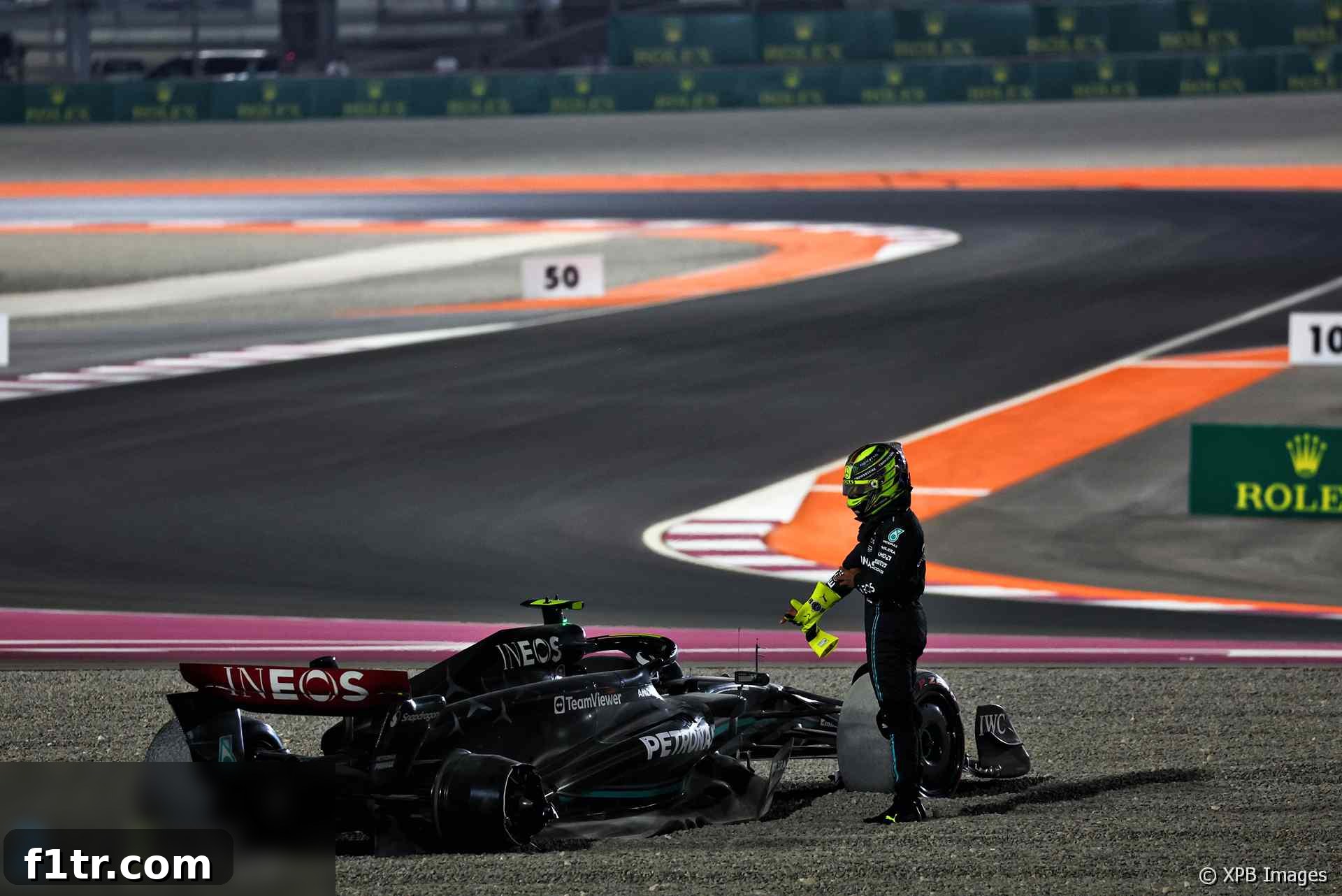
The incident occurred on the very first lap of the Qatar Grand Prix. Hamilton, starting from third position, made contact with his Mercedes teammate George Russell at Turn 1, leading to immediate damage for both cars. While Russell managed to continue, albeit dropping down the order, Hamilton’s W14 suffered terminal damage, forcing him to retire from the race on the spot. After abandoning his stricken car in the gravel trap, Hamilton proceeded to cross the active race circuit to return to the pit lane, a move that quickly drew the attention of race control and subsequently, the stewards.
The stewards’ official statement provided a clear and stark account of the events: “After crashing out of the race [on] lap one, the driver of car 44 [Hamilton] abandoned his car in the gravel and ran back to the pits. He thereby crossed the track that was live at this time and reached the inside edge of the track just seconds before car 63 [Russell] arrived at high speed after exiting the pits. He then continued to walk alongside the track until finally exiting the track.” The proximity of Russell’s car, moving at high speed, to Hamilton’s path illustrated the critical danger of the situation.
During the stewards’ investigation, Hamilton was noted to be “very apologetic and realised that the situation could have been very dangerous for him as well as the drivers approaching.” This acknowledgement of the potential severity of his actions played a role in the stewards’ assessment, but did not negate the need for a penalty to uphold safety standards.
FIA Regulations: Prioritizing Safety Above All Else
The FIA (Fédération Internationale de l’Automobile), the governing body for Formula 1, places paramount importance on safety. Its regulations are meticulously crafted to minimize risks for drivers, team personnel, and spectators alike. Crossing a live track, especially during a race, is a direct contravention of fundamental safety protocols. Drivers are explicitly instructed to remain in a safe location after an incident, awaiting guidance from marshals or race control, rather than attempting to return to the pits on foot across the track.
The stewards’ statement further elaborated on the gravity of the offense: “The stewards reinforced the fact that crossing a live track can cause extremely dangerous situations and the drivers have to be very cautious about it. In addition to imposing a significant fine (which is suspended in parts), the stewards also reprimand the driver bearing in mind that receiving a certain number of reprimands during a season will draw a significant driving penalty in accordance with Article 18.2 of the FIA Formula 1 Sporting Regulations.” This highlights the cumulative nature of reprimands, where accumulating too many can lead to grid penalties, impacting a driver’s championship aspirations.
The speeds involved in Formula 1 are immense, and a driver on foot is almost invisible to an approaching car, particularly if visibility is compromised by spray, dust, or the geometry of a corner. The incident involving Russell passing so close to Hamilton underscores the razor-thin margin for error and the absolute necessity for drivers to adhere to safety guidelines even in the heat of the moment following a race-ending crash.
Lewis Hamilton’s History with Fines: A Pattern of Procedural Infractions
While Hamilton’s driving record is largely clean regarding on-track safety infringements, this is not his first encounter with FIA fines for procedural or safety-related breaches. The stewards’ decision to impose a suspended fine suggests a recognition of a pattern, albeit a minor one, in his recent history.
Last year, during the 2022 Austrian Grand Prix, Hamilton was handed a suspended fine of €10,000 for a parc fermé violation. Parc fermé regulations dictate strict rules about how cars are handled and where personnel can be after qualifying or a race, primarily to prevent unauthorized modifications. Although two other drivers also committed this infringement, Hamilton did not repeat the offense, and therefore the suspended fine was not activated.
Even earlier, in 2021, at the Brazilian Grand Prix, Hamilton incurred a €5,000 fine and a suspended €20,000 fine for disconnecting his seatbelts while returning to the pits at the end of the race. This incident, while seemingly minor, also falls under critical safety protocols designed to protect drivers even during cool-down laps or when returning to the garage. The FIA’s consistent application of penalties for such infractions reinforces the message that safety is non-negotiable at any point during a Grand Prix weekend.
These past incidents, while different in nature, collectively indicate the FIA’s meticulous oversight of all aspects of driver conduct and safety compliance. They serve as a constant reminder to all competitors, regardless of their stature or experience, that adherence to the rules is paramount.
Broader Implications for Formula 1 Safety and Driver Conduct
This incident involving Lewis Hamilton serves as a crucial case study and a stark reminder of the ever-present dangers in motorsport. Even the most experienced and safety-conscious drivers can, in the immediate aftermath of a high-speed crash, make errors in judgment when adrenaline is high. The FIA’s firm response sends an unequivocal message across the paddock: safety protocols must be observed without exception.
The continuous evolution of safety standards in Formula 1, from car design to track infrastructure and operational procedures, is a testament to the sport’s commitment to protecting its participants. Incidents like Hamilton’s track crossing prompt a review not just of driver behavior, but also of communication protocols between race control, marshals, and drivers following an accident. Ensuring drivers are immediately aware of the safest path back to the pits, or instructed to await assistance, is vital.
Ultimately, the responsibility for safety is shared. While the FIA establishes the regulations and race control monitors adherence, each driver carries the personal responsibility to act in a manner that prioritizes their own safety and that of others. Lewis Hamilton’s apology underscores his understanding of this responsibility, acknowledging the potentially catastrophic consequences of his actions, even if unintended in the heat of the moment.
As Formula 1 continues to push the boundaries of speed and technology, the focus on human elements of safety remains paramount. The Qatar Grand Prix incident, and the subsequent penalty, will undoubtedly serve as a potent reminder for all drivers to exercise extreme caution and fully comply with safety directives at all times on a live circuit, reinforcing the culture of safety that is fundamental to the pinnacle of motorsport.
2023 Qatar Grand Prix
- Albon fears Qatar GP conditions risked creating dangerous “wet bulb effect”
- Alonso: New-spec fireproofs and pre-race anthem timing made Qatar heat worse
- Magnussen admits he took “too long to learn” Losail circuit
- Analysis: Sargeant’s Qatar radio reveals his painful struggle to end point-less run
- Alfa Romeo ‘finally understand their upgrade’ Bottas believes as team target Williams
Browse all 2023 Qatar Grand Prix articles