Sergio Perez Sheds Light on Controversial Unsafe Release Incident at Saudi Arabian Grand Prix
Red Bull Racing driver Sergio Perez has provided a candid and detailed explanation for his premature departure from the pit box during last weekend’s Saudi Arabian Grand Prix. The incident, which saw him ignore a red light signal, resulted in a crucial penalty point on his superlicence and a concerning near-miss with Aston Martin’s veteran driver, Fernando Alonso. Perez’s reflections offer valuable insight into the high-pressure environment of Formula 1 pit stops and the split-second decisions that can alter a race outcome.
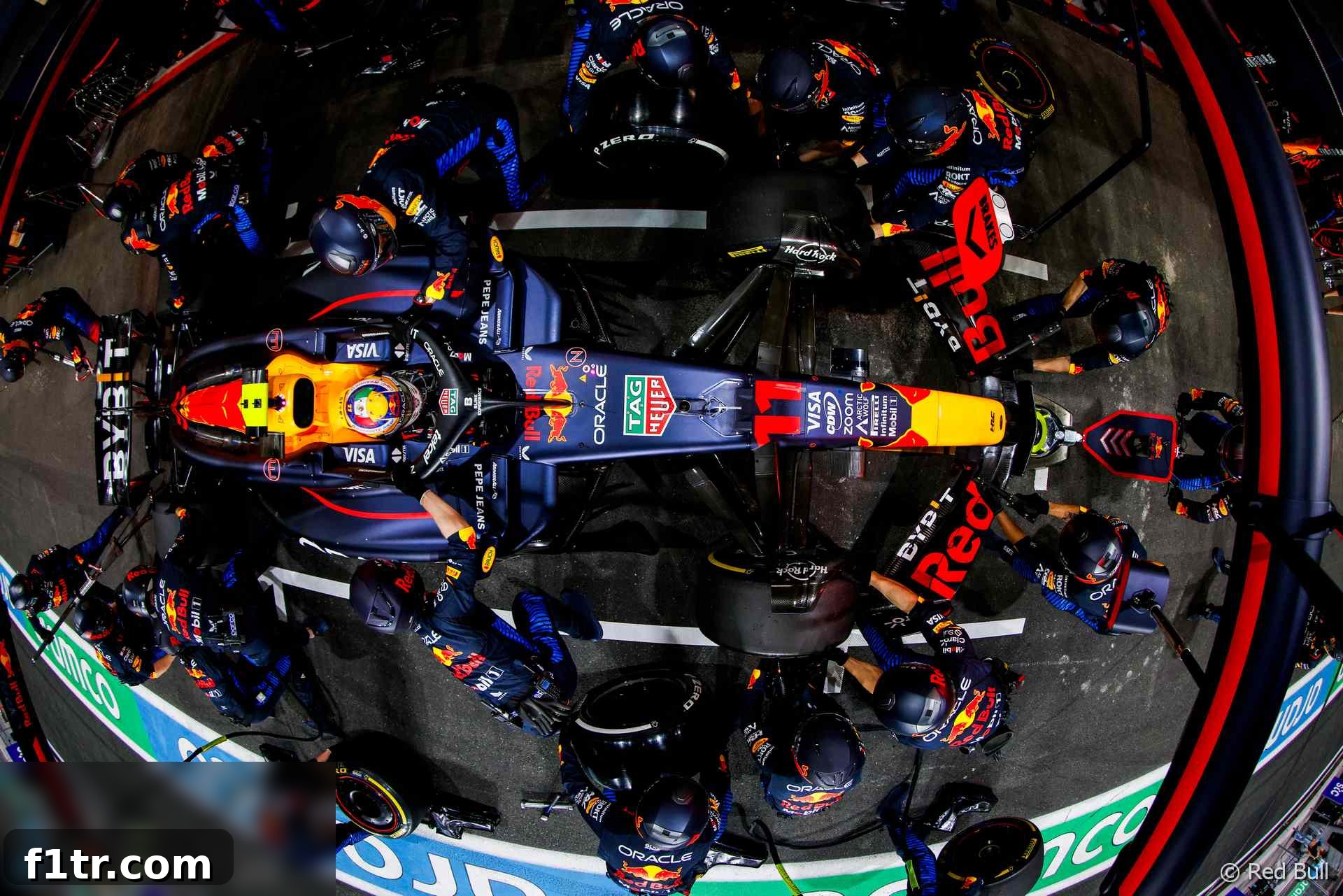
The Critical Moment: A Double Stack Under Safety Car Conditions
The genesis of the incident lay in the early deployment of the Safety Car during Saturday’s race. This common occurrence often triggers a wave of pit stops as teams seize the opportunity to change tyres without losing significant track position under green flag conditions. For leading teams like Red Bull, this frequently leads to a “double-stack” pit stop, where both cars pit sequentially. Perez found himself precisely in this high-stakes scenario, queuing behind his teammate, Max Verstappen.
It was as his pit stop concluded that the critical error occurred. Perez admitted to rejoining the pit lane too hastily, acknowledging his personal role in the unsafe release. “We were compromised with such an early Safety Car, and that meant basically everyone just pitted,” Perez recounted. He went on to take full responsibility: “When I was going out, it was actually my mistake, because I was told by the team to hold back. But I looked on the right, and there was nobody there when I looked.” This highlights the challenge for drivers, who must process information from their team, their own visual checks, and their intuition simultaneously in a matter of seconds.
Perez’s Evolution: From Frustration to Acceptance
Immediately after the race, still reeling from the events, Perez had initially pointed towards external factors, suggesting, “we just need a wider pit lane” in response to the tense situation. This initial reaction underscored the immense pressure and adrenaline associated with racing at the pinnacle of motorsport. However, with time for reflection and a more comprehensive review of the telemetry and video evidence, Perez demonstrated remarkable sportsmanship and accountability.
“In hindsight, I think the penalty was correct, and that pretty much compromised our race,” he conceded. This admission is significant, as it shows a clear understanding of the rules and the severity of his error. Elaborating on his decision-making process, Perez explained that he was concurrently observing his pit crew’s actions and the flow of traffic in the pit lane. “I saw that I didn’t have the proper release. But I didn’t see anyone [coming],” he reiterated, offering a glimpse into the driver’s internal struggle between caution and the inherent urge to rejoin the race as quickly as possible. He further added, “Sometimes the team can be a little bit slower than you in the car. But this time was the other way around, so, my bad in that one,” acknowledging that on this occasion, his judgment was flawed compared to the safety protocols communicated by his team.
Understanding the “Unsafe Release” and FIA Regulations
The “unsafe release” is one of the most serious infractions in Formula 1’s pit lane. The FIA (Fédération Internationale de l’Automobile) meticulously outlines regulations to ensure the safety of drivers, pit crew, and trackside personnel. Article 34.14 of the FIA Formula 1 Sporting Regulations explicitly states that “a car will be deemed to have been released unsafely if it is released from a pit stop position in a manner which is potentially dangerous to other drivers or team personnel.” This rule is non-negotiable and strictly enforced to prevent catastrophic accidents in the congested pit lane.
Pit lights, often supplemented by a manual ‘lollipop’ system in the past, are the primary visual cues for a driver. A red light signifies that the car must remain stationary, typically because another car is approaching, or the stop is not fully completed. A green light gives the all-clear. Perez’s decision to move forward despite the red light was a direct contravention of this critical safety procedure. The stewards’ decision to issue a penalty point was a direct consequence of this breach, underscoring the FIA’s unwavering commitment to safety standards, regardless of the driver’s intent or the perceived lack of immediate danger.
The Looming Threat: Superlicence Penalty Points and Race Bans
Beyond the immediate ramifications of a time penalty during a race, the accumulation of penalty points on a driver’s superlicence carries a far more significant long-term threat. The FIA’s penalty points system is designed to track persistent infringements, with severe consequences for drivers who repeatedly breach regulations. A driver who accumulates 12 or more penalty points within a 12-month rolling period automatically faces a one-race ban, a critical blow to any championship aspirations and team performance.
Perez’s single penalty point from Jeddah now elevates his total to a concerning eight points on his superlicence. This means he is just four points away from the dreaded race ban threshold for the next 15 rounds, a significant portion of the 2024 Formula 1 season. These points will remain active on his licence until the Singapore Grand Prix in September. This extended period places immense pressure on Perez to drive impeccably and avoid even minor infractions, as any further misstep could lead to a forced absence from a Grand Prix, an outcome that would severely impact Red Bull’s Constructors’ Championship campaign and his own standing.
Historical Perspective on Penalty Points and Race Bans
While outright race bans due to penalty points are relatively uncommon in modern Formula 1, the system has proven effective in shaping driver behavior. Notable instances, such as Romain Grosjean’s ban in 2012 for dangerous driving at the Belgian Grand Prix (though under a different system of direct bans for specific offenses), highlight the FIA’s firm stance on safety. For Perez, this elevated penalty point tally means he will be under increased scrutiny from both race stewards and his own team, navigating each race with an added layer of caution and strategic awareness.
Implications for Red Bull and the 2024 Championship Battle
While the Saudi Arabian incident did not drastically alter Perez’s race result – he finished second behind teammate Verstappen – the long-term implications for Red Bull Racing cannot be understated. In a championship battle where every point is crucial, the potential loss of a driver for a race weekend could prove detrimental. Red Bull relies on both drivers to consistently score high points, not only for the Constructors’ Championship but also to keep rival teams at bay.
The psychological impact on Perez himself is also noteworthy. Driving with the constant awareness of being on the precipice of a ban could subtly influence his approach to racing, potentially leading to a more conservative style in wheel-to-wheel combat or during other high-risk moments. This incident serves as a stark reminder that in Formula 1, success is a delicate balance of aggressive driving, strategic brilliance, and unwavering adherence to the rulebook. Red Bull will undoubtedly be working closely with Perez to ensure he maintains focus and avoids further penalty-inducing situations as the intense 2024 season progresses.
Conclusion: A Crucial Learning Moment for the Season Ahead
Sergio Perez’s unsafe release at the Saudi Arabian Grand Prix stands as a significant learning moment, illustrating the extreme pressures and unforgiving nature of Formula 1. His honest assessment and acceptance of responsibility underscore a mature approach to a critical error, highlighting the personal accountability demanded at the elite level of motorsport. While the immediate penalty was a single point, the accumulating eight points on his superlicence now place him in a precarious position, just four points away from a race ban for a substantial portion of the season. This situation will undoubtedly necessitate increased vigilance and precision from Perez in the upcoming races.
For Red Bull Racing, the incident prompts a review of pit stop procedures and communication protocols, ensuring that safety remains paramount even amidst the quest for championship glory. As the 2024 Formula 1 season unfolds, all eyes will be on Sergio Perez, not only for his race performances but also for his ability to navigate the complex landscape of FIA regulations and avoid any further incidents that could jeopardize his, and his team’s, championship aspirations.
More from the 2024 Saudi Arabian Grand Prix
- Bearman’s 2024 Jeddah debut performance makes him ‘feel like an absolute idiot’
- Vowles being patient with Sargeant but expects to see “progress”
- “So I’ve got nothing to worry about?” – The best unheard team radio from Jeddah
- “Shock” of poor start to season showed need for change at Alpine – Famin
- “My tyres are dying”: Stroll’s short-lived struggle until he hit the wall
Browse all 2024 Saudi Arabian Grand Prix articles