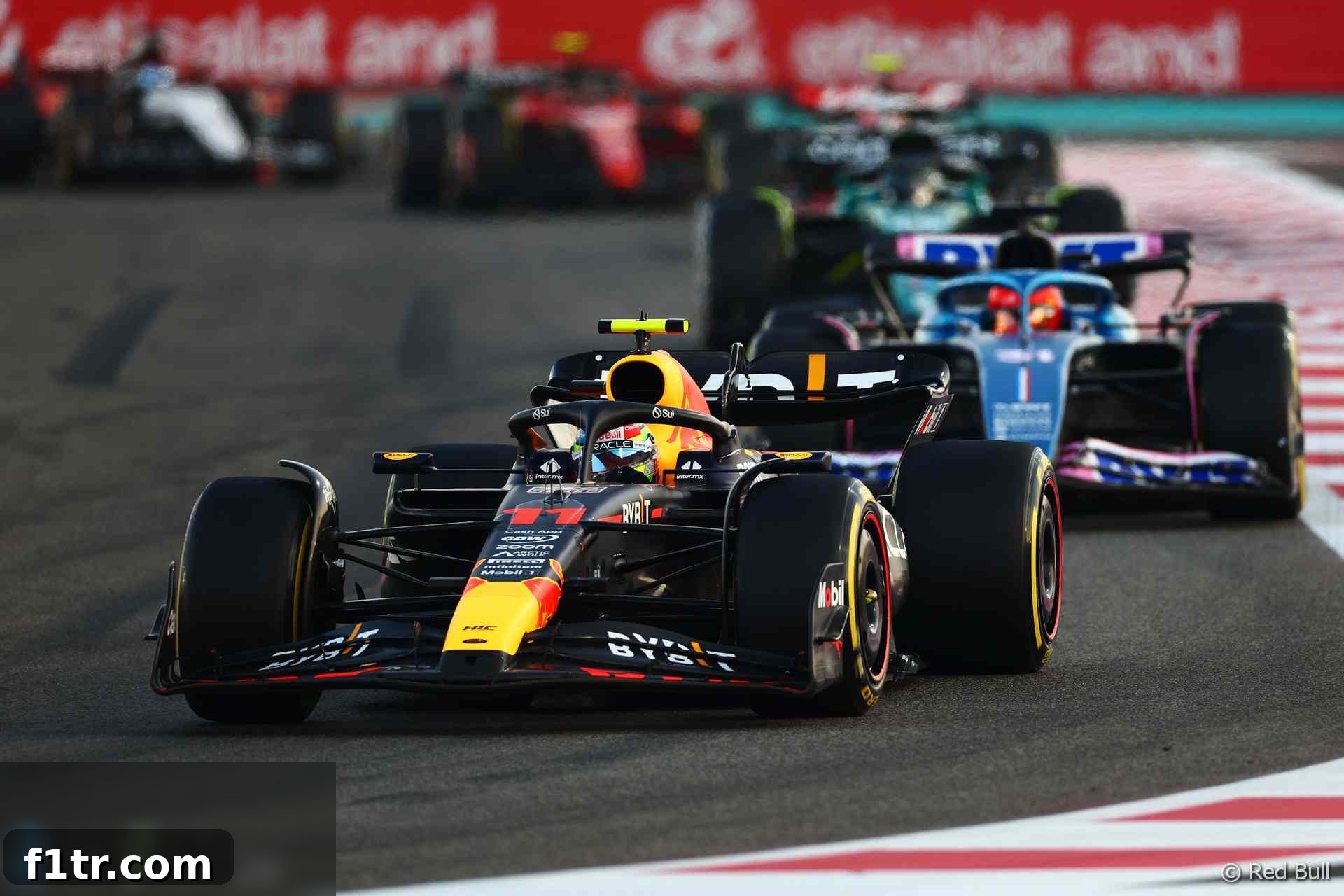
Sergio Perez Receives Formal Warning for Insulting Stewards Following Abu Dhabi Grand Prix Penalty
In a dramatic conclusion to the Formula 1 season at the Abu Dhabi Grand Prix, Red Bull Racing driver Sergio Perez found himself in hot water with race officials. Perez was issued a formal warning by the stewards for comments made over his team radio, where he expressed strong disapproval and insulted them after receiving a five-second time penalty during the race. This incident sparked a significant discussion about driver conduct, the role of F1 stewards, and the pressures of elite motorsport.
The controversy unfolded immediately after the final checkered flag. Perez, visibly frustrated, took to his team radio to voice his indignation, stating, “The stewards are a joke, man. I cannot believe it. They have been very bad this year but this is a joke. That was really a joke.” His outburst came after the stewards imposed a five-second time penalty, which ultimately demoted him from a potential second-place finish to fourth, costing him a valuable podium spot in the season finale. This penalty was attributed to a collision with McLaren driver Lando Norris earlier in the race.
The On-Track Collision with Lando Norris
The contentious incident occurred at Turn 6 of the Yas Marina Circuit. Perez and Norris were locked in a tight battle when the Red Bull driver attempted an overtake on the inside line. As the two cars navigated the left-hander, contact was made, forcing Norris off track into the run-off area. The stewards meticulously reviewed the footage and concluded that Perez was primarily responsible for the collision.
Their official statement detailed the sequence of events: “Coming into Turn 6, notwithstanding that car 11 [Perez] was alongside car four [Norris], the driver of car 11 dived in late, missed the apex of the corner and understeered towards the outside of the corner colliding with car four.” This assessment led not only to the five-second time penalty but also to two endorsement points being added to Perez’s Super Licence. These two points brought his total for the current 12-month period to seven. Accumulating 12 penalty points within a year automatically triggers a one-race ban, a threshold that Perez is now significantly closer to.
Post-Race Outburst and Breach of Code
The severity of the penalty and its immediate impact on his race result fueled Perez’s emotional radio transmission. After being informed by his race engineer, Hugo Bird, that the penalty had indeed cost him a podium finish, the Mexican driver’s frustration boiled over. His strong words, broadcast globally, quickly became a focal point of post-race analysis.
Recognizing the gravity of the comments, the F1 stewards swiftly summoned Perez for a potential breach of Article 12.2.1.k of the International Sporting Code. This specific article strictly forbids “Any misconduct towards […] officers or member of the staff of the FIA,” among other personnel. The initial document mistakenly cited the incident time, but a subsequent revision clarified that the summoning pertained to comments made around 6:31 pm, coinciding with the conclusion of the race. This demonstrated the seriousness with which the FIA regards maintaining respect and decorum towards its officials, crucial for the integrity of the sport.
Perez’s Apology and the Stewards’ Response
Following the summons, Sergio Perez appeared before the stewards to address his remarks. In what was described as a “genuine and sincere apology,” Perez explained that his comments were made “in the heat of the moment” and that he had not considered the implications of them being broadcast to a global audience. He expressed profound regret for any offense caused or potential harm to the sport, emphasizing his commitment to its positive image.
The stewards, in their ruling, acknowledged Perez’s remorse. They stated that while they “had no issue with someone disagreeing with their decisions,” comments that “amount to personal insults are a breach of the International Sporting Code.” They further noted Perez’s generally respectful demeanor in previous hearings, underscoring that such outbursts were uncharacteristic for the Red Bull driver. Accepting his apology, the stewards decided to issue a formal warning rather than a harsher penalty, such as a fine or a further grid penalty for a future race. This decision highlighted a balance between upholding the code of conduct and recognizing the human element of high-pressure sports.
A constructive discussion reportedly took place between Perez, his team manager, and the stewards regarding the broader topic of team radio messages and their public broadcast. The incident itself was also reviewed in detail, where Perez, while still disagreeing with the ultimate penalty decision for the collision, stated he could “understand the stewards’ perspective of the incident.” This dialogue aimed to foster better understanding and mutual respect moving forward.
The Stewards’ Unique Position and Red Bull’s Support
An unusual aspect of this particular incident was the stewards’ acknowledgment of a conflict of interest. They openly stated they were “obviously conflicted in this matter as they were the subject of the radio statements.” Typically, such a matter might be referred to a different panel of stewards. However, given that this was the final event of the season, the immediate resolution was deemed necessary.
Red Bull Team Principal Christian Horner publicly supported his driver, defending Perez’s understandable frustration. Speaking before the formal warning was announced, Horner told Sky, “You can understand drivers’ frustration. I mean, how often do we see football players venting their frustration?” He emphasized the intense pressure and the global audience that Formula 1 commands. Horner himself had faced a similar sanction in 2021, receiving an official warning for comments he made about a “rogue marshal” after Max Verstappen received a penalty at the Qatar Grand Prix, providing a contextual parallel for the current situation. “The problem is that everything is broadcast to a global audience,” Horner added. “For Checo to lose that podium after such a great drive, you can understand a bit of frustration.”
Perez and Norris Offer Contrasting Views on the Collision
The on-track collision remained a point of contention between the two drivers involved. Speaking to the media after the race, Sergio Perez reiterated his disagreement with the initial penalty for the incident with Norris. He argued for shared responsibility, stating, “To be totally honest I think we ended up contacting, which was unfortunate. But to make contact you require both parties.”
Perez firmly believed that Lando Norris also carried a degree of blame: “I think Lando also had some responsibility on that because he turned in to me as if there was no one there. We ended up making contact tyre to tyre as I was fully alongside him. He cut the corner, he gained time and I still had the penalty. So I honestly don’t agree with the decision but there’s nothing you can do.” He further insisted that Norris did not suffer any disadvantage, and arguably gained from the maneuver, reinforcing his view that it was a “50-50” racing incident that should not have warranted a penalty for him alone.
Lando Norris, however, expressed considerable astonishment at Perez’s driving. He stated that he had not been actively defending his position aggressively and simply could not comprehend why Perez had made contact with him. Norris’s perspective suggested that Perez’s move was ill-judged and led to an unnecessary collision, a sentiment that aligns with the stewards’ initial ruling that placed responsibility squarely on the Red Bull driver.
The Broader Implications for F1 Conduct
This incident transcends a simple penalty and an apology; it sheds light on the broader dynamics of conduct within the high-stakes world of Formula 1. The intense pressure on drivers to perform at their peak, coupled with the immediate and global broadcast of their every word, creates a unique environment. While raw emotion is part of the sport’s appeal, the FIA’s International Sporting Code exists to ensure a baseline of respect for officials who make difficult, split-second decisions under immense scrutiny.
The formal warning issued to Sergio Perez serves as a reminder to all competitors about the boundaries of expressing frustration. It underscores that while disagreement with official decisions is permissible, personal insults cross a line. The constructive dialogue that followed between Perez and the stewards, even amidst their initial conflict of interest, suggests a commitment to fostering mutual understanding. This event will likely be referenced in future discussions regarding sporting integrity, driver professionalism, and the delicate balance between passion and protocol in Formula 1.
Become a RaceFans Supporter
RaceFans is run thanks in part to the generous support of its readers. By contributing £1 per month or £12 per year (or the same in whichever currency you use) you can help cover the costs of creating, hosting and developing RaceFans today and in the future.
Become a RaceFans Supporter today and browse the site ad-free. Sign up or find out more via the links below:
- Become a RaceFans Supporter
- RaceFans Supporter FAQ
More from the 2023 Abu Dhabi Grand Prix
- Mercedes’ team photo shows we still have a long way to go on diversity – Hamilton
- Why luck was a factor in Perez’s penalty for “joke” comment
- Bottas and Zhou see encouraging signs from overhauled 2024 car
- Only Verstappen got the best from his car every weekend, rival team bosses admit
- How Sainz suffered the worst season finale for a driver since Schumacher in 1997
Browse all 2023 Abu Dhabi Grand Prix articles