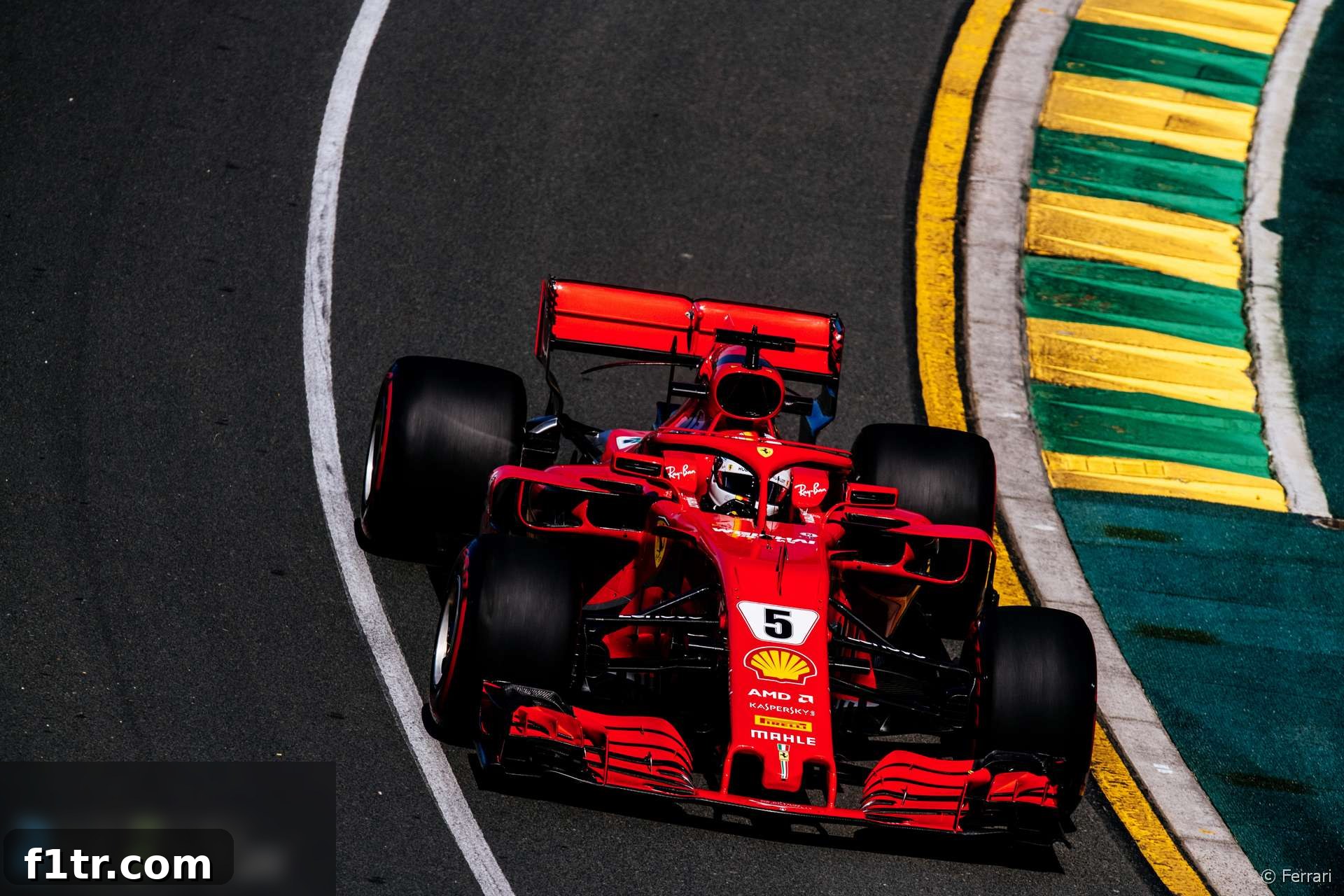
Australian Grand Prix Free Practice 3: Ferrari Takes Command in Evolving Conditions
The final free practice session ahead of the 2018 Australian Grand Prix at Albert Park proved to be a pivotal and intriguing affair, offering a glimpse into potential qualifying and race strategies. Ferrari, demonstrating exceptional adaptability and strategic foresight, emerged at the top of the time sheets by a significant margin. Their drivers, Sebastian Vettel and Kimi Raikkonen, made a decisive late charge on slick tires as the track rapidly dried, setting lap times that left their competitors trailing.
This critical session saw the Scuderia exploit the evolving track conditions to perfection. Sebastian Vettel, in particular, showcased formidable pace, outpacing his teammate Kimi Raikkonen by an impressive two-and-a-half seconds. The only other driver to truly capitalize on the improving conditions with ultra-soft slick tires was Marcus Ericsson from Sauber-Ferrari, who impressively secured third position. This trio’s performance stood in stark contrast to the rest of the field, most of whom had completed their best laps on intermediate wet weather tires, finding themselves almost three seconds adrift.
Strategic Gambles and Missed Opportunities in Dynamic Conditions
The FP3 session commenced on an exceptionally wet track, a stark continuation of the challenging conditions experienced earlier in the weekend. However, with no further rain falling, the circuit surface at Albert Park underwent a rapid transformation, transitioning from heavily soaked to a damp, and then progressively drier state. This evolution presented teams with complex strategic choices regarding tire selection, a decision that ultimately defined the session’s outcome.
Early in the session, before the track began its rapid dry-out, Max Verstappen of Red Bull Racing comfortably led the pack. His early intermediate tire runs saw him holding an advantage of over a second, indicating strong performance from the Red Bull chassis in tricky conditions. However, as the clock ticked down and a dry line began to emerge, the focus shifted to those brave enough to switch to slick tires.
While Ferrari masterfully executed their slick tire strategy, not all teams attempting this gamble were successful. Valtteri Bottas for Mercedes, along with both Toro Rosso drivers, also ventured out on slicks late in the session. Unfortunately, they ran out of time to complete a flying lap, leaving their true dry pace in question. Fernando Alonso, driving for McLaren, voiced his frustration over team radio, having also missed the window to set a representative time on slicks, highlighting the fine margins and critical timing involved in such unpredictable conditions.
Beyond the tire drama, other teams faced their own challenges. Lance Stroll of Williams endured a delayed start to his session as his team worked diligently to rectify a gearbox problem on his car. Meanwhile, the Force India drivers had an even more curtailed outing, only completing installation laps at the very beginning of the session before spending the remainder of the hour in the pits, underscoring potential technical issues or a decision to conserve equipment given the conditions.
Australian Grand Prix FP3 Session: Detailed Results
The final practice session’s results underscore Ferrari’s impressive showing and the significant advantage gained by those who timed their slick tire runs perfectly. Below is a comprehensive breakdown of the lap times from FP3:
| Pos. | No. | Driver | Car | Best lap | Gap | Laps |
|---|---|---|---|---|---|---|
| 1 | 5 | Sebastian Vettel | Ferrari | 1’26.067 | 15 | |
| 2 | 7 | Kimi Raikkonen | Ferrari | 1’28.499 | 2.432 | 13 |
| 3 | 9 | Marcus Ericsson | Sauber-Ferrari | 1’28.890 | 2.823 | 14 |
| 4 | 33 | Max Verstappen | Red Bull-TAG Heuer | 1’31.680 | 5.613 | 8 |
| 5 | 55 | Carlos Sainz Jnr | Renault | 1’33.172 | 7.105 | 11 |
| 6 | 3 | Daniel Ricciardo | Red Bull-TAG Heuer | 1’34.043 | 7.976 | 14 |
| 7 | 77 | Valtteri Bottas | Mercedes | 1’34.174 | 8.107 | 14 |
| 8 | 44 | Lewis Hamilton | Mercedes | 1’34.225 | 8.158 | 7 |
| 9 | 2 | Stoffel Vandoorne | McLaren-Renault | 1’34.233 | 8.166 | 15 |
| 10 | 14 | Fernando Alonso | McLaren-Renault | 1’34.298 | 8.231 | 13 |
| 11 | 10 | Pierre Gasly | Toro Rosso-Honda | 1’34.990 | 8.923 | 16 |
| 12 | 28 | Brendon Hartley | Toro Rosso-Honda | 1’35.438 | 9.371 | 16 |
| 13 | 35 | Sergey Sirotkin | Williams-Mercedes | 1’35.589 | 9.522 | 16 |
| 14 | 18 | Lance Stroll | Williams-Mercedes | 1’35.828 | 9.761 | 8 |
| 15 | 8 | Romain Grosjean | Haas-Ferrari | 1’36.171 | 10.104 | 6 |
| 16 | 16 | Charles Leclerc | Sauber-Ferrari | 1’36.448 | 10.381 | 12 |
| 17 | 20 | Kevin Magnussen | Haas-Ferrari | 1’36.807 | 10.740 | 7 |
| 18 | 27 | Nico Hulkenberg | Renault | 1’38.482 | 12.415 | 8 |
The FP3 table highlights the sheer speed differential when a driver hits the optimal track conditions on the correct tires. Vettel’s time was over 5.6 seconds faster than Max Verstappen, who was the best of the intermediate runners. This stark difference emphasizes the dramatic track evolution and Ferrari’s successful gamble. It also shows a significant grouping of drivers in the mid-field, with less than a second separating Carlos Sainz in fifth from Fernando Alonso in tenth, indicating a tightly contested battle for points.
The Bigger Picture: Combined Practice Pace Across the Weekend
While FP3 offered a snapshot of performance under specific, transitional conditions, the combined lap times from all three practice sessions provide a more comprehensive overview of each team’s underlying pace, particularly focusing on the fastest laps set in drier conditions (typically FP2). This cumulative data is often a better indicator of true potential heading into qualifying and the race.
Combined Lap Times (FP1, FP2, FP3)
| Pos | Driver | Car | FP1 | FP2 | FP3 | Fri/Sat diff | Total laps |
|---|---|---|---|---|---|---|---|
| 1 | Lewis Hamilton | Mercedes | 1’24.026 | 1’23.931 | 1’34.225 | +10.294 | 69 |
| 2 | Max Verstappen | Red Bull-TAG Heuer | 1’24.771 | 1’24.058 | 1’31.680 | +7.622 | 68 |
| 3 | Valtteri Bottas | Mercedes | 1’24.577 | 1’24.159 | 1’34.174 | +10.015 | 77 |
| 4 | Kimi Raikkonen | Ferrari | 1’24.875 | 1’24.214 | 1’28.499 | +4.285 | 75 |
| 5 | Sebastian Vettel | Ferrari | 1’24.995 | 1’24.451 | 1’26.067 | +1.616 | 75 |
| 6 | Romain Grosjean | Haas-Ferrari | 1’25.730 | 1’24.648 | 1’36.171 | +11.523 | 64 |
| 7 | Daniel Ricciardo | Red Bull-TAG Heuer | 1’25.063 | 1’24.721 | 1’34.043 | +9.322 | 67 |
| 8 | Fernando Alonso | McLaren-Renault | 1’25.896 | 1’25.200 | 1’34.298 | +9.098 | 57 |
| 9 | Kevin Magnussen | Haas-Ferrari | 1’27.035 | 1’25.246 | 1’36.807 | +11.561 | 50 |
| 10 | Stoffel Vandoorne | McLaren-Renault | 1’26.482 | 1’25.285 | 1’34.233 | +8.948 | 63 |
| 11 | Carlos Sainz Jnr | Renault | 1’25.922 | 1’25.390 | 1’33.172 | +7.782 | 69 |
| 12 | Sergio Perez | Force India-Mercedes | 1’26.767 | 1’25.413 | 57 | ||
| 13 | Nico Hulkenberg | Renault | 1’26.583 | 1’25.463 | 1’38.482 | +13.019 | 68 |
| 14 | Lance Stroll | Williams-Mercedes | 1’26.636 | 1’25.543 | 1’35.828 | +10.285 | 70 |
| 15 | Esteban Ocon | Force India-Mercedes | 1’26.605 | 1’25.888 | 64 | ||
| 16 | Brendon Hartley | Toro Rosso-Honda | 1’27.745 | 1’25.925 | 1’35.438 | +9.513 | 73 |
| 17 | Pierre Gasly | Toro Rosso-Honda | 1’26.494 | 1’25.945 | 1’34.990 | +9.045 | 80 |
| 18 | Sergey Sirotkin | Williams-Mercedes | 1’26.536 | 1’25.974 | 1’35.589 | +9.615 | 78 |
| 19 | Marcus Ericsson | Sauber-Ferrari | 1’27.964 | 1’26.814 | 1’28.890 | +2.076 | 73 |
| 20 | Charles Leclerc | Sauber-Ferrari | 1’28.853 | 1’26.815 | 1’36.448 | +9.633 | 75 |
Examining the combined times, it’s clear that Lewis Hamilton and Mercedes held a strong hand in the dry conditions of FP2, with Hamilton setting the fastest lap of the weekend so far. Max Verstappen and Valtteri Bottas also demonstrated competitive pace, underscoring the fierce battle at the front. Ferrari, while dominating FP3, appears slightly behind Mercedes and Red Bull in overall dry pace based on their FP2 times. This suggests that their FP3 advantage was largely context-dependent on tire choice and track evolution. Haas drivers Romain Grosjean and Kevin Magnussen showed impressive dry pace in FP2, indicating their potential to challenge for strong grid positions.
Understanding the Gaps: A Closer Look at FP3 Performance
The final practice session’s dynamic nature resulted in significant performance gaps, largely dictated by when and on what tires drivers completed their fastest laps. Sebastian Vettel’s exceptional run on slicks placed him at the top with a 1’26.067. His teammate, Kimi Raikkonen, was 2.432 seconds behind, followed closely by Marcus Ericsson, who was 2.823 seconds off Vettel’s pace. These were the only three drivers to truly exploit the drying track with slick tires.
The gap dramatically widens for drivers who completed their best laps on intermediate tires. Max Verstappen, for instance, was 5.613 seconds behind Vettel. Carlos Sainz Jr. followed with a gap of 7.105 seconds, and Daniel Ricciardo was 7.976 seconds adrift. The Mercedes duo, Valtteri Bottas and Lewis Hamilton, were 8.107 and 8.158 seconds behind respectively, having not set representative slick tire times. Other notable gaps include Stoffel Vandoorne (+8.166), Fernando Alonso (+8.231), Pierre Gasly (+8.923), Brendon Hartley (+9.371), Sergey Sirotkin (+9.522), and Lance Stroll (+9.761). These wide margins vividly illustrate the profound impact of track conditions and tire strategy during this particular session.
Drivers more than ten seconds off the pace omitted from this analysis.
Looking Ahead: Qualifying and Race Prospects
The unpredictable nature of the Albert Park circuit, coupled with the varied conditions experienced across the practice sessions, sets the stage for a thrilling qualifying and race. While Ferrari’s FP3 performance was stellar, the underlying dry pace seen in FP2 suggests Mercedes and Red Bull remain formidable contenders for pole position. The battle for the top spot will likely be intensely fought, with strategic tire calls potentially playing a role even in qualifying, depending on any lingering damp patches.
For race day, tire degradation and further weather changes will be crucial factors. Teams will be analyzing all the data from practice to fine-tune their setups and formulate the optimal strategy. The close midfield suggests that points positions will be hotly contested, promising an exciting and unpredictable Australian Grand Prix. The opening race of the season often throws up surprises, and this weekend in Melbourne looks set to deliver.
Engage with the F1 Action: Predictions Championship and Further Reading
Don’t miss out on the chance to test your Formula 1 knowledge and predict the outcome of this weekend’s race! Enter your predictions for the Australian Grand Prix before qualifying begins to join the excitement:
- Make your race predictions here now
2018 Australian Grand Prix Coverage
- Top ten pictures from the 2018 Australian Grand Prix
- 2018 Australian Grand Prix Star Performers
- Vettel can’t ignore Mercedes’ superior speed after lucky win
- McLaren equal best result of last Honda era in first race with Renault
- Vote for your 2018 Australian Grand Prix Driver of the Weekend
Browse all 2018 Australian Grand Prix articles