Eight years ago, a prodigious 17-year-old talent, not yet legally permitted to drive a road car at the speed limit, made his electrifying Formula 1 debut at the iconic Albert Park circuit in Melbourne. This young phenom would, just 14 months later, etch his name into the history books as the youngest-ever Grand Prix winner, marking the initial chapters of what has already become one of Formula 1’s most decorated and successful careers.
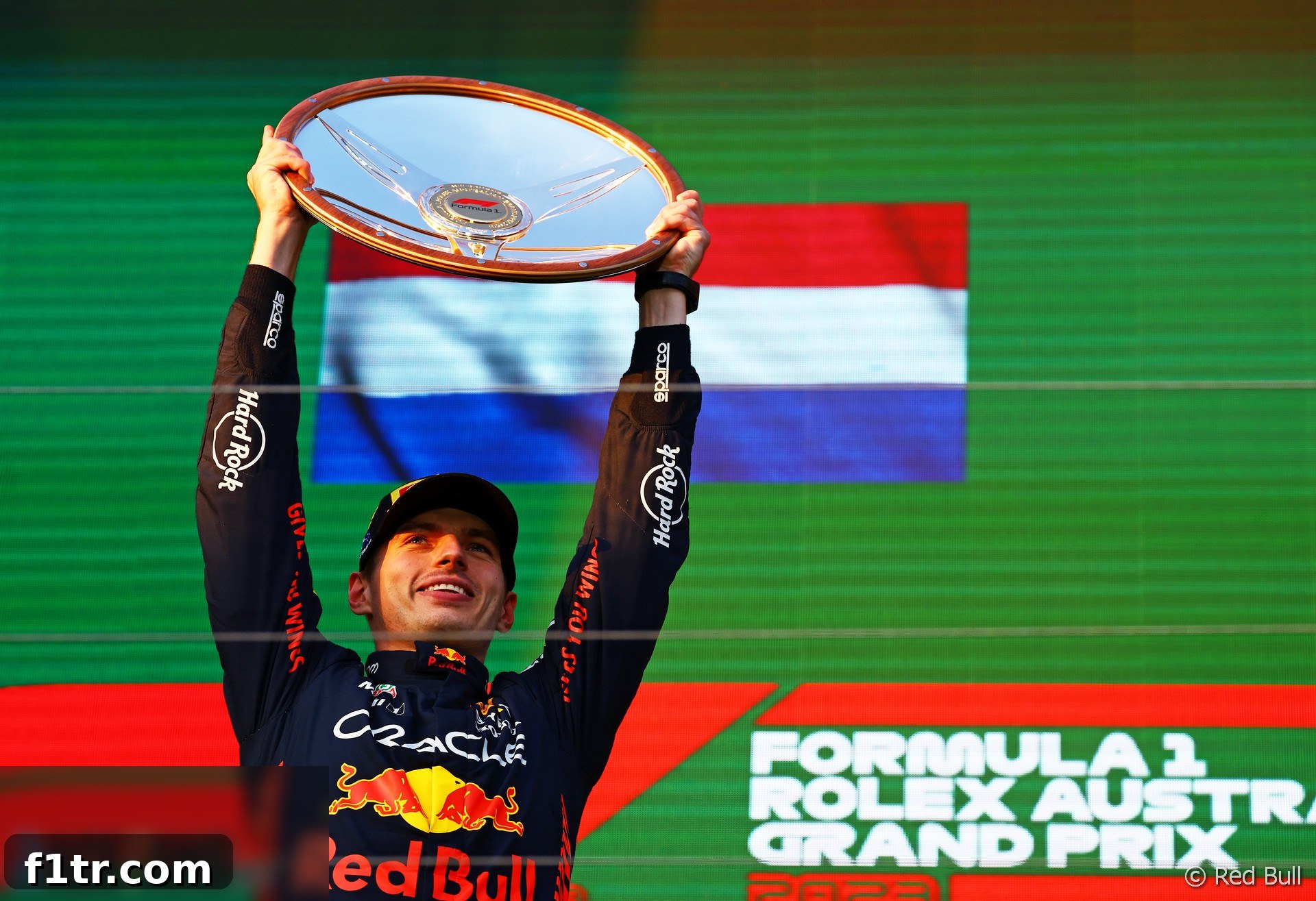
Fast forward to 2023, and that same driver, Max Verstappen, returned to Australia, but this time with a new distinction: it was his first visit as the reigning Formula 1 World Champion and current championship leader. His objective was clear and prestigious – to claim the unique dish-shaped Sir Jack Brabham trophy for the first time in his career, one of only four circuit trophies this year that had yet to grace his extensive cabinet of accolades.
Heading into the 2023 Australian Grand Prix, the world champion found himself in an enviably strong position for victory. Red Bull’s early season dominance was undeniable, a fact underscored by Verstappen securing the team’s third pole position from three attempts. Further bolstering his prospects, his formidable teammate, Sergio Perez, was relegated to starting from the pit lane. This unfortunate fate was the consequence of a substandard qualifying session that culminated in a trip into the turn three gravel trap, effectively removing a key challenger from the immediate front of the grid.
Despite Red Bull’s clear advantage, two silver arrows cast long shadows over Verstappen at the front of the grid: George Russell and Lewis Hamilton. Mercedes had, against prevailing narratives of their performance struggles, delivered their best qualifying result of the season, showcasing a newfound pace. Yet, just behind them, both Fernando Alonso and Carlos Sainz Jnr harbored quiet confidence. While their Aston Martin and Ferrari machines had been outmaneuvered by Mercedes on Saturday, they were convinced that their race pace would prove superior on Sunday, setting the stage for an intriguing battle among the leading contenders.
As the top seven qualifiers aligned their cars in their newly expanded grid slots, all fitted with medium compound tyres, the anticipation was palpable. A potential six-way tussle for the coveted positions behind Max Verstappen seemed to be in the making, promising a gripping contest. However, all preconceptions were shattered the moment the starting lights extinguished, plunging the circuit into immediate drama and reshuffling the order in an instant.
Verstappen’s start was solid, but Russell’s was nothing short of spectacular. As Verstappen moved to strategically squeeze the Mercedes to the inside on the charge to the first corner, Russell was briefly forced towards the pit exit line. Unfazed, Russell masterfully held the inside line, sweeping into a surprising lead. Verstappen’s compromised exit then left him vulnerable to the approaching Hamilton. Though not as far alongside as his teammate, Hamilton displayed remarkable nerve, holding the inside line into turn three to bravely muscle Verstappen down to third place. This bold maneuver immediately prompted objections and frustration from the pole-winner over team radio, signaling an intense start to the race.
Just two car lengths behind the leading trio, Ferrari’s Charles Leclerc fiercely refused to be overtaken by both Aston Martins as they approached turn three. However, as he turned into the tight right-hander, Lance Stroll had already occupied the precise piece of tarmac the Ferrari driver intended to claim. Inevitable contact ensued, sending Leclerc’s car sliding uncontrollably into the same gravel trap that had regrettably claimed Sergio Perez just a day prior. After a desperate 20-second struggle, praying for some miraculous traction to pull him free, Leclerc was forced to concede defeat, his race ending prematurely.
“That’s it,” Leclerc lamented, his voice tinged with resignation as he surrendered to his unfortunate fate. “Lance touched my rear-right wheel.” This marked a second disappointing failure to finish in just three rounds for a driver who, merely one year prior, had departed Australia with one of the strongest early championship leads any Ferrari driver had ever enjoyed, highlighting the cruel unpredictability of Formula 1.
Mere seconds after Leclerc disembarked from his stricken Ferrari, an automated voice cut through the silence of his now-empty cockpit: “Safety Car deployed. Stay positive.” Indeed, the iconic red Mercedes AMG Safety Car, patiently waiting at the pit exit, soon found itself leading two of its silver siblings around the circuit at the conclusion of the very first lap. Russell and Hamilton had orchestrated a remarkable transformation of Mercedes’ race prospects; their new mission was no longer merely to hold their positions behind Verstappen, but to actively keep the dominant Red Bull driver firmly behind them. For Russell, however, a more immediate and pressing concern for the lap four restart was to maintain his lead over his aggressive teammate, who had every reason to challenge him for the prime position.
As the Safety Car pulled into the pits, Russell aggressively stamped on the throttle pedal through turn 11 and bolted, seizing the green flag moment to establish a crucial seven-tenths of a second lead over Hamilton, and an even more significant gap of over a second to Verstappen. Russell understood that breaking the one-second mark would be critical for staying out of DRS range – but so did Hamilton. By the time DRS was activated, Hamilton had narrowly qualified for its assistance along the Lakeside straight, swiftly gaining over seven tenths of a second on his teammate by the time they fiercely braked for turn 11. Russell was clearly feeling the intense pressure, his lead hanging precariously in the balance.
“You’re asking me to manage and I’m being attacked by my own team mate,” Russell’s agitated voice crackled over the radio, his cadence betraying his frustration at a scenario eerily reminiscent of the previous race. “You need to tell me what to do.” The tension within the Mercedes garage was palpable, a classic teammate battle brewing at the front.
However, Mercedes’ immediate concerns soon pivoted to a far more pressing emergency. Alexander Albon, who had been driving an exceptional race and running an impressive sixth, found himself stranded in a broken Williams at the exit of turn six. A high-speed loss of control had sent him careening into the barriers, scattering gravel across the circuit like the very points he had just agonizingly thrown away. The Safety Car was back on track for the second time in a mere seven laps. Sensing a strategic opportunity, the Mercedes pit wall made a bold call, summoning their leader, George Russell, into the pits for a set of hard tyres they optimistically hoped would last until the checkered flag.
Despite inheriting the race lead, Hamilton was far from pleased with this sudden turn of events. “That’s put me at a massive disadvantage,” he bemoaned to his race engineer, Peter Bonnington, recognizing the strategic implications of pitting under a Safety Car that subsequently turned into a red flag. Russell, however, presented a stark contrast, almost licking his lips at the news. “Alright. Bold call,” he responded, having learned he was now in seventh place. “I like it.” His optimism, however, was about to be severely tested.
As Russell drove down towards turn 11, the LED marshal boards around the circuit suddenly flashed red, signaling an immediate suspension of the race. Russell, instantly aware of the catastrophic implications for his race, slammed his steering wheel in a furious display of frustration. As work commenced on repairing the barrier and clearing the debris that race control claimed necessitated the stoppage, Mercedes team principal Toto Wolff offered his sincere condolences to his now-former leading driver. “Sorry George – that screwed us,” Wolff empathized. “But let’s do the most out of it. We can still go to the front – on the podium or better.”
Remarkably, Russell responded with magnanimity, despite his crushing misfortune. “Yeah it’s not your fault, guys,” he replied, showing commendable sportsmanship. “That was a good call.” The red flag period proved to be a critical juncture, effectively allowing all those who had not seized the opportunity to pit under the preceding Safety Car to now change tyres without losing track position. The vast majority of the field opted to do so, and as the cars rolled out of the pit lane when the track re-opened some 15 minutes later, most were equipped with hard rubber, capable of lasting the remainder of the race. Lining up on the grid for the second time in less than half an hour, Lewis Hamilton found himself occupying pole position for the first time since the 2021 Saudi Arabian Grand Prix, a remarkable and unexpected turn of events.
The race resumed with Max Verstappen experiencing yet another inferior getaway compared to the Mercedes alongside him. Fernando Alonso seized the moment, applying immense pressure on the Red Bull, before deftly slotting into third as Hamilton confidently reassumed the lead. However, Verstappen remained stubbornly well within a second of the leader throughout the first green flag lap, while Alonso, in third, gradually began to drop back from the leading pair. Behind them, Pierre Gasly was enjoying a remarkably strong start to the day in his Alpine, positioned an impressive fourth ahead of George Russell, who had skillfully gained two places at the chaotic restart.
As soon as DRS (Drag Reduction System) was enabled, Hamilton could practically see the inevitable unfolding. “He’s gonna get by already,” he stated, his voice tinged with resignation, as he entered the long Lakeside Drive straight with Verstappen less than half a second behind him. The Red Bull’s superior straight-line speed was devastatingly apparent; by the time Verstappen’s nose was ahead of the Mercedes, he was traveling almost 20km/h faster, a stark demonstration of Red Bull’s raw power.
Verstappen effortlessly swept through the chicane, reclaiming the lead with a decisive move before concluding the lap with a blistering new fastest lap, instantly establishing a two-second advantage over Hamilton. In the span of just a single lap, Verstappen and Red Bull had emphatically reasserted their dominance, extinguishing any lingering hopes of a Mercedes challenge in a crushing display of raw pace and efficiency.
“Into management, Max,” race engineer Gianpiero Lambiase cautioned his seemingly unstoppable driver. “It’s a long way from here.” Despite his formidable lead, the message was clear: conserve the machinery and tyres for the marathon that still lay ahead.
With Verstappen steadily escaping out front, the anticipated battle for runner-up honors between Mercedes and Aston Martin truly ignited. Fernando Alonso remained persistently within a second of Hamilton, relentlessly applying pressure. Meanwhile, George Russell, demonstrating impressive recovery, expertly picked off Gasly’s Alpine to ascend into fourth place, setting his sights on pursuing the Aston Martin ahead. However, suddenly and without warning, on lap 17, Russell felt an ominous sensation as he powered down towards turn 11 – something was profoundly wrong with his car.
“Big de-rate,” he reported, his voice filled with alarm. “Check deployment. PU’s broken.” The devastating message confirmed his worst fears: his car’s power unit was failing. Russell was immediately swamped by the cars behind him as his Mercedes slowed dramatically along the pit straight, its engine slowly but surely destroying itself. Unable to safely pull over until he had passed the pit lane exit, ominous flames began to lick from the exhaust, visually symbolizing his chances of a podium finish quite literally going up in smoke. A brief Virtual Safety Car period was deployed to manage the incident, but racing resumed after just a single lap as the charred Mercedes was wheeled back into the pit lane, a cruel end to what had promised to be a remarkable recovery drive.
When the race resumed after Russell’s unfortunate retirement, a significant 40 laps still remained. With none of the top ten drivers planning on making any further pit stops for the duration of the race, the strategic game had effectively concluded. The contest was now purely about raw pace, tire management, and on-track overtakes. If Fernando Alonso harbored any ambition of getting ahead of Lewis Hamilton, he would need to find a way past the Mercedes on track, purely through driving skill and car performance. He certainly had plenty of time to achieve it, setting the stage for a tense, extended duel.
For over 40 grueling laps, two of Formula 1’s most decorated and experienced champions, Lewis Hamilton and Fernando Alonso, were locked in a tactical “cold war” on the track. Hamilton meticulously eked out his advantage over Alonso, carefully maintaining a gap of just over two-and-a-half seconds. This margin, while seemingly comfortable, was just enough for Alonso to relentlessly pick up his pace, quickly reeling back within two seconds of the Mercedes by leaning harder on his tyres through the longer right-handers of turns 12 and 14, exploiting the Aston Martin’s strong chassis.
“Yeah, looks like Alonso’s dropping the management,” Peter Bonnington, Hamilton’s race engineer, informed his driver. “Think he’s trying to push you into using your tyres. Let’s not fall for it.” The communication underscored the strategic chess match unfolding between the two seasoned veterans.
Once within two seconds, Alonso never allowed the gap to Hamilton to expand beyond that critical mark for the remainder of the race. Despite his relentless efforts, the wily Spaniard could not quite break that one-second barrier, the crucial threshold that would have activated DRS and significantly opened up his options for putting Hamilton under severe pressure. It was a testament to Hamilton’s defensive masterclass and the Mercedes’ consistent pace.
“In terms of pace we were very close to Lewis through the race,” Alonso later observed, reflecting on their epic duel. “But every time that I tried to get close, he seemed to pick up the pace.” The tight battle showcased the peak performance of two F1 legends.
Max Verstappen, meanwhile, had no such concerns out front. As he had so frequently demonstrated over the preceding two seasons, the dominant leader incrementally stretched his advantage, meticulously preserving his tyres in the healthiest possible condition. Yet, even the seemingly infallible Max Verstappen is capable of a rare human error. As the Southern Hemisphere sun began its slow descent against the picturesque Melbourne skyline, the leader made a minor mistake into turn 14, snatching an inside brake and momentarily running wide onto the grassy run-off area.
“Just a tiny lock-up,” Verstappen later explained, downplaying the incident. “They tend to flat spot the tyres, so I ran a bit wide, cut the grass a bit, saved Melbourne a bit of money to cut the grass there…” The brief excursion cost him only three seconds, a mere blip that did little to dent his overwhelming chances of victory. Alonso, conversely, would have been absolutely delighted for Hamilton to emulate the leader’s rare error, a mistake that could have opened the door for a crucial overtake. But the Mercedes driver was offering Alonso absolutely nothing, executing a flawless, unyielding defense in his pursuit of the second-placed car.
“Only one lock-up, I think, turn 13, in 58 laps,” Alonso recalled after the race, highlighting Hamilton’s supreme consistency. “I was trying to put pressure, but nothing happened.”
But sometimes drivers do not require external pressure to make costly mistakes. As the race wound down into its final laps, 12th-placed Kevin Magnussen found himself slowly but surely being caught by Zhou Guanyu. Despite being out of DRS range, Magnussen badly misjudged the width of his Haas on the exit of turn one on lap 53, veering into the outside barrier of turn two. The impact violently jettisoned his right-rear tyre off the wheel, sending it bouncing and coming to a rest mere meters from a marshal post, a dangerous obstacle on the racing line.
Despite television cameras immediately confirming that the discarded rubber was clearly sitting on the track, it took just over a minute for race control to call for a Safety Car. By this crucial point, every remaining driver in the race had already passed the offending item at least once at full racing speeds, often exceeding 250km/h. With only five laps remaining, none of the front-runners had any intention of stopping again, despite their tyres having endured almost 50 demanding laps, setting up a tense conclusion to the race.
However, the extremely limited race distance remaining made it highly probable that the race would not be able to resume under green flag conditions before the checkered flag, a factor that surely played into the subsequent decision. Moments later, the red flag was waved for the second time, bringing the entire field to a halt, a decision that seemed fairly self-evident given the circumstances and the dwindling laps.
For the second time that afternoon, cars lined up in the pit lane in order, with teams meticulously mulling over the likelihood of a third grid start in the same race. Max Verstappen’s commanding lead, meticulously built over many laps, was suddenly reduced to nothing. A likely two-lap sprint finish meant that another subpar start could tragically rob him of his hard-earned victory. As Verstappen climbed out of his car and walked to his pit wall to consult with his team, Christian Horner succinctly summarized the formidable, yet simple, task ahead for the leader: “You’ve just got to get the best start you can.” The pressure was immense.
Once more, the stoppage afforded all cars the opportunity to switch tyres, though this made little tangible difference as the vast majority simply transitioned from their well-worn hard tyres to a fresh set of softs, hoping for maximum grip. For only the second time in Formula 1 history, drivers headed out of the pit lane to line up for a staggering third standing start in the same race, an unprecedented scenario underlining the chaotic nature of the event.
Max Verstappen resumed pole position for this third, critical attempt. Despite Lewis Hamilton appearing to react fractionally quicker to the extinguishing lights, the Red Bull found exceptional traction, pulling clear on the run to turn one, leaving Hamilton with no realistic opportunity to challenge for the lead. But while Verstappen was safe out front, an unimaginable wave of chaos engulfed the pack behind him, turning the restart into a destructive maelstrom.
Carlos Sainz, who had skillfully risen to fourth place before the red flag, was unfortunately beaten off the grid by Pierre Gasly alongside him. In the twilight-soaked braking zone for turn one, Sainz appeared to leave his braking just a touch too late, suffering from understeer and consequently colliding with Fernando Alonso’s left-rear on the exit of the first corner, sending the Aston Martin spinning dramatically to the outside. Further back, rookie Logan Sargeant speared into Nyck de Vries, while Gasly and Perez both ran wide off the track, narrowly avoiding further calamity.
As Pierre Gasly desperately rejoined the track, he did so directly in front of his teammate, Esteban Ocon. Whether through an error of judgment or sheer ignorance of Ocon’s position, Gasly inexorably drifted into the other Alpine, sending both cars violently bouncing into the barrier and wrecking them instantly. Just ahead, as the leaders approached turn three, Lance Stroll braked late in a desperate attempt to hold the inside line against Sainz, but ran out of road and onto the gravel. Five separate, high-impact incidents unfolded in less than 30 seconds of racing, resulting in potentially millions of dollars in damage. The promising Alpine team was utterly wiped out, their hopes of a top-five finish brutally dashed, and Aston Martin found itself out of the points. The race was subjected to a third red flag, a stark indication of the unprecedented bedlam that had gripped Albert Park.
“Fuck me!,” Alonso exclaimed angrily over his team radio, his frustration boiling over. “Fucking stupid rule! How the hell can you put a red flag before…” His rage, however, quickly dissipated as the wily Alonso, ever the strategist, swiftly clocked that his race might not have been irrevocably ruined after all, a glimmer of hope piercing through the chaos.
“Maybe because we didn’t complete the lap, we go back to the same positions [as the restart],” he reasoned with his team, recalling a similar incident. “It happened at Silverstone. Check this immediately.” Yet again, the field was brought back into the pit lane. Only a single race lap remained, effectively rendering the race over for all practical purposes. There was zero doubt over who led the race and who would ultimately be credited with the win if it did not restart, but the widespread mayhem in the midfield left a major question mark hanging over how the final order behind Verstappen and Hamilton would be painstakingly calculated.
Eventually, after 15 more agonizing minutes of uncertainty, teams, drivers, and anxious fans finally received their answer. The final racing lap would indeed be completed, but it would be little more than a ceremonial parade lap to gracefully take the checkered flag. Crucially, the restart order for this final, symbolic lap would be determined by the grid order of the *previous* restart – the last point at which race control could reliably and confidently declare an accurate and undisputed order. This controversial decision effectively wiped out Fernando Alonso’s misfortune, miraculously promoting him back to a well-deserved third place. Conversely, Nico Hulkenberg’s impressive rise through the carnage to fourth place was declared null and void, a cruel blow for the Haas driver. Carlos Sainz, who had dropped from third to fourth due to the chaos, received even worse news when his race engineer, Riccardo Adami, relayed the message that the stewards had handed him a five-second time penalty for his clash with Alonso. “No! It cannot be, Ricky!,” a distraught Sainz pleaded, his voice filled with despair. “Tell them, it is unacceptable. They need to wait until the end of the race and speak with me!” Sainz’s impassioned cries for mercy, only a portion of which were broadcast on the world feed, regrettably failed to sway the resolute stewards.
The remaining cars were painstakingly moved back to the exact same order in which they had previously left the pit lane for that ill-fated final restart – with the obvious exception of the two completely wrecked Alpines. Despite no further green flag racing being set to take place, virtually every seat in every grandstand around Albert Park remained miraculously filled. The remaining 12 drive-able cars filtered out of the pits for the final time in what had been an exhausting, incident-packed evening of racing.
Max Verstappen led the field around the circuit for the 58th and final time, a lap of quiet triumph, taking the checkered flag to secure the first Australian Grand Prix victory of his career and his second triumph of the nascent 2023 season. However, even the victorious Verstappen was not entirely impressed by the haphazard and chaotic finish to the race, voicing his discontent.
“Of course, very happy to win the race,” he stated, celebrating his hard-fought victory. “But I think the race itself towards the end was a bit of a mess with all the calls. I don’t think we needed that second red flag. I think that could have been done with a Virtual Safety Car or a Safety Car at worst.” His critique underscored a sentiment shared by many regarding the race’s controversial conclusion.
Although Mercedes had again been thoroughly out-paced by the dominant Red Bull, Lewis Hamilton chose to focus solely on the positives from his and his team’s first podium finish of the season, a morale boost after a challenging start to 2023. “We had a shot at trying to at least overtake Max for a second,” Hamilton summarized after the race, reflecting on their fleeting lead. “We both got ahead, which was amazing – to have a Mercedes one-two for a second. And obviously he came sailing by at one stage, but it was a really entertaining race and I had a really good battle with Fernando, which was awesome.”
Hamilton theorized that the Aston Martin had likely held better overall pace than his Mercedes during the afternoon, but Alonso had been unable to find a way past to fully capitalize on it – a point that Fernando Alonso did not contest. “I think when you do 50 laps within two seconds of the car in front, normally you have a little bit more,” Alonso accepted, acknowledging the Mercedes’ defensive strength. “If you have a little bit of clean air, probably you can get two or three tenths out of that lap time. But in the other end, I could not get any closer than that. So, I think we were very similar.”
Carlos Sainz was beside himself, crossing the finish line in a provisional fourth place. Despite his best efforts to manage his post-race penalty as much as he could during the final parade lap, he plummeted well out of the points and down to a heartbreaking 12th place after the five-second penalty was finally applied, leaving him as the final classified car running. This unfortunate outcome moved Lance Stroll up to a solid fourth, with Sergio Perez coming home in an impressive fifth place after starting all the way from the pit lane and battling his way through a gauntlet of midfield cars while his teammate had remained largely untouched out front, demonstrating a commendable recovery drive.
Lando Norris secured McLaren’s first points of the year with a strong sixth-place finish, a much-needed boost for the Woking-based team. He finished ahead of Nico Hulkenberg, who claimed a robust seventh for Haas, but arguably deserved an even better result given his performance. Melbourne’s own Oscar Piastri took his well-deserved first points in Formula 1 in eighth place, delighting his home crowd. Zhou Guanyu and Yuki Tsunoda claimed the final points, ensuring that every single team had now scored at least one point in the unpredictable 2023 season, a testament to the competitive field.
The absence of the Chinese Grand Prix leaves a substantial four-week hiatus in the Formula 1 calendar before the next round in Azerbaijan – almost as much time as it will take to dissect the countless controversies, strategic debates, and dramatic incidents emerging from this unforgettable race in Melbourne. But as Max Verstappen flies back to Europe to recuperate and meticulously prepare for the challenges of Baku and beyond, he does so with the prestigious Australian Grand Prix winner’s trophy proudly in his possession for the very first time, a significant milestone in his illustrious career.
Now, only three more podiums remain where Verstappen has not yet stood on the top step. At the incredible rate he and Red Bull Racing continue to perform, with their unparalleled combination of speed, strategy, and execution, it is increasingly difficult to envision a scenario where he doesn’t complete the full set of Grand Prix victories before the year’s dramatic conclusion, further cementing his legacy as one of the sport’s all-time greats.
2023 Australian Grand Prix Insights
- Australian GP to forbid fans from entering track at end of this year’s race
- Albon Reflects: “I only missed one chance to score points this year”
- Formula 1 Stewards Should Listen to Drivers Less, Not More
- Mercedes Unsure if Melbourne Gains Were ‘Track-Specific’
- Despite No Points, Ferrari Saw ‘Real Step Forward’ in Melbourne Performance
Explore All 2023 Australian Grand Prix Articles
Latest 2023 F1 Race Reviews
Browse All 2023 F1 Race Reviews