Alpine’s Barcelona Test Cut Short: Alonso’s Hydraulic Issue Halts Crucial Pre-Season Running
The Alpine Formula 1 team concluded its participation in the initial pre-season testing session in Barcelona earlier than planned, with half a day still remaining. This unexpected halt came after a technical problem brought Fernando Alonso’s A522 car to a stop on the track during Friday morning’s session.
The Incident: A Cloud of Smoke and a Hydraulic Setback
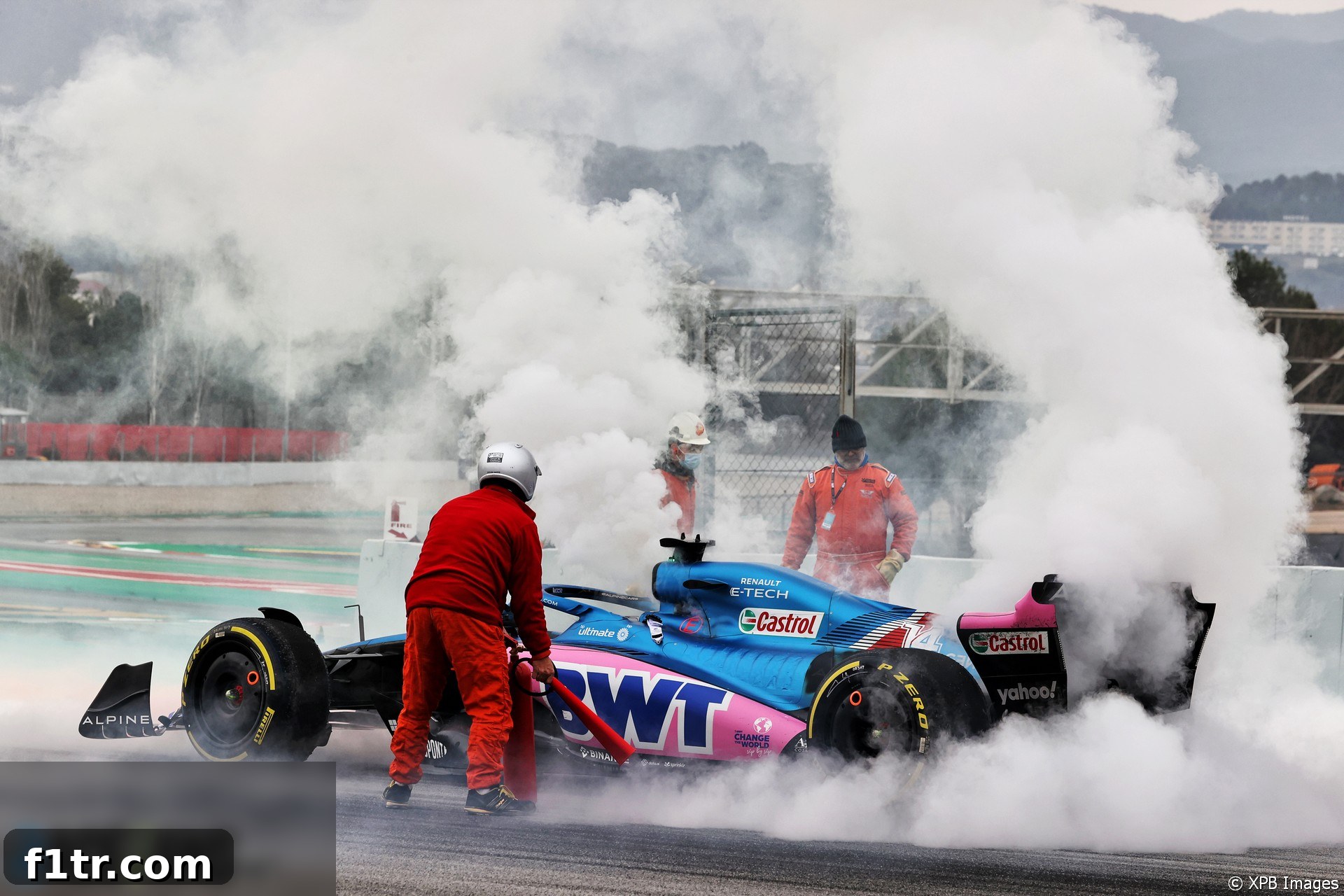
The drama unfolded when Fernando Alonso, a two-time world champion, was forced to pull over, reporting a significant loss of hydraulic pressure. Moments later, the brand-new A522, which Alpine had proudly unveiled just days before, was engulfed in a cloud of smoke as marshals rushed to attend to it. The team later confirmed that the issue stemmed from a minor sealing problem within the hydraulic system, which consequently led to a small fire at the rear of the car.
In an official statement, Alpine elaborated on the situation: “After further investigations in the garage following Fernando Alonso’s on-track stoppage earlier this morning, the team can confirm the issue was a problem with the hydraulics. A minor sealing issue led to a fire in the back of the car.” This type of incident, while concerning, is not uncommon during the intensive shakedown phases of new Formula 1 cars, especially with entirely new technical regulations introduced for the 2022 season.
Hydraulic systems are the unsung heroes of a modern F1 car, governing critical functions such as power steering, gear selection, throttle control, and even aspects of the brake-by-wire system. A loss of hydraulic pressure can instantly incapacitate a car, making it unmanageable and potentially dangerous, thus necessitating an immediate stop. The subsequent fire, though described as minor, highlights the extreme temperatures and pressures involved in these complex machines and the importance of every component’s integrity.
A Critical Day Lost: Ocon’s Missed Opportunity and Wet Weather Simulation
The timing of Alonso’s breakdown was particularly unfortunate for Alpine. Esteban Ocon was scheduled to take over driving duties for the afternoon session. This session was designed to simulate wet weather conditions, a crucial opportunity for teams to gather data on the new 18-inch Pirelli tyres in a simulated race scenario. For Ocon, it meant missing valuable seat time, especially in conditions that are notoriously challenging and require significant driver adaptation and car setup refinement.
Wet weather running is often some of the most beneficial testing for both drivers and engineers. It provides invaluable data on tyre performance, car balance, and aerodynamic efficiency in low-grip environments. Missing this session means Alpine will arrive at the next testing venue with less understanding of their car’s behaviour in these specific conditions, potentially putting them at a disadvantage should rain affect early-season races. The comprehensive nature of pre-season testing aims to prepare teams for every eventuality, and losing half a day, particularly a dedicated wet-weather session, is a significant blow.
Assessing Alpine’s Barcelona Performance: A Mixed Bag of Data
Despite the premature end to their Barcelona outing, Alpine reported a respectable achievement. The team successfully completed a total of 266 laps across the three days of the shakedown. While this lap count is an important indicator of initial reliability and data collection, the quality and type of laps are equally crucial. Early tests typically involve systems checks, aero correlation runs, and basic setup evaluations rather than outright performance laps.
“The team has successfully completed 266 laps during the three days of the Barcelona shakedown,” Alpine added in their statement. “Repairs on the car will continue, and as a result we won’t be running for the remainder of the day. We look forward to be back in action at the next test in Bahrain.” This reflects a mixed outcome for the team. On one hand, 266 laps provide a substantial amount of initial data on the A522’s behaviour, giving engineers a foundation for further development. On the other hand, the nature of the breakdown, coupled with the lost track time, raises concerns about the car’s durability under sustained pressure.
Compared to some rival teams who managed significantly higher lap counts and experienced fewer technical glitches, Alpine’s reliability appears to be an area requiring urgent attention. While minor issues are expected, a fire-inducing hydraulic failure points to a deeper system vulnerability that needs to be thoroughly investigated and rectified before the competitive season begins. Every lap missed is a data point lost, a setup change not evaluated, and a learning opportunity foregone in this critical pre-season period.
The Significance of Pre-Season Testing in a New Era
Pre-season testing in Formula 1 is more than just a shakedown; it’s a rigorous trial by fire, especially in a year like 2022 with its radically overhauled technical regulations. The new aerodynamic concepts, the introduction of ground effect, and the larger 18-inch wheels fundamentally change how cars behave and interact with the track. For teams, these tests are the only real-world opportunities to correlate simulator data, validate aerodynamic designs, and understand the intricate nuances of their new machinery before competitive racing commences.
For drivers like Fernando Alonso and Esteban Ocon, these sessions are equally vital. They need to adapt their driving styles to the new cars, understand the limits of grip, and provide crucial feedback to engineers on handling characteristics, braking performance, and power delivery. Every minute of track time is invaluable for building confidence and fine-tuning the car-driver relationship. Therefore, any disruption, like Alpine’s hydraulic issue, represents a significant setback in this learning curve.
Looking Ahead: The Bahrain Test and Beyond
With Barcelona behind them, Alpine’s focus now shifts entirely to the second and final pre-season test, scheduled to take place in Bahrain. This upcoming test holds even greater significance, not only because it is the last chance for teams to refine their cars but also because it takes place at the same venue that will host the opening Grand Prix of the 2022 season. The conditions in Bahrain (higher temperatures, different track surface) will provide a fresh set of challenges and data points.
For Alpine, the Bahrain test will be critical for addressing the reliability concerns highlighted in Barcelona. They will need to ensure the hydraulic system is robust and that no other underlying issues manifest. Furthermore, they will need to compress their testing program to catch up on the lost wet weather running data and general car performance evaluations. The pressure will be on to maximize every minute of track time, conducting long runs to test durability, short runs to assess raw pace, and driver feedback sessions to optimize the car’s setup for the challenging Sakhir circuit.
Alpine’s Ambitions for the 2022 Season
Entering the 2022 season, Alpine carries considerable ambitions. With a restructured technical department and the formidable pairing of Fernando Alonso and Esteban Ocon, the team aims to establish itself firmly in the upper midfield and challenge for podiums. The new regulations offer a unique opportunity for teams to shake up the pecking order, and Alpine intends to be among those making significant gains.
However, the early setback in Barcelona serves as a stark reminder of the immense challenges involved in Formula 1, especially in a year of such significant change. Building a competitive and reliable car from scratch under a completely new regulatory framework is a monumental task. While the team remains optimistic, the hydraulic issue underscores the crucial importance of reliability alongside outright speed. A fast car that can’t finish races is ultimately not a championship contender. The journey to success in 2022 for Alpine will hinge on their ability to learn quickly from these early tests and meticulously refine their A522.
Stay Connected with the Latest F1 Updates
Don’t miss a moment of the exciting 2022 Formula 1 season. Stay up-to-date with all the breaking news, in-depth analysis, and exclusive insights from RaceFans by following us on social media:
- Join RaceFans on Facebook for community discussions and updates
- Follow RaceFans on Twitter for real-time news and live commentary
- Receive daily email updates directly from RaceFans
Support independent Formula 1 journalism: Become a RaceFans supporter for an ad-free experience and exclusive content.
Explore More from the 2022 F1 Season
Delve deeper into the stories and developments shaping the current Formula 1 season with our extensive coverage. You can find more related articles below:
- Mercedes told me “you’re wrong” about 2022 car’s problems – Hamilton
- FIA confirms all 10 F1 teams complied with 2022 cost cap
- Steiner “not ashamed” of panning “slow” Schumacher in Drive to Survive
- Albon believes year out of F1 improved him as a driver
- Hamilton sees diversity gains in F1 years on from his ‘traumatising’ experience of racism
Browse all 2022 F1 season articles