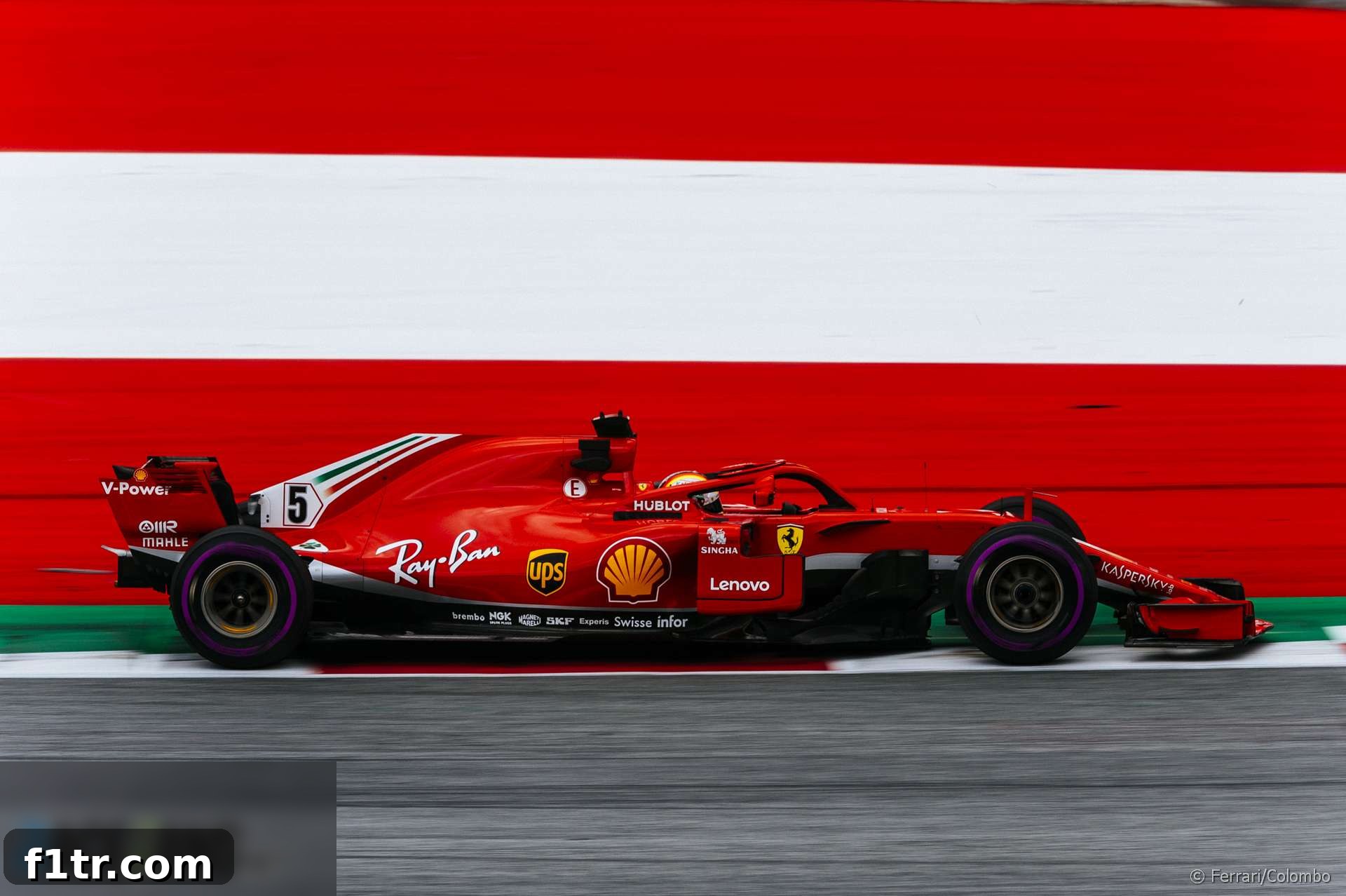
Sebastian Vettel Receives Grid Penalty After Impeding Carlos Sainz in Austrian Grand Prix Qualifying
In a significant turn of events that reshaped the starting grid for the Austrian Grand Prix, four-time Formula 1 World Champion Sebastian Vettel was handed a three-place grid penalty by the race stewards. The penalty was issued following an incident during qualifying where the Ferrari driver was deemed to have impeded Carlos Sainz Jnr of Renault, a decision that has sparked considerable discussion within the paddock and among fans. This judgment moves Vettel from a promising third position on the grid down to sixth, significantly impacting his strategy and prospects for the race.
The immediate consequence of this penalty sees his teammate Kimi Räikkönen elevate to third place, gaining a crucial advantage. Verstappen also moves up to the second row. Beyond the grid rearrangement, Vettel also received one penalty point on his Super Licence, bringing his total for the current 12-month period to three. Such penalties, while not immediately threatening his eligibility, underscore the seriousness with which the FIA views incidents of impeding, especially in the critical qualifying sessions where track position is paramount.
The Incident: A Driver’s Unaware Moment
Speaking after the qualifying session, a visibly frustrated Sebastian Vettel explained his perspective on the incident. He maintained that he had no intention of obstructing Carlos Sainz’s flying lap and was genuinely unaware of the Renault driver’s rapid approach. Vettel’s account highlighted the inherent challenges drivers face in maintaining full track awareness, particularly on cool-down laps when their focus shifts from outright speed to preparing for the next run or returning to the pits.
“Obviously I wasn’t meaning to block him or ruin his lap,” Vettel stated. “I was looking in the mirror, I was finishing my lap. I checked my mirrors, I could see anything, after turn one I checked again, there was nothing to see. By then it was side-by-side so fair enough.” His comments immediately pointed to a long-standing issue in Formula 1: the limited rear visibility offered by current car designs. Vettel elaborated, “The problem is the mirrors, we don’t see straight back. It’s the same for all of us. It’s to do with where the mirrors are and they are more or less in the same place for all of us. When the rear wing is closed, which is was because I was closing my lap and not pushing any more, and it’s also a little bit uphill here, you literally see nothing.” This explanation underscores a common complaint among drivers, suggesting that while the responsibility ultimately lies with them, the equipment itself can sometimes hinder their ability to comply with regulations.
Stewards’ Explanation for Vettel’s Penalty: A Matter of Responsibility
The stewards reviewed the video evidence, team radio and heard from the driver of car five (Sebastian Vettel), the driver of car 55 (Carlos Sainz) and team representatives.
Car five had just finished a push lap and was on an in lap, travelling quite slowly into and around turn one, on the racing line. The driver conceded that he had passed car 55 between turns seven and eight but assumed it had pitted after. However, car 55 was actually commencing a push lap and closed on car five rapidly along the pit straight and into turn one.
During evidence, the driver of car 55 stated that he felt the driver of car five was completely unaware of his approach. This was confirmed by the driver of car five who stated he was unable to see car 55 in his mirrors and that his team had not informed him of its approach, by radio. The latter was confirmed by the team representative.
It is the belief of the stewards that notwithstanding the absence of a radio call, the driver of car five, being aware of the issue of rear vision with his mirrors, should not have been so slow and on the racing line, during a slowdown lap in qualification.
Having reviewed all alleged impeding incidents since the beginning of 2016, the penalty of a drop of three grid positions is consistent with all other similar incidents.
The stewards’ detailed explanation provided a comprehensive breakdown of their decision-making process, highlighting key elements that led to the penalty. Their investigation involved a thorough review of video footage from multiple angles, analysis of team radio communications, and direct testimonies from both Sebastian Vettel and Carlos Sainz, as well as representatives from their respective teams. This multi-faceted approach ensures that all available evidence is considered before a judgment is rendered.
Central to their findings was the observation that Vettel, on his in-lap, was traveling at a significantly reduced speed and, critically, remained on the racing line through turn one. While Vettel genuinely believed Sainz had pitted after passing him earlier in the lap, Sainz was, in fact, commencing a crucial flying lap, closing the gap rapidly. Carlos Sainz’s testimony corroborated Vettel’s claim of unawareness, stating that Vettel seemed “completely unaware” of his approach. This lack of awareness was further attributed to Vettel’s inability to spot Sainz in his mirrors and, significantly, the absence of any radio warning from his Ferrari team – a fact confirmed by the team representative.
Despite acknowledging the difficulties with mirror visibility and the team’s radio silence, the stewards ultimately placed the onus on the driver. Their ruling emphasized that a driver, particularly one aware of the limitations of their rear vision, bears the ultimate responsibility to ensure they are not impeding another competitor on a flying lap, especially when on the racing line during a qualifying slowdown lap. This judgment reinforces the strict standards of driver conduct expected in Formula 1, where safety and fair competition are paramount. The stewards also noted that the three-place grid penalty aligns with precedents set in similar impeding incidents since the beginning of the 2016 season, emphasizing consistency in applying the sporting regulations.
Implications for the Austrian Grand Prix and the Championship Battle
This grid penalty carries substantial implications for Sebastian Vettel’s Austrian Grand Prix weekend and, potentially, for his championship aspirations. Dropping from third to sixth on the grid means he starts from the third row, surrounded by different competitors and facing a more challenging opening lap. This can significantly alter race strategy, requiring more aggressive overtakes or a greater reliance on tire strategy to make up positions. Given the tight competition at the front of the grid, even a three-place drop can be incredibly difficult to recover from, especially on a track like the Red Bull Ring where clean air and track position are often crucial.
For Ferrari, the penalty also shifts the dynamic, placing Kimi Räikkönen in a prime starting position to challenge the Mercedes and Red Bull cars. His move up to third could be beneficial for Ferrari’s overall race strategy, potentially allowing him to act as a buffer or offer tactical support. However, it undoubtedly makes Vettel’s individual pursuit of championship points more arduous.
Understanding Impeding Rules in Formula 1 Qualifying
The rules concerning impeding are fundamental to the fairness and safety of Formula 1 qualifying sessions. During qualifying, drivers push their cars to the absolute limit, seeking every fraction of a second to secure the best possible grid position. A clear track is essential for achieving optimal lap times, as even a slight disturbance or the presence of another car can disrupt aero balance, force a driver off their ideal line, or create a dangerous situation. The regulations therefore mandate that drivers on cool-down or in-laps must not obstruct those on flying laps.
This responsibility extends beyond just active blocking; it includes maintaining awareness of surrounding traffic, moving off the racing line promptly, and being responsive to team radio warnings. While teams are expected to provide clear and timely information about approaching cars, the ultimate onus remains on the driver to drive safely and fairly. Penalties for impeding, ranging from grid drops to more severe sanctions depending on the severity and impact of the incident, underscore the FIA’s commitment to upholding these critical sporting regulations.
Driver Responsibility Versus Team Communication
The Sebastian Vettel incident highlights the intricate interplay between driver responsibility and team communication in modern Formula 1. While a driver is solely in control of their car on track, teams play an indispensable role in providing real-time information, particularly regarding traffic and potential hazards. The stewards’ findings that Vettel’s team had not informed him of Sainz’s approach by radio points to a potential breakdown in communication that contributed to the incident.
However, the stewards’ ultimate conclusion reaffirms that a driver cannot simply defer all responsibility to their team or blame equipment limitations. Awareness of one’s surroundings, anticipating potential issues, and taking proactive measures (such as moving off the racing line or checking mirrors more diligently, despite their flaws) are all part of the professional expectations placed on a Formula 1 driver. This incident serves as a stark reminder for all teams and drivers about the continuous need for flawless communication and unwavering situational awareness, especially during the high-stakes environment of qualifying.
In conclusion, Sebastian Vettel’s grid penalty for impeding Carlos Sainz at the Austrian Grand Prix qualifying is a clear demonstration of the strict enforcement of sporting regulations in Formula 1. While the incident may have been unintentional and influenced by technical limitations and communication gaps, the stewards’ decision underscores the paramount importance of driver responsibility in ensuring fair play and safety on the track. The revised grid promises an even more electrifying start to the race, with Vettel now facing an uphill battle to recover positions and maximize his championship points haul.
See the updated Austrian Grand Prix grid following Vettel’s penalty
Don’t miss anything new from RaceFans
Follow RaceFans on social media:
- Join RaceFans on Facebook
- Follow RaceFans on Twitter
- Get daily email updates from RaceFans
2018 F1 season
- F1 feared “death knell” for Drive to Survive after Ferrari and Mercedes snub
- McLaren staff told us we were “totally crazy” to take Honda engines in 2018 – Tost
- ‘It doesn’t matter if we start last’: How Red Bull’s junior team aided Honda’s leap forward
- Honda’s jet division helped F1 engineers solve power unit problem
- McLaren Racing losses rise after Honda split
Browse all 2018 F1 season articles