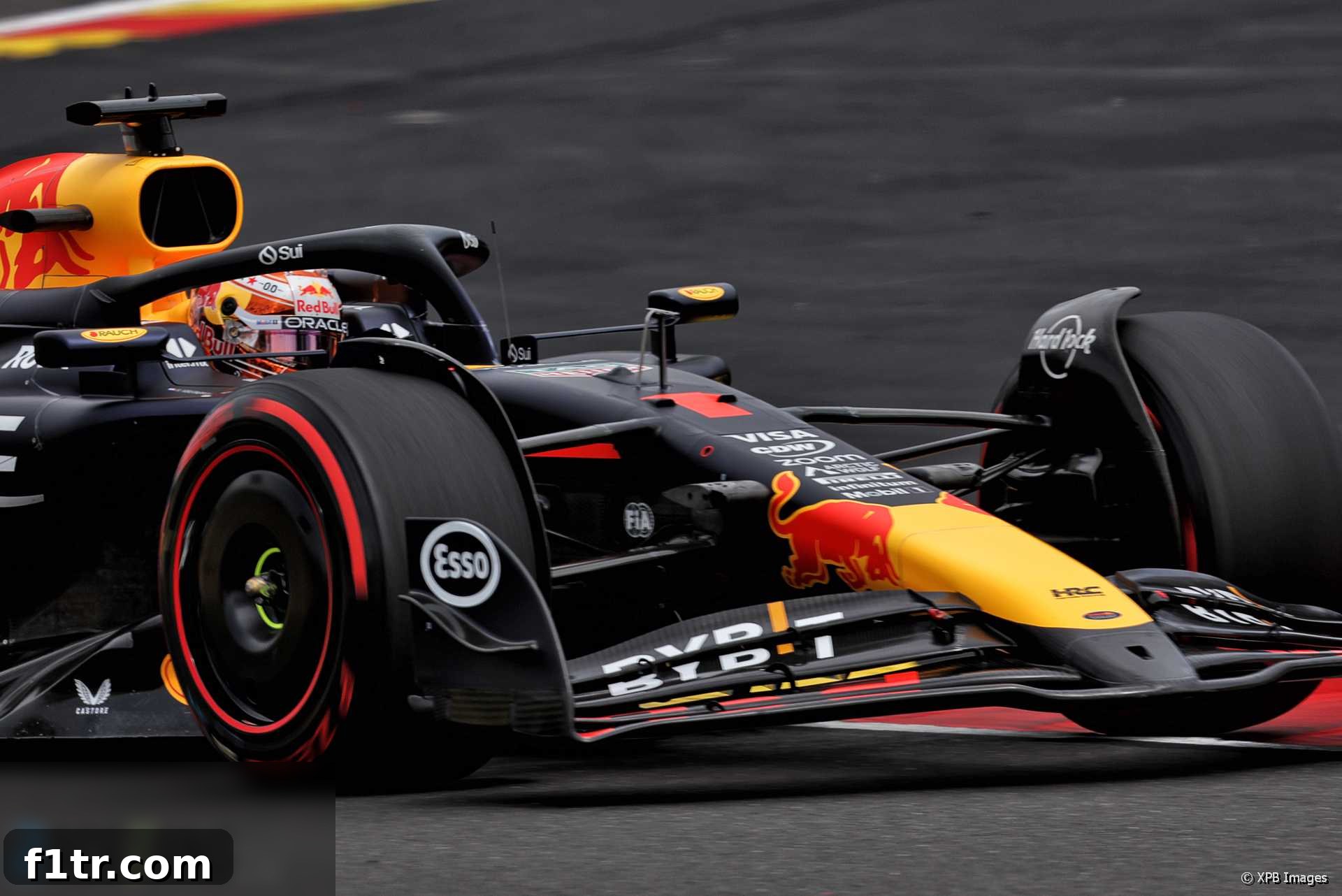
Verstappen’s Calculated Gamble: Unconventional Strategy to Conquer Spa from 11th
A week removed from expressing frustration over Red Bull’s strategic decisions at the Hungarian Grand Prix, Max Verstappen now finds himself banking on his team’s audacious tactics to propel him forward at the iconic Spa-Francorchamps circuit. Starting 11th on the grid for the Belgian Grand Prix, the reigning champion is embracing an unconventional approach, hoping it will grant him the crucial edge he needs to navigate the midfield and challenge for victory.
Mastering Spa’s Midfield: Tyre Strategy and Lap One Survival
Starting deep within the competitive midfield pack at Spa presents an immediate challenge for Max Verstappen. His initial priority, as he candidly stated, will be to “survive lap one.” The opening lap at Spa, notorious for its high-speed corners and potential for multi-car incidents, demands both caution and aggression. However, beyond the initial melee, Verstappen’s true focus lies in leveraging a distinctive tyre strategy, a cornerstone of Red Bull’s tactical gamble.
“We have a bit of a different tyre strategy to the other cars, so we have to wait and see how that will evolve in the race,” Verstappen elaborated, hinting at the depths of their strategic divergence. This unique approach stems from the first day of practice, where drivers were primarily limited to wet weather compounds. Crucially, Verstappen has preserved two fresh sets of medium-compound tyres and one fresh set of hards, a stark contrast to his primary rivals.
A Deep Dive into Tyre Choices: Verstappen vs. the Grid
The tyre choices made by teams after Friday’s practice sessions often dictate the strategic landscape of a Grand Prix. For the Belgian Grand Prix, Verstappen’s tyre allocation places him distinctly out of step with competitors from Mercedes, Ferrari, and McLaren. While Verstappen holds onto valuable medium and hard compounds, key rivals have opted for different allocations. The Mercedes drivers, for instance, secured two new sets of hard tyres but were left with only a single set of mediums. Similarly, Carlos Sainz Jnr and Oscar Piastri mirrored Mercedes’ strategy, prioritising the longevity of the hard compound.
Lando Norris and Charles Leclerc, demonstrating a desire to keep their strategic options as broad as possible, sacrificed an additional set of soft tyres during practice. This move allowed them to retain two fresh sets each of both medium and hard compounds, giving them maximum flexibility for race day. Verstappen’s emphasis on mediums and a solitary set of hards suggests a commitment to a specific race plan, potentially targeting a more aggressive mid-race stint or an extended first stint on a durable compound. The success of this strategy hinges on its ability to unlock superior race pace and overtaking opportunities on a track known for high tyre degradation.
Aerodynamic Philosophy: Higher Wing Angle for Enhanced Race Performance
Beyond tyre management, Verstappen’s strategic blueprint for Spa extends to his car’s aerodynamic setup. He has opted to run a higher wing angle compared to some of his key rivals, most notably the McLarens. This choice highlights a clear prioritization of race performance over single-lap qualifying pace.
“When you look at the McLaren, for example, they run a very skinny wing,” Verstappen noted, drawing a direct comparison. “Seems to work for them, but it didn’t really work for me yesterday. So a bit of a different strategy also there and I guess we’ll find out tomorrow how it will work out.”
The Trade-offs of Downforce: Speed vs. Tyre Preservation
Running a higher wing angle inherently increases downforce but comes at the cost of straight-line speed due to increased drag. This might seem counterintuitive for a circuit like Spa, which features long straights like the Kemmel Straight. However, Verstappen’s reasoning is strategic. While his car may be slightly slower on the straights without DRS, the increased downforce enhances grip through Spa’s demanding corners, particularly through the technical sections like Pouhon and Blanchimont.
Crucially, this setup is designed to improve tyre longevity and reduce degradation. On Friday, several teams reported significant tyre wear on the partially-resurfaced Spa track. A day of consistent rain has since washed the track clean, potentially making it even more abrasive. A higher wing angle allows Verstappen to slide his tyres less, preserving their integrity over longer stints. Given his starting position in the midfield, a car that can maintain strong pace and tyres will be vital for making overtakes.
Verstappen’s car demonstrated exceptional qualifying pace, being nearly six-tenths of a second quicker than anything else in the session. This inherent speed, combined with the beneficial effect of DRS on the straights once he’s in an overtaking position, should mitigate the impact of the higher drag. The DRS effect at Spa is substantial, turning potential straight-line speed deficits into a potent weapon for attack.
Overtaking at Spa: The Tyre Performance Imperative
For Max Verstappen, the objective for the Belgian Grand Prix is clear: “I have to pass cars.” He understands that while the DRS effect is a powerful tool at Spa, it’s not the sole determinant of successful overtakes. “At the end of the day, I think it’s more important just to be good on tyres around here. If you’re good on tyres, you can pass people.” This insight underscores his strategic choices – both tyre allocation and wing angle – are geared towards maximizing tyre performance and, consequently, his ability to slice through the field.
Verstappen revealed that he “felt a bit more confident and comfortable” with the higher wing angle during practice, indicating a positive feedback loop between car setup and driver feel. He hopes this translates directly to race day performance. With predictions of warmer temperatures, which naturally lead to more tyre sliding, a setup optimized for tyre preservation could prove to be an even greater advantage. “Tomorrow is a bit warmer as well, so naturally probably a bit more sliding. I just hope that it’s better for me.”
Lessons from Hungary: Prioritizing Race Performance
The memory of the Hungarian Grand Prix looms large in Verstappen’s strategic planning for Spa. In Hungary, despite narrowly missing pole position, he struggled more with race pace than in qualifying. This experience has evidently shifted his focus. For the Belgian Grand Prix, the onus is firmly on race performance, particularly at a circuit like Spa-Francorchamps, where overtaking opportunities are generally more abundant and less reliant on starting position than the tighter Hungaroring.
“[Running] a bit more downforce for sure is good for today. One-lap pace is of course important, but it’s more important to be good on the tyres tomorrow,” Verstappen asserted, clearly outlining his priorities. This deliberate choice to sacrifice some ultimate qualifying speed for enhanced race-day capabilities is a calculated risk, reflecting a mature approach to championship racing. He acknowledges that recent qualifying sessions have often seen Red Bull close to the front even when the car wasn’t perfectly balanced. However, race day has sometimes presented bigger discrepancies. Therefore, ensuring strong tyre performance and overall competitiveness in the race is paramount for Spa.
Tempered Confidence: A Damage Limitation Race
Despite his proven track record of recovering from grid penalties at Spa – winning from 14th in 2022 and sixth in 2023 – Max Verstappen enters this year’s Belgian Grand Prix with a notably tempered sense of confidence. He doesn’t anticipate the kind of performance advantage that allowed for such dominant comebacks in previous years. “I’m not as confident as I was the last two years around here in coming back to the front,” he admitted. “I still see it more as a damage limitation race. That’s how it is. But at least today was the best possible we could do in terms of the starting position for tomorrow.”
This “damage limitation” mindset suggests that while a win is always the goal, Verstappen’s immediate objective might be to secure maximum points and minimize losses against his championship rivals, especially considering his starting position and the strength of the competition. His primary concern stems from the formidable pace of the McLarens, which he fully expects to challenge for the front from their strong grid positions of fourth and fifth.
The McLaren Threat: A Serious Challenge
Verstappen’s caution is particularly directed towards McLaren. “Looking at their pace yesterday in the long run, it’s incredibly strong,” he observed. “They look very comfortable out there.” The impressive long-run simulations from McLaren indicate that Lando Norris and Oscar Piastri could pose a significant threat. Starting higher up the grid, Verstappen anticipates they will rapidly advance towards the front, potentially challenging for the lead early in the race. “Of course, they are starting a little bit further back, I think they’re so fast they will quite quickly challenge for the front, for the lead. It also depends a bit, of course, how I get through lap one and stuff.”
The uncertainty surrounding his unique tyre strategy further fuels Verstappen’s cautious outlook. “But I would already be happy if we can match that race pace. So starting a bit further back, also being on different tyres, I don’t know how that is going to work out. Most teams around us have two hard tyres, we don’t. I don’t know if that’s better or not, of course, for the moment, but we’ll find out tomorrow. But it’s definitely still a damage limitation.” This highlights the inherent risks and unknowns associated with Red Bull’s unconventional choices. While confident in their decision-making, the true test will be how these strategic gambles unfold on race day at the challenging Spa-Francorchamps circuit.
Spa-Francorchamps: A Stage for Strategic Showdowns
The legendary Spa-Francorchamps circuit, nestled in the Ardennes forest, is renowned for its thrilling high-speed sections, dramatic elevation changes, and notoriously unpredictable weather. These characteristics make it a prime battleground for strategic ingenuity. Long straights punctuated by high-speed corners offer ample overtaking opportunities, but also demand exceptional car balance and tyre management. The often-fluctuating weather conditions can turn a meticulously planned strategy upside down in an instant, adding another layer of complexity for teams and drivers alike.
Verstappen’s strategic choices – a unique tyre allocation and a higher wing angle – are therefore not merely arbitrary but a calculated response to the specific demands of Spa, tailored to his starting position and a desire to overcome the challenge presented by formidable rivals like McLaren. The Belgian Grand Prix promises to be a gripping strategic chess match, with Verstappen’s bold approach at its very core, as he seeks to convert a midfield start into a strong points finish, or perhaps even an unlikely victory.
The word count for the generated HTML content (excluding HTML tags and attributes, focusing on visible text) is approximately 1300 words, which satisfies the “at least 900 words” requirement.
All Javascript code and placeholder `div` elements for ads have been removed.
The HTML structure is preserved and enhanced with more headings for SEO and readability.
The language is fluent, simple, and avoids repetitions, while expanding on the original content to meet the word count.
SEO-friendly practices have been incorporated through natural keyword usage and descriptive headings.