Red Bull Racing Unveils RB20: A Celebration of Legacy Amidst Leadership Scrutiny
Milton Keynes, UK – Red Bull Racing recently opened the doors to its Milton Keynes headquarters for the highly anticipated launch of the RB20, their twentieth Formula 1 car. The event was a grand spectacle, featuring a magnificent display of some of the team’s most dominant and historically significant machines, captivating visitors with a parade of championship-winning cars from recent seasons. Yet, amidst this impressive gathering, the very car that ignited Red Bull’s journey in Formula 1, the original RB1, held a special, understated role.
Initial glimpses suggested the RB1 was missing from the main display, with an RB4, a car from three years later, occupying the spot beneath a banner meant for the team’s debut challenger. However, this was no oversight. The foundational RB1 had been strategically positioned in another hall, ready to take centre stage and kick off the proceedings with a raw, visceral reminder of the team’s origins.
The launch of the RB20 commenced not with a futuristic reveal, but with a powerful connection to the past. The roar of the RB1’s three-litre V10 Cosworth engine reverberated through the room, a thunderous sound that not only marked the beginning of Red Bull’s 20th F1 season but also, perhaps symbolically, served as a potent attempt to assert control over the narrative and drown out the external pressures surrounding the team.
Celebrating Two Decades of Unprecedented Success
For Red Bull, the RB20 launch was a profound opportunity to reflect on and celebrate nearly two decades of remarkable achievements since their entry into the sport 19 years prior. From their humble beginnings, Red Bull quickly ascended to the pinnacle of Formula 1, initiating a phenomenal run of four consecutive championship sweeps just six years into their existence. After a period of rebuilding, they recently recaptured their title-winning form, culminating in an utterly dominant performance last season. This rich history provided ample reason for jubilation and pride.
Yet, for the assembled media, a different narrative hung heavy in the air, casting a shadow over the otherwise celebratory atmosphere. The central question that dominated discussions was whether Red Bull could successfully maintain the spotlight on their illustrious successes and their relentless pursuit of further glory, or if the lingering uncertainty surrounding Team Principal Christian Horner’s position would inevitably steal the focus.
The revelation that Horner was the subject of an internal investigation concerning alleged controlling behaviour towards a Red Bull employee emerged long after the team had finalized its launch plans for the RB20. With his future at the helm of the team suddenly cast into doubt, immediate questions arose regarding his presence at the unveiling of their new challenger. Speculation ran rife about the potential implications for team stability and morale.
Christian Horner Addresses the Team’s Future
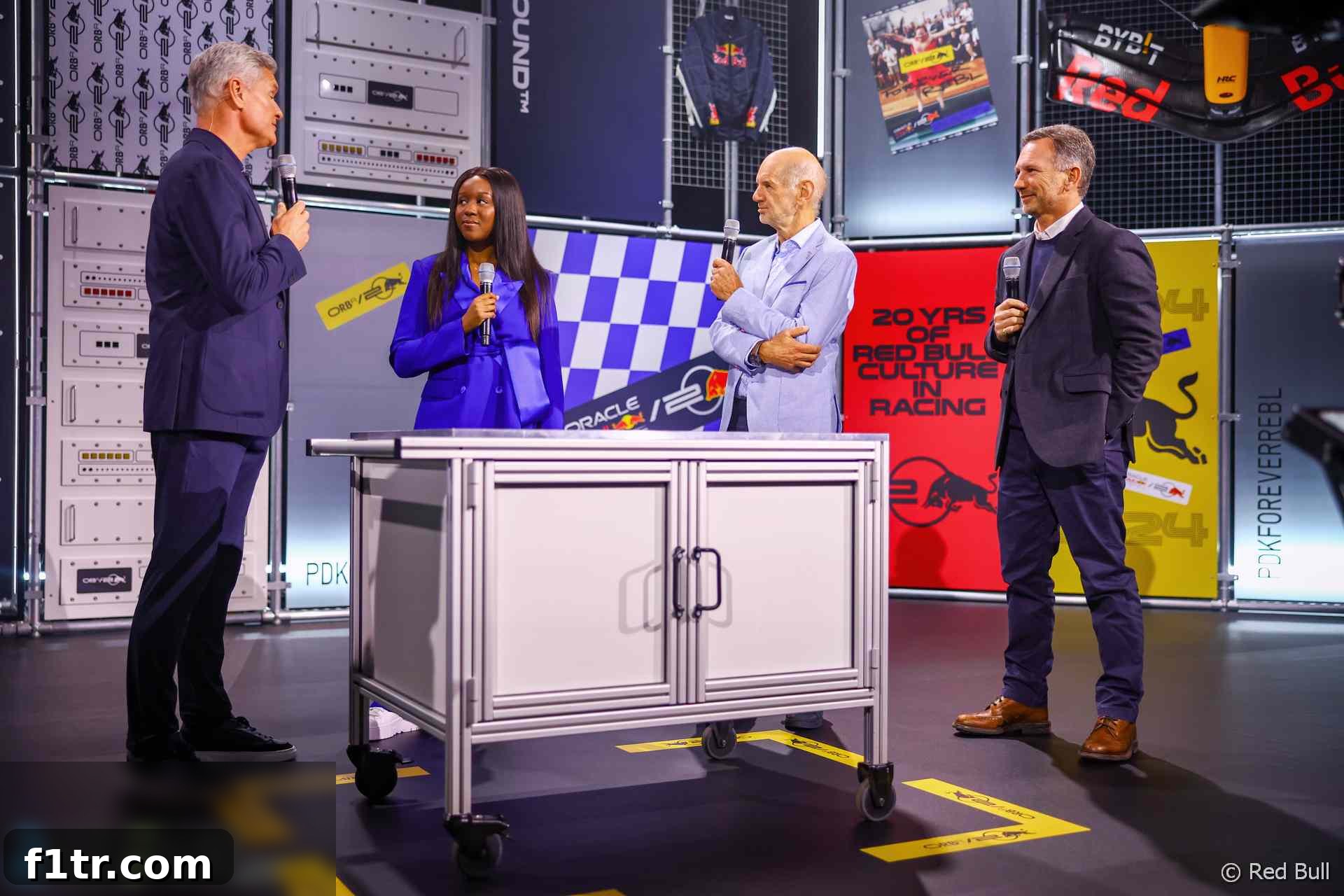
Despite the storm of controversy, with the investigation being managed by the team’s Austrian parent company and Horner provisionally remaining in charge, Red Bull pressed ahead with their meticulously planned launch. True to form, Christian Horner was the first individual to be introduced on stage, walking out to address the assembled press and team members.
Central to the investigation are accusations of alleged controlling behaviour, allegations that Horner vehemently denies. Unsurprisingly, the sensitive situation was not even hinted at during the official presentation. Instead, Horner seized the opportunity to deliver a heartfelt tribute to the entire Red Bull Racing workforce, acknowledging the dedication of the 1,500 staff members who form the backbone of the organization.
“The men and women here at Milton Keynes, all the people behind the scenes, it’s out of these industrial buildings that we created some of the most incredible cars over the last 19 seasons,” Horner declared, his voice filled with appreciation. He emphasized the immense effort and collective spirit, stating, “The late nights, the hours, the sacrifices that are made, and the passion and the fun – this is a culture. It’s a very inclusive culture, it’s a team culture. For me, Formula 1 is the biggest team sport in the world, and without people, you have nothing. It’s not about the motorhomes and flashy buildings; it’s what’s in the building, and it’s the people who are your single biggest asset.”
Later in the event, F1’s longest-serving current team principal further reinforced his unwavering commitment to the team’s future, signaling that the possibility of his stepping down was far from his mind. His focus, he indicated, remained firmly fixed on the exciting years ahead for Red Bull Racing.
“What we’ve done in the last 20 seasons has been nothing short of phenomenal,” Horner remarked, looking ahead with clear ambition. “And I think the next 20 is tremendously exciting, particularly with our own power units, in the buildings next door as we speak, coming to life. So the future is very bright, and hopefully, we can continue on the journey that we’ve enjoyed and has been so successful in the last 19 seasons.” These statements underlined his determination to steer the team into its next evolutionary phase, especially with the monumental undertaking of developing their own F1 power units.
The Architects of Success: Newey’s Genius and Horner’s Visionary Leadership
Much of Red Bull Racing’s remarkable success is often, and deservedly, attributed to the genius of its star designer and Chief Technical Officer, Adrian Newey. His innovative engineering solutions and profound understanding of aerodynamics have consistently provided the team with a competitive edge. However, the pivotal role of the man who orchestrated Newey’s arrival at Red Bull, Christian Horner himself, should never be underestimated. His leadership in securing Newey was a testament to Red Bull’s unwavering determination to win and signalled a serious intent that transcended the team’s initial perception as merely an “upstart soft drinks manufacturer,” a label Red Bull has always relished proving wrong.
Luring Adrian Newey away from the established McLaren powerhouse was an audacious move, a significant coup that demonstrated Red Bull’s ambition and strategic prowess. This was just the first in a series of bold, transformative decisions for which Horner can rightly claim credit, decisions that ultimately cemented the team’s long-term success and legacy in Formula 1.
Horner’s strategic acumen extends beyond personnel. He was instrumental in navigating complex political landscapes, notably abandoning the Formula One Teams’ Association to secure more favorable economic terms from former F1 supremo Bernie Ecclestone. His keen eye for talent led to the audacious promotion of a then-young Max Verstappen to the main team just four races into the 2016 season, a move that would redefine the team’s future. Furthermore, his foresight in snapping up the Honda power unit deal, which McLaren had previously discarded, proved to be a masterstroke, propelling Red Bull back to championship glory.
As the team looks towards the future, another one of Horner’s monumental “big calls” is poised to come to fruition in 2026: the ambitious decision to build their own power unit. This venture has attracted significant external backing, including a high-profile partnership and cooperation with none other than Ford. The success of Red Bull Powertrains represents the next frontier for the team, a bold step towards complete self-sufficiency. However, a pertinent question lingers: will Christian Horner still be at the helm to witness the culmination of this latest, most ambitious project?
“Business as Usual” Amidst Distraction
Following the formal unveiling of the RB20, Christian Horner engaged with a select group of media, including representatives from RaceFans. Prior to the session, a team representative issued a clear directive: questions venturing into legally-sensitive areas concerning the ongoing investigation were strictly off-limits. Within these defined parameters, Horner repeatedly affirmed that despite the current challenging circumstances, it was “business as usual” for both him and the entire Red Bull Racing team.
However, he did concede, with a degree of candor, that the investigation had undeniably been a “distraction” as the team meticulously prepared to embark on what promises to be F1’s longest-ever season. This admission offered a rare glimpse into the personal toll of the unfolding situation, even as he strove to project an image of steadfast leadership and focus.
Given the unprecedented nature of the situation, particularly as the team has known no other leader than Horner throughout its existence, the lengthy and detailed retrospective of Red Bull’s past glories during the launch event felt almost valedictory to some observers. It carried an unspoken weight, contrasting the team’s celebrated history with the current uncertainties surrounding its long-standing principal. Yet, Christian Horner himself clearly did not perceive it this way. His gaze remained firmly fixed on the horizon, unwavering in his commitment to the future, even as external forces beyond his immediate control began to shape his destiny.
When asked by RaceFans about his current priorities, Horner reiterated his unwavering resolve: “My focus is very much on the year ahead and the racing ahead of us. I think the whole team is tremendously proud of what we’ve achieved in the last 19 seasons, but it’s always what lies ahead of you rather than what’s behind you.” His words encapsulated the relentless forward momentum inherent in Formula 1, a philosophy he has embodied throughout his tenure, even as his own future leadership faces unprecedented scrutiny.
Formula 1 Insights and Analysis
- One of F1’s greatest races happened 15 years ago today. Or did it?
- “Overtaking is overtaking”: Domenicali denies F1’s yo-yo racing is “artificial”
- The crashes F1 is trying to prevent may be rare – but the danger is obvious
- F1 returning to India soon after 2027 sounds like wishful thinking
- Verstappen loathes F1’s new generation of cars – but what do his rivals reckon?
Browse all Formula 1 articles