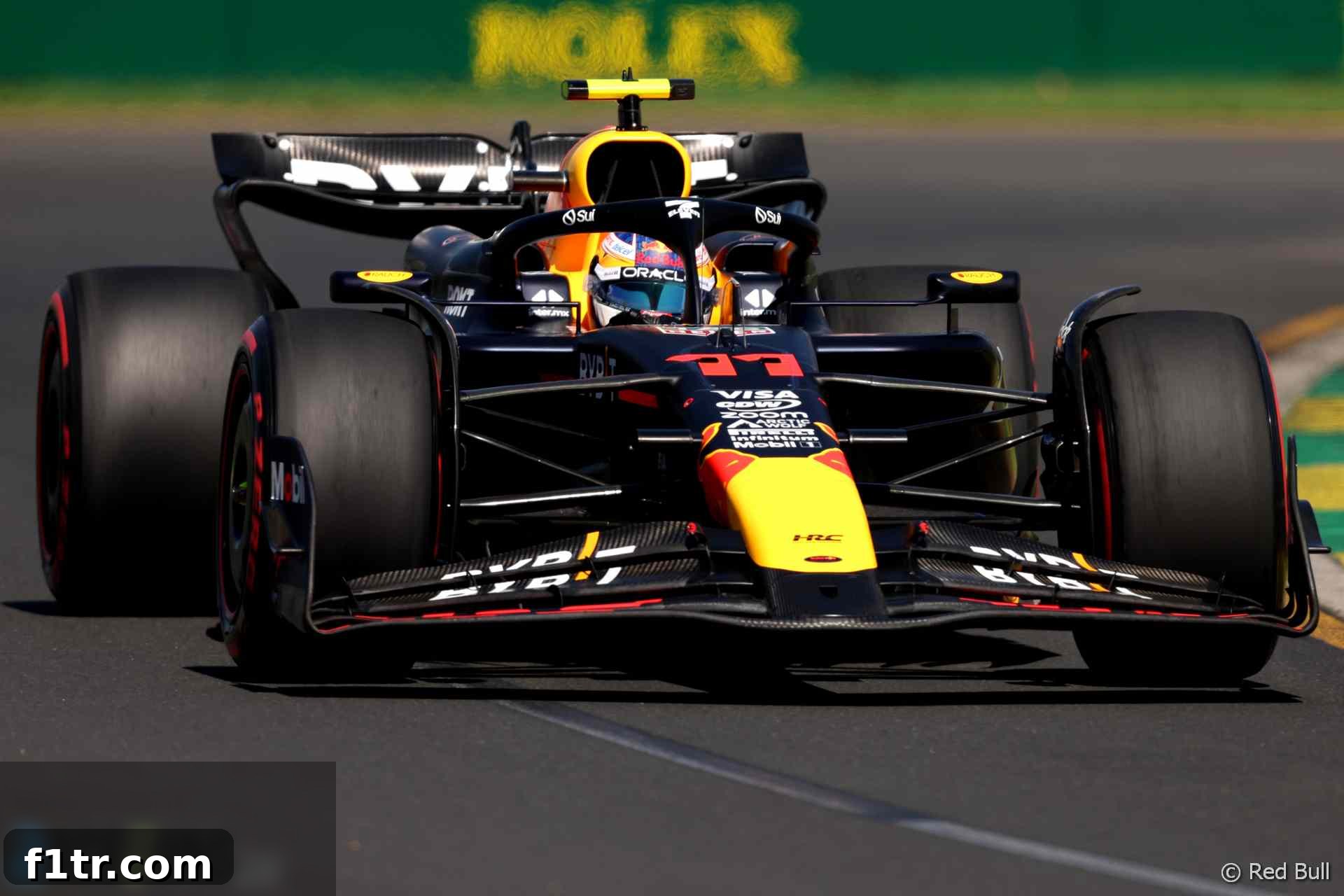
Sergio Perez, the acclaimed Red Bull Racing driver, faced a significant setback for Sunday’s Australian Grand Prix, losing his hard-earned third-place qualifying position. Following an investigation by race stewards, Perez was slapped with a three-place grid penalty for impeding Nico Hulkenberg during the crucial Q1 session. This decision has sparked considerable discussion within the Formula 1 community, highlighting the stringent nature of the sport’s regulations concerning on-track conduct and traffic management.
Advert | Become a Supporter & go ad-free
The incident, which occurred at the penultimate corner, Turn 13, during the initial phase of qualifying, saw the Red Bull ace deemed to have obstructed the Haas F1 Team’s Hulkenberg. In the high-stakes environment of Formula 1 qualifying, where every millisecond counts and track position is paramount, such infringements are taken extremely seriously, often leading to immediate penalties that can significantly alter a driver’s weekend trajectory.
Sergio Perez Receives Three-Place Grid Penalty for Impeding Nico Hulkenberg at Australian Grand Prix
The highly anticipated 2024 Australian Grand Prix qualifying session proved to be a nail-biting affair, but for Sergio Perez, it also brought an unwelcome post-session penalty. The Red Bull driver, who initially secured an impressive third position on the grid, was subsequently demoted three places to sixth after being found guilty of impeding Haas’s Nico Hulkenberg. This decision underscores the meticulous scrutiny applied by Formula 1 stewards to ensure fair play and safety, particularly during the intense qualifying segments where drivers push their machinery to the absolute limit.
The Pressure Cooker of Q1: Traffic Management and Track Position
Qualifying for a Formula 1 Grand Prix is a complex dance of precision, speed, and strategy. The Q1 session, in particular, often presents a unique challenge: managing heavy traffic. With all 20 cars attempting to set competitive lap times within a limited window, the circuit can become incredibly congested. Drivers on flying laps need clear air to extract maximum performance from their cars, while those on out-laps or cool-down laps must be acutely aware of their surroundings to avoid impeding faster cars. The Albert Park Circuit, known for its flowing nature but also its tight sections, adds another layer of complexity to this scenario. Turn 13, a critical left-hander leading into the final sector, is a prime example of where vigilance is paramount.
The incident involving Perez and Hulkenberg unfolded approximately three minutes into Q1. At this early stage, many drivers, including Perez, were still warming up their tyres and preparing for their first crucial push laps. As Perez navigated the final sector behind Esteban Ocon’s Alpine, his race engineer, Hugh Bird, provided essential feedback on car status and setup adjustments. “B-bal three. B-bal three. And brakes are looking good,” Perez was instructed, followed by specific guidance: “Handbrake to open the lap. Recharge off when you’re ready.” These instructions highlight the intense communication and multi-tasking required by drivers even on their out-laps, balancing car preparation with track awareness.
Unfolding the Incident: Perez, Hulkenberg, and the Critical Turn 13 Encounter
As Perez approached Turn 13, a tight left-hander that demands precision, Hulkenberg, who was on a fast flying lap, rapidly closed in from behind. The critical issue stemmed from the timing of the warning given to Perez. While his engineer, Hugh Bird, eventually alerted him that Hulkenberg was “at one [second]” behind, this communication arrived significantly too late for the Red Bull driver to take evasive action. The proximity and speed differential meant that Perez was directly in Hulkenberg’s path as the Haas driver rounded Turn 13, causing a clear obstruction.
Hulkenberg’s immediate reaction over team radio encapsulated the frustration of an impeded driver. “That was impeding by Perez, Turn 13,” he reported emphatically. His race engineer, Gary Gannon, confirmed the severity of the situation, replying, “We’ve reported.” This prompt reporting by the Haas team immediately flagged the incident for the attention of the race stewards, initiating a formal review process. Such instantaneous communication between driver and pit wall is standard practice in F1, allowing teams to quickly bring potential infringements to the stewards’ notice.
Despite the incident, Perez continued his qualifying efforts, ultimately securing a strong third place on the grid, much to the delight of his team and fans. Hulkenberg, unfortunately, was eliminated at the end of Q1, his lap potentially compromised by the obstruction. The disparity in their immediate outcomes only heightened the importance of the subsequent stewards’ investigation.
Advert | Become a RaceFans supporter andgo ad-free
The Stewards’ Scrutiny: Unpacking the Evidence and Deliberation
The race stewards, after noting the incident during the session, initiated a full investigation once qualifying concluded. This meticulous process involved examining multiple sources of evidence: onboard footage from both cars, telemetry data showing speed and braking points, and crucially, the audio communications between both drivers and their respective pit walls. Both Perez and Hulkenberg were called to the stewards’ office to provide their accounts of the event, offering invaluable first-hand perspectives.
Following a thorough review, the stewards concluded that Red Bull’s Perez was indeed guilty of impeding the Haas driver. Their official statement detailed their observations: “Perez, who was on an out-lap, was at the apex of the turn and Hulkenberg had to leave the racing line to drive around him. Hulkenberg was forced to lift the throttle early and brake early for that corner.” This precise description highlighted the concrete impact of Perez’s position on Hulkenberg’s lap, demonstrating a clear loss of time and a compromised racing line for the Haas driver.
A significant factor in the stewards’ decision was the timing of the team radio communication to Perez. “In reviewing the audio from Perez’s car, the stewards observed that the team was focused on the car in front of Perez that had just slowed, and did not give Perez a warning that Hulkenberg was behind him until one second before Hulkenberg arrived, and significantly too late to avoid impeding Hulkenberg.” This finding placed a degree of responsibility on the Red Bull pit wall for the late warning, emphasizing the critical role of real-time communication in traffic management. While acknowledging the dynamic and challenging nature of Q1, the stewards maintained that the impeding was “unnecessary,” a key term in Formula 1 regulations that often leads to penalties. This verdict was delivered with consistency to previous cases involving similar impeding infractions, reinforcing the precedent set in such situations.
The Verdict and its Immediate Consequences: Reshaping the Grid
As a result of the investigation, Sergio Perez was handed a three-place grid penalty, which immediately reshuffled the starting order for Sunday’s Australian Grand Prix. This meant that Perez would now start from sixth position instead of his initially qualified third, a significant demotion that could have profound implications for his race strategy and chances of securing a podium finish.
The penalty had a ripple effect, elevating several other drivers up the grid. Lando Norris of McLaren was promoted to third place, moving him into an excellent starting position. Charles Leclerc from Ferrari moved up to fourth, placing him directly behind his teammate Carlos Sainz, who qualified second. Local hero Oscar Piastri, also from McLaren, benefited, climbing to fifth on the grid. These shifts underscore how a single incident and subsequent penalty can dramatically alter the complexion of the grid, creating new opportunities and challenges for multiple teams.
Beyond the Grid: Penalty Points and Future Implications
Interestingly, despite the grid penalty, no penalty points were assessed to Perez for this specific incident. Formula 1’s penalty points system is designed to track a driver’s cumulative driving infractions over a 12-month period, with 12 points triggering a one-race suspension. Perez remains on eight penalty points, meaning he is still four points away from reaching the suspension threshold. The absence of penalty points in this instance suggests that while the stewards deemed the impeding unnecessary, they perhaps did not view it as a particularly reckless or dangerous maneuver that warrants a direct impact on a driver’s license points.
This incident serves as a stark reminder of the tightrope walk drivers and teams perform in Formula 1 qualifying. The pursuit of optimal performance often pushes the boundaries of track limits and traffic management, and the consequences for misjudgment can be severe. For Perez, starting three places lower means a tougher fight through the field, especially on a circuit like Albert Park where overtaking can be challenging. His Red Bull team will need to rethink their strategy to maximize his potential from a midfield starting position, turning a qualifying triumph into a damage limitation exercise or a strategic masterclass.
The impeding rule itself is a cornerstone of fair competition and safety in Formula 1. It ensures that drivers who are on flying laps are not unduly disadvantaged by those who are not, preserving the integrity of qualifying results and preventing potentially dangerous high-speed encounters. The stewards’ diligent application of this rule, even when it affects a top driver like Sergio Perez, reinforces their commitment to maintaining a level playing field across the grid.
Advert | Become a RaceFans supporter andgo ad-free
Looking Ahead to Sunday’s Australian Grand Prix
With the grid now confirmed and the controversy surrounding Perez’s penalty subsiding, all eyes turn to Sunday’s main event. The Australian Grand Prix promises to be an exhilarating race, and the altered starting positions only add another layer of intrigue. Sergio Perez will undoubtedly be pushing hard to recover positions, showcasing his renowned race craft from further down the pack. Meanwhile, the drivers who benefited from his penalty – Norris, Leclerc, and Piastri – will be eager to capitalize on their improved grid slots. The incident serves as a prelude to what is expected to be a fiercely competitive race, where strategy, driver skill, and a bit of luck will all play crucial roles in determining the ultimate winner.
2024 Australian Grand Prix
- Alonso calls Australian GP penalty a ‘one-off I’ve had too many of’
- Red Bull saw warning sign of Australian GP brake problem on Saturday – Verstappen
- Failing to punish Alonso would have “opened a can of worms” – Russell
- Leclerc sure “many team principals” are pursuing Sainz for 2025 seat
- “Don’t put me under pressure” – The best unheard team radio from Melbourne
Browse all 2024 Australian Grand Prix articles