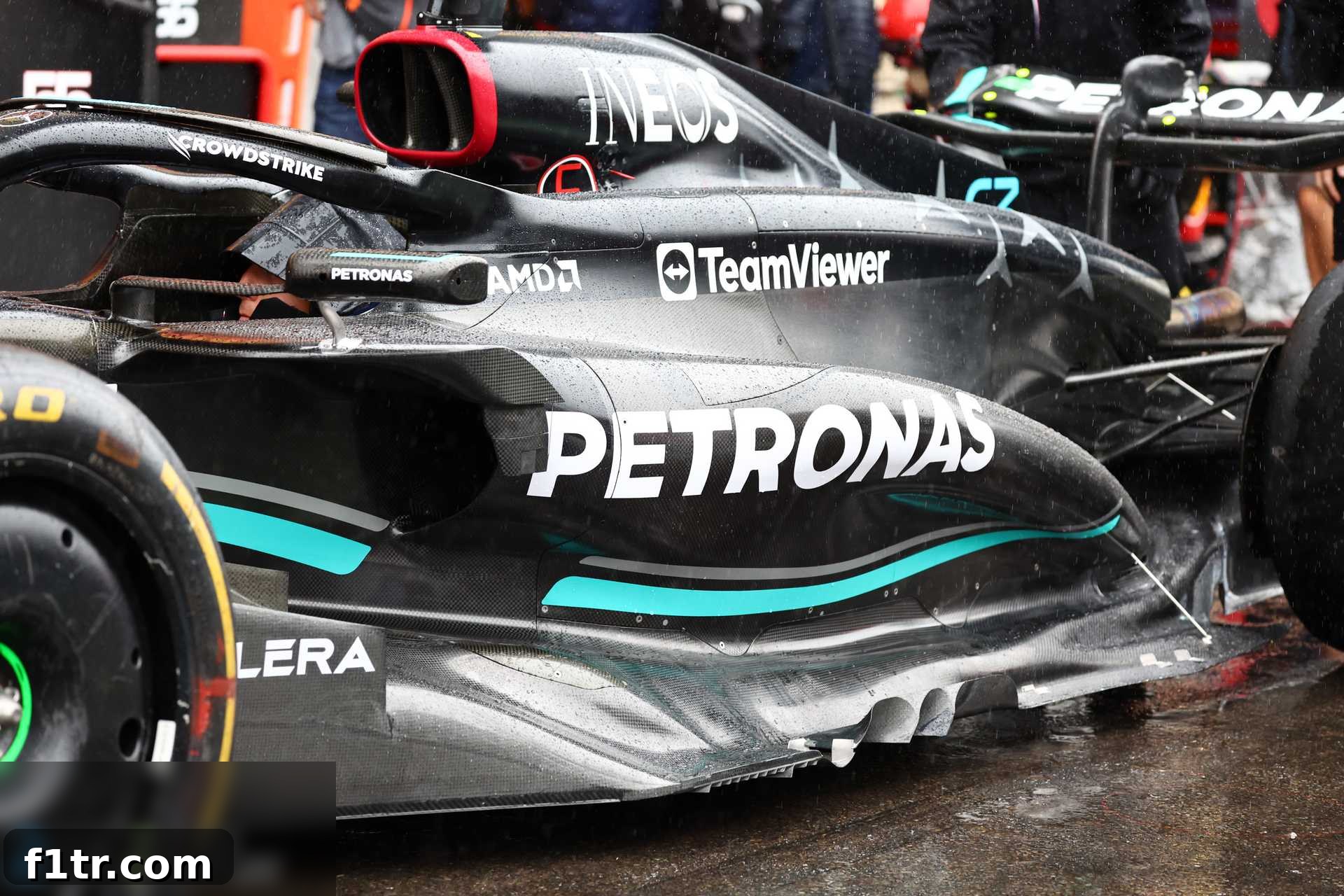
Mercedes-AMG Petronas Formula 1 Team continues its relentless pursuit of performance, introducing a significant and highly anticipated aerodynamic overhaul to its W14 challenger at the iconic Belgian Grand Prix. The focus remains keenly on the car’s intricate sidepod design and its interaction with the floor, marking another pivotal step in their mid-season development push. This latest iteration signals a more aggressive and defined direction for the Silver Arrows as they strive to unlock the W14’s full potential and contend at the sharp end of the grid.
Mercedes W14 Unleashes Radical Sidepod Overhaul at Belgian Grand Prix: A Deep Dive into F1 Aerodynamics
The journey of the Mercedes W14’s sidepod design has been one of the most talked-about sagas in recent Formula 1 seasons. The team, known for its innovative engineering, initially persevered with its distinctive ‘zero-pod’ concept, a bold and unconventional approach to the new ground effect regulations introduced in 2022. This design, characterized by its minimal bodywork around the engine bay, aimed to maximize airflow to the floor and diffuser. However, despite its theoretical advantages, the zero-pod proved challenging to optimize, leading to a period of inconsistent performance and a significant deficit to rivals.
Recognizing the limitations of their initial philosophy, Mercedes made a strategic pivot at the Miami Grand Prix earlier this season. They introduced a more conventional sidepod arrangement, featuring a broader, more sculpted profile akin to designs successfully employed by other teams. This shift was a clear acknowledgment that their unique concept was not delivering the expected performance gains and that a change in direction was necessary to improve the car’s fundamental aerodynamic characteristics. The Miami update marked a crucial turning point, offering glimmers of improved stability and a more predictable platform for development.
The Spa Evolution: A More Aggressive Aerodynamic Philosophy Takes Shape
Now, at the challenging Spa-Francorchamps circuit, Mercedes has unveiled yet another significant revision to their W14’s sidepods, demonstrating their commitment to an aggressive development curve. This newest version, observed for the first time in the pit lane ahead of the Belgian Grand Prix, showcases a refined and more pronounced aerodynamic profile. The most striking visual change is a more distinct downward slope at the rear of the sidepods, a design element meticulously crafted to manipulate airflow over the rear of the car. Furthermore, the bodywork now curves more acutely inwards underneath, indicating a sophisticated effort to control the airflow along the car’s flanks and optimize its interaction with the crucial floor area.
Beyond the immediately visible bodywork, subtle yet critical modifications have also been applied to the edges of the floor. In the high-stakes world of Formula 1 aerodynamics, where mere millimeters can translate into significant performance gains, these seemingly minor adjustments play an outsized role. The floor, often referred to as the “engine” of a modern F1 car, is paramount for generating ground effect downforce. Any alteration to its edges, no matter how small, can profoundly influence the pressure distribution underneath the car, managing the turbulent air generated by the front wheels and directing it efficiently towards the diffuser at the rear.
Learning from Rivals: The Path to Performance Convergence
Mercedes’ evolution in sidepod design reflects a broader trend within Formula 1, where successful concepts are often observed, analyzed, and adapted by competing teams. Since abandoning their original ‘zero-pod’ approach, Mercedes has increasingly converged towards a design philosophy embraced by others, most notably the dominant Red Bull Racing team. Red Bull’s innovative sidepod and floor solutions have been instrumental in their unparalleled success under the current technical regulations, offering a masterclass in aerodynamic efficiency and consistent downforce generation across various track conditions.
A recent and highly conspicuous example of this convergence yielding significant results is McLaren. The Woking-based outfit introduced a comprehensive package of new bodywork, strikingly similar to Red Bull’s philosophy, at the Austrian Grand Prix. The impact was immediate and dramatic, with McLaren securing podium finishes in the subsequent two races. This rapid performance leap served as a powerful testament to the efficacy of the Red Bull-esque design direction, undoubtedly reinforcing Mercedes’ resolve to pursue similar aerodynamic avenues.
Toto Wolff on the Engineering Challenge and Strategic Direction
Mercedes Team Principal Toto Wolff provided valuable insights into the team’s development process at the British Grand Prix, shedding light on the complexities of adopting rival concepts. Wolff explained that their technical director, James Allison, and his dedicated aerodynamics team had rigorously studied similar sidepod designs employed by competitors. However, the challenge lay not merely in copying a design, but in seamlessly integrating it with the W14’s existing architecture and ensuring it worked synergistically with the car’s overall aerodynamic package.
“We had the sidepod concept and the bodywork in the tunnel very early on already to see which avenues it would open up and how much it would add to performance,” Wolff stated at Silverstone. “The relative loss of the downforce, the way we measure it, was substantial. So it’s not something that we wanted to follow up earlier in the year.” This highlights the intricate balance required in Formula 1 development; a design that works wonders on one car might be detrimental on another without extensive re-engineering and recalibration.
Wolff’s comments underscore the immense computational power and empirical testing involved in modern F1 car development. Even with advanced CFD (Computational Fluid Dynamics) and wind tunnel facilities, predicting the exact real-world impact of a new component can be challenging. The initial tests on rival-inspired sidepods might have shown a theoretical downforce increase in isolation, but also indicated an adverse effect on other critical areas of the car’s performance, such as drag or balance. This necessitates a holistic approach, where every component is optimized not just individually, but as part of an integrated system.
When asked about the future direction, Wolff expressed confidence in his team: “Will we change our design direction? I think we have a great group of aerodynamics led by James, and I’m sure that it will be a consideration seeing the step they made.” This statement reaffirms Mercedes’ commitment to iterative improvement and their willingness to evolve their design philosophy based on emerging data and competitor performance. The team is not simply reacting, but strategically adapting their long-term vision for the W14 and future contenders.
A Holistic Development Approach: Beyond Sidepods
It is crucial to view these sidepod revisions not in isolation, but as part of a comprehensive development strategy. The latest updates follow a significant revision to the W14’s front suspension system, which was introduced at the Hungarian Grand Prix. The primary objective of this earlier update was to improve the flow of air into the floor area, a critical component for generating downforce. By optimizing the airflow at the front of the car, Mercedes aimed to present cleaner, more energetic air to the underfloor, allowing it to work more efficiently and consistently.
The combination of a revised front suspension and these new sidepods and floor edges demonstrates a multi-faceted approach to aerodynamic improvement. It suggests that Mercedes is addressing various upstream and downstream elements of the airflow path, seeking to create a more cohesive and high-performing aerodynamic package. This holistic strategy is essential for maximizing ground effect and ensuring the car operates within its optimal aerodynamic window across different speed ranges and cornering conditions.
Implications for the Championship and Future Prospects
These persistent updates underscore Mercedes’ ambition to not only secure second place in the Constructors’ Championship but also to lay strong foundations for their 2024 challenger. Each revision provides invaluable data and insights, informing the design and development trajectory for the next season. The Belgian Grand Prix, with its unique blend of high-speed straights and challenging technical sections, will serve as a crucial testbed for the efficacy of these latest modifications.
While the gap to Red Bull remains substantial, Mercedes’ systematic approach to development indicates their determination to close that deficit. The lessons learned from the W14’s journey – from the initial ‘zero-pod’ experiment to the current convergence with more conventional, high-performance designs – will be pivotal for shaping their future success. Formula 1 is a perpetual race of innovation, and Mercedes continues to demonstrate its commitment to pushing the boundaries of engineering excellence in its relentless pursuit of victory.
Mercedes’ Old and New Sidepods
Pictures: Mercedes’ New Sidepods at Spa-Francorchamps
2023 Belgian Grand Prix Related Articles
- Haas Drivers Fear Losing Battle for Seventh After “Grim Weekend” in Spa
- Mercedes Optimistic They’re “In the Right Place for Winter” with Development Plan
- Ferrari Not Convinced by Call to Equalise Engines: ‘Renault Is Not So Far Away’
- Ferrari Staying “Calm” Amid Swings in Performance From Race to Race
- Pirelli Proposes New “Super-Intermediate” to Address Wet Weather Tyre Problems
Browse all 2023 Belgian Grand Prix articles