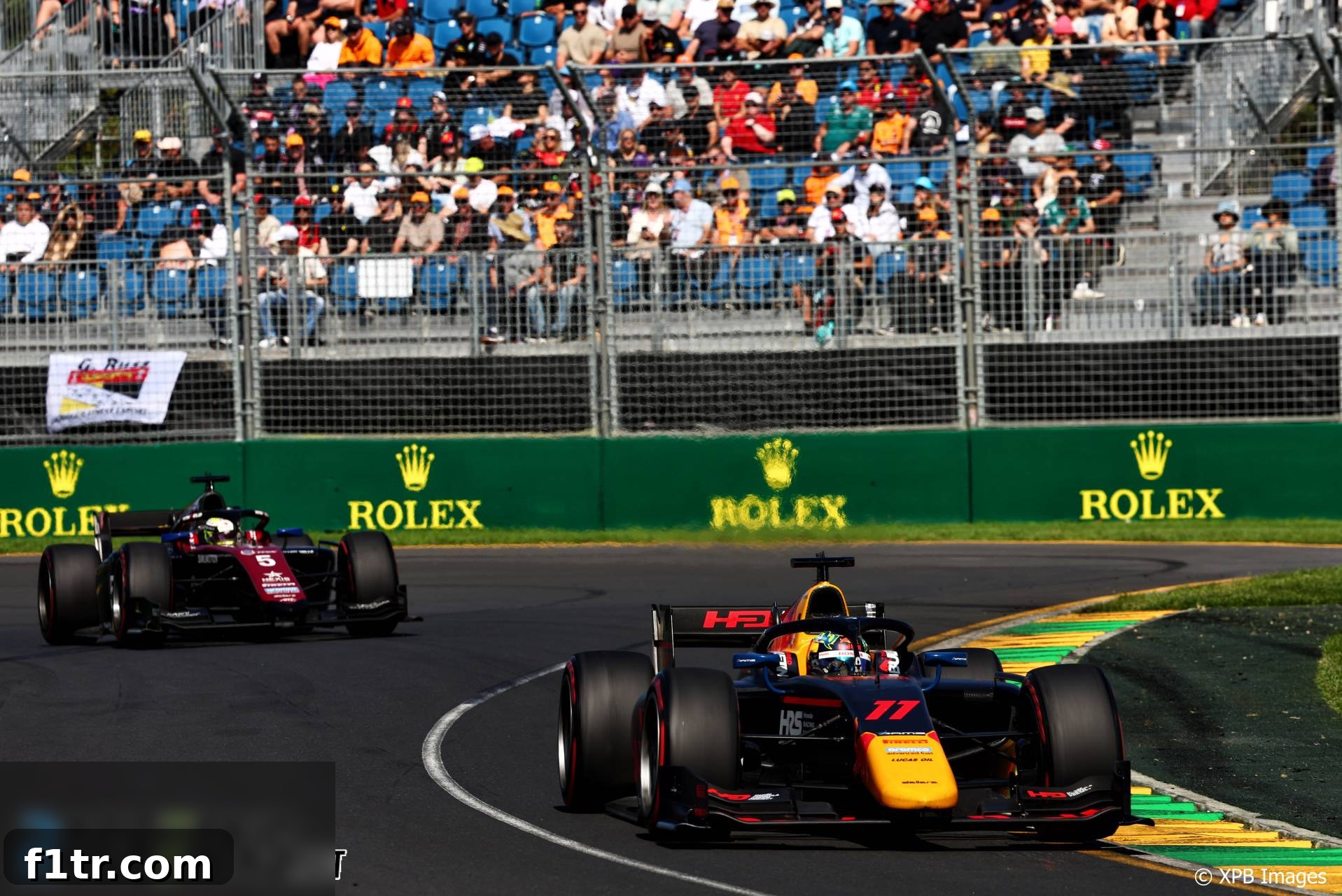
Ayumu Iwasa Masters Chaos in Melbourne F2 Feature Race, Claims Championship Lead
In a breathtaking display of skill and composure, Ayumu Iwasa secured a commanding victory at the Formula 2 Melbourne Feature Race, masterfully converting his pole position into a crucial win. The DAMS driver navigated a tumultuous race filled with dramatic incidents and two Safety Car periods, ultimately seizing the championship lead after six rounds of the highly competitive series. His stellar performance under immense pressure saw him finish just ahead of a resilient Théo Pourchaire, with Arthur Leclerc inheriting a sensational third place following a late-race collision.
The Australian Grand Prix weekend proved to be a pivotal moment in the Formula 2 season, showcasing both raw talent and the unpredictable nature of motorsport. With Iwasa’s strategic brilliance and unwavering focus, he emerged as the undisputed star, demonstrating why he is a formidable contender for the 2023 title. The dramatic events at Albert Park provided a compelling narrative, from intense early battles to controversial pit lane incidents and late-race collisions that reshaped the podium.
Melbourne F2 Feature Race: A High-Stakes Showdown
Having claimed pole position by a remarkable 0.6 seconds in Friday’s rain-soaked qualifying session, Ayumu Iwasa lined up on the front row alongside Théo Pourchaire in dry, sunny conditions for Sunday’s feature race. Both drivers were eager to make amends after a challenging sprint race a day prior, which had been won by Dennis Hauger. The stage was set for an exhilarating contest on the iconic Albert Park street circuit, where precision and nerve would be paramount, with drivers knowing that any mistake could be severely punished.
Flawless Start and Early Battles
As the lights went out, Iwasa delivered a dream start, maintaining his lead confidently into Turn 1. Behind him, the ART Grand Prix duo of Victor Martins and Théo Pourchaire engaged in an intense wheel-to-wheel battle for second place. Martins initially surged past Pourchaire into the opening corner, only for his seasoned teammate to reclaim the position with a decisive move heading into Turn 3. This early intra-team rivalry highlighted the competitive stakes, as both ART drivers sought to maximize their points haul and challenge Iwasa at the front.
The opening laps were relatively clean, allowing the front-runners to settle into a rhythm. Iwasa began to build a slender lead, showcasing the impressive pace he had demonstrated in qualifying, while Pourchaire worked diligently to fend off Martins and keep the DAMS driver within striking distance. The initial phases of the race hinted at a strategic battle, but the inherent challenges of the Melbourne circuit soon brought the first major disruption, proving that composure under pressure would be the ultimate decider.
First Safety Car: Chaos and Strategic Decisions
The race’s complexion dramatically shifted on Lap 7 with the deployment of the first Safety Car. Australian hopeful Jack Doohan, who had already demonstrated strong pace by climbing four positions to 11th, made an ambitious late lunge down the inside of Turn 13. Unfortunately, his aggressive maneuver resulted in contact with Jak Crawford, sending the Hitech driver into the gravel trap and necessitating the Safety Car intervention. Crawford’s immediate retirement marked a disappointing end to his race, while Doohan’s move came under scrutiny.
This incident triggered a frenzied rush into the pit lane as many teams seized the opportunity to switch to fresh tyres under caution. However, the pit lane itself became a scene of controversy and costly mistakes, demonstrating the high-pressure environment of F2 pit stops. Prema’s Oliver Bearman, a rising star and front-runner, suffered a puncture after colliding with the front-left of Isack Hadjar’s car. Hadjar had been prematurely released from his pit box just as Bearman was approaching, an error that severely compromised both drivers’ races and drew the attention of the stewards. Victor Martins also found himself severely disadvantaged by the timing of the Safety Car, dropping valuable track positions behind Hadjar, who had pitted moments before the yellow flags were waved, showcasing the fine margins that define success and failure in F2 pit strategy.
Not all teams opted for the pit stop gamble. Frederik Vesti of Prema chose to remain out, inheriting the lead for the Lap 12 Safety Car restart. Iwasa, having taken fresh tyres, found himself in fifth place among those who had pitted, setting the stage for an exciting chase as the ‘fresh-tyred runners’ prepared to battle their way past those who had stayed out on older rubber. This strategic divergence added another layer of intrigue, promising thrilling overtakes and intense wheel-to-wheel action as the race restarted.
Mid-Race Incidents and Penalties
As racing resumed, the track action intensified, confirming the high risk of incidents that comes with a mixed-strategy field. On Lap 14, Isack Hadjar’s difficult day continued when he was hit from behind by Roy Nissany at the penultimate corner, causing him to lose several positions and further disrupting his progress. Nissany himself had already been involved in an incident earlier that same lap, finding the gravel at Turn 10 after making contact with Enzo Fittipaldi. The stewards swiftly reviewed this, handing Fittipaldi a five-second time penalty for his role in the collision, underscoring the strict officiating in Formula 2 and the consequences of aggressive driving.
Meanwhile, the battle for podium positions heated up considerably. On Lap 15, Dennis Hauger executed a brilliant overtaking maneuver, diving down the inside of Turn 1 to pass Victor Martins for what was effectively third place on the road. This move showcased Hauger’s sharp racecraft and determination to recover from his earlier sprint race victory. Ahead of them, Iwasa and Pourchaire, having expertly navigated through the traffic and the varying strategies, began to consolidate their positions at the front, demonstrating exceptional race craft and discipline amidst the unfolding drama. Their ability to manage tyres and avoid incidents was a testament to their championship aspirations.
Second Safety Car: A Double Disaster and Podium Shake-up
The race took another dramatic turn on Lap 26 with the deployment of the second Safety Car, once again triggered by Roy Nissany. The PHM Racing driver veered slightly onto the grass at the exit of Turn 2, lost control, and spun violently into the barrier, ending his race prematurely. Moments later, in a bizarre twist of fate, his earlier rival Enzo Fittipaldi also spun into the wall at precisely the same location. Fittipaldi initially spun at Turn 2, attempted to resume, but his rear suspension appeared to fail catastrophically, pitching him violently into the wall just metres ahead of Nissany’s now stationary car. This double incident highlighted the unforgiving nature of the Albert Park circuit and the fine line between heroics and disaster, leading to a second significant Safety Car period.
Amidst this carnage, Frederik Vesti, who had courageously remained out on track, finally made his compulsory pit stop under the Safety Car. This strategic move, while necessary, effectively handed the lead back to Ayumu Iwasa, who had managed his tyre advantage brilliantly throughout the earlier phase of the race, putting him in a commanding position. However, the drama was far from over, especially for Isack Hadjar, whose luck seemed to run out entirely during this Safety Car period. First, he was handed a 10-second time penalty for leaving the track and rejoining unsafely. Then, came an even more critical and unfortunate error just before the race was about to restart, sealing his fate.
Late Race Collision and Leclerc’s Unexpected Podium
As the field bunched up for the impending restart, a moment of high tension led to yet another pivotal incident. Victor Martins, pushing hard to warm his tyres and prepare for the sprint finish, locked up heavily at the penultimate corner. The ensuing loss of control saw him collide with Dennis Hauger, who had been running strongly as a podium contender. Both Martins and Hauger tumbled down the order, their hopes of a strong finish dashed in an instant and their promising races ending in bitter disappointment. This dramatic turn of events paved the way for Arthur Leclerc, who, through no direct action of his own, inherited a shock third place as the race prepared for a thrilling three-lap sprint to the chequered flag. Leclerc found himself on the cusp of an unexpected podium, a testament to the unpredictable nature of Formula 2.
Iwasa’s Masterclass and Championship Dominance
With just three laps remaining, Ayumu Iwasa demonstrated exceptional control and race management. He expertly controlled the restart and held off the relentless pressure from Théo Pourchaire behind him, who was pushing hard to close the gap. Iwasa ultimately crossed the finish line 0.8 seconds ahead of Pourchaire, securing his second victory of the Formula 2 season and a career-defining performance in Melbourne, showcasing his true championship pedigree. His ability to remain calm and precise amidst the late-race chaos was truly remarkable.
Arthur Leclerc, despite the intense pressure from Frederik Vesti who was charging hard on significantly fresher tyres, drove a mature final few laps to valiantly hold onto third place. This marked a memorable and somewhat unexpected podium finish for the DAMS driver, a result he certainly earned through sheer defensive skill in the closing stages. The final points positions saw Zane Maloney come home in fifth, ahead of Jehan Daruvala, Richard Verschoor, Jack Doohan, and Kush Maini, while Roman Stanek secured the final point in tenth position after a hard-fought race, demonstrating the depth of talent across the grid.
This triumphant victory in Melbourne propelled Ayumu Iwasa to the top of the Formula 2 championship standings, making him the first driver this year to claim two feature race wins. He now leads the title race with 58 points, eight points clear of Théo Pourchaire in second, while Frederik Vesti holds third with 42 points. The championship battle is set to intensify as the Formula 2 season resumes with another highly anticipated round in Baku at the end of April, promising more thrilling action, strategic battles, and unpredictable results as the young drivers continue their quest for Formula 1 glory.
Formula 2 Australia Race Two Results
| Position | Car | Driver | Team |
|---|---|---|---|
| 1 | 11 | Ayumu Iwasa | DAMS |
| 2 | 5 | Theo Pourchaire | ART |
| 3 | 12 | Arthur Leclerc | DAMS |
| 4 | 7 | Frederik Vesti | Prema |
| 5 | 3 | Zane Maloney | Rodin Carlin |
| 6 | 2 | Jehan Daruvala | MP |
| 7 | 22 | Richard Verschoor | Van Amersfoort |
| 8 | 14 | Jack Doohan | Virtuosi |
| 9 | 24 | Kush Maini | Campos |
| 10 | 20 | Roman Staněk | Trident |
| 11 | 23 | Juan Manuel Correa | Van Amersfoort |
| 12 | 21 | Clement Novalak | Trident |
| 13 | 17 | Brad Benavides | PHM Racing by Charouz |
| 14 | 15 | Amaury Cordeel | Virtuosi |
| 15 | 8 | Ollie Bearman | Prema |
| 16 | 6 | Victor Martins | ART |
| 17 | 10 | Isack Hadjar | Hitech |
| 18 | 25 | Ralph Boschung | Campos |
| 19 | 1 | Dennis Hauger | MP |
| DNF | 4 | Enzo Fittipaldi | Rodin Carlin |
| DNF | 16 | Roy Nissany | PHM Racing by Charouz |
| DNF | 9 | Jak Crawford | Hitech |
Formula 2 News and Analysis
- Formula 2 to debut in Miami and Montreal after Iran war cancellations
- Ex-McLaren junior Dunne’s move to Alpine finally confirmed
- Schumacher says his IndyCar feels like ‘an F2 car, just with better tyres’
- The Formula 2 team with an older driver line-up than almost half the F1 grid
- FIA to award more F1 superlicence points to IndyCar drivers from 2026
Browse all Formula 2 articles