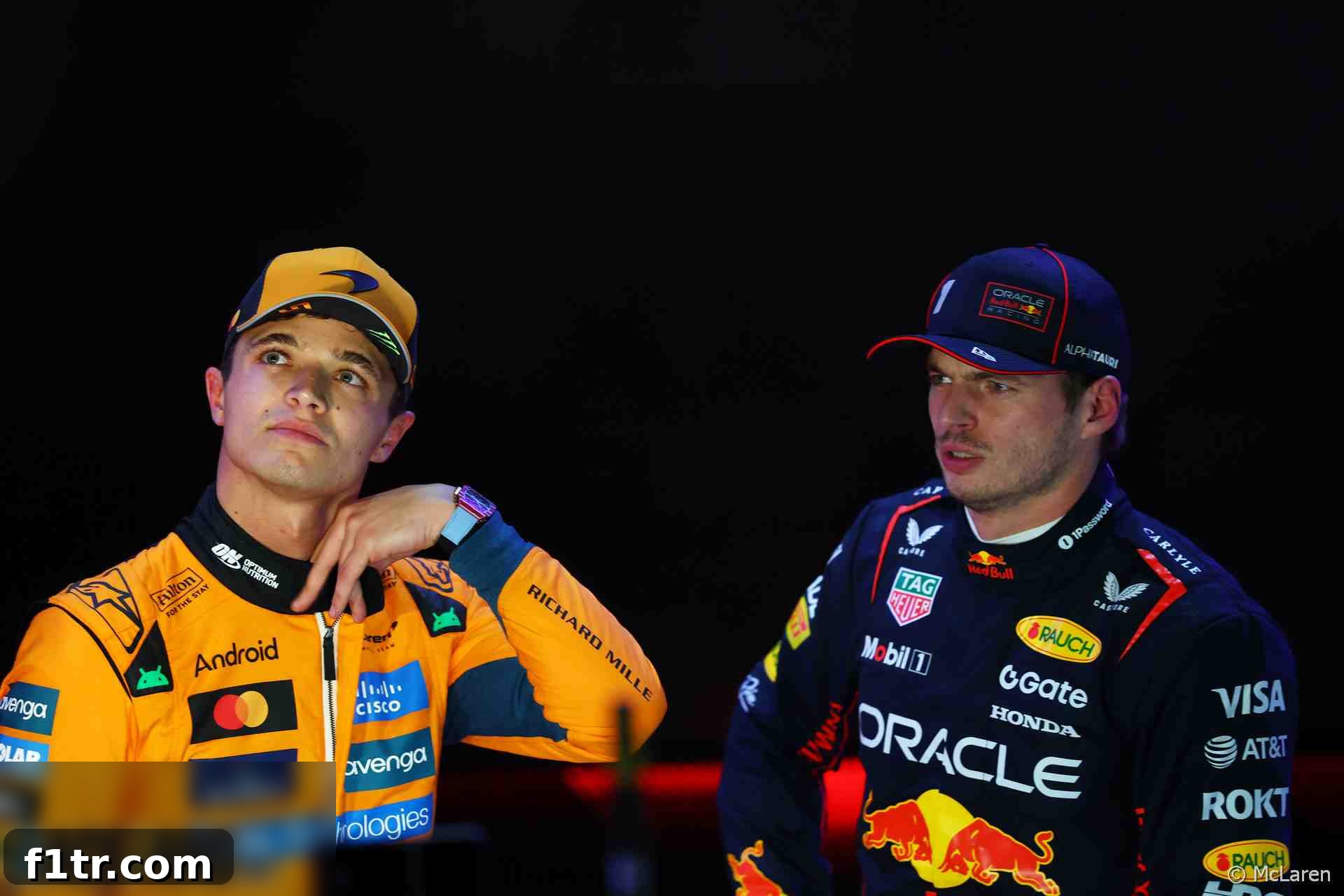
Lando Norris Grapples with Costly Qatar Qualifying Error and Looming Race Challenges
A momentary lapse on the crucial final lap of qualifying for the Qatar Grand Prix has left Lando Norris facing an uphill battle, not just for victory but potentially for his championship aspirations. The McLaren driver candidly admitted to a significant error that saw him forfeit what looked like a strong chance at pole position, a mistake he now believes will prove to be a “double blow” as he prepares for a challenging race day at the Losail International Circuit.
The Agony of Near-Pole: A Costly Slip-Up in Q3
The tension in Q3 was palpable, with drivers pushing the limits to secure the best possible grid slot for Sunday’s main event. Lando Norris had demonstrated blistering pace throughout the session, holding a provisional pole after his initial run. The stage was set for an epic final lap, where he aimed to solidify his position and convert raw speed into a prime starting spot. However, fate, or rather a slight misjudgment, intervened at Turn 2 during his decisive second attempt. “It wasn’t the best lap, there was a lot of room to improve on my second lap, but I went off and I made a mistake,” Norris confessed, detailing the incident to Viaplay.
This small but critical error opened the door for his McLaren teammate and fellow championship contender, Oscar Piastri, who capitalized perfectly to snatch pole position. The all-McLaren front row is a testament to the team’s incredible performance, yet for Norris, it carries a bitter taste, knowing what could have been. Norris’s disappointment stems from more than just losing pole; it’s the nature of the loss itself. A minor off-track excursion, a fraction of a second lost, proved enough to shift the dynamic entirely. In Formula 1, where margins are razor-thin, such errors are magnified, particularly in high-stakes qualifying sessions with championship implications. While Piastri’s performance was impeccable, taking pole position fair and square, Norris’s self-admitted mistake means he begins the race from a compromised position, adding another layer of complexity to his Sunday strategy and hopes for the championship fight.
A Double Disadvantage: Grid Position and Rivalry
Norris isn’t just lamenting the loss of pole; he’s acutely aware of the tactical repercussions of his second-place start. He famously described his grid slot as a “double penalty,” emphasizing two distinct disadvantages he faces. Firstly, starting on the racing line, which offers superior grip and a cleaner surface, is paramount for a strong getaway. Norris, however, will commence the Grand Prix from the “dirty side” of the track. This typically means reduced traction, making it harder to launch off the line and potentially losing ground to rivals in the initial meters of the race.
The second aspect of this “double blow” is the immediate proximity of his key rivals. Not only did he concede pole to his teammate Piastri, but the ever-present threat of Max Verstappen looms large, starting directly behind him in third place. Crucially, Max Verstappen will be on the clean side of the grid, perfectly positioned to exploit any hesitancy or lack of grip from Norris. This scenario sets up a fascinating, and potentially volatile, opening lap, with championship standings for all three drivers hanging in the balance, creating an electrifying start to the Qatar Grand Prix.
The Peril of the Dirty Side
The concept of the “dirty side” of the grid is a well-understood phenomenon in motorsport. During a race weekend, the racing line is constantly rubbered in and cleaned by the cars. Off-line, however, accumulates dust, tire marbles, and other debris, significantly reducing grip. This can be a critical factor at the start of a Grand Prix, where milliseconds can dictate positions. While last year, Max Verstappen managed to surge from second on the grid to take the lead, benefiting from a good start on the clean side, the recent sprint race at Losail offered a stark warning. Observations from Saturday’s sprint race indicated that drivers starting off the racing line generally experienced worse starts compared to those alongside them, struggling to find traction and often conceding positions early on. This recent precedent only amplifies Norris’s concerns, making his task of maintaining or gaining positions immediately after lights out even more challenging.
The Losail International Circuit’s unique characteristics, combined with the extreme temperatures and dusty conditions often experienced in Qatar, can exacerbate the dirty side’s impact. A poor start from P2 could quickly see Norris vulnerable to not just Verstappen but also other cars behind him, jeopardizing his entire race strategy before it even properly begins. The pressure on Norris to execute a flawless start, despite the inherent disadvantage, will be immense, as any slip-up could be severely punished.
Losail’s Overtaking Conundrum and Strategic Constraints
Beyond the start, the Qatar Grand Prix presents further strategic hurdles, largely due to the challenging nature of the Losail International Circuit and a specific rule change for the main race. Overtaking proved remarkably difficult during the sprint race, serving as a clear indicator of what drivers can expect on Sunday. Throughout the entire sprint, Andrea Kimi Antonelli was the sole driver within the top 16 positions to successfully gain a place, highlighting the circuit’s propensity for processional racing when cars are closely matched. This lack of overtaking opportunities means that track position, especially at the start, will be king, making Norris’s grid disadvantage even more impactful.
The circuit’s layout, characterized by its fast, flowing corners and limited heavy braking zones, makes it difficult for cars to follow closely without suffering from dirty air. This aerodynamic turbulence reduces downforce for the trailing car, making it harder to carry speed through corners and subsequently hindering any attempts to get close enough for an overtake. Drivers often describe it as battling a ‘wall’ of air, which depletes their tires and makes maintaining pace an arduous task when attempting to chase down an opponent. This fundamental characteristic of the Losail circuit puts a premium on qualifying performance and starting position.
The Mandatory Two-Stop Rule: A Strategic Straitjacket?
Adding another layer of complexity is a specific rule change implemented for the Grand Prix: a mandatory requirement for drivers to make two pit stops. This regulation, often introduced due to concerns over tire degradation or safety, is widely expected to significantly reduce teams’ strategic options. In races with flexible pit stop windows, teams can employ various strategies – an aggressive undercut, a prolonged overcut, or even a one-stop gamble – to gain an advantage. However, with two mandatory stops, the strategic variation diminishes substantially. Teams are forced into a more rigid framework, often leading to very similar race plans across the grid, essentially becoming a race of raw pace and impeccable pit stops.
This limitation on strategy is particularly relevant for Norris. If overtaking on track is already a challenge, and strategic creativity is curbed by mandatory stops, his options for making up ground after a potentially difficult start become severely restricted. He wouldn’t be able to rely on a clever pit strategy to leapfrog rivals, as everyone else will be operating within similar parameters. This places an even greater emphasis on raw pace, efficient tire management within the set pit stops, and exploiting any potential safety car periods or rival errors. The rule change transforms the race into a test of consistent performance and execution, rather than ingenious strategy.
Norris’s Measured Outlook: Battling Odds and Teammate
Given these formidable challenges, Lando Norris’s candid assessment of his prospects reflects a pragmatic, albeit reserved, outlook. He didn’t mince words about the difficulty of the task ahead. “It’s almost impossible to follow,” he stated, highlighting the Losail circuit’s design flaws for close-quarters racing. This difficulty is compounded when “you’re against your sister car and especially when you’re split by nothing.” The reference to his “sister car” underscores the unique predicament of battling Piastri, where car performance is virtually identical, eliminating any inherent machinery advantage and forcing the drivers to rely purely on their own skill and race craft.
Norris therefore anticipates very limited opportunities for overtakes. “So I don’t think there’s going to be a lot of opportunity apart from the run down to turn one.” But even there, the dirty side of the grid presents a significant hurdle. “Again there, I’m on the dirty side, so I’m not the most optimistic that I’m having things on my side.” This realistic appraisal paints a picture of a driver fully aware of the disadvantages he faces. However, despite the measured pessimism, Norris concluded with a note of cautious optimism, acknowledging the unpredictable nature of motorsport: “But it’s a long race, we’ll wait and see.” This reflects the resilience and hope that every F1 driver carries, knowing that circumstances can change rapidly, and perseverance often yields unexpected results in the cutthroat world of Formula 1.
Navigating the ‘Sister Car’ Challenge
The battle against a teammate, especially one who is also a championship rival, adds a unique psychological layer to Norris’s challenge. While a McLaren front row lockout is a dream scenario for the team in the constructor’s standings, it complicates the individual fight for the drivers. Overtaking a rival in a different car can be tough, but passing a teammate in an identical machine, often with identical setup philosophies, adds an extra dimension of difficulty. There’s an unwritten rule of not jeopardizing the team’s overall result, yet the individual championship ambitions are fiercely strong. Norris knows Piastri will be acutely aware of his own race strategy, making any surprise moves harder to execute. Their close performance margins mean that any advantage will have to come from exceptional driving, superior tire management, or reacting faster to unforeseen events, rather than a significant pace differential or a tactical masterstroke.
The Broader Championship Narrative
The Qatar Grand Prix is more than just another race; it’s a pivotal moment in what has shaped up to be a thrilling championship battle. With Norris, Piastri, and Verstappen all in contention, every point, every position gained or lost, carries immense weight. A strong performance from Piastri could see him solidify his challenge, while a comeback drive from Norris could reignite his. Conversely, any ground lost by either McLaren driver could open the door further for Verstappen, who remains a formidable force in his Red Bull. The Constructors’ Championship is also on the line, with McLaren looking to cement its position and potentially challenge Red Bull. The outcome of this race, particularly how the two McLaren drivers manage their internal rivalry while fending off external threats, will undoubtedly shape the narrative for the remaining rounds of the season and intensify the already fierce competition.
Anticipating the Qatar Grand Prix: A Test of Resilience
As the Qatar Grand Prix approaches, all eyes will be on Lando Norris and his ability to convert a challenging starting position into a strong race result. His final-lap error in qualifying has undeniably put him on the back foot, facing a “double blow” from both a less advantageous grid slot and the relentless pursuit of championship rivals. The Losail International Circuit’s reputation for difficult overtaking, coupled with the restrictive mandatory two-stop rule, further complicates his mission. Yet, Formula 1 is a sport of unpredictability and resilience. While Norris’s initial outlook is tempered with realism, the inherent drama of a Grand Prix means anything can happen. His ability to manage his tires, execute a flawless start from the dirty side, and seize any fleeting opportunities will be critical. The Qatar Grand Prix promises to be a true test of character, strategy, and pure driving skill for Lando Norris, as he aims to overcome his self-inflicted wound and keep his championship hopes alive in what is shaping up to be an enthralling season.
2025 Qatar Grand Prix Related Articles
- Norris wins 2025 F1 title and ends Verstappen’s four-year reign as champion
- McLaren “helping Stefano with TV ratings” with Qatar strategy error, jokes Brown
- Alpine are guaranteed to finish last in 2025 – but will set an obscure points record
- Norris take note: The F1 points leader usually loses three-way title fights
- Mercedes grateful for Red Bull’s statement on Antonelli after “disappointing” online abuse
Browse all 2025 Qatar Grand Prix articles