The exhilarating world of Formula 1 constantly balances the thrill of high-speed competition with the paramount concern for driver safety. This delicate equilibrium was brought sharply into focus recently when FIA race director Charlie Whiting addressed the use of the Drag Reduction System (DRS), asserting that its safe application ultimately rests with the drivers. This statement came in response to prominent figures like Lewis Hamilton, who critically labelled Silverstone’s newly introduced DRS zone as an “unnecessary danger” after a series of unsettling incidents.
Advert | Become a Supporter & go ad-free
The Silverstone Controversy: High Stakes at Abbey
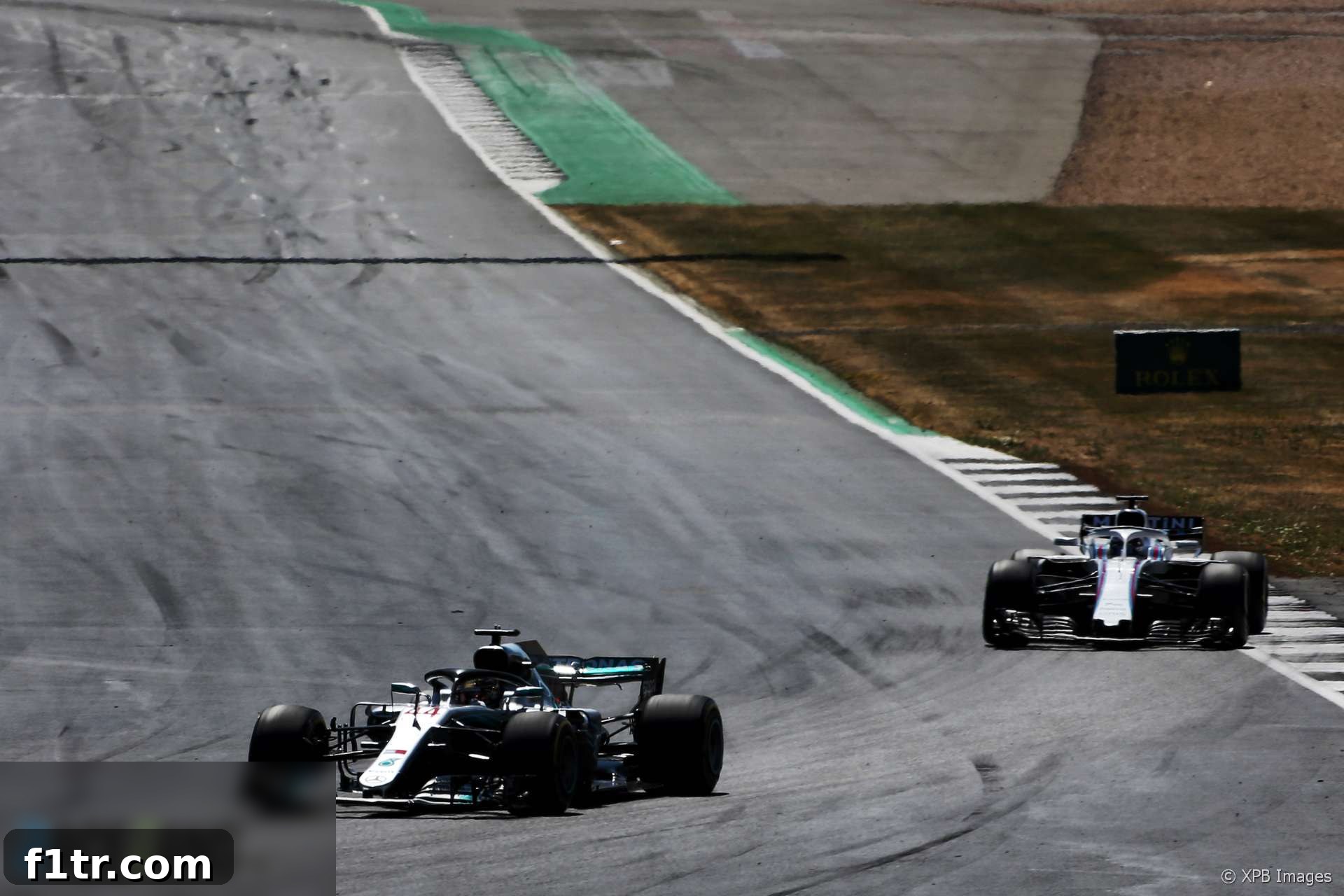
The 2018 British Grand Prix at Silverstone served as the crucible for this intensified debate. The circuit, renowned for its challenging, high-speed corners, introduced a new, third DRS zone on the Wellington Straight, extending through the iconic Abbey corner. It was this specific placement that sparked contention and ultimately led to critical incidents, raising fundamental questions about the interaction between technology, track design, and driver decision-making in the pursuit of marginal gains.
Lewis Hamilton’s Concerns: A Champion’s Call for Caution
Lewis Hamilton, a four-time world champion and a vocal advocate for safety, did not mince words when discussing the new zone. His declaration of it being an “unnecessary danger” resonated widely within the paddock and among fans. Hamilton, known for his precision and deep understanding of car dynamics, likely based his assessment on the extreme speeds achieved with DRS open combined with the inherent challenges of the Abbey corner. This section of the track demands absolute commitment and accuracy, and adding the instability of an open DRS flap at such velocities pushed the boundaries of what drivers could manage safely, even for the best in the world.
Romain Grosjean’s High-Speed Scare at Abbey
The theoretical concerns voiced by Hamilton unfortunately materialized into tangible incidents. During practice sessions, Romain Grosjean suffered a dramatic high-speed crash in this very zone. The Haas driver, pushing the limits, failed to close his DRS early enough while navigating the rapid Abbey corner. The sudden loss of downforce, coupled with the immense speed, resulted in a violent spin and a significant impact with the barriers. This incident underscored the razor-thin margin for error and the potentially severe consequences of misjudging the closure point for the DRS system.
Marcus Ericsson’s Close Call and Medical Car Deployment
Tragically, Grosjean’s incident was not isolated. In the race itself, Marcus Ericsson endured a strikingly similar crash, reinforcing the pattern of peril. He too failed to close his DRS in time through the demanding Abbey section, leading to a loss of control and a significant collision with the protective barriers. The severity of Ericsson’s impact was such that the Medical Car was promptly dispatched to the scene, a standard precautionary measure for high-G incidents, highlighting the potential for serious injury and the very real dangers drivers face when pushing the limits of both man and machine. These back-to-back incidents within the same weekend, in the identical DRS zone, served as a stark warning and amplified the calls for a re-evaluation of the zone’s suitability.
FIA’s Stance: The Imperative of Driver Choice and Responsibility
Despite the harrowing visuals and the concerns raised by drivers, FIA race director Charlie Whiting maintained a firm stance on the issue. He unequivocally stated that the responsibility for safely deploying DRS lies squarely with the drivers. “I think the incidents where drivers lost control through turn one because they had their DRS open is driver choice,” he told media, including RaceFans. “Just like any other choice you make in a car.”
Whiting drew a parallel between DRS usage and other challenging aspects of racing. “It’s like any corner that is challenging to drivers, sometimes they try to do it flat when it’s not really flat, it’s the same thing. It’s their choice.” This perspective underscores the FIA’s long-standing philosophy that Formula 1 is a sport that inherently demands exceptional skill, judgment, and risk assessment from its participants. While the FIA is responsible for setting the framework and ensuring overall safety standards, the ultimate execution of strategy and the management of available tools during a race fall upon the driver.
The Purpose and Evolution of DRS in Formula 1
To fully appreciate the debate, it’s essential to understand the context of DRS. Introduced in Formula 1 in 2011, the Drag Reduction System was designed to promote overtaking and enhance the racing spectacle. By allowing a driver within one second of a car ahead to momentarily open a flap on their rear wing, it reduces drag and increases straight-line speed, providing a crucial advantage for attacking positions. While highly effective in its primary goal, the system inherently trades stability for speed, requiring precise timing and confident handling, especially when used through or immediately preceding high-speed corners.
Driver Briefings and the Dynamic of Feedback
Whiting also pointed out that drivers had not raised any specific concerns about the Silverstone DRS zone during their pre-event briefing on Friday. This observation adds another layer to the discussion. It suggests that while drivers are crucial stakeholders in safety, their initial assessments might differ from real-world, high-pressure scenarios. Often, the true limits of a new track configuration or a technical aid like DRS are only discovered when drivers push their cars to the absolute maximum during qualifying or race conditions. This highlights the dynamic process of safety evaluation, which evolves from theoretical discussions to practical, on-track experience and subsequent feedback.
The Delicate Balance: Performance, Safety, and Regulation
The Silverstone incidents highlight the continuous tension between pushing the boundaries of performance and ensuring an acceptable level of safety in Formula 1. Modern F1 cars are marvels of engineering, designed to generate incredible downforce and achieve astounding speeds. DRS, while a relatively simple device, fundamentally alters the car’s aerodynamic balance, temporarily reducing downforce at a critical moment. The FIA’s role is to define the boundaries within which this technology can be safely exploited, considering track layouts, car capabilities, and driver skill. The debate, therefore, isn’t just about DRS itself, but about where the responsibility truly lies when these boundaries are tested.
Hockenheim Awaits: A New DRS Challenge for the German Grand Prix
As the F1 season progresses, the focus shifted to the German Grand Prix at Hockenheim, where a new, third DRS zone was planned. This addition, following the controversy at Silverstone, garnered significant attention regarding its design and potential implications. The FIA confirmed that a single activation point would cover this new zone, which strategically ends before the high-speed Turn 1. This new zone then feeds into the existing zone that follows the corner. The other established DRS zone, located on the approach to the Spitzkehre (Turn 6), retains its own independent activation point at the exit of Turn 4.
Advert | Become a RaceFans supporter andgo ad-free
The design of the Hockenheim DRS zones appears to reflect a cautious approach, particularly with the new zone concluding before the potentially problematic Turn 1. This contrasts with Silverstone’s Abbey, where the DRS zone extended *through* a high-speed corner. By ending the zone prior to the corner, the FIA seemingly aims to mitigate the risks associated with drivers attempting to carry an open DRS flap into a turn, thereby allowing them to regain full aerodynamic stability before cornering. This strategic placement will undoubtedly influence driver strategies, demanding careful consideration of when and for how long to deploy DRS to maximize overtaking opportunities without compromising safety.
The Road Ahead: Evolving DRS and Driver Safety in Formula 1
The incidents at Silverstone and the subsequent debate underscored that DRS, while a vital tool for enhancing the racing spectacle, is not without its risks. The FIA and Formula 1 teams are in a continuous process of refining regulations and track configurations to strike the optimal balance between thrilling competition and ensuring driver well-being. This ongoing evolution will undoubtedly involve scrutinizing incidents, gathering driver feedback, and adapting zone placements or operational rules to prevent future occurrences. Ultimately, the future of DRS will likely continue to be shaped by a collaborative effort between the regulatory body, the teams, and the drivers themselves, all striving for a safer, yet equally exciting, pinnacle of motorsport.
Related Formula 1 Insights
- F1 feared “death knell” for Drive to Survive after Ferrari and Mercedes snub
- McLaren staff told us we were “totally crazy” to take Honda engines in 2018 – Tost
- ‘It doesn’t matter if we start last’: How Red Bull’s junior team aided Honda’s leap forward
- Honda’s jet division helped F1 engineers solve power unit problem
- McLaren Racing losses rise after Honda split
Browse all 2018 F1 season articles