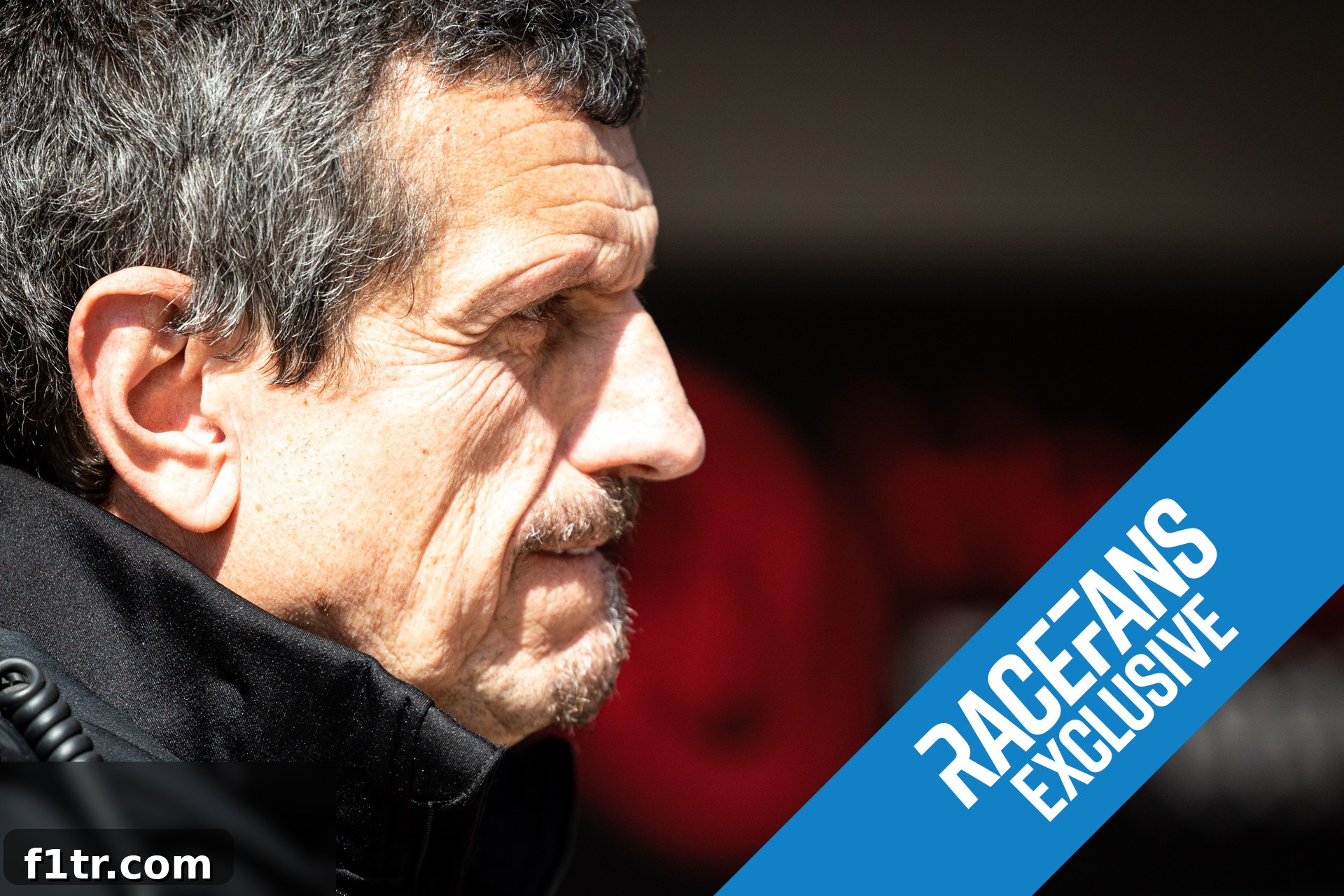
Guenther Steiner on F1’s Future: Navigating Crisis, Budget Caps, and the Quest for Competition
During pre-season testing, RaceFans conducted interviews with several Formula 1 team principals, seeking their insights into the year ahead. The 2020 season was anticipated as a pivotal moment for the sport, marking the conclusion of the Bernie Ecclestone era. All regulations, contracts, and agreements inherited by Liberty Media, F1’s commercial rights holder since January 2017, were set to expire on December 31st, paving the way for a new chapter.
However, the global pandemic dramatically reshaped these expectations, rendering much of the initial pre-season discussions obsolete. Many early insights were ultimately left on the cutting room floor.
One notable interview that was published as F1 prepared for its (ultimately aborted) season opener involved Guenther Steiner, the outspoken and charismatic team principal of Haas F1. Steiner’s business model significantly disrupted the sport when Haas made its debut in 2016.
The American outfit made an impressive entry, finishing eighth in its inaugural championship after a consistently strong year, a position they replicated in their second season. In 2018, the team, owned by machine tool magnate Gene Haas, achieved a sensational fifth place in the constructors’ standings. They harbored ambitions of challenging the top teams in the subsequent season. However, a combination of complex aerodynamic issues and associated Pirelli tire problems led to a disappointing slump to ninth place, as comprehensively detailed in our previous interview.
To provide an update on the evolving situation, Guenther Steiner graciously agreed to another interview. This conversation, unlike the team’s usual hospitality setting, was conducted via video link to his home just north of Charlotte, North Carolina. Steiner settled in the United States after leaving his native South Tyrol region – a German-speaking area of Italy – to take up a position with Red Bull’s NASCAR team, a fascinating story for another time.
“I came back straight from Australia on Saturday,” he recounts, referring to the swift cancellation of the Grand Prix. “I’ve been back here since then, trying to leave the house as little as possible.”
Unsurprisingly, this famously energetic team principal maintains that he is managing to keep “as busy as ever” despite the extensive lockdown measures. The challenges, he explains, have merely shifted.
“It’s just different challenges at the moment. It isn’t like you don’t have a target, so you go easy. I’ve got so much to do. There are a lot of big decisions in Formula 1, for the team, and I have my own company to run.” This refers to Fibreworks, his carbon fiber supplier for the local motorsport industry.
“I normally start between 7 and 7:30 in the morning in my office here at home – obviously I’m not going to the office – but there is so much to do. I normally finish a little bit earlier than I did before because when it is getting to afternoon here [with a time zone difference of five hours to the UK], everybody is slowing around 2, 3pm there my time, I then do all the things I pushed back during the day.”
Haas F1 operates a uniquely distributed model. Research and development, along with design and production, are carried out at Ferrari and Dallara in Italy. The primary team base is situated in the British Midlands (Banbury), and support functions operate out of the Haas race headquarters in Kannapolis, USA (near Charlotte), where its NASCAR and off-road teams are also active. This structure meant Steiner had embraced ‘distance working’ long before it became a necessity for much of the world. He reflects on how this prepared him for the pandemic’s challenges.
“For me, not a lot changed. For example, the meetings with the people in the UK or Italy, where 95% of them are in any case, it’s a matter of ‘Just give me an address or send me an invitation and I’ll be there’,” he explains. “I think the world will learn a lot out of this, that maybe we don’t need to do all this travel. Look at how we’re speaking – I mean, the quality. We can’t shake our hands, but we shouldn’t be doing that anyway at this time.”
Steiner believes this shift could greatly benefit F1 in the long term. “It costs less because we don’t need to travel, and it’s less tiring because you don’t sit down in an aeroplane,” he points out, highlighting potential efficiencies for a sport notorious for its demanding travel schedule.
Lessons for Formula 1: Preparedness and Prudence
Beyond travel efficiencies, Steiner emphasizes a more profound lesson F1 must absorb from the current global situation.
“Not everything is always going up. Sometimes you go down as well and you need to be ready. I think we were not prepared for this because normally you have a crisis plan about what you will be doing, but now we are still negotiating our crisis plan between the ten teams,” he states, underscoring the lack of a unified contingency plan.
“So I think to learn, we need to be a little bit more careful. Not always aim for more, more and more but sometimes just stabilize something and try to live within our means so that everybody can live even if we hit a bump on the road, which always can happen.”
Steiner’s passion for this point is evident as he continues: “You know, nobody predicted this one. Everybody was afraid of a financial crisis coming, and all of a sudden we have a pandemic which ends up to be a financial crisis as well. Nobody predicted this. We just need to be a little bit more careful, not be scared of it, but be better prepared for anything that could cross the road.”
It raises the question: could F1 realistically have planned for a global pandemic, especially when the entire world seemed caught off guard? Steiner clarifies his perspective on preparedness.
“You cannot put a specific plan in place, in my opinion. But what we should plan is not to run always at 100%, to squeeze whatever we can get out of it, because then you have nothing left. You should make sure that you’ve got a buffer in case something like this happens,” he asserts.
“Like in every company, you need some money back in the bank, then if something goes wrong, you know that you can survive for a period of time. We have never even thought there could be a crisis. If you get a crisis, we thought we just deal with it. But it’s not easy, and a lot of people are working hard to make it happen.”
Despite reports of internal dissent among the teams, Steiner remains optimistic about the collaborative spirit emerging during this challenging period. “A lot of people which came out pretty strong are trying to help this, you know, within the teams, and being creative and positive,” he says.
“Not everybody has understood yet that we are in a crisis, but a lot of people are very, very supportive, very creative so that we can survive. All of us, not only a few of us.”
This statement subtly hints at ongoing discussions, possibly referencing Ferrari’s reported stance on budget caps. We later delve into this specific point. Returning to his emphasis on maintaining a crisis reserve, one might argue this goes against the very essence of Formula 1, which traditionally operates on the absolute limit at all times.
“Basically, as a sport it needs to be on the limit,” he concedes. “As a business we need to differentiate. It’s always two discussions. As a sporting competition we always need to go 100%, max. As a business, we need to be clever enough as businessmen, because it’s a big business. We’ve got a lot of responsibility for a lot of employees, a lot of families which work in F1.” This highlights the dual nature of Formula 1 as both a relentless sporting pursuit and a significant commercial enterprise with real-world responsibilities.
Team Principal Teleconferences: Seeking Compromise and a Fairer Future
Given the aforementioned comments on collaboration and crisis management, what is Guenther Steiner’s assessment of the frequent team principal teleconferences, regularly convened by the FIA and F1 to address the sport’s multifaceted challenges head-on?
“There’s a lot more understanding of each other,” he observes. “It is not unanimous – yet – that we are all agreeing on the same things. There are different things we disagree on. You also need to consider that our business models are quite different, so if it would be unanimous, something would be wrong.” Steiner acknowledges the inherent divergence of interests, especially between factory teams and customer teams, or those with varying levels of external funding.
“We just need to be unanimous to find a compromise. We have to respect each other. But we are getting close and hopefully in the next week, we can make a step to be done with our discussions in the moment.” This suggests progress, albeit slow, towards a unified path forward for the sport.
Naturally, each team arrives at these discussions with its own distinct wish list. When pressed on his preferred outcome, Steiner outlines a clear vision for a more equitable and competitive future for Formula 1.
“If you want a simple answer: that everybody can be competitive. Even on the prize money, the money needs to be very similar in order for us to be competitive. So, it should be a budget cap everybody can live within: The big teams can live within it; the small teams can live within it,” he passionately argues. The financial disparities have long been a contentious issue, and Steiner advocates for a budget cap that levels the playing field significantly.
“But the biggest thing for me that needs to come out, is we need to be competitive. Being competitive doesn’t mean that all of sudden Haas wants to win races. Yes, we want to win races, obviously, but you have to be conscious about where we are.” Steiner understands the current pecking order but envisions a clearer pathway to success.
“We want to be in a position – in a realistic position – where in a few years we can be on the podium. And then if we do a good job we get more prize money, and we can get the higher budget. Then we can win races. There needs to be an honest possibility to achieve that. That is for me what I would like to see coming out of this.” His aspiration is not instant victory but a structured, meritocratic system where strong performance is genuinely rewarded and enables progression.
The Dream of Winning: Making F1 Truly Competitive
During pre-season testing, I briefly conversed with Gene Haas, who expressed his initial belief that his team had a chance of winning in F1. However, he soon realized this was an improbable goal due to the sport’s entrenched financial and organizational structures. Building on Gene’s comments, I asked Guenther if F1 could once again become a sport where every entrant has a genuine chance of winning, provided they execute everything optimally.
“Most could. I wouldn’t say everybody because it’s not possible. Everybody over a certain time period, I would say just to clarify that, should be able to win if they do a good job. I think we’re getting closer to that. But at the moment, who can beat the big teams?” he muses, highlighting the current dominance.
“Works teams like McLaren and Renault cannot beat them, so what chance do we smaller ones have? But with a budget cap I think we have at least a chance to bring the field closer together, and then if you do a good job, you will be rewarded. That maybe pushes you up the next step, and then maybe you can actually win.” This underlines the transformative potential of a well-implemented budget cap, offering a credible ladder to success.
“But, in the moment, it’s just not possible. Or you inject billions. I’m not talking millions. Billions.” The sheer scale of investment required to compete at the very top under the old system is a stark reminder of the financial chasms that existed.
This naturally leads to the thorny topic of the budget cap itself. Given that budget caps are arguably the most contentious subject during team principal calls, at what level would Steiner ideally like to see them set? Haas already operates with one of the lowest budgets and certainly the lowest headcount, thanks to its unique ‘buy-in’ model from Ferrari and Dallara.
Initially, he hesitates to name a specific figure, explaining that the teams were still about $10 million apart after their last discussion. However, when presented with rumored numbers ranging between $100 million and $150 million, he offers a more direct assessment.
“The truth is somewhere in the middle,” he admits, acknowledging the complexities for all parties. “Because I think $100 million is very difficult for big teams, and we need to be respectful about what they’re doing.”
“The FIA and the president of the FIA (Jean Todt) have a good understanding of where the budget cap needs to be, to suit everybody. Their decision will be based on facts, not on politicking and biased opinions. I think we’re getting there, but we’re not there yet, so I don’t want to sing ‘glory’ too early.” This statement implies confidence in the FIA’s ability to act as a fair arbiter, balancing the diverse interests within the paddock.
Haas and Ferrari: A Relationship of Mutual Respect, Not Servitude
One of the criticisms frequently leveled at Haas by its detractors is the accusation that it functions as a de facto political extension of Ferrari, operating in lockstep with Maranello due to its reliance on the Italian team for technical support and services. Yet, the current disagreements over budget caps clearly put the two entities at odds. How challenging is it to maintain cordial and productive relations under such divergent circumstances?
“Our respect for each other, Ferrari and Haas, it’s still there, for sure. We have got discussions about it, obviously, but we never were a slave to Ferrari. We always worked together in a respectful way. Without them, we wouldn’t be here, and I would never deny that one. I said it in public more than one time that without their help we would not be here,” Steiner emphatically states, acknowledging the foundational role of Ferrari in Haas’s very existence in F1.
“But we cannot be slaves, because at the moment it’s a crisis. We need to look after our own corner, because if we go with them, we go down. And we cannot go down. They know that. I think our relationship is strong enough that we can agree to disagree on some things in life, or how we conduct our business. I think that shows that we respect each other, but by no means are we servants or slaves.” This eloquently clarifies the independent stance Haas must take, especially in times of crisis, prioritizing its own survival while maintaining deep respect.
“By saying that I don’t disrespect them, because I respect them a lot. So, it’s one of these things in this relationship that sometimes you need to agree to disagree, and just move on. We don’t decide. They don’t decide; we ten teams decide the way forward.” This final point emphasizes the collective responsibility and decision-making process within Formula 1, where no single entity dictates the path for all.
When asked if he would describe the relationship between Italy’s iconic team and the team he helped found in his adopted homeland as purely commercial, or perhaps politico-commercial, Steiner offers a nuanced perspective with a laugh.
“I mean,” he chuckles, “it’s political when it suits both of us. It’s business but it’s not opportunistic; it’s somewhere in between. It doesn’t need to be always one or the other. There can be something in between, you know.” This captures the complex, symbiotic nature of their partnership, which blends commercial realities with strategic alignments and occasional political maneuvering.
“It’s like if you agree on something, we fight together; if we disagree on it, we don’t fight each other, but tell each other what we think about that. But, there’s no disrespect in it, and whenever I go against Ferrari there’s no disrespect.” His loyalty and pragmatism shine through, underscoring that his primary allegiance is to Haas.
“My biggest interest is to protect Haas, and the second one is to protect everything that comes after that.” Guenther Steiner’s unwavering commitment to his team and his clear vision for a more sustainable and competitive Formula 1 future offer valuable insights into the ongoing transformation of the sport.