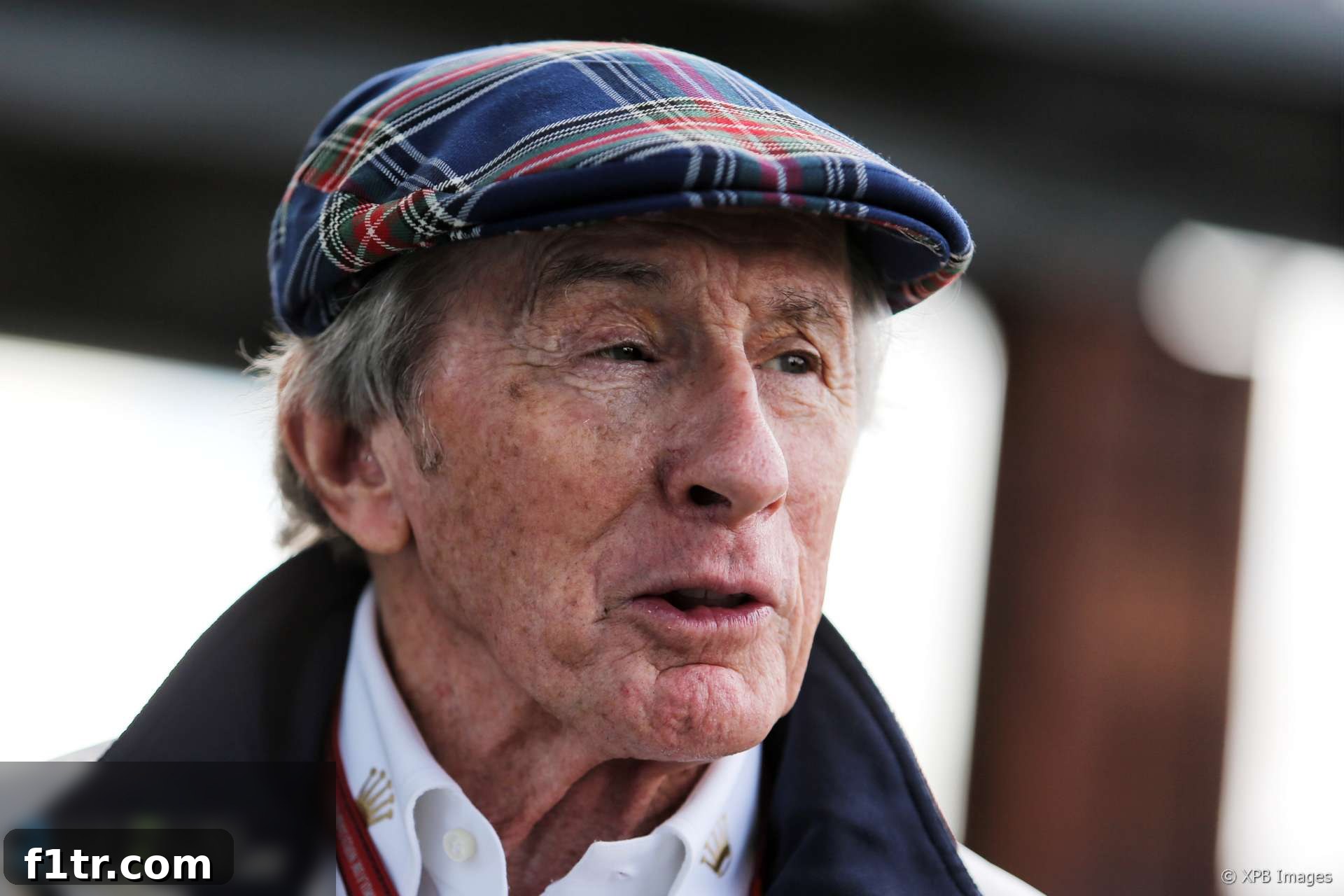
In the fiercely competitive arena of Formula 1, where every millisecond and every strategic decision can dictate success or failure, few drivers have generated as much discussion and anticipation as Max Verstappen. Following a particularly tumultuous start to his 2018 Formula 1 season, the prodigious Dutch driver found himself under an intense spotlight, prompting legendary figures within the sport to offer their perspectives on his notably aggressive approach. Among these influential voices was Sir Jackie Stewart, the revered three-time Formula 1 world champion, who articulated a clear and firm conviction: while Verstappen possessed immense, undeniable talent, he needed to temper his enthusiasm and bring his driving style under more rigorous control.
Stewart, a titan of motorsport renowned for his meticulous attention to detail, strategic acumen, and deep understanding of the sport’s intricacies, didn’t shy away from praising Verstappen. He lauded him as a “wonderful talent,” an acknowledgement from such an iconic figure that unequivocally highlights the raw speed, instinctive ability, and natural prowess Verstappen showcased from a remarkably young age. These qualities, combined with his fearless attitude, marked him as a future champion. However, Stewart’s commendation was swiftly followed by a crucial caveat, emphasizing that Verstappen “categorically has to” get things under control. This was more than just casual advice; it was a potent directive rooted in the hard-won wisdom of someone who not only achieved championship glory but also navigated an era where the consequences of on-track incidents were far more severe.
“Max is an an extraordinarily fast driver and quite remarkable for his age,” Stewart elaborated, highlighting the inherent duality of Verstappen’s early career. His youthful exuberance brought an almost unparalleled pace and a fearless willingness to push boundaries, yet it also frequently manifested in a higher incidence of on-track mishaps. “However, the number of accidents that he has had must surely be extremely frustrating, to him as much as the team.” This statement cuts to the core of the dilemma. While an aggressive, no-holds-barred driving style can undoubtedly yield spectacular overtakes and crucial race wins, a consistent pattern of accidents inevitably incurs significant costs – not just in terms of lost championship points, but also in substantial financial outlays for car repairs, depleted team morale, and potentially, a dent in a driver’s own self-belief and reputation for reliability. The cumulative frustration stems from more than just missed opportunities on race day; it’s a burden shared by the entire team, reflecting the immense effort, time, and resources invested in preparing a competitive car for every Grand Prix.
Sir Jackie provided a compelling historical perspective by drawing a poignant parallel with his own illustrious racing career, serving as a stark reminder of Formula 1’s profound evolution regarding driver safety. “From my own experience, I was terribly conscious back in those days not to have an accident because the penalty was of course much more life-threatening.” While contemporary Formula 1 has achieved remarkable advancements in safeguarding its drivers, significantly mitigating the immediate mortal dangers associated with high-speed crashes, the professional repercussions of accidents remain substantial. Incidents on track can lead to grid penalties, considerable repair expenses for the team’s often multi-million-dollar machinery, a detrimental loss of vital championship points for both drivers and constructors, and a potential erosion of a driver’s standing for consistency and dependability. Stewart’s anecdotal recollection served to ground his advice in a timeless principle: irrespective of evolving safety standards, the fundamental imperative to minimize risk for maximum reward remains an unshakeable truth at the pinnacle of motorsport.
Further refining his insightful assessment, Stewart asserted, “He has surely got all the skills but he categorically has got to put more effort into controlling his enthusiasm.” This was not intended as a dismissal of Verstappen’s innate ability, but rather a sagacious counsel on how best to channel and optimize it. Raw speed and exceptional skill, while indispensable, are rarely sufficient in isolation. They must be meticulously intertwined with discipline, astute strategic foresight, and a profound, intuitive understanding of precisely when to attack with full force and when to judiciously conserve resources or exercise caution. Stewart’s enduring mantra, a pearl of wisdom that has resonated through generations of racers, “‘to finish first, first you must finish’,” served as the ultimate encapsulation of his philosophy. It emphatically underscores the foundational truth that championship points are exclusively awarded to those who successfully complete the race, and that a consistent record of finishes forms the absolute bedrock of a successful, sustained championship campaign.
Indeed, Max Verstappen’s early 2018 season was marked by a series of incidents that continually fueled this intense debate. From uncharacteristic crashes during critical practice sessions to high-stakes contact during races, the young Dutchman frequently found himself at the epicentre of discussion, often for reasons that concerned his team and worried observers. Early in the season, during the Malaysian Grand Prix, he was involved in a notable tangle with Mercedes’ Lewis Hamilton, a rival vying for the championship. Subsequent races saw him clash with Ferrari’s Sebastian Vettel, another title contender, and even his own Red Bull teammate, Daniel Ricciardo. While many of these events could be attributed to his relentless, aggressive pursuit of every available gap and opportunity on track, their accumulation began to form a pattern that triggered genuine concern among seasoned pundits, ardent fans, and crucially, within his own Red Bull Racing team.
Amidst the swirling vortex of speculation, advice, and media scrutiny, Verstappen arrived in Montreal for the Canadian Grand Prix, where he remained resolute and unapologetic. He forcefully rejected any suggestions that he needed to temper his aggressive driving style. This unwavering confidence, a defining characteristic of his personality both inside and outside the cockpit, meant he was utterly unwilling to compromise the very essence of what makes him such a thrilling and unique competitor. This defiance underscored a critical facet of his character: an unwavering belief in his own methods and an almost relentless drive to push the boundaries of what’s possible, often perceiving what others might call aggression as a necessary tool for success in the cutthroat environment of Formula 1. For a driver of his exceptional talent, the elusive fine line between a calculated, high-percentage risk and an ill-judged, reckless manoeuvre is frequently indiscernible, often defined by mere milliseconds and minuscule inches.
Providing a nuanced layer to the ongoing discussion, his then-teammate, the affable and mature Daniel Ricciardo, offered a profound degree of understanding for Verstappen’s challenging predicament. Ricciardo, known for his composed demeanor and insightful observations, recognized the unique and immense pressure his younger counterpart was enduring. He presciently noted that Verstappen could anticipate an even greater level of scrutiny from that point forward, precisely because of his recent string of on-track difficulties. “Now he’s in the spotlight – obviously the FP3 crash wasn’t a small error – but any small error from now on he’s probably going to get a little bit picked apart for,” Ricciardo candidly remarked, referring to a significant incident during a free practice session.
This insight from Ricciardo was not merely anecdotal; it was a crucial, empathetic acknowledgement of the often-harsh realities inherent in being a top-tier Formula 1 driver. Every decision, every maneuver, and critically, every perceived mistake is magnified exponentially under the intense glare of global media and the critical eyes of millions of devoted fans. The “FP3 crash” Ricciardo specifically referenced, while not occurring during a points-paying race, still carried significant implications, impacting team resources, pre-race preparation, and overall morale. For a driver already marked by a series of high-profile incidents, subsequent minor errors would inevitably become disproportionately scrutinized, leading to an amplified sense of pressure and the constant feeling of being under an unyielding microscope, every action dissected and debated.
Ricciardo further offered a perceptive prediction regarding the internal struggle Verstappen would undoubtedly face: “There will be times when it’s probably going to be frustrating but at the end of the day I guess it’s in his control. I think he’s pretty headstrong, he won’t let it get to him too much. I understand where it’s coming from.” This refreshingly candid assessment perfectly encapsulated Verstappen’s strong-willed, uncompromising nature. While his “headstrong” quality can indeed be an immense asset, imbuing him with remarkable resilience and an unshakeable determination, it also implied a potential reluctance to fully heed external advice that might contradict his deeply ingrained core instincts. The multifaceted challenge for Verstappen, therefore, extended beyond the mere physical control of a high-performance racing car; it encompassed a crucial mastery of emotional and psychological control amidst an onslaught of mounting external pressures and an inevitable surge of internal frustrations.
The overarching narrative that enveloped Max Verstappen during the 2018 season presented a compelling case study of a truly prodigious talent standing on the precipice of enduring greatness, yet grappling with the demanding and unforgiving learning curve inherent in elite motorsport. His singularly aggressive driving style, while undeniably thrilling to witness and often exceptionally effective in securing advantageous track positions, concurrently carried with it an inherently elevated risk of on-track incidents. This intrinsic tension between raw, electrifying pace and the paramount need for crucial consistency represents a common, albeit arduous, developmental phase for a significant number of young drivers making their initial forays into the Formula 1 landscape. Historically, even legendary figures such as Michael Schumacher and Ayrton Senna demonstrated a raw, occasionally controversial aggression during their formative years in the sport, before maturing into more calculated, consistent, and ultimately, championship-winning drivers. Their respective journeys serve as powerful testaments to the fact that refining one’s approach without sacrificing the vital competitive edge is an absolutely critical rite of passage on the path to becoming a true F1 icon.
For Red Bull Racing, Verstappen’s series of incidents presented a complex and multifaceted dilemma. On one hand, they unequivocally possessed a generational talent with the undeniable potential to become a multiple world champion – a driver capable of executing breathtaking maneuvers and delivering truly stunning, dominant victories. On the other hand, the significant financial implications of repeatedly damaged cars, coupled with the crucial loss of potential constructors’ championship points, were substantial and could not be overlooked. The team’s strategic imperative was to meticulously nurture this exceptional talent, providing a supportive environment and sagacious guidance to help him channel his incredible, raw speed into consistent, championship-worthy performances. This delicate and intricate balancing act of encouraging his aggressive brilliance while simultaneously instilling the necessary discipline is absolutely vital for any top-tier team aspiring to achieve and sustain long-term success at the very pinnacle of motorsport.
Ultimately, the extensive discourse surrounding Max Verstappen’s challenging yet formative 2018 season brilliantly illuminated the perennial and intricate challenge that defines Formula 1: how does one judiciously balance exhilarating, limit-pushing, and often spectacular driving with the absolute precision, control, and consistency that are unequivocally required to secure world championships? Sir Jackie Stewart’s invaluable veteran wisdom, Daniel Ricciardo’s empathetic and insightful analysis, and Verstappen’s own unwavering, resolute stance collectively painted a vivid and compelling portrait of a young driver navigating a truly critical juncture in his nascent yet promising career. His remarkable journey since that pivotal season has vividly demonstrated a clear and profound evolution, showcasing a growing maturity and a far more refined ability to judiciously pick his battles, often translating his raw, blistering speed into dominant, meticulously controlled, and ultimately triumphant victories. The indelible lessons learned during 2018, the invaluable expert advice received, and his own profound internal reflection have undoubtedly played an absolutely pivotal and instrumental role in shaping the indomitable champion he was unequivocally destined to become.
2018 F1 season: Related Articles
- F1 feared “death knell” for Drive to Survive after Ferrari and Mercedes snub
- McLaren staff told us we were “totally crazy” to take Honda engines in 2018 – Tost
- ‘It doesn’t matter if we start last’: How Red Bull’s junior team aided Honda’s leap forward
- Honda’s jet division helped F1 engineers solve power unit problem
- McLaren Racing losses rise after Honda split
Browse all 2018 F1 season articles