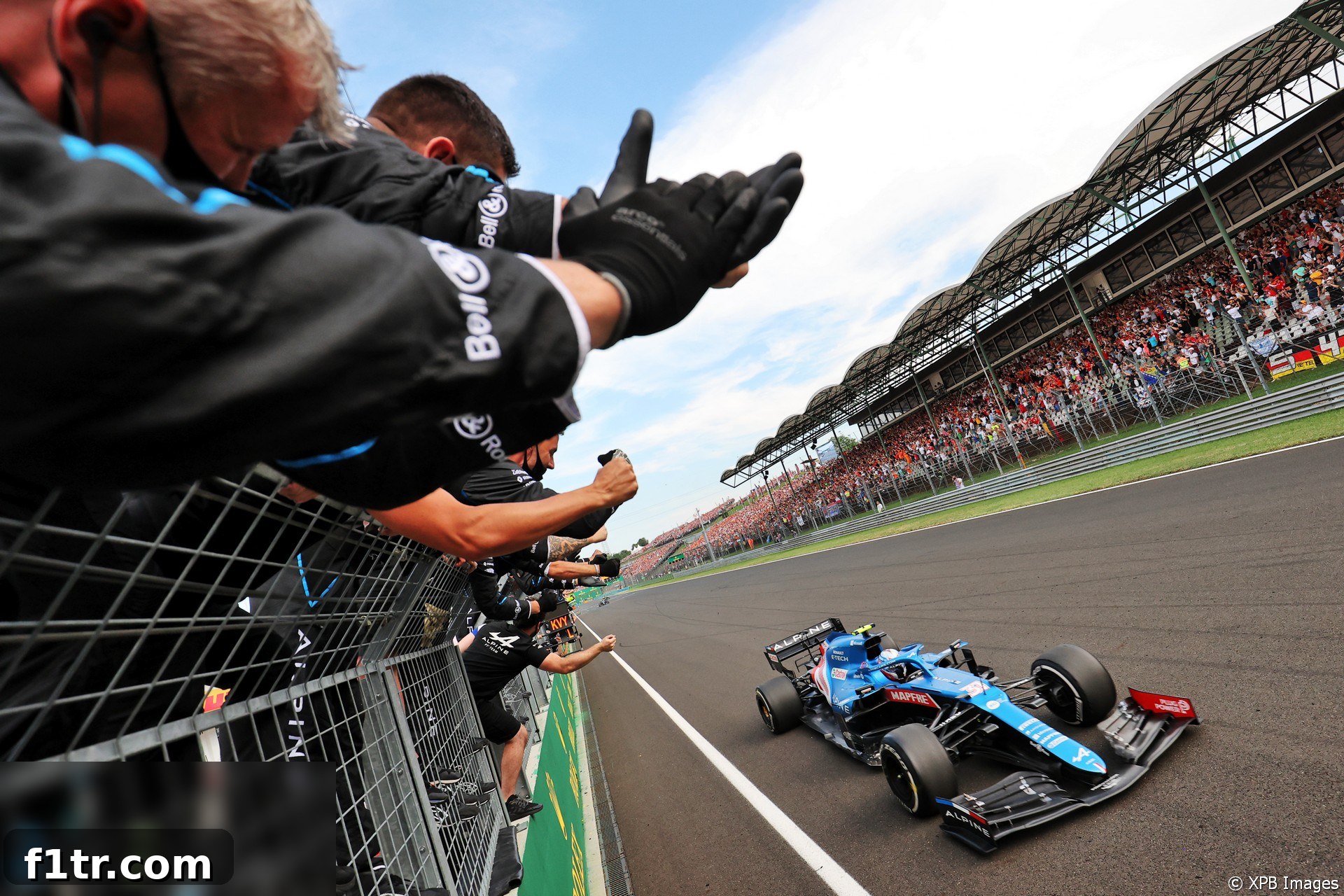
By all measurable standards, the Alpine brand experienced an exceptionally successful August, marking a pivotal period in its motorsport endeavors. The month began with a historic triumph for its Formula 1 team – historically known as Renault and various other monikers – celebrating a momentous first victory for the distinctive blue cars. This breakthrough came courtesy of Esteban Ocon at the Hungarian Grand Prix, a result that sent ripples of excitement through the paddock and among fans.
Ocon’s teammate, the seasoned veteran Fernando Alonso, further cemented the team’s strong performance by being elevated to an impressive fourth place. This occurred after the disqualification of runner-up Sebastian Vettel due to a fuel system infringement, a decision that was definitively confirmed when his Aston Martin team withdrew their appeal bid 11 days later. These significant results collectively propelled Alpine from a pre-Budapest seventh position in the constructors’ standings to a highly competitive fifth, successfully leapfrogging both Aston Martin and AlphaTauri in the process. This achievement brought the team closer to its stated objective. During an exclusive interview in May, Alpine CEO Laurent Rossi had clearly articulated the team’s target: to at least match its fifth-place classification from the 2020 season. Thus, the team was able to enter Formula 1’s traditional summer break with a palpable sense of ‘mission accomplished,’ at least for that juncture of the season.
Alpine’s Grand Ambitions: F1 and Beyond
When questioned on a Friday at the iconic Spa-Francorchamps circuit whether the team could now afford a slight relaxation, Rossi adopted a cautious yet confident tone. “Let’s not count our chickens before they hatch,” he remarked, emphasizing the unpredictable nature of motorsport. “It’s earlier than what we expected, but that’s racing; there are always a couple of races where there’s a bit of a change of circumstances and you have to seize the opportunities.” He reaffirmed the team’s unwavering commitment to its strategic goals. “But the objective remains finishing in the position we’re in, which is fifth at the very least, but for the moment that’s the most tangible objective and it helps towards keeping that position, obviously, because we were a bit far from it.” This statement underscored the team’s determination to not only reach but firmly consolidate its improved standing in the fiercely competitive Constructors’ Championship.
To dispel any lingering doubts about Alpine’s long-term commitment to Formula 1, Rossi made a bold declaration, outlining a vision that extends far beyond immediate results. He stated, “It’s a long-term project; it’s a 100-race project.” This ambitious statement signals a strategic, multi-year plan focused on sustained development and eventual championship contention, indicating that Alpine views its Formula 1 involvement as a cornerstone of its brand identity and technological showcase, not a short-term venture.
The brand’s successful streak was not confined to Formula 1 alone. Alpine also secured another prestigious podium finish at the legendary Le Mans 24 Hour classic. Here, a ‘grandfathered’ hypercar class Signatech Alpine A480 impressively placed third, showcasing Alpine’s prowess in endurance racing. At one stage, the Alpine entry ran remarkably close to the eventual winner, Toyota – albeit only after both Japanese cars encountered their own fuel system glitches. Regardless of the circumstances, the adage “you have to be in it to win it” held true, and Alpine’s entry demonstrated exceptional reliability and performance by running the full duration of the grueling 24-hour race.
In the lead-up to the endurance spectacle, CEO Rossi confirmed that Alpine was actively investigating a full-blown hypercar project. This ambitious initiative is specifically targeting the 2023 season, coinciding with the centenary celebration of the revered French endurance racing classic. Rossi added that a definitive decision on this promising venture was anticipated in the near future, further highlighting Alpine’s strategic expansion across multiple top-tier motorsport disciplines.
Rossi articulated a compelling rationale for Alpine’s engagement in endurance racing. “I have a very keen and positive outlook because endurance racing is a good way to express Alpine’s qualities that are complementary to Formula 1,” he explained. “But we need to look at all the parameters, chiefly the economic and sporting equations: what would it take for us to race in endurance with a chance of winning?” He further elaborated on the strategic marketing value: “While it has a big audience, F1 is by no means representative of all the consumers we would like to provide cars to in the future. In that respect, endurance racing is complementary,” suggesting that success in different categories broadens Alpine’s appeal and market reach.
Just a week after these discussions, news broke that further amplified Alpine’s positive momentum: the team had successfully persuaded Fernando Alonso to extend his contract. The two-time world champion was widely believed to have held an option that was due to expire mid-August, making the extension a critical strategic move. With Alonso fully onboard for 2022 and beyond, it seemed that for Alpine, the wave of good news was simply unstoppable, pointing towards a stable and ambitious future on the grid.
The Unexplained Departure: Rémi Taffin and Viry-Châtillon’s Future
Yet, amidst this flurry of positive developments and strategic achievements, a significant and somewhat enigmatic shift occurred behind the scenes. It emerged that Rémi Taffin, a deeply embedded and highly respected employee, had left the organization. Taffin had a long and distinguished tenure, having worked his way up through the team ranks from a race engineer to ultimately become the director of operations for the crucial Renault F1 engine division, based in the north Parisian suburb of Viry-Châtillon. His departure, given his extensive history and pivotal role, immediately raised eyebrows.
Addressing Taffin’s departure on Friday, Rossi offered a measured explanation: “We agreed with Rémi that we’d reached the natural fork in our history. We’re going in a new direction, we’re taking the team in a new direction, so it was only natural to part ways now rather than in the midst of a new adventure.” While seemingly straightforward, the explanation lacked specific details about the “new direction” or the succession plan. Rossi added that Taffin’s exit “doesn’t change what’s in the pipe in terms of the engine [for] next year. The plan was laid out before the beginning of the year and we’re following it,” aiming to reassure about the continuity of engine development.
While personnel changes are a natural part of any evolving organization, Rossi’s subsequent refusal to elaborate further sparked concern. Despite being surprisingly open about driver matters, he point-blank declined to answer specific questions from RaceFans regarding Taffin’s replacement or the organizational structures reporting through him. “This is internal stuff, there are four directors reporting directly into me,” he stated. “I won’t tell you their names, but that’s about it,” adding a layer of secrecy that seemed to contradict the team’s otherwise transparent public relations.
This shroud of secrecy around the engine division wasn’t entirely new. Hints that something significant was unfolding became evident during the Austrian Grand Prix in early July when a team insider, when pressed for information about the engine division, pointedly refused to answer, merely stating: “It would take me all day to explain it all to you, and I don’t have that amount of time…” This earlier evasiveness, combined with Taffin’s departure and Rossi’s subsequent reticence, begs a critical question: What exactly is transpiring within the Viry-Châtillon engine facility?
Engine Performance and the Looming Freeze: A Critical Juncture
It has long been a widely held belief among industry insiders that Renault’s power units have consistently underperformed, primarily attributed to their complex composite turbo architecture. The recent victory in Hungary, while a significant milestone, does not entirely erase years of perceived disadvantage. Compounding this concern is the undeniable fact that Renault has lost three key customer teams since 2018: McLaren transitioned to Mercedes power, while both Red Bull and AlphaTauri switched their allegiance to Honda. Indeed, of the four current Formula 1 engine suppliers – Mercedes, Ferrari, Honda, and Renault – the French manufacturer stands alone in supplying only a single team: its own factory outfit, Alpine. This isolation underscores the challenges and potential vulnerabilities of its power unit program.
The impending engine freeze, set to come into effect from 2022 and extend through 2025, amplifies the urgency of this situation. This regulatory framework means that power units cannot be significantly upgraded at will during this period. Consequently, developing a competitive and robust engine for the 2022 season will be absolutely critical to ensuring sustained success for the following four years. Given that Formula 1 typically features 22 Grands Prix per year, Alpine’s ambitious “100-race plan,” which commenced at the start of the current season, is projected to conclude precisely before the end of the 2025 regulatory cycle. This timeline makes the current state of their engine development, and the leadership overseeing it, paramount to the entire project’s viability.
Uncertainties Ahead: Will Alpine’s Momentum Last?
The unexplained departure of Rémi Taffin, coupled with the notable secrecy surrounding the engine division, inevitably raises a series of probing questions. Who will now take the helm and execute this pivotal “100-race plan” for power unit development? And why, in a sport where transparency is often valued (especially from a manufacturer aiming to attract talent and partners), is there such an overt policy of confidentiality regarding such a crucial department? These lingering uncertainties cast a shadow over Alpine’s otherwise triumphant August. They leave observers to wonder whether the brand’s current cycle of positive news, fueled by on-track success and strategic expansions, might reach a premature and unforeseen end if the underlying technical leadership and engine performance issues at Viry-Châtillon are not adequately addressed and communicated. Alpine’s journey is undoubtedly one of ambition, but its ultimate success will hinge on navigating these internal challenges as deftly as it manages its external sporting endeavors.
News Focus
- Strategic Shifts: How F1 Teams Adapt to New Regulations
- The Future of Power Units: Innovation vs. Freeze
- Behind the Scenes: Negotiating F1 Driver Contracts
- Le Mans Legacy: Challenges and Triumphs in Endurance Racing
- Leadership in Motorsport: Impact of Key Personnel Changes
Browse all News Focus articles