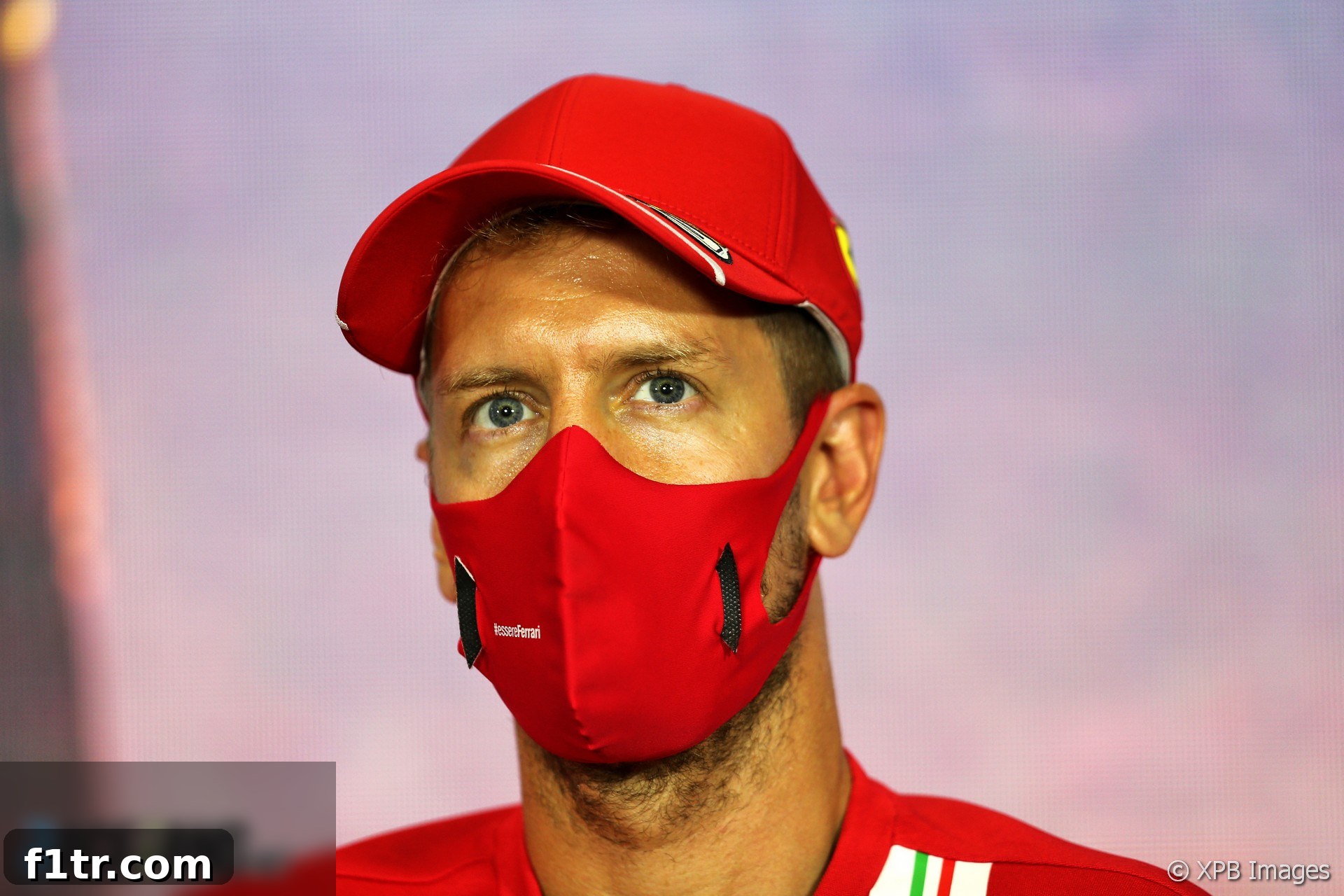
Ever since Carlos Sainz Jnr was announced as Sebastian Vettel’s replacement at Ferrari for the 2021 F1 season in mid-May, the Formula 1 paddock has been gripped by a maelstrom of speculation surrounding the four-time world champion’s future. The unexpected nature of Vettel’s departure from the iconic Scuderia, a team he had once hoped to emulate Michael Schumacher’s success with, immediately ignited intense debate and fueled an already volatile F1 driver market.
Adding fuel to this fire have been Vettel’s uncharacteristic bouts of radio silence during race weekends, often failing to respond even when directly addressed by his engineers. When he has communicated, his responses have frequently been tetchy and terse, reflecting a growing tension within the Maranello outfit. This palpable discomfort has inevitably led to persistent questions for both Vettel and Ferrari regarding the possibility of an early separation, a premature end to his contract even before the current season concludes.
The prevailing theory among enthusiasts and pundits alike suggests that an early exit for Vettel could trigger a high-speed merry-go-round in the F1 driver lineup. The first domino is already set to fall next year: Carlos Sainz Jnr’s move to Ferrari. This would naturally create an opening at McLaren, which Daniel Ricciardo is slated to fill. Ricciardo’s departure from Renault, in turn, paves the way for the much-anticipated return of two-time world champion Fernando Alonso to the Enstone-based team, rebranded as Alpine for 2021.
According to the most popular version of this theory, Alonso, who was already scheduled to return to his former team for the 2021 campaign, would become available shortly after this weekend’s Indianapolis 500. This availability would allow him to simply start his new role a few months earlier than originally contracted, potentially bringing forward the entire chain of driver movements. This interconnected series of events paints a neat picture where every team secures their future driver sooner, and the perceived “painful” relationship between Ferrari and Vettel reaches an early conclusion, freeing the four-time world champion to focus on securing a competitive drive for 2021.
On the surface, this scenario seems perfectly logical, offering mutual benefits to all parties involved. Each team would gain early access to their respective future drivers, allowing for earlier integration and preparation. Moreover, the prematurely terminated Ferrari-Vettel partnership, widely speculated to be a source of discomfort for both driver and team, would allow Vettel precious extra time to scout and secure a new seat for the upcoming season. However, the world of Formula 1, renowned for its intricate politics and commercial complexities, rarely aligns neatly with simple logic. A closer examination of this seemingly flawless domino effect reveals several significant flaws and practical impediments that make its execution highly improbable.
For a start, one must question McLaren’s motivation to release Carlos Sainz early. The Woking-based squad, currently positioned precariously with 62 points, finds itself embroiled in an incredibly fierce and financially significant battle for third place in the constructors’ championship. Their primary rivals are Racing Point (63 points) and Ferrari (61 points). This isn’t merely a fight for bragging rights; achieving a top-three finish holds substantial added value under the recently finalized Concorde Agreement. As previously reported, F1’s 2021 revenue structure incorporates a rolling 10-year bonus scheme specifically for the top three performing teams. This means that a strong result this year could significantly impact McLaren’s financial health for a full decade, offering a powerful incentive to maintain stability and focus.
Under such high-stakes circumstances, it defies reason that McLaren would willingly introduce instability into what is arguably one of the most cohesive and well-settled driver pairings on the current grid: that of Sainz and Lando Norris. Their partnership has been instrumental in McLaren’s recent resurgence, fostering a positive team environment and consistently delivering strong results. Disrupting this dynamic by bringing in Ricciardo prematurely would involve significant risks, potentially jeopardizing their hard-fought position in the constructors’ standings and the considerable financial rewards associated with it. The team would need to integrate a new driver, adapt to his specific feedback, and potentially re-align their development direction mid-season, all while battling intensely with direct competitors. The downside risks far outweigh any speculative benefits of an early swap.
Furthermore, let’s consider this hypothesis from Ferrari’s viewpoint. While specific driver salaries remain confidential, our analysis suggests Sebastian Vettel commands an annual stipend of approximately $30 million, a figure negotiated during the peak of his championship-winning prowess. With six of F1’s revised 15-18 race calendar already completed, the season is roughly between 33% and 40% done. Would Ferrari genuinely agree to pay Vettel the remaining $20 million or more on his contract merely for him to sit on the sidelines, tending to his garden and spending time with his children? Such a financial outlay, particularly for a team that has already committed to replacing him, makes absolutely no commercial sense for the Scuderia, especially in a season where their performance has been significantly below expectations.
If stability is paramount for McLaren, it is doubly so for the Prancing Horse. The Scuderia currently languishes fifth in the constructors’ standings, a trajectory that puts them on course for their worst championship finish since the challenging 1981 season. In such a difficult period, introducing further change and potential instability by integrating a new driver mid-season presents an enormous risk. Would Carlos Sainz, talented and highly capable as he undeniably is, realistically be able to learn the intricate ropes of this notoriously complex team, adapt to the unique pressures of Ferrari, and deliver better results than Vettel during a heavily compressed and already challenging season? This would be a monumental ask for any driver, and a massive gamble that could easily backfire, further derailing Ferrari’s already tumultuous season. The transition from one team to another, especially to a team with Ferrari’s unique culture and technical demands, typically requires significant time and preparation, usually afforded by pre-season testing.
The same logistical and financial considerations apply to Daniel Ricciardo’s potential early switch to McLaren. A planned move at the end of the season, granting him three crucial pre-season months to fully embed himself into the ‘McLaren Way’ and understand the new car, would undoubtedly yield superior results with minimal risk. Beyond the integration challenges, there’s the significant financial hurdle: Ricciardo is estimated to be on a $25 million annual salary, and while Fernando Alonso is fiercely competitive, he is unlikely to race for free. In these economically “straitened times,” exacerbated by the global pandemic, who would be willing to foot the bill for Ricciardo’s early release and simultaneously cover the cost of his successor at Renault? The complex web of contracts, bonuses, and severance packages makes such early transitions prohibitively expensive and logistically challenging without a compelling underlying incentive.
While early driver moves are not entirely unprecedented in Formula 1 history – this writer, for instance, reported on one such swap in 2017 involving Sainz, Jolyon Palmer, and Pierre Gasly – the context was entirely different. That particular deal saw Sainz displace Palmer at Renault, with Gasly slotting into his Toro Rosso seat, but it was inextricably linked to a broader engine supply agreement between the teams, with drivers effectively used as trading currency. No such overarching deal or reciprocal trade currently exists in the current scenario. The proposed early moves would require direct financial compensation or highly complex contractual agreements without the benefit of a larger strategic alliance, making them far less viable.
Another speculative faction has suggested that Kimi Raikkonen might make an unexpected return to Ferrari in Vettel’s place, marking his third stint with the illustrious Scuderia. While Raikkonen’s history with Ferrari is well-documented and his popularity unwavering, the feasibility of such a move has diminished significantly. The ties between Alfa Romeo Racing and Ferrari have loosened considerably since the latter’s 2015 initial public offering. Furthermore, Alfa Romeo’s parent company, Fiat-Chrysler Automotive, is in the advanced stages of merging with Peugeot, a process that adds further layers of complexity to any driver management decisions. Consequently, a straightforward transition of Alfa Romeo’s star asset back to its engine supplier is no longer as simple as it once might have been. Again, the perennial question of money looms large: who would compensate Alfa Romeo for Raikkonen’s early departure, and who would then fill the vacant seat at Alfa Romeo?
Barring any unforeseen and dramatic developments, the most probable outcome as things currently stand is that Sebastian Vettel will remain in the distinctive red overalls of Ferrari until the Abu Dhabi Grand Prix belatedly brings the 2020 F1 calendar to a close on December 13th. His future beyond that point remains a subject of intense speculation. It remains to be seen whether he will opt for retirement, take a sabbatical from the sport, or sign elsewhere, with Racing Point, which is set to become Aston Martin next year, widely considered his most plausible destination for a continued career in Formula 1.
However, even the prospect of Vettel joining Aston Martin is shrouded in conflicting information. RaceFans has received mixed messages from sources close to the situation. One source is adamant that a deal has already been concluded between Vettel and Racing Point and could potentially be announced as early as the Italian Grand Prix at Monza, Ferrari’s spiritual home. Conversely, another source suggests that the team has cooled on Vettel following some of his perceived lacklustre performances this season. This latter perspective implies that Sergio Perez’s backers have substantially increased their financial commitment, aiming to secure his continued presence in the Mercedes-powered ‘pink panther’ – or whatever hue it adopts as Aston Martin next year. These contrasting reports highlight the fluidity and secrecy surrounding the final pieces of the 2021 F1 driver market puzzle, leaving fans and pundits eagerly awaiting concrete announcements.
2020 F1 season
- Grosjean to make F1 test return tomorrow for first time since Bahrain horror crash
- Pictures: Wrecked chassis from Grosjean’s Bahrain fireball crash to go on display
- Bottas vs Rosberg: Hamilton’s Mercedes team mates compared after 78 races each
- F1 revenues fell by $877 million in Covid-struck 2020 season
- Hamilton and Mercedes finally announce new deal for 2021 season
Browse all 2020 F1 season articles