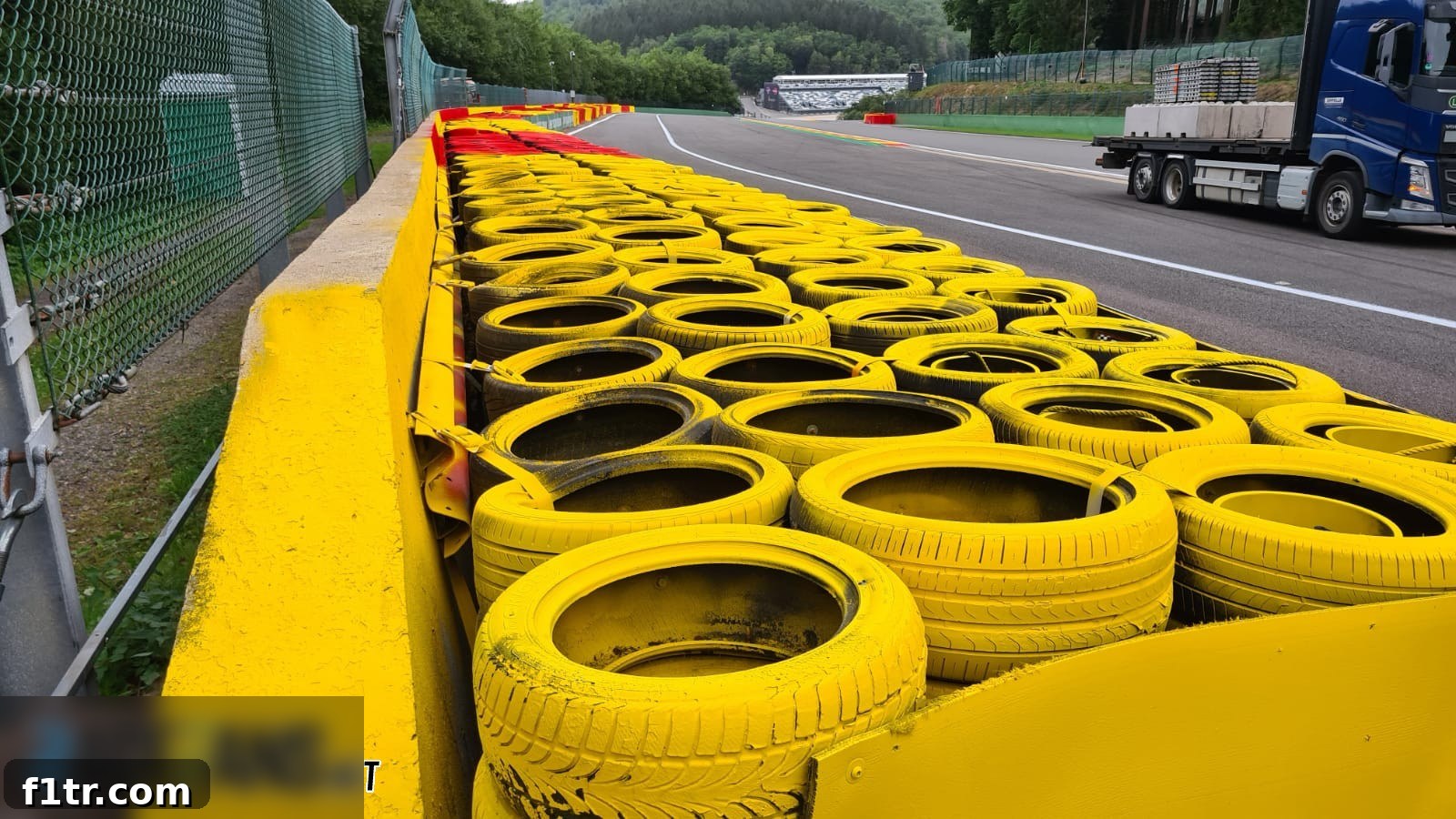
The legendary Spa-Francorchamps circuit, a jewel in the crown of motorsport, has implemented crucial safety modifications ahead of the upcoming Belgian Grand Prix. These vital changes focus on a specific tyre barrier that was tragically involved in the fatal accident of Anthoine Hubert during last year’s Formula 2 feature race. This proactive measure underscores motorsport’s unwavering commitment to driver safety, constantly evolving to mitigate risks on circuits renowned for their thrilling, yet demanding, layouts.
Anthoine Hubert, a promising talent in the Formula 2 series, suffered a catastrophic impact at the perilous exit of the Raidillon corner. This incident occurred on the second lap of the fiercely contested race, sending shockwaves through the global motorsport community. The initial contact with the barrier ejected Hubert’s car back onto the track, directly into the path of Juan Manuel Correa’s vehicle. The ensuing collision was devastating, a stark reminder of the inherent dangers drivers face in pursuit of their passion.
The consequences of this harrowing collision were profound and heart-wrenching. Anthoine Hubert tragically succumbed to his injuries, leaving behind a legacy of determination and a community deeply saddened by his untimely passing. Juan Manuel Correa, while incredibly fortunate to survive, sustained severe leg injuries, necessitating extensive and arduous reconstructive surgeries. His long road to recovery, marked by incredible resilience and determination, has been closely followed by fans and peers alike, embodying the spirit of a fighter dedicated to returning to the cockpit.
As the Formula 2 championship prepares to make its poignant return to Spa-Francorchamps this weekend, serving as a key support event for the pinnacle of motorsport, Formula 1, emotions are expected to run high. This return marks the first time the series has competed at the iconic Belgian venue since the tragedy, making the implemented safety enhancements even more significant. It represents a collective effort to honor Hubert’s memory by striving for a safer future in racing.
Central to these enhanced safety measures is the modification of the very section of the tyre barrier Hubert’s car first struck. Previously, the barrier situated at the notorious exit of Raidillon, often referred to as Turn 4, exhibited a varied design. For the majority of its length, it comprised a robust four-row deep tyre wall. However, this depth reduced to only two rows at the specific point where the secondary pit lane exit merges with the main track. In a critical upgrade for this year’s event and all future races, this vulnerable section has now been uniformly reinforced to also be four rows deep. This seemingly subtle yet impactful change is designed to significantly improve energy absorption and minimize the potential for vehicles to be propelled back onto the track after an impact, thereby reducing the risk of secondary collisions.
The comprehensive investigation conducted by the FIA (Fédération Internationale de l’Automobile) into Hubert’s crash provided crucial insights into the complex chain of events. The report concluded that Hubert’s initial collision with the barrier was precipitated by damage to his front wing, which occurred following contact with Ralph Boschung’s car. This initial contact was itself a consequence of evasive action taken by both drivers in response to an incident further ahead involving Giuliano Alesi. Alesi had lost control of his car and crashed after suffering a sudden loss of tyre pressure, triggering a multi-car incident in one of the circuit’s most challenging sectors. The meticulous detail in the FIA’s report highlights the intricate and often unpredictable nature of high-speed motorsport incidents, where a minor issue can cascade into a major event.
The FIA’s findings elaborated on the severity of the initial impact. Hubert, having lost control due to his compromised front wing, collided with the barrier at an astonishing speed of 216 kilometers per hour (approximately 134 miles per hour). The force of this impact registered a staggering 33.7G, at an angle of roughly 40 degrees. The report chillingly detailed the subsequent trajectory: “Following the impact and energy absorption by the barrier, the car was ejected and continued to travel in the racing direction while rotating, such that the left-hand side of the chassis was facing oncoming cars in the run-off area of turn four,” said the FIA’s report. This critical detail explains how Hubert’s car became a devastating obstacle for other drivers, particularly for Juan Manuel Correa, who was moments behind.
Juan Manuel Correa’s situation was further complicated by the circumstances leading up to his collision with Hubert. The report confirmed that Correa himself had lost control of his car moments before the impact with Hubert, having struck debris scattered across the track from the initial multi-car incident. This unexpected loss of control left him vulnerable and unable to avoid the now stationary or slowly moving wreckage of Hubert’s car. The subsequent impact between their two vehicles propelled Hubert’s car into the barrier for a second time, ultimately bringing it to a rest. The severity and complexity of the incident led race officials to immediately red-flag the race, which was subsequently not restarted out of respect and in recognition of the tragic circumstances. Furthermore, the following day’s scheduled sprint race was also cancelled, reflecting the profound impact the event had on everyone involved and the need for a period of mourning and reflection.
The tragedy of Anthoine Hubert’s passing at Spa-Francorchamps served as a powerful, albeit painful, catalyst for an intensified global focus on motorsport safety. While Formula 1 and its feeder series, like Formula 2, have made incredible strides in safety over decades, the incident highlighted areas where continuous improvement is not just desirable but absolutely imperative. The FIA, along with circuit designers, team engineers, and governing bodies, meticulously studies every serious incident to extract invaluable lessons. These lessons inform design changes for cars, improvements in helmet and driver equipment, and critically, enhancements to track infrastructure. The extension of the four-row deep tyre barrier at Raidillon is a direct consequence of this investigative process, a tangible outcome designed to prevent a similar sequence of events from unfolding in the future. It’s part of a broader, ongoing commitment to push the boundaries of safety technology and track design, ensuring that while racing remains exhilarating, the risks for drivers are systematically minimized. The motorsport community, united in its sorrow, continues to honor Anthoine Hubert’s memory through these relentless efforts to make the sport safer for future generations.
Formula Two
- Formula 2 to debut in Miami and Montreal after Iran war cancellations
- Ex-McLaren junior Dunne’s move to Alpine finally confirmed
- Schumacher says his IndyCar feels like ‘an F2 car, just with better tyres’
- The Formula 2 team with an older driver line-up than almost half the F1 grid
- FIA to award more F1 superlicence points to IndyCar drivers from 2026
Browse all Formula 2 articles