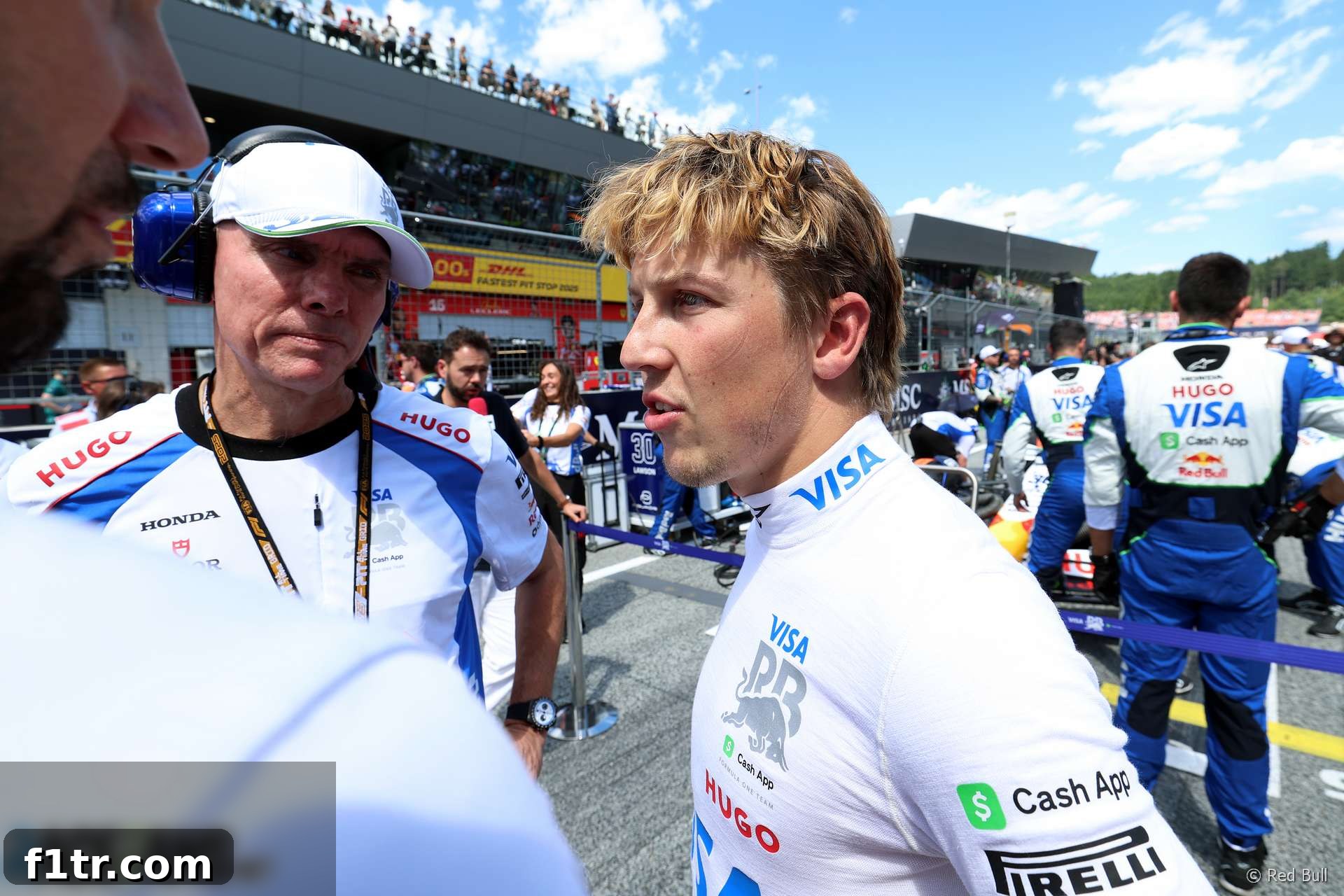
Liam Lawson’s Resurgence: Permane Hails Breakthrough After Key Suspension Upgrade at Racing Bulls
The highly competitive world of Formula 1 often sees young talents facing immense pressure and rapid changes in their careers. Liam Lawson, a promising young driver in the Red Bull stable, recently navigated such a period of intense scrutiny. However, his fortunes have taken a significant turn, leading to an impressive resurgence that has caught the attention of his team principal. Alan Permane, the newly appointed team principal of Racing Bulls, has publicly expressed his admiration for Lawson’s progress, specifically highlighting a pivotal moment at the Austrian Grand Prix when a new front suspension system was introduced to the VCARB 02 car.
Permane’s insights reveal a story of resilience, technical innovation, and unwavering dedication from both the driver and his engineering team. This breakthrough not only transformed Lawson’s performance on track but also reignited his confidence, marking a crucial chapter in his burgeoning Formula 1 career. His journey serves as a powerful testament to how strategic technical developments, coupled with a driver’s mental fortitude, can unlock significant gains in motorsport’s pinnacle.
Lawson’s Challenging Start to the 2025 Season
Liam Lawson entered the 2025 Formula 1 season with high expectations, having been granted a coveted seat at Red Bull’s senior team alongside reigning world champion Max Verstappen. This promotion was a recognition of his raw talent and potential, honed through various junior categories and a promising stand-in performance in previous seasons. However, the step up to a top-tier team like Red Bull, with its cutthroat environment and the sheer pace of a driver like Verstappen, proved to be a formidable challenge. The pressure on young drivers at this level is immense, often demanding immediate results and seamless integration into a championship-contending setup.
After just two rounds of the season, culminating with the Chinese Grand Prix, concerns over Lawson’s performance led to a difficult decision: he was sent back to Racing Bulls, Red Bull’s sister team, to partner Isack Hadjar. This move, while perhaps a temporary setback, was undoubtedly a significant blow to Lawson’s morale. Permane, who recently took over as Racing Bulls team principal following Laurent Mekies’ promotion, candidly admitted that Lawson’s return to the team was not under the best circumstances. “He won’t thank me for saying this, but he definitely was a bit downbeat. He didn’t have a spring in his step,” Permane recounted, painting a vivid picture of a driver grappling with the disappointment of a prematurely curtailed opportunity at the sport’s sharp end.
The transition itself presented its own set of difficulties. Lawson had to adapt quickly to the VCARB 02, a car he hadn’t extensively tested, placing him at a disadvantage compared to his teammate. Isack Hadjar, who had been with Racing Bulls since the start of the season, had already established a strong rhythm and familiarity with the car. Permane noted the immediate challenge: “To jump in our car straight away without having tested it was, of course, not easy. He’s up against Isack who has been outstanding this year. First race for him was Japan and Isack was absolutely flying there. So, it’s a tough introduction for him, but we’ve made some changes.” Indeed, the initial rounds after his return saw Hadjar significantly outscore Lawson, tallying 21 points to Lawson’s four over their first eight races together. This period underscored the uphill battle Lawson faced, both mentally and technically.
The Pivotal Breakthrough: Austrian Grand Prix and the New Front Suspension
The turning point in Liam Lawson’s season, and indeed his outlook, arrived at the Austrian Grand Prix. This event proved to be far more than just another race weekend; it was the crucible where a combination of technical innovation and relentless hard work forged a significant breakthrough. Racing Bulls introduced a new front suspension system for the VCARB 02, an upgrade that would fundamentally alter the car’s dynamics and, consequently, Lawson’s confidence and performance.
Understanding the Impact of a Front Suspension Upgrade
In Formula 1, every component plays a critical role in car performance, and the suspension system is no exception. The front suspension is particularly crucial as it directly influences a car’s turn-in, stability under braking, and overall responsiveness. A well-designed front suspension provides the driver with better feel and feedback, allowing them to push the limits of the car with greater confidence. It affects how the tires interact with the track, influencing grip, wear, and overall balance. Improvements in this area can translate to quicker lap times, better handling through corners, and enhanced consistency over a race distance.
The new front suspension for the VCARB 02 was not a speculative change; it was the result of meticulous development, largely conducted through advanced simulator testing. This iterative process allows engineers and drivers to virtually test new parts, gather data, and refine designs before manufacturing and track deployment. Lawson played a crucial role in this development, spending considerable time in the simulator providing feedback. “Him and his engineering team have worked really, really hard,” Permane emphasized, highlighting the collaborative effort behind the upgrade. Lawson’s direct involvement meant that the new component was tailored to his driving style and preferences, which is paramount for a driver to extract maximum performance.
Lawson’s Enthusiastic Reception and On-Track Validation
Upon experiencing the new front suspension, Lawson’s reaction was overwhelmingly positive. “He really liked it, was really enthusiastic about it,” Permane revealed. This immediate positive feedback from the driver is a strong indicator of an effective upgrade. It meant that the car felt more responsive, predictable, and gave Lawson the confidence to attack corners and push harder without fear of unexpected handling characteristics. This renewed confidence was swiftly translated into on-track results.
At the Austrian Grand Prix, Lawson delivered a season-best performance, securing a commendable sixth-place finish. This was a significant achievement for both him and Racing Bulls, marking a clear turning point in his season. It was not just the points scored, but the manner of his driving – assured, aggressive, and consistently fast – that signaled a true breakthrough. Permane reflected on this transformation: “Monaco was a decent race for him, but Austria, he had a spring back in his step.” This metaphorical “spring” represented a resurgence of his inherent passion and confidence, a far cry from the “downbeat” mood observed upon his return to the team.
Sustained Performance and Future Prospects
The momentum generated in Austria proved to be sustainable. Following his strong performance at the Red Bull Ring, Liam Lawson began to consistently outshine his teammate, Isack Hadjar, and became the primary points-scorer for Racing Bulls. His improved form was evident in subsequent races, with Permane noting his strong performance at Spa, building on the foundation laid in Austria. This consistent ability to extract performance from the updated VCARB 02 underscores the efficacy of the technical upgrade and Lawson’s adaptability and skill.
Lawson’s turnaround has significant implications for his future in Formula 1. In a sport where performance is everything, his ability to bounce back from an initial setback and demonstrate strong, consistent results is invaluable. It positions him as a credible candidate for a full-time seat in the future, whether at Racing Bulls or potentially even a return to the senior Red Bull team. The Red Bull driver program is renowned for its ruthless yet effective approach to developing talent, and Lawson’s resilience and improved performance align perfectly with their ethos.
For Racing Bulls, Lawson’s resurgence is equally vital. Having a driver capable of consistently scoring points is crucial for their Constructors’ Championship aspirations. It validates the team’s engineering efforts and provides a strong foundation for future car development. Alan Permane’s leadership, arriving at a critical juncture, has clearly played a role in fostering an environment where a driver like Lawson can thrive and overcome adversity. His ability to identify and support Lawson through this challenging period speaks volumes about his understanding of driver psychology and team dynamics.
The synergy between technical innovation, engineering excellence, and driver talent is the cornerstone of success in Formula 1. Liam Lawson’s journey in the 2025 season encapsulates this perfectly. His initial struggles, the strategic introduction of a new front suspension, and his subsequent return to form represent a compelling narrative of resilience and progress. As the season progresses, all eyes will be on Lawson to see if he can continue this impressive trajectory, further solidifying his place as one of the sport’s most exciting young talents. His breakthrough in Austria stands as a powerful reminder that in F1, even the smallest technical adjustments, combined with unwavering determination, can lead to monumental shifts in performance and outlook.