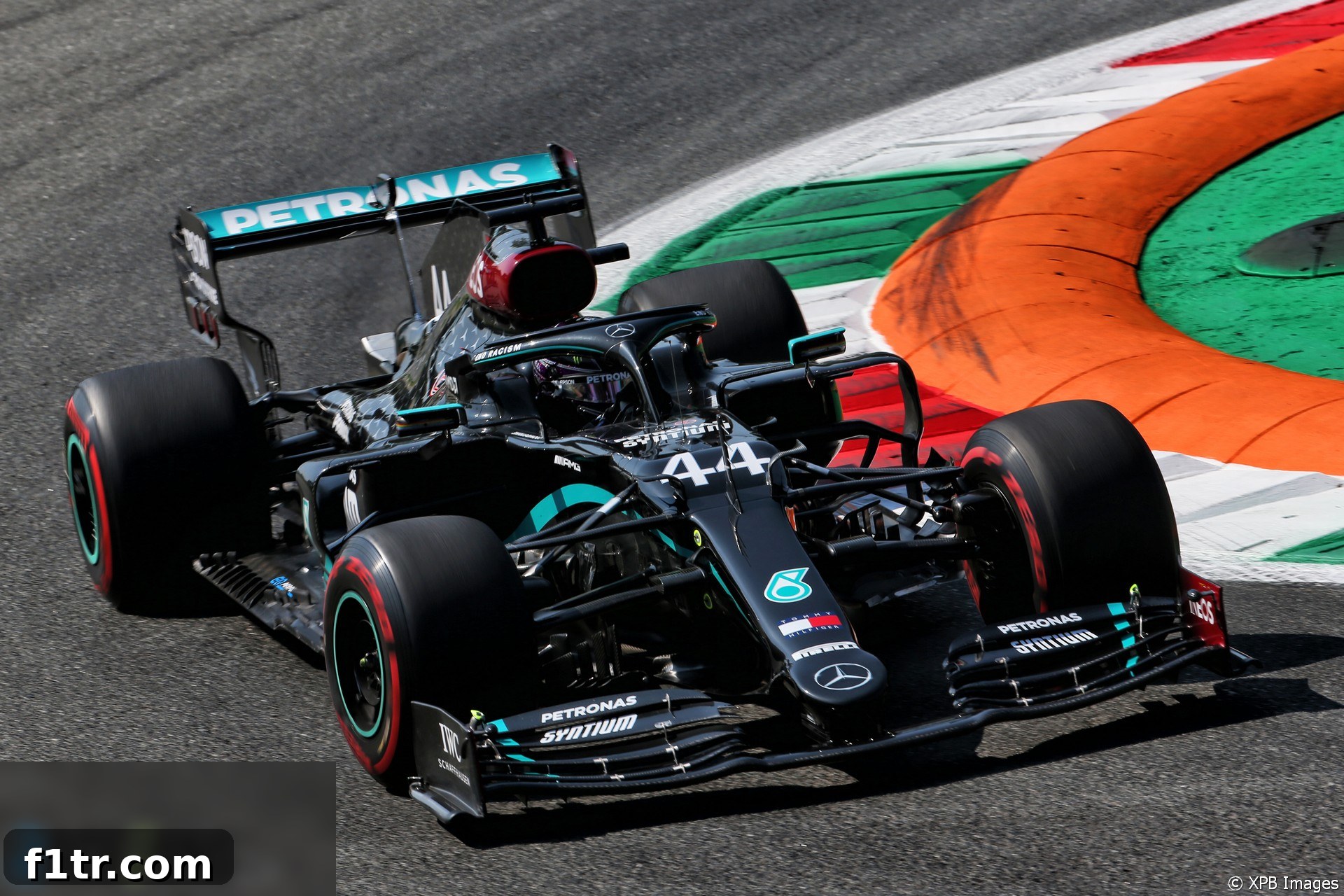
The iconic Autodromo Nazionale Monza, often revered as the ‘Temple of Speed’, played host to a captivating second practice session for the 2020 Italian Grand Prix. As anticipated, Mercedes asserted their commanding authority, with reigning champion Lewis Hamilton comfortably setting the pace. His teammate, Valtteri Bottas, reinforced the Silver Arrows’ supremacy by securing second place, making it a formidable one-two for the W11s. Their performance left competitors scrambling, as only Lando Norris and Pierre Gasly managed to get within a second of Hamilton’s blistering session-topping lap time, underlining Mercedes’ seemingly unassailable advantage on this high-speed circuit.
From the outset, it was clear that the Mercedes W11 chassis, coupled with its potent power unit, was perfectly suited to the demands of Monza. The team’s dominant display in FP2 was not merely a reflection of individual driver talent but also a testament to the car’s exceptional aerodynamic efficiency and engine performance, crucial factors at a track where top speed and minimal drag are paramount. Both Hamilton and Bottas demonstrated impeccable control and raw pace, consistently pushing the limits and extending their lead over the rest of the field. This early statement of intent from Mercedes sent a clear message to their rivals: the weekend would be an uphill battle to challenge their supremacy.
However, the session was far from straightforward, punctuated by familiar challenges inherent to Monza’s unique layout. Traffic management emerged as a significant concern for many drivers, particularly during the crucial qualifying simulations attempted halfway through the session. The long straights and the allure of a slipstream meant drivers were often backing up on out-laps, meticulously timing their runs to gain a crucial aerodynamic advantage. This tactical maneuver, while understandable, inevitably led to congestion and frustration on the track. George Russell, making his first appearance at Monza this weekend after Roy Nissany drove his car in FP1, voiced his apprehension over the radio, warning presciently: “There’s going to be a shunt sometime, in all of this,” highlighting the palpable tension and risk of collision as drivers jostled for position and clear air.
The complications arising from drivers strategically waiting for a slipstream are unfortunately a recurring theme at Monza, having been a major talking point just 12 months prior and also seen last weekend at Spa. This phenomenon continued to plague FP2, with numerous drivers vocally complaining about the impact of traffic on their precious flying laps. The quest for a perfect tow, while offering a tangible performance boost, often disrupted the rhythm of other drivers, leading to compromised lap times and a heightened sense of disarray. This delicate balance between seeking an advantage and impeding others creates a unique challenge for both drivers and race control at the Italian Grand Prix, often blurring the lines between shrewd strategy and potential unsporting conduct.
Adding to the list of afternoon’s operational challenges were the stringent track limits regulations, which saw a multitude of lap times deleted for infringements. The high-speed nature of Monza’s corners, combined with drivers pushing their cars to the absolute edge, often results in drivers running wide, particularly at chicanes and the infamous Parabolica. Charles Leclerc was among the many drivers who fell foul of these rules, losing a valuable lap time. The young Monegasque driver expressed his desire to review his onboard video footage, seeking to understand precisely where he had transgressed, underscoring the fine margins and unforgiving nature of the track limit penalties. Such deletions can significantly impact a team’s data analysis and a driver’s confidence heading into the critical qualifying session.
While Mercedes seemingly operated in a league of their own, the battle behind them was fiercely contested. For almost the entirety of the session, only Pierre Gasly managed to maintain a proximity to the dominant Mercedes duo, consistently placing within a second of Hamilton and Bottas. Gasly, driving for AlphaTauri, positioned himself admirably in third place after the majority of the grid completed their qualifying simulations on soft tyres. His strong performance was a notable highlight and a potential indicator of AlphaTauri’s competitiveness at their home race, a significant boost for the Italian team. He held onto this impressive position until the very closing moments of the session, demonstrating genuine pace and composure.
In a dramatic twist, Lando Norris, who had spent a significant portion of the session confined to the garage due to engine problems, dramatically surged into third place in the dying minutes. Having completed only five laps, reportedly because of issues with his Energy Recovery System (ERS) – Norris relayed over the radio that there was “no deployment” – the McLaren driver emerged from the pits with just five minutes remaining on the clock. Against the odds, he managed to string together a remarkably well-timed and rapid lap, leapfrogging Gasly to claim P3. This heroic effort not only showcased Norris’s talent but also highlighted the McLaren team’s quick problem-solving and the potential of their package, even under duress. His ability to deliver such a strong performance with minimal running was a testament to his adaptability and the team’s efficiency.
However, the woes for Ferrari at their home Grand Prix continued to deepen. The Scuderia’s challenging 2020 season, exacerbated by a significant dip in engine performance compared to previous years, appeared particularly acute at Monza. Charles Leclerc, despite being the quickest Ferrari-powered driver in ninth position, openly voiced his struggles, lamenting: “This car is so difficult to drive.” His frustration was palpable, and at one point, he ran wide at Lesmo 1, a clear indication of the car’s instability. The situation was even more dramatic for his teammate, Sebastian Vettel, who spun at the same corner. Vettel’s radio communication painted a vivid picture of the car’s unpredictable nature: “The rear was nowhere already the two laps before,” he explained, “I tried to lean on it,” suggesting a lack of confidence and grip from the rear axle. Ferrari’s ongoing struggles at a circuit that has historically been their fortress cast a long shadow over their weekend prospects, leaving their legions of Tifosi longing for better days.
Max Verstappen, considered a strong contender for the podium in most races, could only manage the fifth-fastest time, highlighting Red Bull’s challenges on a low-downforce track where Mercedes’ engine advantage is magnified. He was closely followed by Carlos Sainz Jnr in sixth, less than a tenth behind him, further illustrating the tight competition within the midfield pack. Daniil Kvyat and Lance Stroll also remained within a tenth of Sainz, securing seventh and eighth respectively, showcasing the incredibly close battle for best of the rest. Charles Leclerc in ninth was nearly two-tenths off this tight group, with Sergio Perez another tenth back in tenth position, underscoring the competitive but distinct performance tiers emerging from the practice session.
A notable regression came from Alexander Albon, who had shown promising pace in first practice, securing third quickest. However, the Red Bull driver plummeted to 14th in the second session, nearly a second adrift of Lando Norris’s impressive P3 time. This significant drop in performance for Albon raises questions about his consistency and ability to extract maximum performance from the Red Bull package, particularly in contrast to his teammate Verstappen, who, despite his own challenges, still managed a top-five finish. The mixed results for Red Bull indicate a need for further optimization and understanding of their car’s setup to challenge the front-runners effectively at Monza.
2020 Italian Grand Prix Second Practice Classification
| Pos. | No. | Driver | Car | Best lap | Gap | Laps |
|---|---|---|---|---|---|---|
| 1 | 44 | Lewis Hamilton | Mercedes | 1’20.192 | 32 | |
| 2 | 77 | Valtteri Bottas | Mercedes | 1’20.454 | 0.262 | 29 |
| 3 | 4 | Lando Norris | McLaren-Renault | 1’21.089 | 0.897 | 19 |
| 4 | 10 | Pierre Gasly | AlphaTauri-Honda | 1’21.121 | 0.929 | 25 |
| 5 | 33 | Max Verstappen | Red Bull-Honda | 1’21.228 | 1.036 | 30 |
| 6 | 55 | Carlos Sainz Jnr | McLaren-Renault | 1’21.313 | 1.121 | 30 |
| 7 | 26 | Daniil Kvyat | AlphaTauri-Honda | 1’21.376 | 1.184 | 35 |
| 8 | 18 | Lance Stroll | Racing Point-Mercedes | 1’21.389 | 1.197 | 32 |
| 9 | 16 | Charles Leclerc | Ferrari | 1’21.503 | 1.311 | 32 |
| 10 | 11 | Sergio Perez | Racing Point-Mercedes | 1’21.594 | 1.402 | 31 |
| 11 | 31 | Esteban Ocon | Renault | 1’21.697 | 1.505 | 32 |
| 12 | 5 | Sebastian Vettel | Ferrari | 1’21.733 | 1.541 | 28 |
| 13 | 99 | Antonio Giovinazzi | Alfa Romeo-Ferrari | 1’21.786 | 1.594 | 32 |
| 14 | 23 | Alexander Albon | Red Bull-Honda | 1’21.883 | 1.691 | 36 |
| 15 | 3 | Daniel Ricciardo | Renault | 1’22.080 | 1.888 | 29 |
| 16 | 20 | Kevin Magnussen | Haas-Ferrari | 1’22.088 | 1.896 | 32 |
| 17 | 7 | Kimi Raikkonen | Alfa Romeo-Ferrari | 1’22.147 | 1.955 | 34 |
| 18 | 8 | Romain Grosjean”>Romain Grosjean | Haas-Ferrari | 1’22.254 | 2.062 | 34 |
| 19 | 6 | Nicholas Latifi | Williams-Mercedes | 1’22.825 | 2.633 | 32 |
| 20 | 63 | George Russell | Williams-Mercedes | 1’22.927 | 2.735 | 34 |
Second Practice Visual Gaps
Lewis Hamilton – 1’20.192
+0.262 Valtteri Bottas – 1’20.454
+0.897 Lando Norris – 1’21.089
+0.929 Pierre Gasly – 1’21.121
+1.036 Max Verstappen – 1’21.228
+1.121 Carlos Sainz Jnr – 1’21.313
+1.184 Daniil Kvyat – 1’21.376
+1.197 Lance Stroll – 1’21.389
+1.311 Charles Leclerc – 1’21.503
+1.402 Sergio Perez – 1’21.594
+1.505 Esteban Ocon – 1’21.697
+1.541 Sebastian Vettel – 1’21.733
+1.594 Antonio Giovinazzi – 1’21.786
+1.691 Alexander Albon – 1’21.883
+1.888 Daniel Ricciardo – 1’22.080
+1.896 Kevin Magnussen – 1’22.088
+1.955 Kimi Raikkonen – 1’22.147
+2.062 Romain Grosjean – 1’22.254
+2.633 Nicholas Latifi – 1’22.825
+2.735 George Russell – 1’22.927
Drivers more than ten seconds off the pace omitted from visual graph for clarity.
The conclusion of Friday’s second practice session at Monza provided a clear, albeit challenging, picture for the teams heading into the remainder of the 2020 Italian Grand Prix weekend. Mercedes stands out as the undisputed leader, with Lewis Hamilton and Valtteri Bottas demonstrating formidable pace that appears difficult to match. Their advantage suggests a strong likelihood of securing the front row for qualifying, and potentially dictating the terms of the race. The midfield, however, remains an enthralling battleground, with McLaren’s Lando Norris, AlphaTauri’s Pierre Gasly, and drivers from Racing Point and Red Bull all vying for strong points finishes. Ferrari, unfortunately, seems to be bracing for a tough home race, as their performance struggles persist. The lessons learned from the traffic chaos and track limit infringements will undoubtedly influence strategies for qualifying, where finding clean air and executing perfect laps will be paramount. With qualifying just around the corner, the stage is set for an exciting and potentially unpredictable Saturday at the ‘Temple of Speed’.
2020 Italian Grand Prix Related Articles
- Grosjean “obviously jealous” but pleased for Gasly after win
- 2020 Italian Grand Prix Star Performers
- Gasly: I’m ready for Red Bull return
- Ban on ‘quali mode’ reduced overtaking at Monza – Hamilton
- Gasly beats Sainz in closest F1 finish for 10 years
Browse all 2020 Italian Grand Prix articles