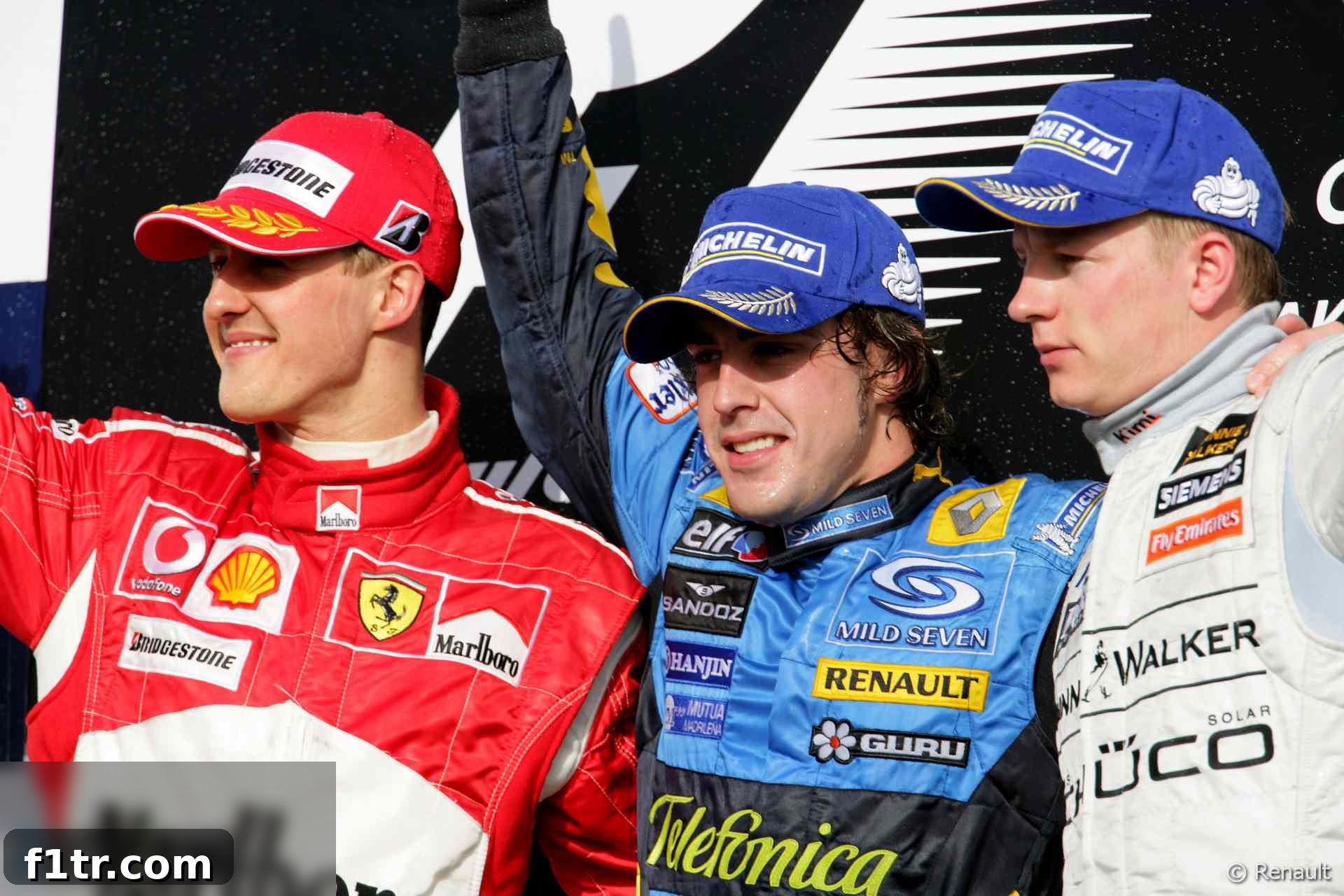
The scorching sands of Bahrain bore witness to an electrifying start to the 2006 Formula 1 season, delivering a spectacle that immediately set a high bar for the championship battle ahead. Reigning champion Fernando Alonso, demonstrating unparalleled grit and strategic brilliance, clinched a hard-fought victory over the legendary Michael Schumacher in a truly captivating duel. Adding to the drama, Kimi Raikkonen executed a masterful recovery drive, charging from the very back of the grid to secure a remarkable podium finish, hinting at a potential three-way fight for the coveted title.
The Anticipated Opening and Ferrari’s Early Promise
With the new V8 engine regulations ushering in a fresh era of Formula 1, the anticipation for the 2006 season opener in Bahrain was palpable. All eyes were on the championship protagonists: Fernando Alonso, fresh from his maiden title, and the seven-time world champion Michael Schumacher, seeking to reclaim his dominance. Ferrari had laid down an early marker in qualifying, securing a dominant front-row lockout with Schumacher on pole and his new teammate, Felipe Massa, alongside him. Rivals had predicted Massa’s role would be to act as a shield for Schumacher, keeping Alonso’s Renault at bay during the crucial opening laps.
As the lights went out, Massa dutifully moved to block Alonso from the ideal racing line. However, in his eagerness, the young Brazilian driver overshot his braking point into Turn 1, creating a momentary gap. Alonso, ever the opportunist, seized the chance, expertly drawing alongside and sweeping past Massa. This decisive early move positioned the champion perfectly to challenge Schumacher directly, instantly disrupting Ferrari’s planned strategy.
Early Race Drama: Setbacks and Breakthroughs
While the lead battle ignited, drama unfolded throughout the field. Jenson Button, piloting his Honda, suffered a dismal start, finding himself trailing his teammate Rubens Barrichello. Further back, Williams’ rookie Nico Rosberg, making his highly anticipated F1 debut, was involved in an unfortunate incident, T-boning Nick Heidfeld’s BMW. Rosberg was forced to pit early for a new front wing, a significant setback for his first race. Fellow newcomer Yuji Ide also endured a chaotic start when his Super Aguri team’s marshals failed to clear the grid in time, resulting in a penalty.
The early laps saw a surprising intra-team battle at Honda. Barrichello, perhaps trying to prove a point in his new team, defended fiercely against Button, despite it being only lap three and Button clearly demonstrating superior pace. This robust defense was a stark contrast to his often-subdued role alongside Schumacher in previous seasons. Nevertheless, by lap four, Button’s persistence paid off, and he eventually found a way past Barrichello, quickly pulling away to become a distant speck in the Brazilian’s rearview mirrors.
However, Felipe Massa’s challenging debut took a turn for the worse on lap seven. Pushing hard to recover, he lost control of his Ferrari at Turn 1, narrowly avoiding taking Alonso with him as he hurtled off the track. The incident forced Massa to limp back to the pits for a lengthy 45-second stop, effectively shattering any hopes of a points finish on his inaugural outing with the Scuderia.
Raikkonen’s Charge and the Intensifying Lead Battle
Amidst these early incidents, Kimi Raikkonen was orchestrating a sensational recovery drive. Starting from 22nd on the grid due to an engine change penalty, the McLaren driver meticulously carved his way through the slower traffic. By lap 11, he had already surged into the top ten, skillfully maneuvering past the likes of Jacques Villeneuve’s BMW. On the very same lap, Jenson Button continued his upward trajectory, skillfully passing Juan Pablo Montoya to claim third place and setting his sights on the intensifying duel between Schumacher and Alonso.
At the front, Michael Schumacher was relentless, showcasing the raw speed of the Ferrari 248 F1 by consistently posting a string of fastest laps. His objective was clear: to build a significant gap and break free from Alonso’s relentless pressure before his crucial first pit stop. When Schumacher finally dived into the pits on lap 15, emerging with a fresh set of tyres, the new regulations of 2006, which allowed tyre changes during races, played into his hands. Despite carrying a heavier fuel load for his second stint, he immediately matched Alonso’s pace, lapping within 0.3 seconds of the Renault driver.
Alonso’s Precision and Mid-Field Mayhem
Alonso, meanwhile, extended his first stint for an additional four laps, maximizing his track position and light fuel load. When he eventually pitted, his Renault crew executed a flawless stop, including a lightning-fast tire change and a minor front wing adjustment. This impeccable pit work allowed Alonso to rejoin the track with devastating pace. Armed with fresh rubber and a balanced car, he swiftly decimated Schumacher’s hard-earned lead, immediately latching onto the German’s gearbox and hounding him lap after lap, applying immense pressure.
The mid-field continued to be a hotbed of activity and misfortune. The nascent Super Aguri team experienced a chaotic moment in their garage when both Takuma Sato and Yuji Ide arrived for pit stops almost simultaneously. While Sato eventually motored on, Ide’s stop turned into a disaster. He accidentally ran over the foot of one of his mechanics, and to compound the issue, the refueling rig malfunctioned. This double blow brought an ignominious end to Ide’s first Formula 1 race.
Strategic Battles and Notable Performances
Nico Rosberg’s recovery drive from his early incident was rapidly becoming one of the race’s standout performances, drawing considerable attention in the pit lane. The young German demonstrated remarkable composure and speed, scything past Nick Heidfeld on lap 24 and setting a blistering fastest lap of the race. Elsewhere, McLaren opted for a classic heavy-fuel strategy with both their drivers. Juan Pablo Montoya pitted on lap 23, while Kimi Raikkonen, having started from the back, pushed his one-stop strategy to the extreme, finally pitting on lap 30. This bold gamble propelled Raikkonen further up the order, putting him into an impressive sixth position.
In stark contrast to the thrilling battles, the Toyota team endured a particularly dismal start to the season. Despite being the first team to launch their 2006 car, their pace was severely lacking. Michael Schumacher compounded their misery by lapping Jarno Trulli on lap 32, with Alonso following closely behind. Adding to Renault’s mixed fortunes, Alonso’s teammate Giancarlo Fisichella had already retired on lap 22 due to a hydraulic failure, leaving the reigning champion to carry the team’s hopes alone.
The Climax: Alonso’s Masterstroke
As the race entered its decisive phase, the strategic chess match between Renault and Ferrari reached its peak. Renault appeared to have perfectly anticipated Ferrari’s game plan, and as predicted, Michael Schumacher peeled off into the pits for his second and final stop on lap 36. However, traffic soon became a critical factor. Alonso, still on track, found himself repeatedly catching slower cars in the fast, sweeping corners of Turns 8 and 9, costing him precious time and threatening to negate his advantage.
Despite the traffic, Alonso made his final pit stop on lap 39, having gained precious little time on Schumacher. But the Renault pit crew delivered under immense pressure, executing a truly perfect turnaround. Alonso emerged from the pits right alongside his legendary rival. In a breathtaking display of cool precision, Alonso pressed Schumacher to the very exit of the pit lane, forcing the German to cede the position before making his decisive getaway. From that moment on, Schumacher, likely preserving his engine for the upcoming Malaysian Grand Prix, offered no further resistance, effectively conceding the battle.
Final Positions and Season Implications
Following the lead battle, Jenson Button made his final pit stop shortly after Alonso and rejoined the race behind Raikkonen in fifth. This position soon became fourth when Juan Pablo Montoya completed his final stop. The three drivers ultimately finished in that order, with Raikkonen’s exceptional drive highlighting his ability to extract more performance from his McLaren than his teammate Montoya on this occasion.
Mark Webber quietly steered his Williams to a respectable sixth place. But arriving just 21 seconds behind him in an astonishing seventh position was his rookie teammate, Nico Rosberg. Despite his early front wing change and having battled through a host of rivals, Rosberg’s debut performance left no doubt about his Formula 1 credentials, marking him as a talent to watch. Christian Klien of Red Bull fittingly rounded off the points-scorers in eighth, having out-qualified and out-raced his more experienced teammate David Coulthard. Both Red Bulls remarkably finished the race, a significant achievement given their testing reliability issues, though Coulthard’s car did grind to a halt just after taking the chequered flag.
BMW’s debut as a constructor saw Nick Heidfeld struggle, while his teammate Jacques Villeneuve had driven strongly before being sidelined by an unfortunate engine fire. Despite only four retirements in total, the new V8 engine regulations introduced for 2006 raised concerns about reliability. The intense heat of Malaysia, the next stop on the calendar, was widely expected to claim more victims among the new generation of power units.
Fernando Alonso, in a display of admirable modesty, dedicated his stunning victory to his team. It was a well-deserved tribute, for very few drivers have managed to beat Michael Schumacher in a direct, head-to-head fight, in comparable machinery, especially when the German started from pole position. Kimi Raikkonen’s phenomenal charge from 22nd to third underscored his raw talent and adaptability. This thrilling opening race, with its intense strategic battles and standout individual performances, strongly suggested that the 2006 Formula 1 season was set to deliver a captivating, three-way fight for the world championship.
Formula 1 Insights & Analysis
- One of F1’s greatest races happened 15 years ago today. Or did it?
- “Overtaking is overtaking”: Domenicali denies F1’s yo-yo racing is “artificial”
- The crashes F1 is trying to prevent may be rare – but the danger is obvious
- F1 returning to India soon after 2027 sounds like wishful thinking
- Verstappen loathes F1’s new generation of cars – but what do his rivals reckon?
Browse all Formula 1 articles