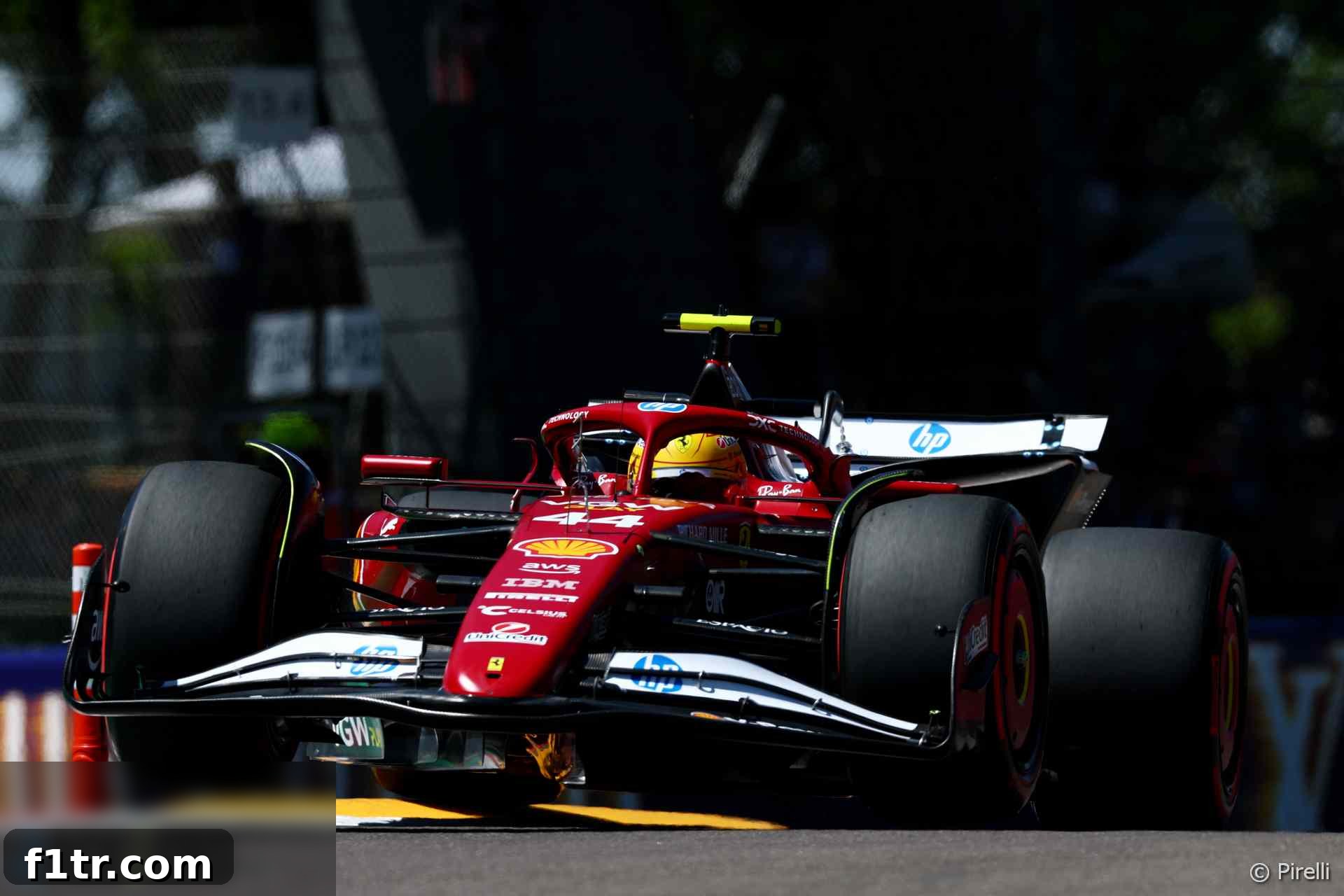
Ferrari drivers Lewis Hamilton and Charles Leclerc experienced a tumultuous Free Practice Friday, highlighting the delicate balance of car setup in modern Formula 1. While both drivers grappled with persistent brake performance issues, Hamilton’s day was particularly marred by a dramatic deterioration in his car’s handling, a puzzling regression attributed to what he described as a minimal setup alteration between the two sessions. This unexpected setback has cast a shadow over Ferrari’s preparations for a crucial weekend, stirring concerns about their competitive prospects.
Hamilton’s initial optimism was palpable after the first practice session (FP1). The seven-time world champion felt a genuine connection with his SF-24, perceiving a significant leap forward in performance and comfort. “I was really, really happy with the car in FP1,” Hamilton conveyed to the official F1 channel, his tone initially reflecting satisfaction. “It felt like we had made a step forward, and it’s been really positive.” This sentiment, however, quickly evaporated as the day progressed, replaced by frustration and bewilderment.
The turning point came during the interval between FP1 and FP2. Hamilton explained that he approved “literally two of the tiniest things” in terms of setup adjustments. These modifications were so minor, he stressed, that they “should have had barely any effect at all – the smallest change I’ve ever probably done this year.” Yet, the consequence was profound. The subtle tweaks, combined with an exacerbation of brake issues, transformed his Ferrari into an entirely different, much less manageable machine.
The veteran driver detailed the immediate and drastic impact: “We had some brake issues that then made a massive difference. So that was then a fight with that.” This isn’t a new problem for Hamilton; the brake consistency has been a recurring thorn in his side throughout the current season. “That’s been a problem, that’s been quite a big issue all year, actually,” he admitted, clearly exasperated. “I’ve never experienced that before, that’s a new thing for me this year.” This candid admission underscores the depth of the challenge Ferrari faces in providing their lead driver with a consistently predictable package, especially when such minor changes can have such disproportionate effects.
The uncertainty surrounding the brake issues leaves Hamilton in a precarious position for Saturday. He grimly anticipates that his experience with the brakes will be a “lottery.” “We will roll the dice – you put one on and it works and then you put another on and then it doesn’t,” he explained, painting a vivid picture of the unpredictable nature of the problem. This lack of consistency is a significant hurdle, particularly heading into the crucial qualifying session where every tenth of a second counts. “So I hope tomorrow we figure something out. We’re working on it, for sure,” Hamilton concluded, his voice tinged with a mix of hope and weariness.
The contrasting narrative emerged from the other side of the Ferrari garage, where Charles Leclerc, despite his own initial struggles, found more solace by the end of Friday’s running. Leclerc also contended with severe brake performance issues, at one point describing them as “horrendous.” His FP1 session was far from smooth, marked by various technical and handling problems that prevented him from finding a rhythm. “The whole FP1 was very tricky, we had some different problems,” Leclerc recounted.
However, Leclerc and his engineering team managed to make meaningful improvements for the second session. “In FP2 we put everything together a bit more and it was feeling better on my side,” he observed, indicating a positive trajectory. Despite this improvement, the Monegasque driver remained realistic about Ferrari’s overall performance, acknowledging a glaring weakness. “But still we are lacking performance. We know our weak point at the moment is the qualifying pace and we still need to work on that.”
This persistent struggle with single-lap pace is a significant concern, especially at a circuit where track position is paramount. Leclerc doesn’t believe Ferrari currently possesses the outright speed to challenge for pole position. “I don’t think we’ve got that in the car for now,” he stated definitively. This assessment sets a pragmatic expectation for Saturday’s qualifying session, implying that Ferrari’s focus might shift towards optimizing for a solid grid position rather than aiming for the very front row.
Interestingly, while qualifying pace is a known Achilles’ heel, Leclerc found encouragement in Ferrari’s long-run performance. “The race pace was strong, so that’s positive,” he noted, offering a glimmer of hope for Sunday. However, he quickly underscored the strategic challenge posed by the track’s layout. “But it’s also a track where overtaking is very difficult.” This characteristic elevates the importance of a strong qualifying result. Starting further down the grid, even with superior race pace, can lead to frustrating afternoons stuck in traffic, negating any inherent speed advantage.
Consequently, Ferrari’s immediate priority remains unequivocally clear. “So we’ve got to focus on our qualifying pace. That’s where we are putting all our effort into and I hope that will pay [off] tomorrow,” Leclerc affirmed. The divergent experiences of Hamilton and Leclerc highlight the complexities Ferrari faces. While one driver feels a small change can derail his entire session, the other finds progress, albeit with lingering doubts about ultimate speed. This inconsistency across the garage makes finding a unified setup direction challenging for the team, demanding intense analysis and decisive action overnight.
The contrasting moods and technical predicaments within the Ferrari camp set the stage for a dramatic Saturday. The team’s engineers will be working tirelessly to unravel the mystery of Hamilton’s setup regression and to collectively enhance the SF-24’s qualifying performance. The delicate balance between stability, braking performance, and outright speed must be found, especially with the competitive field showing no signs of relenting. The pressure on Ferrari, a team with rich history and fervent Tifosi support, is immense to deliver a more consistent and potent package for both drivers. Their ability to overcome these Friday woes will be a true test of their engineering prowess and their ambition to contend at the sharp end of the grid.
For Hamilton, the goal is to eliminate the ‘lottery’ aspect of his brakes and regain the confidence he felt in FP1. For Leclerc, it’s about extracting every possible tenth from the car to secure a grid slot that allows his promising race pace to shine on Sunday. The weekend hangs in the balance, and Ferrari’s performance in the upcoming sessions will be critical in shaping their fortunes and potentially influencing the championship narrative. The fine margins in Formula 1 mean that even the “tiniest things” can have monumental consequences, as Lewis Hamilton discovered to his cost on Friday.
The team’s debriefs will be extensive, dissecting every data point, every driver feedback, to ensure that the car presented for FP3 and qualifying is a significant step forward. The challenge is not just to fix the immediate problems but to understand the underlying causes of the setup sensitivity and brake inconsistency that have plagued their season. With the grid becoming increasingly tighter, Ferrari cannot afford to leave any stone unturned in their pursuit of competitive excellence.
2025 Emilia Romagna Grand Prix
- Antonelli was tiring from home race at Imola attention by Friday – Wolff
- Ferrari struggling to recreate set-up which “worked well” in Shanghai – Hamilton
- Verstappen told Red Bull to use Tsunoda before “hold him up” call
- ‘Saturdays have been mine for years but for some reason it’s drifted away’ – Norris
- “Plan C?”: Why McLaren only got their strategy right for one driver at Imola
Browse all 2025 Emilia Romagna Grand Prix articles